

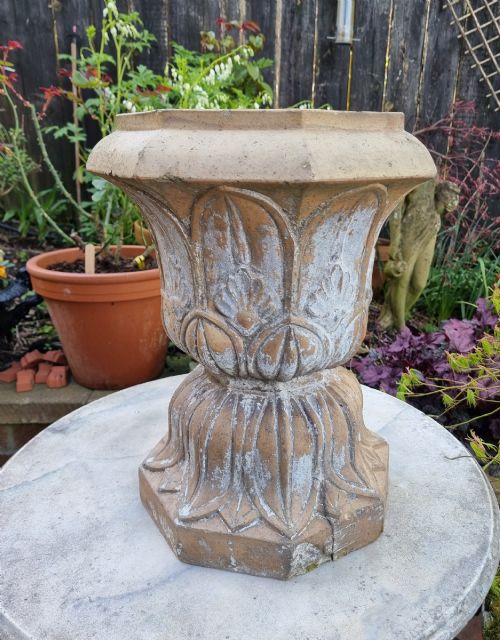


Buff Terracotta Garden Planters
Buff terracotta garden planters bring architectural warmth to outdoor spaces through porous earth and muted tones that settle naturally among foliage.
Buff Terracotta Garden Planters
These buff terracotta garden planters encompass garden pots, urns, and tree planter bases designed to weather outdoors over decades. When searching for buff terracotta garden planters, a buyer meets pieces originating across the nineteenth and twentieth centuries, spanning Victorian, Edwardian, and later periods.
The forms range from classical pedestals and urns to rustic farm pancheons and adapted chimney pots. Most examples on this page reflect British country house, garden, and conservatory traditions.
How they were made
Makers shaped these pieces using buff clay, terracotta, and salt-glazed stoneware, often throwing large vessels on a wheel or pressing them into moulds. The fired earthenware and stoneware bodies remained unglazed to allow moisture to breathe through the walls.
Firing temperatures varied, producing dense frost-resistant bodies in some utilitarian vessels and finer porous earthenware in decorative garden urns.
Buff Terracotta Garden Planters Retail Price Guide 2026
Typical asking prices for buff terracotta garden planters among the pieces listed under this phrase on Sellingantiques today, from the lower quarter to the upper quarter. They describe what is for sale here now, not the wider market.
At least one towering late Georgian chimney pot has found a second career in the garden, proving that good clay refuses to retire.
What varies in quality
Quality rests upon the crispness of moulded ornament and the balance of proportion between rim, body, and base. Finer examples display deliberate weight and even wall thickness achieved by experienced potters.
Patination and weathering contribute significantly to character, where deep surface encrustation and lichen growth elevate pieces beyond ordinary gardenware.
The Buff Terracotta Garden Planters Glossary
- Buff clay
- A pale yellowish-brown earthenware body favored for nineteenth-century garden ceramics and architectural ornaments. It provides a lighter alternative to traditional red terracotta.
- Salt-glazed stoneware
- A dense, vitreous ceramic surface created by throwing salt into the kiln during high-temperature firing. This process leaves a characteristic orange-peel texture that resists frost.
- Pancheon
- A wide, shallow earthenware or stoneware vessel traditionally used in dairies for settling milk. In gardens, these sturdy basins serve effectively as wide planters.
- Jardiniere
- An ornamental pot or stand designed to hold growing plants, often displayed in orangeries or formal patios. The term usually denotes a more decorative domestic or conservatory piece.
Buff Terracotta Garden Planters: Frequently Asked Questions
Can buff terracotta garden planters stay outside in winter?
Most high-fired stoneware and dense terracotta vessels withstand winter frost if elevated slightly on pot feet to prevent water trapping at the base.
More porous earthenware benefits from being moved into a sheltered greenhouse or porch during hard freezes.
How do I clean an antique garden planter?
Gentle brushing with water removes loose soil and dirt while preserving the natural weathering and organic patination that accumulate over decades.
Harsh chemical detergents and wire brushes damage the historic clay surface and strip away desirable lichen growth.
What is the difference between terracotta and stoneware?
Terracotta is a porous, lower-fired earthenware that breathes moisture and develops soft surface patination quickly.
Stoneware is fired at higher temperatures until vitrified, creating a harder, heavier, and less porous material.
How do I date an old garden pot?
Dating relies on observing manufacturing marks, clay colour, tool signatures left by the potter, and the style of decorative moulding.
Comparing pieces to dated nineteenth-century garden catalogues and architectural salvage records helps confirm an era.