

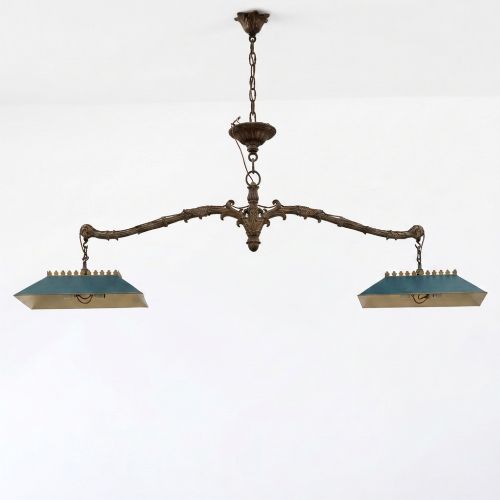


Brass Double Pendant
A brass double pendant brings genuine period illumination and architectural character to a room, offering functional downward light through twin bulb mounts.
Brass Double Pendant
When you search for a brass double pendant, you are looking at overhead lighting fixtures designed to distribute illumination from two distinct points within a single hanging assembly. These pieces span from the nineteenth century through the mid-twentieth century, encompassing varied domestic and institutional settings.
The versions most commonly met on this page include early twentieth-century prismatic glass pendants, industrial twin-light lanterns, and multi-tiered chandeliers featuring brass construction alongside copper, bronze, and steel elements. Styles range from Gothic Revival and Dutch Baroque to French mid-century and industrial designs.
Objects on this page also extend beyond standard domestic illumination into ceiling lights, chandeliers, and devotional items like Spanish religious pieces. Each format utilises dual light sources or tiering to create balanced, functional brightness suited to period interiors.
Materials and construction methods
These pendants and chandeliers rely primarily on solid brass, cast bronze, and copper, often paired with structural steel and iron framing for stability. Metal components are shaped through casting, spinning, and hand-assembly, reflecting the workshop techniques of their respective periods.
Glass forms an essential component in many pieces, appearing as prismatic shades, globes, or crystal dressings that diffuse the light emitted by the dual bulbs. Gilt finishes and patinated surfaces are applied to the metalwork to achieve specific decorative effects ranging from high-status French chateau styling to robust industrial utility.
Evaluating quality and execution
Quality in these lighting fixtures is determined by the weight and purity of the metal casting, the crispness of decorative detailing in styles like Rococo Revival or Gothic Revival, and the integrity of the original joints and mounts. Heavier gauge brass and deeply chased bronze indicate superior workshop production compared to lighter, mass-produced alternatives.
The integration of specialised glass components, such as prismatic Holophane shades or hand-blown globes, elevates a piece significantly. Superior examples maintain balanced proportions across their double tiers or twin arms, ensuring that the decorative metalwork and the glass elements complement one another harmoniously.
The Brass Double Pendant Glossary
- Brass
- An alloy of copper and zinc known for its bright golden appearance and durability. It forms the primary structural and decorative material for many period hanging lights.
- Prismatic
- A glass moulding technique featuring patterned ridges or prisms designed to refract and diffuse light efficiently. This finish is frequently encountered on early twentieth-century functional shades.
- Gilt Bronze
- Bronze metal treated with a thin layer of gold or gold-coloured leaf to create a luxurious metallic sheen. It appears frequently in French decorative lighting and chateau-style fixtures.
- Chandelier
- A branched ornamental ceiling light designed to hold multiple illumination points. These fixtures often feature double tiers to maximise light distribution across large spaces.
Brass Double Pendant: Frequently Asked Questions
What is a double pendant light?
A double pendant light is a ceiling-suspended fixture that incorporates two distinct light sources or bulb holders within a single hanging unit. These fixtures provide extended illumination across dining tables, billiard tables, or larger architectural spaces.
They appear across various periods from the nineteenth century to the mid-twentieth century, utilising brass, bronze, and glass materials to suit different interior schemes.
How do I date a brass pendant?
Dating a brass pendant involves examining the manufacturing techniques, fastener types, and stylistic indicators such as Gothic Revival or French mid-century motifs. Heavier cast components and hand-finished metalwork typically point towards nineteenth or early twentieth-century production.
Associated materials like prismatic glass shades or specific wiring configurations can also help narrow down the period of manufacture to decades such as the Edwardian era or the 1930s.
Where should I hang a twin light fixture?
Twin light fixtures and double pendants work effectively when centred over specific functional areas like dining tables, kitchen islands, or billiard tables. Their dual configuration ensures that light is spread evenly across a wider surface than a single bulb pendant allows.
When hanging these pieces, consider the ceiling height and the drop length of the pendant to ensure the light source sits at a comfortable visual and practical level.
Are these lights compatible with modern wiring?
Period lighting fixtures generally require professional rewiring to meet modern electrical safety standards before installation in a contemporary home. Electricians can usually adapt the internal lampholders while preserving the historic exterior brass and bronze components.
Retaining the original metalwork and glass shades ensures the historical character remains intact while providing safe, everyday illumination.