



Brass Column Candle Holders
These brass column candle holders bring steady classical weight and bright candle-light to a room, forged from enduring metal through centuries of changing domestic style.
Brass Column Candle Holders
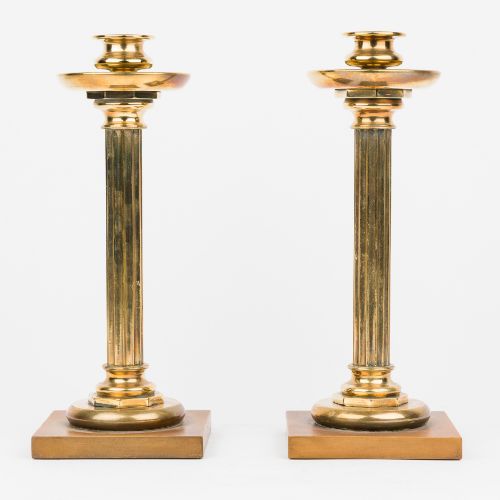
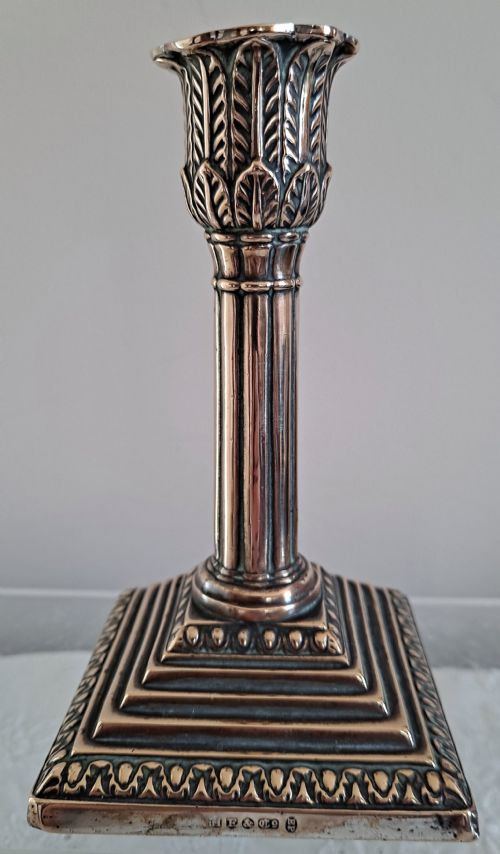
Brass column candle holders take the architectural form of classical columns and adapt it to support wax candles upon tables, desks and altars. When you search for brass column candle holders, you encounter tall shafts cast or turned from metal, often raised upon square or stepped bases.
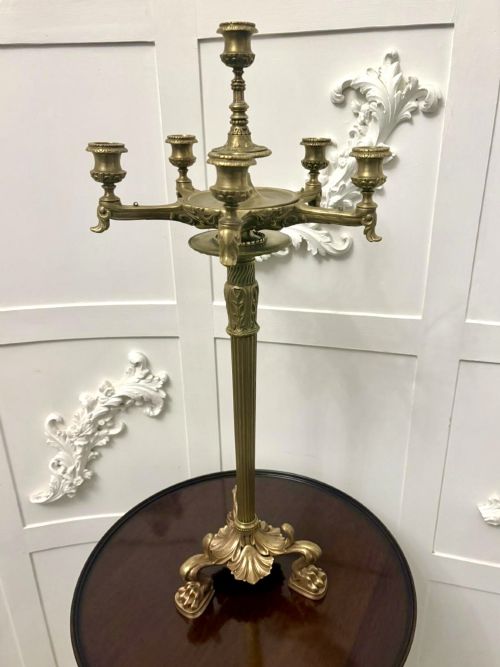
The examples gathered here span from the Georgian and Victorian eras into the twentieth century, taking the shape of single sticks, tall floor-standing prickets, multi-light candelabra and converted candle lamps. Many appear in balanced pairs, designed originally to flank a mirror or mantelpiece.
Georgian and Victorian pieces dominate the selection, showing the enduring appeal of neoclassical column designs. Alongside standard household candlesticks, the evidence includes ecclesiastical designs, Masonic pieces and items incorporating wood, tortoiseshell and bronze.
How they were made
Foundry workers shaped these items primarily through casting and turning brass, bronze and gilt metal, sometimes combining the metal shafts with hardwood, oak or painted surfaces. Molten metal poured into moulds created the detailed Corinthian capitals, stepped bases and vase-shaped columns seen across the period.
Makers finished the cast components by turning them on lathes to sharpen profiles like barley twists and teardrop sections. Hand-finishing and assembly united the separate socket, column and base sections, while occasional pieces received silver plating or decorative boulle-work details.
Brass Column Candle Holders Retail Price Guide 2026
Typical asking prices for brass column candle holders among the pieces listed under this phrase on Sellingantiques today, from the lower quarter to the upper quarter. They describe what is for sale here now, not the wider market.
Periods represented span from the 18th century through the Victorian era and into 1940 Art Deco production.
What varies in quality
The distinction between standard utility items and finer examples rests upon the crispness of the casting and the ambition of the architectural detail. Sharp fluting, well-defined acanthus leaves on Corinthian capitals, and heavy, solid metal gauge signal superior production.
Proportion and material combination also elevate certain pieces, such as those pairing cast brass with bronze, tortoiseshell boulle-work or carved hardwood. Items bearing the marks of known makers or specialist ecclesiastical workshops carry greater design complexity.
J. Miller·T Thomason & Co
The Brass Column Candle Holders Glossary
- Corinthian column
- A classical column style featuring an ornate capital decorated with carved acanthus leaves. This motif appears frequently on tall nineteenth-century candlesticks.
- Pricket candlestick
- A candle holder that uses an upward-pointing metal spike to secure a large wax candle rather than a socket to hold it. These often feature in church or ecclesiastical settings.
- Candelabra
- A branched candlestick designed to hold multiple candles simultaneously on a single stand. These range from heavy Victorian table pieces to tall floor-standing arrangements.
- Boulle-work
- An elaborate marquetry technique using tortoiseshell and metal inlay to decorate surfaces. On candlesticks, this appears as rich contrasting panel work.
- Barley twist
- A spiral column turning that resembles the twisting stalks of barley. This decorative form creates movement and catches the light along the shaft.
Brass Column Candle Holders: Frequently Asked Questions
What is a column candlestick?
A column candlestick is a domestic lighting piece modelled on ancient architectural pillars, featuring a distinct base, vertical shaft and capital supporting the candle socket.
These designs drew inspiration from classical Greece and Rome, remaining popular across Georgian, Victorian and Edwardian interiors.
How do I date an old brass candlestick?
Dating relies on examining the manufacturing methods, such as whether components were cast in multiple sections, hand-turned, or extruded by machine. Stylistic clues like neoclassical proportions, Victorian Gothic details, or Art Deco geometric lines also point to specific eras.
Base construction and the presence of maker marks or registration numbers further help narrow down the period of production.
Were these used in churches?
Many large brass candlesticks and pricket stands were made specifically for ecclesiastical use on church altars. These pieces often feature heavier construction and religious motifs.
Church candlesticks were designed to burn large wax candles during services, distinct from smaller domestic desk or dining table items.
Why do they come in pairs?
Domestic candlesticks were traditionally manufactured and purchased in matching pairs to create symmetry on dining tables, sideboards and mantelpieces. Keeping pairs intact was a priority for households aiming for balanced interior decoration.
Single surviving candlesticks often resulted from the loss or separation of their original companion over the centuries.