
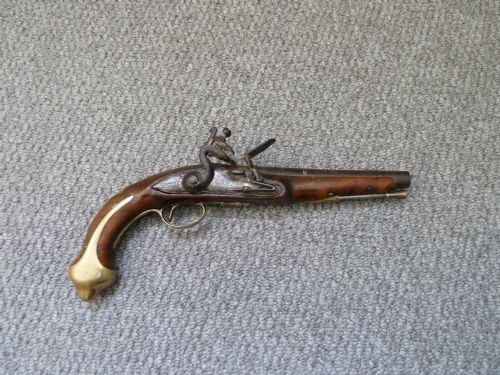
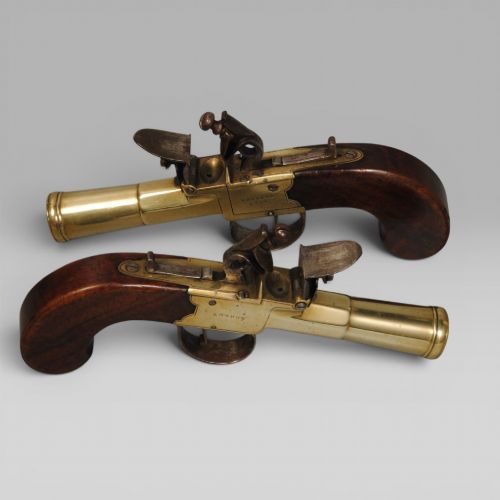


Brass Barrel Pistols
Brass barrel pistols are purposeful period arms, offering collectors substantial metalwork and historical weight.
Brass Barrel Pistols
Brass barrel pistols encompass flintlock and percussion firearms spanning the eighteenth and nineteenth centuries, featuring prominently in military and civilian contexts. When searching brass barrel pistols, buyers encounter everything from compact pocket and overcoat pieces to heavy dragoon and holster arms.
The selection here includes Georgian, Napoleonic, and Victorian military examples, alongside regional variants from France, the Ottoman Empire, and Britain. Most pieces take the form of flintlock or percussion mechanisms mounted with walnut or timber stocks.
How they were made
Makers shaped the distinct barrels from cast brass, pairing them with steel locks and internal mechanisms to withstand the pressure of discharge. Stocks were typically carved from walnut or other dense wood, fitted with brass furniture such as trigger guards and butt caps.
Engraving and maker signatures frequently appear on the brass lock plates or metal surfaces, demonstrating the specialised skill of period gunsmiths. Barrels range from smooth-bore pocket designs to heavy blunderbuss and cannon configurations.
Materials recorded across the inventory include cast brass, steel, walnut, and turned wood, configured into holster, pocket, dragoon, and blunderbuss formats.
What varies in quality
Quality rests upon the crispness of the engraving, the integrity of the brass casting, and the retention of original matching components across the lock and stock. Pieces bearing clear maker signatures and crisp proof marks command greater interest than unsigned or heavily restored equivalents.
The balance between the warm patination of the brass and the preservation of the timber stock dictates the overall visual success of an arm. Examples retaining working lock actions and distinct military or civilian provenance naturally stand apart.
Henry Nock·La Motte·Thomas Henshaw·I Parr·John Rimes·J Robinson
The Brass Barrel Pistols Glossary
- Flintlock
- An ignition mechanism utilising a flint struck against a steel frizzen to create sparks that ignite the gunpowder charge. This system dominated military and civilian firearms throughout the eighteenth century.
- Percussion cap
- A later ignition system employing a small priming cap struck by the hammer to fire the main charge. It largely superseded the flintlock during the nineteenth century.
- Turn-off pistol
- A firearm featuring a barrel that unscrews from the breech for loading, commonly seen on pocket and Queen Anne designs. This configuration allowed tight ball seating without a ramrod.
- Blunderbuss
- A weapon characterised by a flared muzzle designed to scatter lead shot at close range. These forms appear in both shoulder and pistol lengths for coach or home defence.
- Proof marks
- Official stamps applied to firearms indicating they passed testing for structural safety under gunpowder pressure. British and regional proof houses stamped these directly onto the metal components.
Brass Barrel Pistols: Frequently Asked Questions
How do I identify a Georgian military pistol?
Georgian military examples typically display government ownership marks, crown stamps, and standard regulation barrel lengths suited for cavalry or infantry service. They prioritize functional durability over decorative flourish.
Inspect the lock plate for contractor names and royal ciphers to confirm the period and branch of service.
What is the difference between flintlock and percussion?
Flintlock arms rely on a piece of flint striking steel to generate sparks, visible on the exterior side of the lock. Percussion pistols use an external hammer striking a small primed percussion cap.
This technical shift occurred in the early nineteenth century for improved reliability in wet weather.
Why were brass barrels used instead of steel?
Brass resisted corrosion from sea air and gunpowder residue better than untreated iron or early steel, making it ideal for naval and tropical deployments. It also reduced the risk of rusting in pocket and holster pieces.
Gunsmiths valued brass for its malleability during casting and its distinct appearance.
How should I display a brass barrel pistol?
Keep pistols in stable indoor environments away from direct sunlight and excessive humidity to protect the timber stocks and metal finishes. Secure wall mounts or enclosed cabinets provide safe viewing angles without harming the piece.
Avoid applying harsh metal polishes that strip historical patination from the brass.