



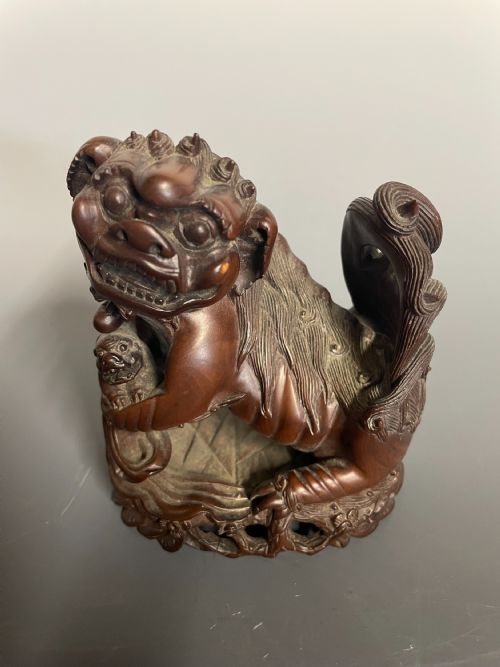


Boxwood Carving
A boxwood carving delivers dense, pale grain and micro-detail that rewards close handling in chess sets, netsuke and figures.
Boxwood Carving
A boxwood carving brings together dense, pale timber and minute hand-chiseled detail across centuries of Asian and European workshop traditions.
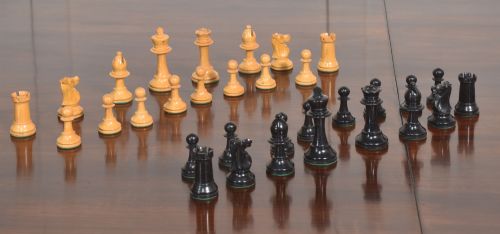
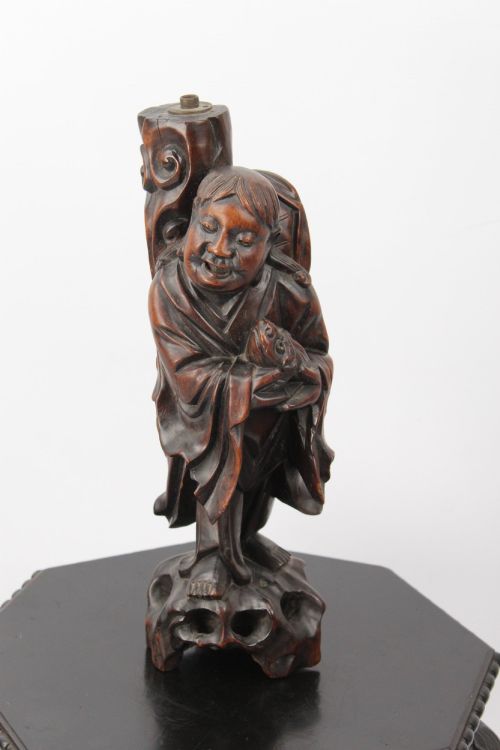
Buyers seeking this phrase encounter three main forms on this page: precision-turned chess sets in boxwood and ebony, Japanese netsuke and okimono from the Edo and Meiji periods, and Chinese figures such as immortals and sages.
The material spans the seventeenth to the early twentieth century, appearing in domestic game sets, scholarly desk objects and religious pieces like seventeenth-century Corpus Christi figures.
Materials and Techniques
Makers select boxwood for its tight, uniform grain and lack of prominent growth rings, which allows micro-carving without splintering.
Carvers combine deep undercutting with smooth surface finishing, often pairing the pale boxwood with contrasting ebonised wood or dark ebony for chess pieces and inlaid furniture details.
Many Japanese and European pieces receive a signature or artist mark incised directly into the timber base.
Listings feature boxwood across Japanese netsuke, European chess sets, and Chinese figurative carvings spanning the seventeenth to twentieth centuries.
Assessing Quality in Carvings
Quality rests upon the crispness of the undercutting and the confidence of the hand behind the chisel, distinguishing fluid anatomical forms from stiff, mechanical copies.
The depth of patination and the preservation of original tool marks separate well-handled pieces that have developed a warm, aged skin from over-cleaned surfaces.
Makers known for specific patterns, such as Jaques or Calvert in chess sets and signed carvers in netsuke, demonstrate superior weight, balance and proportion.
Simon Troger·Tomochika·Masayuki·Jaques·F. H. Ayres
The Boxwood Carving Glossary
- Netsuke
- A small carved toggle fastened to the end of a cord on a traditional Japanese pouch or container. These small sculptures depict animals, deities and daily life.
- Staunton
- A standard design of chess set introduced in the mid-nineteenth century, defined by architectural pieces with a weighted base. It remains the universal pattern for tournament play.
- Okimono
- A Japanese statuette designed for display rather than practical use. They frequently portray figures from folklore, deities or animals.
- Ebonised
- Wood treated with a dark stain or finish to imitate ebony. It provides high contrast against pale boxwood in game pieces.
- Corpus Christi
- A representation of the body of Jesus on the cross. These figures appear carved in boxwood and olive wood.
Boxwood Carving: Frequently Asked Questions
How do I clean an antique boxwood carving?
Dust the carving gently with a soft dry brush to lift debris from deep recesses. Avoid water, damp cloths and modern chemical polishes, which can darken or lift the historic patina.
Allow the wood to breathe naturally in a stable environment away from direct sunlight and radiators. Excessive heat causes the dense boxwood grain to shrink and split over time.
What is the difference between a netsuke and an okimono?
A netsuke is a miniature toggle with cord holes carved through the body, designed to secure a small container to a traditional Japanese kimono sash. An okimono is simply a larger decorative figurine intended for display on a shelf or tabletop.
Both forms utilise the dense grain of boxwood for intricate carving, but their original function and scale set them apart.
Why does old boxwood turn yellow or brown?
Boxwood naturally darkens with age and exposure to light, developing a rich amber skin known as a patina. Oils from human hands during centuries of handling also enrich the colour.
This gradual shift in tone is a sign of authenticity and age, separating historic carvings from newly milled timber.