

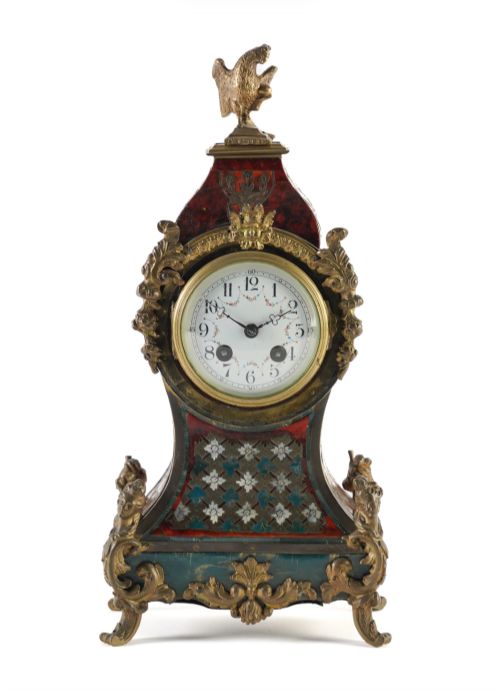
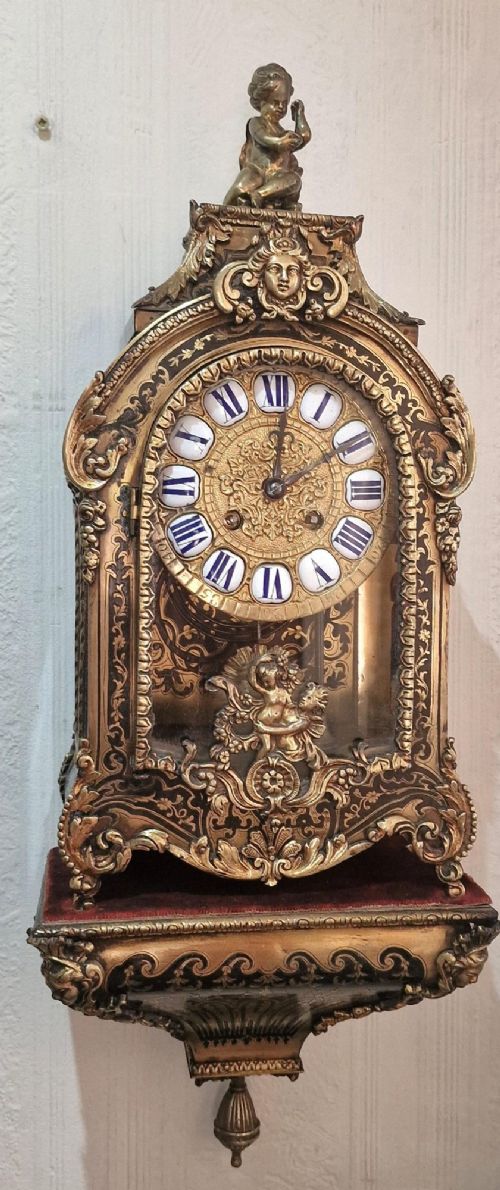


Boulle Inlay Clock
A boulle inlay clock brings dramatic tortoiseshell and cut brass into a room, catching the light as French horology at its most ornate.
Boulle Inlay Clock
A boulle inlay clock combines tortoiseshell and brass marquetry across forms that range from mantel clocks and wall brackets to tall longcase pieces. Most examples on this page date to the nineteenth century, reflecting enthusiastic revivals of Louis XIV and Napoleon III styles.
Makers housed these movements in elaborate wooden carcases, often ebonised and mounted with gilded bronze or ormolu. Buyers encounter everything from compact mantel pieces to monumental bracket clocks with matching pedestals.
Materials and Construction
The technique relies on sawing sheets of tortoiseshell and brass together to create interlocking patterns of premier partie and contre partie. These delicate veneers are then applied to wooden structures and finished with cast ormolu mounts and enamel dial cartouche markers.
Movements inside are mechanical eight day systems, sometimes driven by fusee chains and signed by prominent makers like Henri Marc or Samuel Marti.
Boulle Inlay Clock Retail Price Guide 2026
Typical asking prices for boulle inlay clock among the pieces listed under this phrase on Sellingantiques today, from the lower quarter to the upper quarter. They describe what is for sale here now, not the wider market.
Materials recorded across the selection include ebonised wood, enamel, glass, and bone inlay alongside brass and tortoiseshell.
Assessing Quality
Quality rests on the crispness of the brass cutting and the depth of colour in the underlying tortoiseshell, whether amber or dyed green. Finer pieces display sharper chasing in the ormolu mounts and greater harmony between the clock case and its bracket or pedestal.
The reputation of the horologist signing the movement also elevates a piece, alongside the survival of original glass panels and matching components.
Henri Marc of Paris·Samuel Marti·Payne London
The Boulle Inlay Clock Glossary
- Boulle
- A method of marquetry using contrasting sheets of tortoiseshell and brass, named after André Charles Boulle. This technique defines the distinct aesthetic of these clocks.
- Ormolu
- Gilded bronze used for decorative mounts and feet. It provides a bright metallic contrast to the dark tortoiseshell and brass inlay.
- Fusee
- A conical pulley used in clock movements to equalise the drive force of the mainspring as it unwinds. This mechanism improves timekeeping accuracy across the eight day run.
- Cartouche
- Individual enamelled plates forming the hours on the dial. Each numeral is painted separately before mounting.
Boulle Inlay Clock: Frequently Asked Questions
How do I wind a boulle inlay clock?
Use the provided key gently on the winding arbours, turning until you feel resistance without forcing the spring.
Most movements require a steady hand and a weekly routine to keep the eight day mechanism running accurately.
Where should I place a bracket clock?
These pieces need a sturdy wall bracket or a dedicated pedestal that can bear the considerable weight of timber, brass, and bronze.
Keep them away from direct sunlight and damp walls to protect the fragile tortoiseshell veneer.
How do I identify a nineteenth century copy from an earlier piece?
Look closely at the movement construction and the style of the enamel dial cartouches, which often bear nineteenth century serial numbers or maker signatures.
Most examples found today originate from the Victorian and Napoleon III revival periods rather than the seventeenth century.