

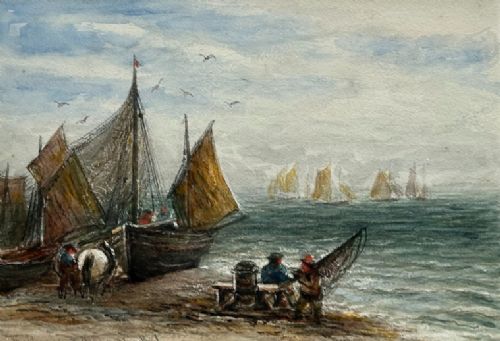



Beach Watercolour
A beach watercolour captures coastal life and marine scenery through transparent pigment on paper, offering direct views of nineteenth and twentieth-century shores.
Beach Watercolour
A beach watercolour brings coastal landscapes, fishing ports and shorelines into domestic spaces through delicate washes of pigment on paper. When searching for a beach watercolour, buyers encounter works depicting British and European coasts, ranging from busy Victorian fishing harbours to quiet Devon bays and Scottish estuaries. These paintings record maritime history, coastal trades and seaside leisure across the nineteenth and twentieth centuries.
The pieces on this page span several decades, moving from late nineteenth-century Victorian fine art and British impressionism into twentieth-century modern British and Scottish school works. Common subjects include beached fishing boats, seaweed gatherers, chalk cliffs and harbour scenes rendered by named artists and regional painters. Collectors find these works framed in original wood, ebonised or gilt surrounds, often protected behind glass.
Materials and technique
These works rely on watercolour pigment applied to paper, utilising the white of the sheet to create luminosity and light across sea and sky. Artists built up transparent washes alongside opaque bodycolour to define breaking waves, wet sand and distant cliffs.
Framing materials reflect the period of creation, with surviving examples set in wood, gilt wood or hand enamelled polychrome frames under glass to protect the delicate paper surface.
Beach Watercolour Retail Price Guide 2026
Typical asking prices for beach watercolour among the pieces listed under this phrase on Sellingantiques today, from the lower quarter to the upper quarter. They describe what is for sale here now, not the wider market.
Listings feature paper, watercolour pigment, glass, wood, gilt wood and gold leaf across nineteenth and twentieth century periods.
Distinctions in quality
Quality rests upon the artist's handling of light, atmosphere and perspective within the marine environment, separating swift topographical sketches from highly finished exhibition pieces. Skilled brushwork captures the movement of water, the texture of weathered fishing boats and the expanse of coastal air with economy and precision.
Condition and originality also determine standing, particularly the preservation of the paper against fading and foxing, alongside the presence of period frames such as ebonised or gilt wood surrounds.
James Orrock·William Banks Fortescue·Sir William Russell Flint·Thomas Bush Hardy·Yves Brayer
The Beach Watercolour Glossary
- Watercolour pigment
- Finely ground colour mixed with a water-soluble binder, applied in washes to paper to create transparent effects.
- Bodycolour
- Watercolour mixed with white pigment to make it opaque, used to highlight details like foaming water and sails.
- Ebonised frame
- Wood treated to imitate ebony, providing a dark contrasting border popular for framing works from the late nineteenth and early twentieth centuries.
- Gilt wood
- Wood carved and coated with gold leaf or metallic paint, adding decorative warmth to period picture frames.
Beach Watercolour: Frequently Asked Questions
What periods do these paintings date from?
The works span from the nineteenth century through the Edwardian era and into the mid-twentieth century, encompassing Victorian fine art and twentieth-century British impressionism.
Surviving examples reflect shifting artistic approaches to coastal and marine subjects across these decades.
How should I hang a watercolour?
Watercolours require placement away from direct sunlight to prevent the pigments and paper from fading over time.
Keeping them in rooms with stable humidity protects both the paper support and the original wood or gilt frames.
Are these works signed by the artists?
Many pieces feature artist signatures, inscriptions or studio attributions inscribed on the front or noted on the reverse.
Signatures help place works within specific regional schools and operational periods of the creators.
What subjects appear in these scenes?
Common subjects include beached fishing boats, harbour activities, seaweed gatherers and chalk cliffs along British and European shores.
Coastal communities and working maritime scenes dominate the compositions across different regions.