

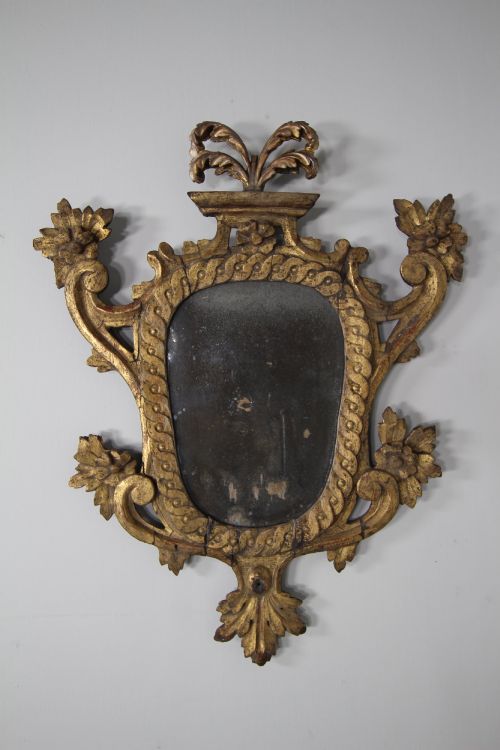

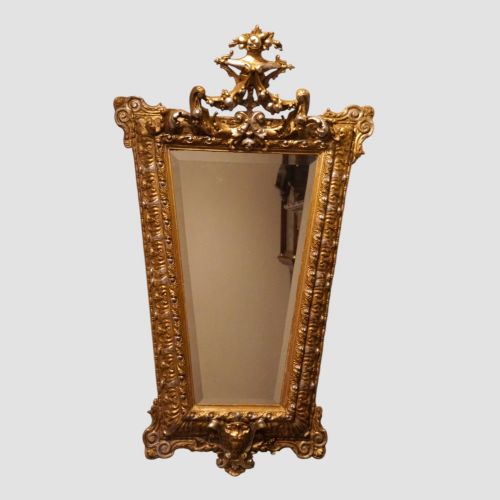


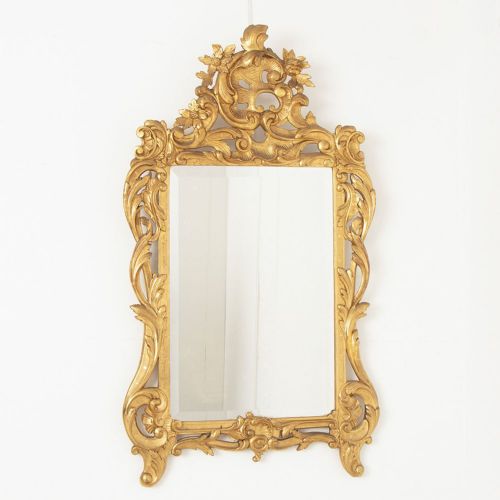

Baroque Style Hanging Mirror
These baroque style hanging mirror pieces bring dramatic presence to a room, using carved frames and gilded surfaces to catch the light.
Baroque Style Hanging Mirror
A baroque style hanging mirror serves as a dramatic focal point in a hallway, salon or bedroom, offering deep frames and elaborate decoration. When buyers search for a baroque style hanging mirror, they encounter pieces spanning the seventeenth century through to the Edwardian period, with nineteenth-century revivals appearing most frequently on this page.
The objects take various geometric and organic forms, including rectangular wall mirrors, trapezoidal shapes, oval oak frames, cushion frames and crested designs. Italian origins predominate, alongside French and English interpretations, showing styles from Florentine Rococo to Carolean Revival.
How they were made
Frames rely upon carved wood, limewood, pine and oak as a structural base, shaped by hand into intricate scrolls, crests and animal motifs such as lions' heads. Artisans applied layers of gesso to the carved wooden foundations to create a smooth, receptive ground for subsequent surface decoration.
Gilding techniques involve the application of gold leaf or silver leaf over the prepared gesso, creating the luminous metallic finishes characteristic of the period. Alternatively, some seventeenth-century examples utilise distinctive oyster veneers cut from branchwood to pattern the wooden surface.
Baroque Style Hanging Mirror Retail Price Guide 2026
Typical asking prices for baroque style hanging mirror among the pieces listed under this phrase on Sellingantiques today, from the lower quarter to the upper quarter. They describe what is for sale here now, not the wider market.
Materials documented across the pieces include mirror glass, giltwood, gesso, gold leaf, carved wood, oak, silver leaf and pine.
What varies in quality
The depth and clarity of the hand-carved detail separate ordinary examples from exceptional ones, with superior pieces showing crisp undercut foliage and confident asymmetry in the revival styles. The handling of the gesso and the finesse of the gold or silver leaf application dictate how the frame catches ambient light.
The character and integrity of the mirror glass itself contribute significantly to the overall presence of the object, alongside the structural soundness of the underlying wooden frame and cresting.
The Baroque Style Hanging Mirror Glossary
- Giltwood
- Wood that has been coated with gold leaf or powder. This finish gives the carved frames their characteristic metallic brilliance and protection.
- Gesso
- A plaster mix applied to carved wood to create a smooth surface. It receives the gold leaf or paint in traditional frame making.
- Oyster veneer
- Slices of wood cut across the branch to show circular growth rings. This technique creates patterned wooden surfaces on seventeenth-century pieces.
- Cushion framed
- A frame profile that swells outwards towards the outer and inner edges. This convex shape adds physical volume to wall mirrors.
Baroque Style Hanging Mirror: Frequently Asked Questions
How do I hang a heavy antique mirror safely?
Heavy carved frames require robust fixings secured directly into wall studs or masonry using appropriate brackets. Professional installation is recommended to support the substantial weight of wood and glass.
Ensure the hanging wire or integrated mirror rings match the weight distribution specified for the mirror dimensions.
Where should I place a baroque wall mirror?
These pieces suit principal reception rooms, hallways or above a mantelpiece where they reflect light and anchor the interior scheme. Their decorative frames make them natural focal points in traditional or eclectic spaces.
Consider the sightlines from adjoining rooms to maximise the visual impact of the gilded surfaces.
What is the difference between baroque and rococo styles?
Baroque design emphasises symmetry, monumental scale and dramatic, theatrical grandeur. Rococo introduces lighter, more asymmetrical scrolling and naturalistic shell motifs.
Revival pieces often blend these elements, drawing on seventeenth-century baseline forms with eighteenth-century ornamentation.
How do I care for antique giltwood frames?
Dust the carved surfaces gently with a soft, dry brush to prevent the accumulation of dirt within the intricate recesses. Avoid using liquid cleaners, polishes or damp cloths on the gold leaf surface.
Keep the mirror away from direct heat sources and high humidity to protect the gesso and wooden substrate.