
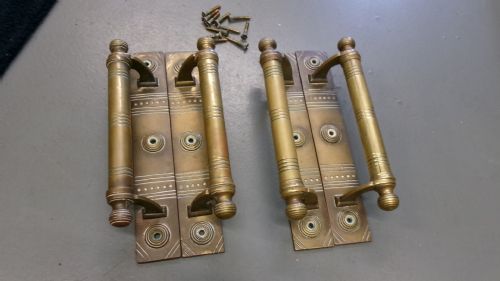


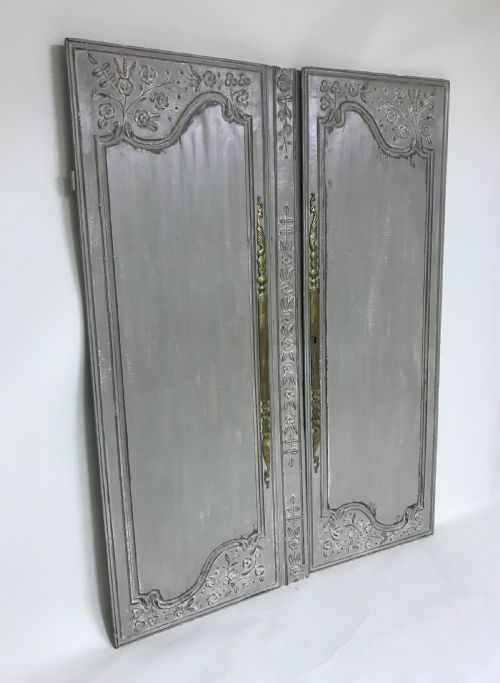


Architectural Salvage Door Handles
Architectural salvage door handles bring tactile weight and historic character to a modern interior through genuine period metalwork.
Architectural Salvage Door Handles
Architectural salvage door handles encompass solid metal hardware recovered from historic properties, ranging from humble shop entries to grand public spaces. When you search for architectural salvage door handles, you encounter heavy brass, bronze, and iron mountings spanning the Georgian, Victorian, and Edwardian eras. The selection on this page relies heavily on Victorian and Edwardian brass pairs, alongside early twentieth-century bronze and shop fixtures.
Beyond standard lever sets and knobs, these listings include matching push plates, centre door knobs, bell pulls, and elaborate ballroom pull handles. Forms vary from simple turned beehive profiles to ornate Art Nouveau and Art Deco designs shaped by French and British makers. Each piece bears the distinct patina of active use rather than modern artificial distressing.
How they were made
The majority of these pieces utilise cast brass, cast bronze, and cast iron, shaped through traditional foundry methods that yielded thick, robust components. Makers poured molten metal into sand moulds before hand-finishing the surfaces with files, lathes, and polishers. This foundational casting technique ensured the metal could withstand generations of daily turning and pulling.
Selected designs incorporate contrasting materials such as crystal, horn, and wood inserts secured within metal collars. Details like the raised patterns on Art Nouveau locks and classical revival plates were chased or stamped directly into the metal alloy during production.
Materials recorded across current inventory include crystal, horn, wood, copper alloy, cast iron, bronze, and brass.
What varies in quality
Quality in these handles rests upon the thickness of the original metal casting and the crispness of any applied ornamentation. Superior examples display deep relief work, well-defined turning lines on wooden or metal grips, and substantial weight that signals generous metal content rather than hollow fabrication.
The degree of original surface integrity and the survival of matching components, such as concurrent push plates or locking mechanisms, separate standard utility hardware from exceptional collector pieces. Fine craftsmanship shows in the precise alignment of internal threads and the smooth articulation of moving parts.
Gerwin & Co Birmingham
The Architectural Salvage Door Handles Glossary
- Brass
- An alloy of copper and zinc commonly cast or stamped for domestic hardware. It develops a warm golden tone and patinates with handling.
- Bronze
- A copper alloy containing tin, valued for its strength and dark weathering properties. It appears frequently on heavy institutional and French ballroom hardware.
- Centre Door Knob
- A stationary handle fixed to the middle of an exterior door rather than the edge. These serve as a pull while a separate latch operates the door.
- Bell Pull
- A mechanical lever or handle connected to a remote bell system inside a house. They often feature elaborate backplates and ornate pivoting grips.
- Beehive
- A turned decorative profile featuring concentric ridged rings resembling a traditional skep. This shape is especially prevalent on Victorian brass knobs.
Architectural Salvage Door Handles: Frequently Asked Questions
How do I clean old brass handles?
Warm soapy water and a soft cloth remove accumulated dirt without stripping the historic surface layer. Avoid harsh chemical polishes that eliminate the character-defining dark oxidation.
Allow the metal to dry thoroughly before refitting. A microcrystalline wax can protect the cleaned surface from further tarnishing.
What is a sample board?
Hardware sample boards were used by nineteenth-century manufacturers and ironmongers to display various door fittings to prospective buyers. These boards feature original mounted specimens showing the range of patterns available from a specific firm.
Today, they survive as curated collections of historical metalwork preserved in their original presentation format.
How do I date a brass door knob?
Georgian and Regency designs often favour simpler geometric turns, heavy cast weight, and distinct fixing methods. Victorian pieces frequently display heavier ornamentation, such as beehive turnings or elaborate foliate cast backplates.
Edwardian and later twentieth-century examples shift towards cleaner neoclassical revivals or the flowing asymmetrical lines of Art Nouveau and Art Deco.