
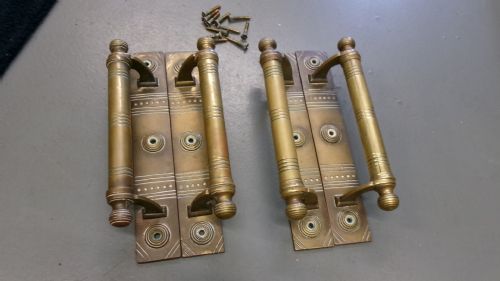


Architectural Hardware Handles
Architectural hardware handles connect the weight of a heavy door to the hand, offering functional longevity in brass, bronze, and iron.
Architectural Hardware Handles
Architectural hardware handles span functional door furniture, centre knobs, and finger plates designed to operate or secure heavy domestic and commercial entries. You encounter a wide variety here, ranging from ornate Victorian brass and Regency oval knobs to heavy bronze Arts and Crafts designs and early seventeenth-century examples.
The selections on this page draw heavily from nineteenth-century production alongside earlier seventeenth-century survivals and twentieth-century Art Deco interpretations. Most examples tend toward cast brass, bronze, and wrought iron forms associated with primary doorways, shop entries, and internal rooms.
Makers and manufacturers occasionally surface through hardware sample boards or stamped workshop plates, providing concrete evidence of nineteenth-century production centres like Birmingham. These items reflect the shifting aesthetic demands of their respective eras, moving from restrained classical forms to decorative gothic and organic shapes.
Materials and Construction
Foundry casting dominates the physical construction of these handles, utilising molten brass and bronze poured into sand moulds to achieve solid structural bodies and crisp ornamental relief. Smiths also shaped wrought iron and cast iron through traditional forging methods to create durable hardware meant to withstand daily mechanical stress.
Makers incorporated contrasting elements such as lead crystal, horn, ebony wood, and paper inserts directly into the metal housings of door pulls and centre knobs. These composite assemblies rely on threaded spindles, pinned joints, and integrated mounting plates to secure the grip to the timber door frame.
Listings feature hardware spanning multiple centuries, from seventeenth-century ironwork to Art Deco bronze and twentieth-century industrial fixtures.
Assessing Quality
Quality rests upon the heft of the metal casting and the crispness of the surface detail, where sharper moulding and deeper hand-chasing distinguish superior workshops from mass production. Thicker gauge brass and solid bronze components hold their structural integrity and decorative finish far better over centuries of active use.
The integrity of the original mechanical components, such as threaded spindles, matching backplates, and intact fixing screws, elevates a piece beyond mere decorative salvage. Superior examples maintain their original surface patination and operational smoothness without excessive wear to the gripping surfaces.
Gerwin & Co Birmingham
The Architectural Hardware Handles Glossary
- Centre Door Knob
- A fixed handle placed in the middle of a primary entrance door rather than the edge, primarily used for pulling the door shut. These often feature an ornate backplate and heavy brass or bronze construction.
- Finger Plate
- A flat metal plate mounted on a door surface adjacent to the handle to protect the timber from finger marks. They typically match the style and material of the accompanying door knobs.
- Barleytwist
- A decorative column or spindle design carved or cast in a spiral helix resembling twisted barley sugar. This motif appears frequently on Victorian gothic ecclesiastical fittings and rails.
- Sash Lift
- A small flush or projecting handle fitted to the bottom rail of a sliding window sash to allow easier raising. They share the same cast brass and iron metallurgy as larger door hardware.
- Bell Pull
- A mechanical lever or pendant handle mounted on a wall and connected by wire to a domestic service bell. These often incorporate ornate brass backplates and articulated joints.
Architectural Hardware Handles: Frequently Asked Questions
How do I clean antique brass handles?
Wash brass handles gently using warm water and a soft cloth to remove surface dirt while preserving the natural historic patination built up over decades. Avoid harsh chemical polishes that strip away the aged character and dull the underlying metal relief.
Dry the metal thoroughly with a lint-free cloth after cleaning to prevent water spotting. A light application of microcrystalline wax can help protect the surface from future oxidation.
Can I install these on modern doors?
Many architectural hardware handles can be fitted to modern doors provided the backsets and spindle sizes align with contemporary latch mechanisms. Some antique handles use older square spindle dimensions or fixed centre mounting bolts that require minor adaptation.
Check the depth of the fixing plates and the clearance around the grip to ensure comfortable operation. Consulting a professional carpenter helps protect fragile antique mechanisms during fitting.
What is a bronze door handle?
A bronze door handle is a heavy architectural fitting cast from an alloy of copper and tin, prized for its exceptional durability and resistance to corrosion. These pieces often develop a rich, dark brown surface patina through constant handling.
Bronze hardware was frequently selected for grand civic buildings, high-end commercial premises, and substantial domestic entrances. Their robust nature ensures they survive centuries of active service.
How do I date antique door handles?
Dating antique handles involves examining the manufacturing technique, alloy composition, and prevailing design style associated with specific historical periods like the Regency or Victorian eras. Cast marks, patent stamps, and screw types also provide reliable chronological markers for nineteenth-century production.
Compare the ornamental motifs, such as Arts and Crafts leaf work or Art Deco geometric lines, against dated examples. Material choices, including the presence of early plastics or specific woods, narrow down the decade of manufacture.