



Antique Whitby Coastal Painting
An antique whitby coastal painting brings the North Yorkshire harbour, abbey and fishing dockyards into focus through the brushwork of British artists.
Antique Whitby Coastal Painting
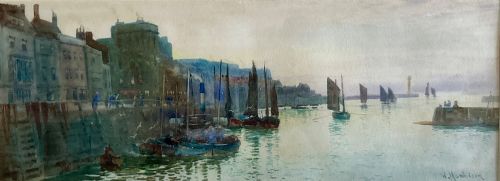
When you search for an antique whitby coastal painting, you encounter works capturing the North Yorkshire landscape, harbour scenes, and maritime views around the abbey and piers. These watercolours and oil paintings record local landmarks such as Henrietta Street, Flowergate, and the River Esk across the Victorian, Edwardian, and later periods.
The version you are most likely to meet on this page is a watercolour painting on paper, often dated around nineteen hundred or from the nineteen-thirties, signed by British artists who worked in the region. Works depict fishing dockyards, evening departures of boats, and coastal vistas defined by the distinctive light of the Yorkshire coast.
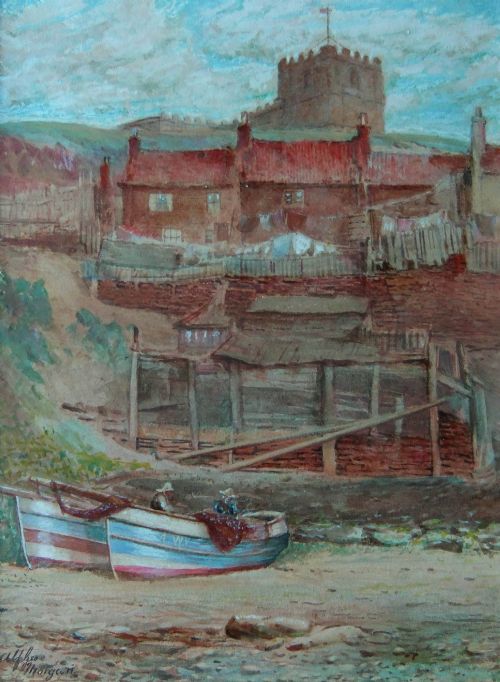
Compositions range from intimate street scenes in the market place to broad views looking towards Larpool or out to sea from the cliffs. Painters such as Alfred George Morgan and Rowland Henry Hill document the topography and maritime activity of the town with regional precision.
Materials and Techniques
Watercolour pigment applied to paper dominates the medium, capturing the translucent atmospheric conditions of the North Yorkshire coast. Artists utilised watercolour paint combined with pencil underdrawings to map out harbour buildings, shipping vessels, and the silhouette of Whitby Abbey.
Oil paintings on canvas provide a heavier texture, often housed in gilt wood frames behind glass or left open depending on the substrate. Pigments capture the deep tones of marine scenes and coastal weather from the nineteenth century into the mid twentieth century.
Antique Whitby Coastal Painting Retail Price Guide 2026
Typical asking prices for whitby coastal painting among the pieces listed under this phrase on Sellingantiques today, from the lower quarter to the upper quarter. They describe what is for sale here now, not the wider market.
Seaweed gatherers occasionally share the coastal canvas with historic fishing boats.
Distinctions in Quality
Quality rests upon the sureness of the hand and the precision of the topographical detail, separating ordinary local sketches from finished exhibition watercolours and oil paintings. The handling of light on the water and the structural clarity of historic buildings like the abbey reveal the capability of the painter.
Condition of the paper, the preservation of pigment intensity under glass, and the integrity of the original gilt wood framing contribute to the standing of an individual piece. Stronger examples maintain their original colour values without heavy fading or excessive foxing on the paper surface.
Alfred George Morgan·William Matthison·Tom Clough·Fred Waugh·George Hamilton Constantine·James Thomas Watts·Frederick William Booty·Frederick Williamson·Albert Robert Quinton·William Kay Blacklock·Rowland Henry Hill·Julian Drummond·Harry Wanless·H. Hadfield Cubley·John Sanderson Wells·Thomas Clavering Alder·Walter Emsley·Frank Rousse·Donald Wood·Walter Meegan·Robert Leslie Howey·A. G. Stevens·R. J. S. Bertram
The Antique Whitby Coastal Painting Glossary
- Watercolour
- A paint consisting of colour suspended in a water-soluble vehicle, used extensively on paper for marine and landscape subjects. It allows for delicate washes of light and sky.
- Oil painting
- Pigments bound in a medium of drying oil applied to canvas, offering rich colour saturation and textured brushwork. This technique suits heavier coastal seascapes and dramatic skies.
- Gilt wood
- Wood coated with a thin layer of gold leaf or gilt paint, commonly found on frames enclosing these historic paintings. It provides a decorative border that complements the artwork.
- Cobles
- Traditional open fishing boats with flat bottoms used along the northeast coast of England. They frequently appear in harbour scenes and beach views.
Antique Whitby Coastal Painting: Frequently Asked Questions
What subjects appear in these paintings?
Paintings show the harbour, the abbey, the piers, and local street scenes around Whitby.
Views extend from the River Esk and Larpool out to Upgang Beach and the coastal waters.
How do watercolours differ from oils here?
Watercolours use pigment on paper to capture light and atmospheric weather conditions.
Oils employ canvas to build richer textures and deeper tones for marine subjects.
Which periods do the works cover?
Pieces date from the nineteenth century through the Edwardian era and into the nineteen-fifties.
Many examples originate from around nineteen hundred and the nineteen-thirties.
How should these paintings be framed?
Watercolours require framing under glass with mounts to protect the paper from moisture and direct contact.
Oil paintings on canvas are typically housed in gilt wood frames suited to the period of creation.