

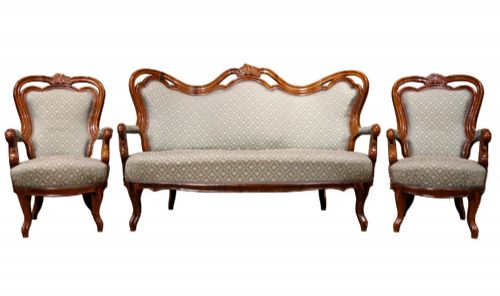


Antique French Style Suite
An antique french style suite brings monumental scale and carved walnut or giltwood elegance straight into formal reception rooms and grand bedrooms.
Antique French Style Suite
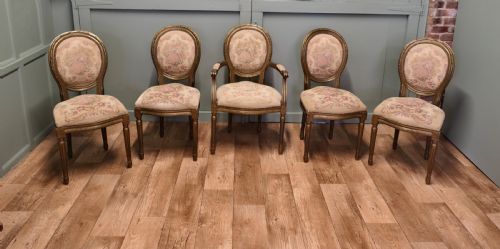
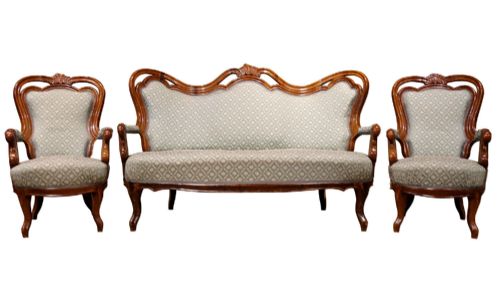
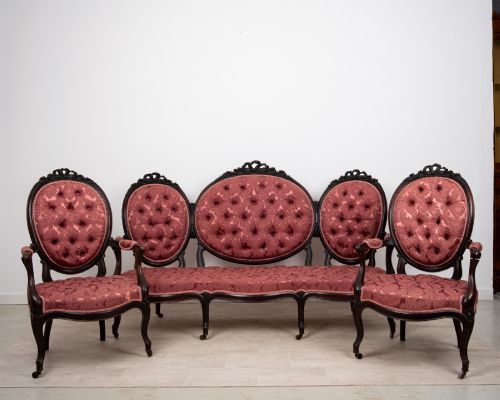
An antique french style suite gathers matching seating or bedroom furniture conceived to unify a grand interior through consistent carving and upholstery. When searching for an antique french style suite, buyers commonly encounter multi-piece salon sets comprising a small sofa alongside pairs of armchairs, as well as expansive bedroom suites uniting beds with matching bedside cabinets.
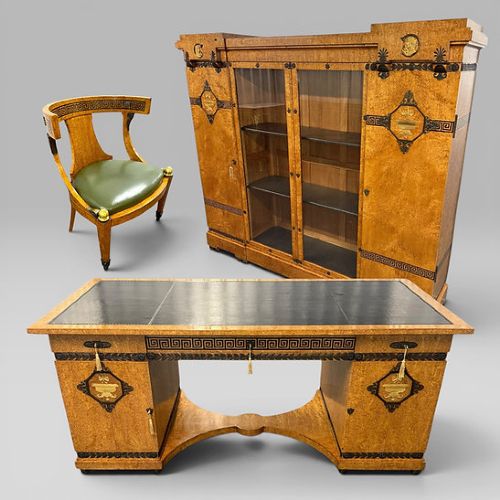
The pieces span the nineteenth century and the early decades of the twentieth century, drawing heavily on Louis XVI, Rococo, and Empire revivals. Surviving examples range from intimate three-piece walnut groupings to substantial five-piece giltwood or mahogany assemblages designed for formal reception rooms.
Materials and construction
Cabinetmakers predominantly shaped these suites from solid walnut, mahogany, and giltwood, applying detailed hand-carved ornamentation to crest rails and cabriole legs. Structural frames frequently incorporated cane work alongside tactile textile coverings like silk damask, deep buttoned upholstery, and tapestry.
Bedrooms introduced functional stone elements, pairing carved wooden frames with marble top side cabinets and integrated glass details. Joinery techniques relied on traditional framing methods to support heavy textile loads and sustained daily use across large drawing rooms and chambers.
Even the bedside table gets invited to the stylistic party when matched with a grand carved bed.
Assessing quality and distinction
Quality rests in the crispness of the hand-carved wooden ornament and the architectural balance shared across every matching component in the grouping. Finer suites display deeply articulated foliage, controlled gilding, and substantial walnut or mahogany framing that maintains structural integrity without excessive bulk.
The integrity of the original textile choice, whether damask, tapestry, or deep buttoned fabric, elevates a suite when it complements the precise period revival of the woodwork. Cohesion between seating frames, auxiliary tables, and companion cabinets dictates whether a suite reads as a unified commission or a later assemblage.
Mercier Frères
The Antique French Style Suite Glossary
- Bergère
- An enclosed upholstered armchair with wooden framing around the sides and back, frequently constructed from walnut or giltwood. These seats often form part of larger salon groupings.
- Giltwood
- Timber treated with gold leaf or metallic paint to create a brilliant decorative surface. This finish defines many formal nineteenth-century revival salon pieces.
- Damask
- A reversible figured fabric woven on a jacquard loom, commonly utilised for formal upholstery on period chairs and sofas. It adds rich texture to matching seating sets.
- Duchesse brisée
- A chaise longue split into two or three distinct components, such as an armchair accompanied by a matching footstool or ottoman. This form provides extended lounging capability within a unified framework.
- Cabriole leg
- A furniture leg that curves outward in a convex arc before tapering inward in a concave sweep, finishing in a decorative foot. The design appears frequently on revival seating.
Antique French Style Suite: Frequently Asked Questions
What pieces belong in a salon suite?
A standard salon suite typically combines a small settee or multi-seater sofa with matching armchairs designed for formal entertaining. Additional chairs often complete the grouping to ensure uniform seating throughout a reception room.
Larger configurations may expand to five or seven pieces, incorporating matching side chairs or auxiliary tables that share identical wood carving and textile upholstery.
How do I identify Louis XVI style features?
Louis XVI style pieces are easily recognised by their straight fluted legs, symmetrical geometric lines, and classical neoclassical motifs. Carved ribbon bows, beaded moulding, and oval chair backs frequently appear on these formal items.
In contrast to earlier curving rococo forms, this aesthetic favours restrained architectural proportion, squared corners, and disciplined structural symmetry.
Can bedroom suites include matching cabinets?
Comprehensive bedroom suites frequently pair a king-size or super king-size bed with matching bedside cabinets, dressing tables, and wardrobes. These companion pieces ensure visual harmony across the entire chamber.
Matching marble top side tables and carved woodwork unify the furniture group, reflecting the coordinated design standards of the nineteenth and early twentieth centuries.
Where should I place a large seating suite?
Large seating suites require generous drawing rooms or open reception spaces where sofas and multiple armchairs can be arranged around a central focal point. Placing pieces away from walls allows the carved backs and detailed woodwork to be viewed from all angles.
Allowing sufficient clearance around each matching chair preserves the architectural balance and intended circulation of a grand interior.