

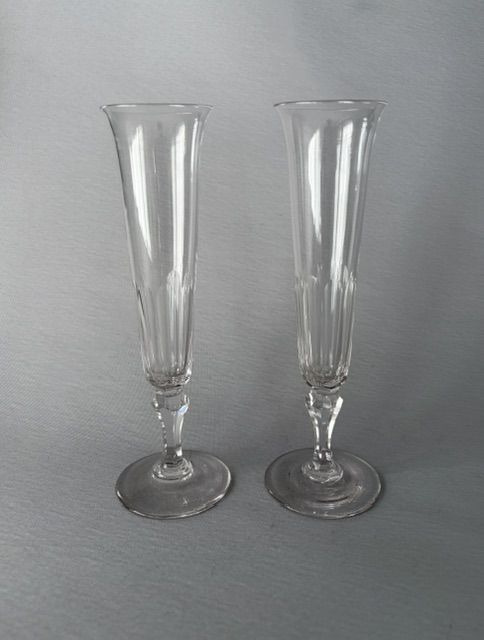





Antique Crystal Drinkware
Antique crystal drinkware brings weight, clarity, and brilliant refractive surfaces to the table, uniting centuries of craftsmanship.
Antique Crystal Drinkware
Antique crystal drinkware comprises drinking vessels and serving sets spanning periods from the eighteenth century through the Art Deco era of the nineteen-thirties. Pieces encountered here range from early Georgian port and whiskey glasses to Edwardian cordial sets and French Art Deco suites.
Materials and methods of production
Makers utilised lead crystal, lead glass, and clear glass to achieve the necessary density and transparency for deep cutting. The heavy composition of lead crystal allowed artisans to carve sharp facets that catch and scatter light.
Decoration relied heavily on manual skill, employing techniques such as wheel cutting, acid etching, and fine engraving. Surface ornamentation ranges from geometric cut patterns to delicate floral or abstract motifs.
Antique Crystal Drinkware Retail Price Guide 2026
Typical asking prices for crystal drinkware among the pieces listed under this phrase on Sellingantiques today, from the lower quarter to the upper quarter. They describe what is for sale here now, not the wider market.
A good antique whiskey dram glass from eighteen-twenty makes modern glassware feel terribly timid in the hand.
Factors that define the standard of pieces
Quality rests upon the crispness of the cutting and the clarity of the metal itself. Superior examples display sharply defined facets without wobble or distortion, alongside a clean, resonant ring when tapped.
Larger matching suites and pieces with distinguished design provenance, such as those from the Wiener Werkstätte, command attention for their unified aesthetic and skilled execution.
Moser·Otto Prutscher
The Antique Crystal Drinkware Glossary
- Lead crystal
- Glass containing a significant proportion of lead oxide, which increases weight, brilliance, and softness for easier cutting. This material is denser than standard soda-lime glass.
- Cut glass
- Glassware ornamented by holding the vessel against a rotating abrasive wheel to carve facets and patterns. Deeper cuts indicate greater skill and time spent at the wheel.
- Acid etching
- A decorative technique where wax or a resist is applied to the glass before acid eats away the exposed surface. This creates frosted or matte designs against polished clear glass.
- Decanter
- A stoppered glass vessel used for serving wine or spirits. These range from heavy Georgian vessels to geometric Art Deco sets.
Antique Crystal Drinkware: Frequently Asked Questions
How can I tell Georgian glass from later periods?
Georgian pieces often display a darker metal tone with natural imperfections like tiny bubbles, alongside heavier pontil marks on the base. The cutting tends to be broader and less uniform than machinery-assisted twentieth-century work.
Later Victorian and Edwardian examples generally exhibit brighter metal and more precise, symmetrical geometric patterns due to industrial advancements.
Are these glasses suitable for daily use?
Many people enjoy using antique crystal for special dinners or quiet evenings, appreciating the tactile weight and historical connection. Hand washing after each use keeps them safe from knocks.
Very fragile eighteenth-century specimens or pieces with delicate engraving are better reserved for careful display or gentle handling.
What defines an Art Deco drinkware set?
Art Deco suites, emerging around nineteen-thirty from France and Bohemia, favour geometric lines, stylised motifs, and simplified forms. These sets often include matching decanters and dozens of uniform glasses.
The aesthetic moves away from Victorian clutter toward clean angles and contrasting frosted and clear surfaces.