

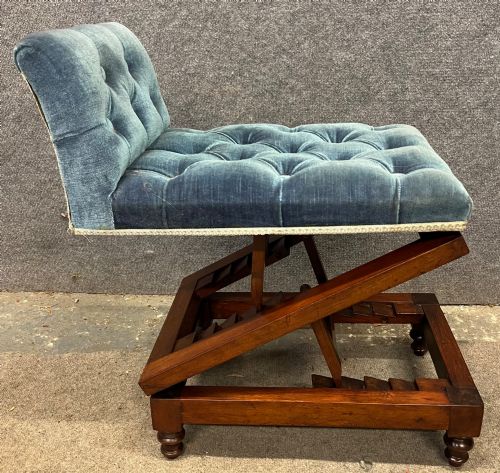
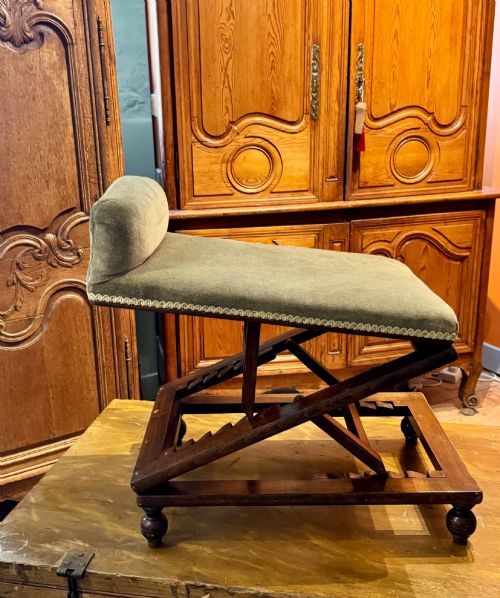


Adjustable Leg Stool
An adjustable leg stool brings mechanical cleverness to the simple seat, offering tailored comfort through clever hinges, screws and swivels.
Adjustable Leg Stool
An adjustable leg stool is primarily found in the form of piano stools, gout stools, and footstools that span the Georgian, Victorian, and Edwardian periods. These pieces utilise revolving seats, rise-and-fall mechanisms, and pivoting frames to alter height and angle.
Buyers will most frequently encounter nineteenth-century mahogany and walnut piano stools featuring swivel tops or rise-and-fall screws, alongside specialised gout stools designed for foot elevation.
How they were made
Cabinetmakers constructed the frames using hardwoods such as mahogany, walnut, rosewood, and beech, often turning the timber for legs and central columns. Carved details and gilt accents appear on finer examples from the Victorian era.
Upholstery involved textiles like fabric, velvet, leather, and various traditional coverings fixed over padding, while the mechanical height adjustments relied on brass and metal screws, swivels, and ratchets.
Adjustable Leg Stool Retail Price Guide 2026
Typical asking prices for adjustable leg stool among the pieces listed under this phrase on Sellingantiques today, from the lower quarter to the upper quarter. They describe what is for sale here now, not the wider market.
Materials recorded across the pieces include mahogany, walnut, rosewood, brass, leather, and various woven textiles.
What varies in quality
The refinement of the turning and the depth of the carved woodwork distinguish standard seating from exceptional examples. Timber selection, such as figured mahogany or rich walnut, dictates the visual weight of the piece.
The precision and smoothness of the mechanical action, whether a brass screw mechanism or a revolving swivel base, mark the distinction in craftsmanship. Maker attribution also plays a role when workshops like Gillows or H Brooks and Co are involved.
Gillows·James Shoolbred·H Brooks and Co
The Adjustable Leg Stool Glossary
- Gout stool
- A footstool with an adjustable sloping top designed to elevate and support feet affected by gout. These pieces often feature pivoting panels and cushioning.
- Metamorphic
- A term describing furniture that transforms from one form or function into another. In stools, this typically involves folding or pivoting leg assemblies.
- Rise and fall
- A mechanical system utilising a central threaded screw to raise or lower the seat height when rotated. It is commonly found on nineteenth-century piano seating.
- Revolving
- A seat construction allowing the top to spin entirely on a central axis without moving the base or legs. This action relies on a concealed pivot mechanism.
Adjustable Leg Stool: Frequently Asked Questions
How do you adjust the height on these stools?
Many nineteenth-century examples use a central screw mechanism that raises or lowers the seat when you rotate the top.
Other versions rely on a swivel or pivoting frame that locks into different angles to suit the user.
What is the difference between a piano stool and a gout stool?
Piano stools are generally designed for seating height adjustment while playing an instrument, often featuring revolving tops or rise-and-fall screws.
Gout stools are intended for foot elevation and typically feature an adjustable sloping platform upholstered in fabric or leather.
Are these stools suitable for daily use?
These pieces function well in modern interiors as occasional seating, dressing table seats, or living room footstools.
Care should be taken with the older mechanical parts to ensure the swivel and screw actions are not forced beyond their limits.
How can I tell a Victorian stool from an Edwardian one?
Victorian examples frequently showcase heavier timbers like mahogany and walnut with rich carving, deep velvet, or show-wood frames.
Edwardian pieces often display lighter Edwardian mahogany constructions with refined proportions reflecting changing domestic tastes at the turn of the twentieth century.