


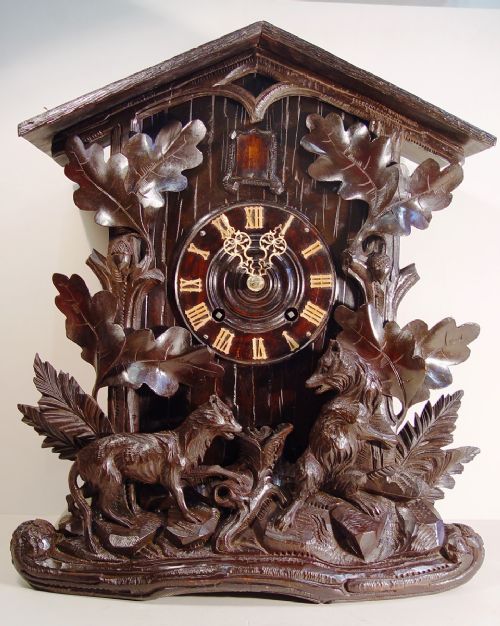

8 Day Fusee Clock
An 8 day fusee clock brings steady, reliable timekeeping into a room through a traditional mechanism driven by a tapered drum and chain or cord.
8 Day Fusee Clock
An 8 day fusee clock is a horological piece designed to run for just over a week between winds, utilising a fusee cone to equalise the declining power of the mainspring. When you search for this phrase, you encounter various formats designed for different domestic settings.
The most common form on this page is the wall clock, often presented as a circular dial, drop-dial, or trunk dial version housed in mahogany or oak. These wall-hung items served railway stations, offices, and domestic hallways.
Beyond wall-hung pieces, the selection includes bracket clocks, mantel clocks, and grandfathers or longcase clocks designed for table or floor placement. These encompass styles from the Georgian, Regency, and Victorian periods.
How they were made
Clockmakers constructed the cases using dense timbers such as mahogany, oak, rosewood, and ebonised wood, frequently framing painted iron or silvered dials beneath protective glass and brass bezels.
The internal mechanics rely on a brass movement governed by a chain or cord fusee drive, occasionally incorporating twin-fusee setups for bell or gong striking trains alongside single-fusee timepieces.
8 Day Fusee Clock Retail Price Guide 2026
Typical asking prices for 8 day fusee clock among the pieces listed under this phrase on Sellingantiques today, from the lower quarter to the upper quarter. They describe what is for sale here now, not the wider market.
Listings feature woods like mahogany, oak, rosewood, and ebonised wood alongside brass and marble.
What varies in quality
The standard of a piece depends heavily on the precision of the movement and the integrity of the cabinet work, from plain oak wall cases to elaborate rosewood or brass skeleton frameworks.
Makers who added quarter-striking, repeating mechanisms, or automation created pieces requiring greater skill, distinguishing everyday timepieces from high-grade mantel and bracket examples.
Thwaites of London·Dent of London·Richard Rooker·Somersall London·John McGregor·L.Donne Birchin Lane·Beha·Russell of Liverpool·Benson·Hall of Dover·Geo Borrett of Stowmarket·James Hargraves of Bawtry·White of London·Webster·Joseph Alborn of Windsor·William Long of Bristol
The 8 Day Fusee Clock Glossary
- Fusee
- A conical pulley used in mechanical clocks to equalise the driving force of the mainspring as it unwinds. This ensures a consistent pull on the gear train throughout the running duration.
- Bracket clock
- A portable table or mantel clock originating from the period when such pieces sat on architectural wall brackets. They often feature brass carrying handles and elaborate wooden cases.
- Drop dial wall clock
- A wall-mounted timepiece featuring a circular dial positioned above an extended wooden trunk or box enclosing the pendulum. This form became common in Victorian public spaces and homes.
- Chapter ring
- The outer ring on a clock dial that bears the hour numerals. In older longcase and bracket clocks, this is frequently silvered brass.
- Bezel
- The metal ring that holds the glass door or cover in front of the clock dial. It usually hinges open to allow hand-setting.
8 Day Fusee Clock: Frequently Asked Questions
How do I wind an 8 day fusee clock?
Use the designated winding key inserted into the dial aperture to turn the movement clockwise until resistance indicates a full mainspring. Take care not to overwind the mechanism.
Ensure you support the pendulum and handle the key smoothly to protect the internal fusee chain or cord from sudden shocks.
Where should I place a wall clock?
Hang your timepiece on a sturdy interior wall free from dampness and direct sunlight, ensuring it is level so the pendulum swings evenly. Avoid exterior walls that experience heavy temperature shifts.
Positioning the dial at eye level makes daily reading and weekly winding straightforward.
How do I tell a Georgian clock from a Victorian one?
Georgian examples often display cleaner architectural lines in mahogany or oak, reflecting 18th-century cabinetmaking traditions. Dial typography and brasswork styles also shift toward more ornate Victorian industrial designs.
Examine the backplate and movement layout for maker signatures and structural signatures typical of each era.