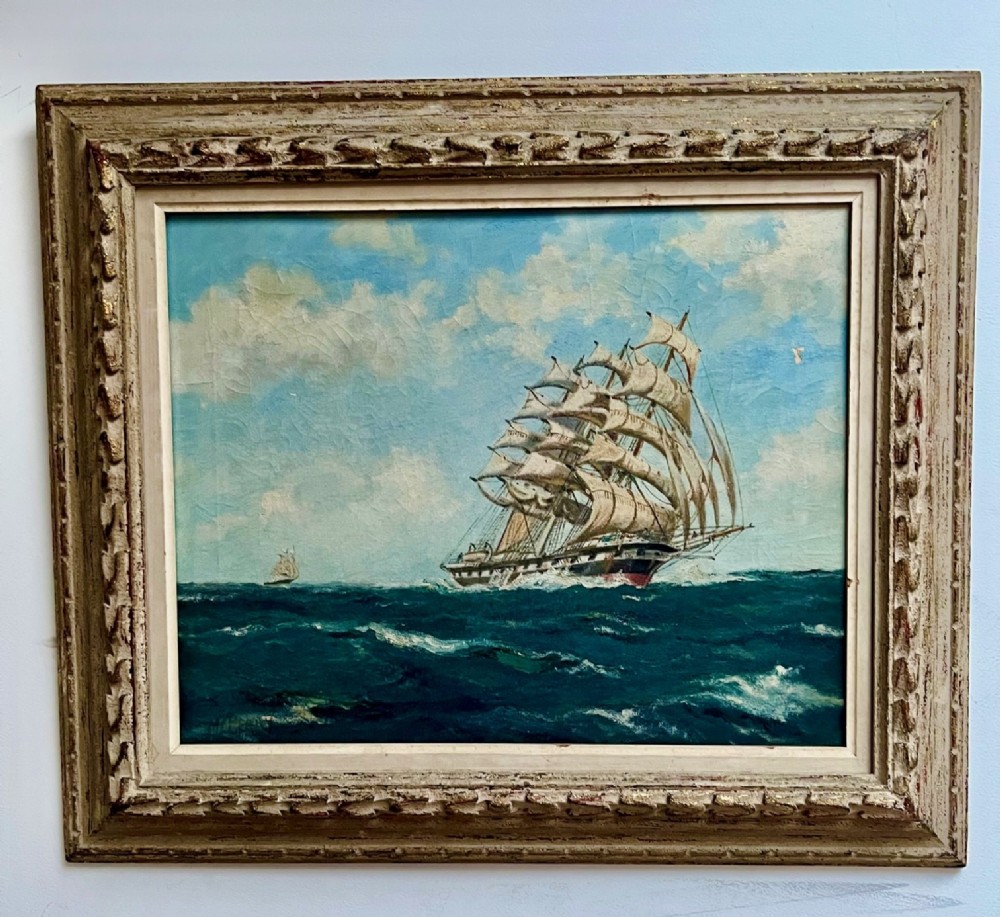
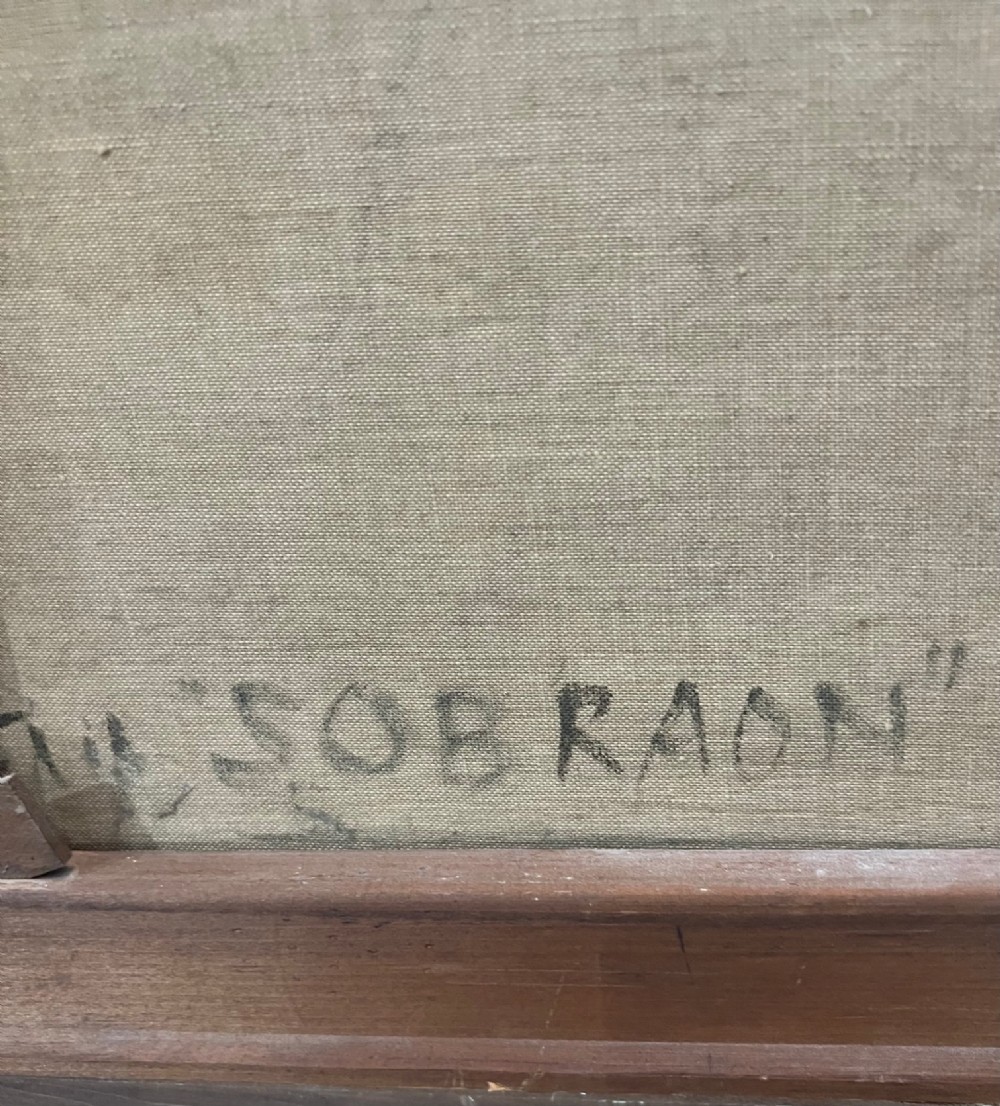
SUPERB 19TH/EARLY 20TH CENTURY OIL ON CANVAS CLIPPER SHIP SOBRAON
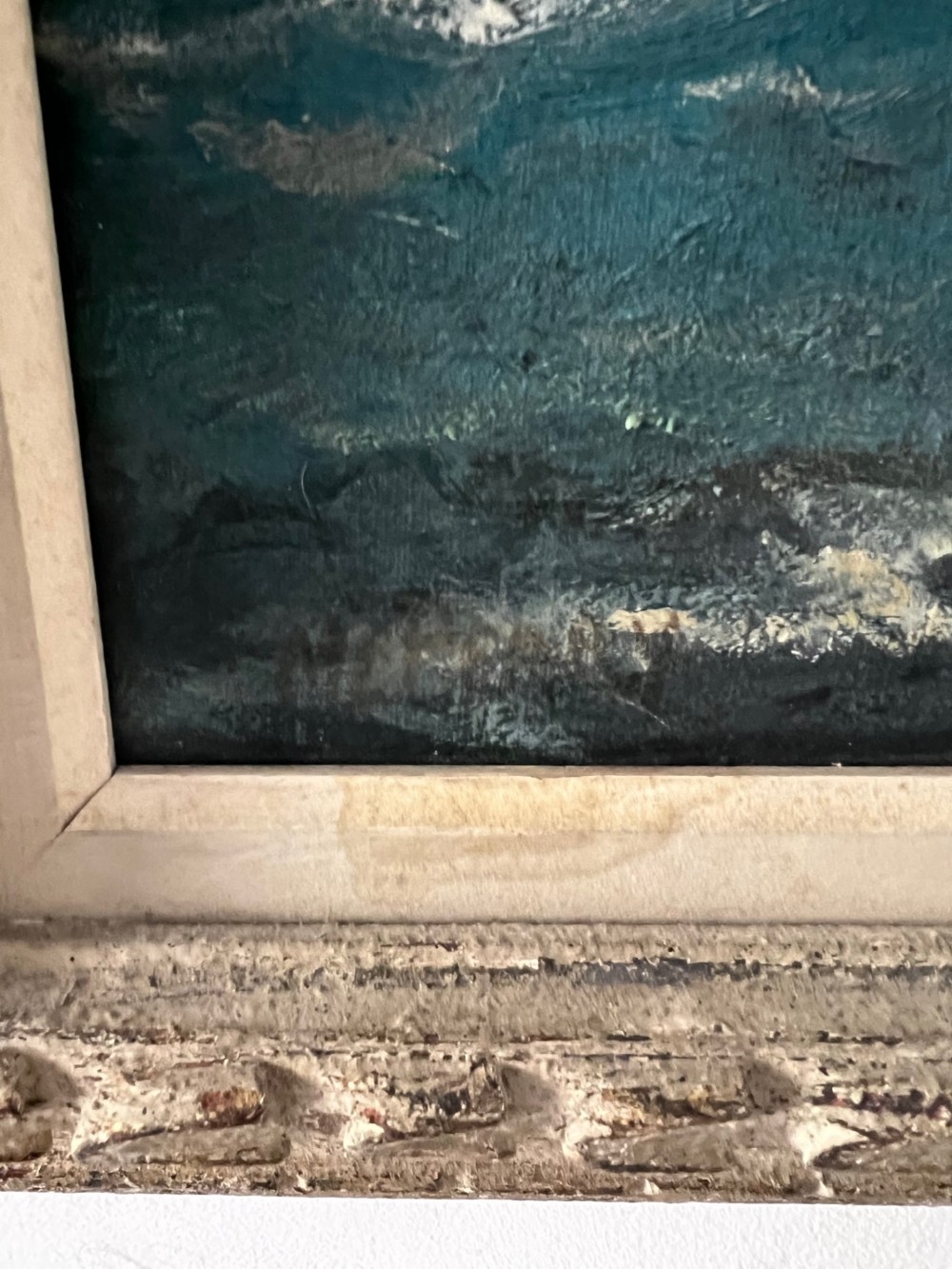
Artist - Possibly Peary, Parry or Perry (signed at bottom left)
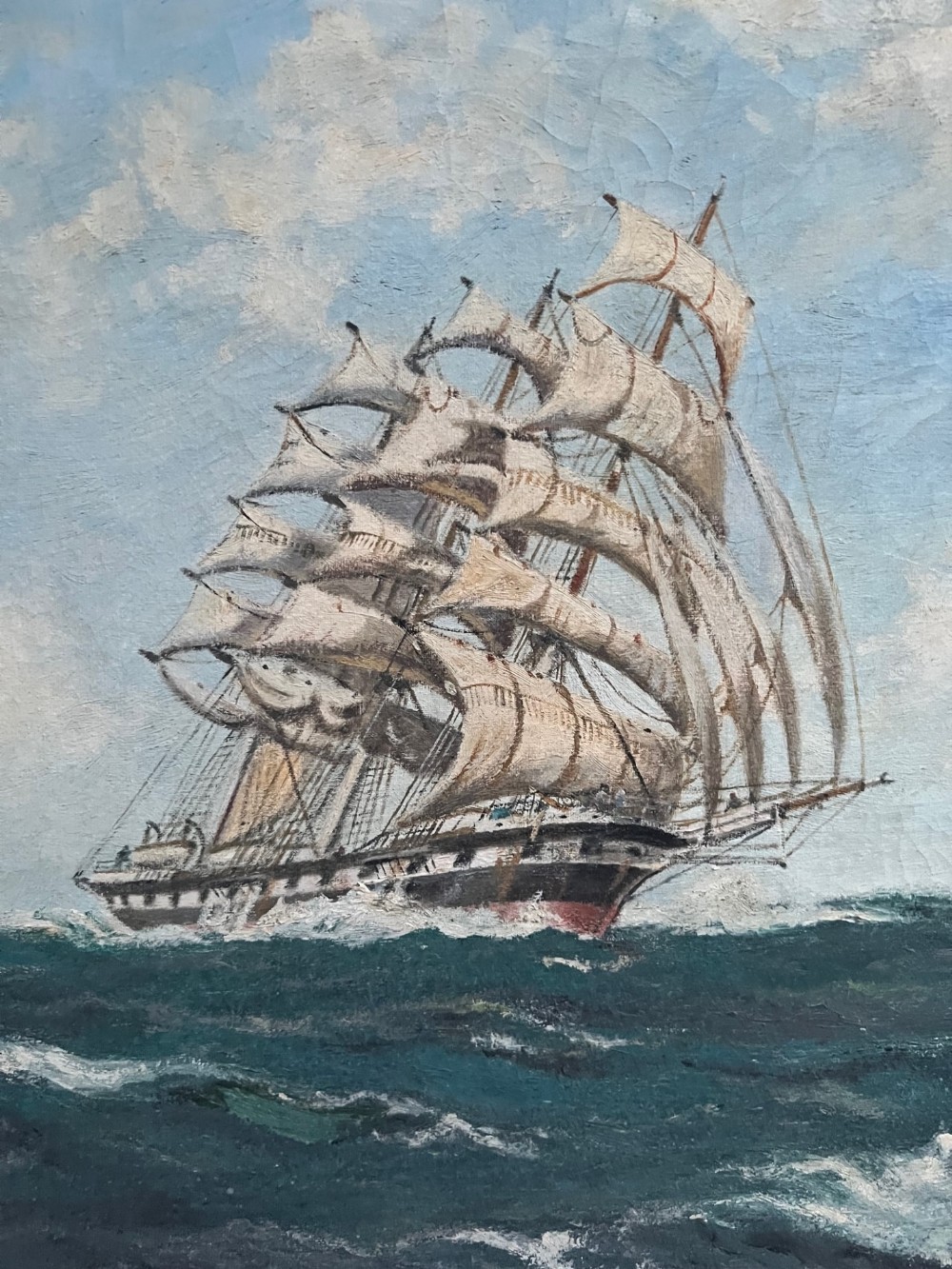
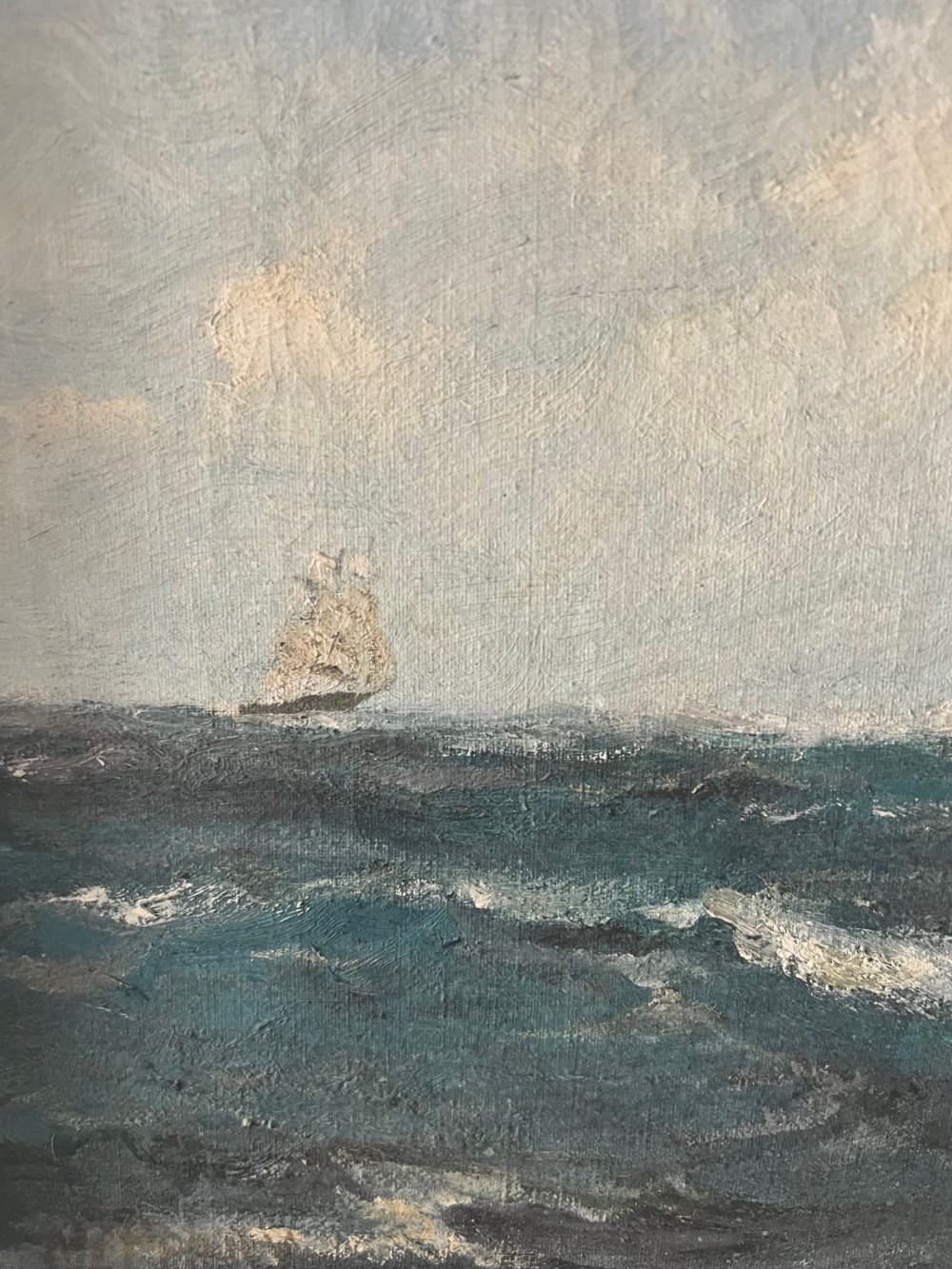
Title - Clipper Ship Sobraon
Medium - Oil on Canvas late C1930s
Size - 61 x 71cm (24 x 28in) Frame
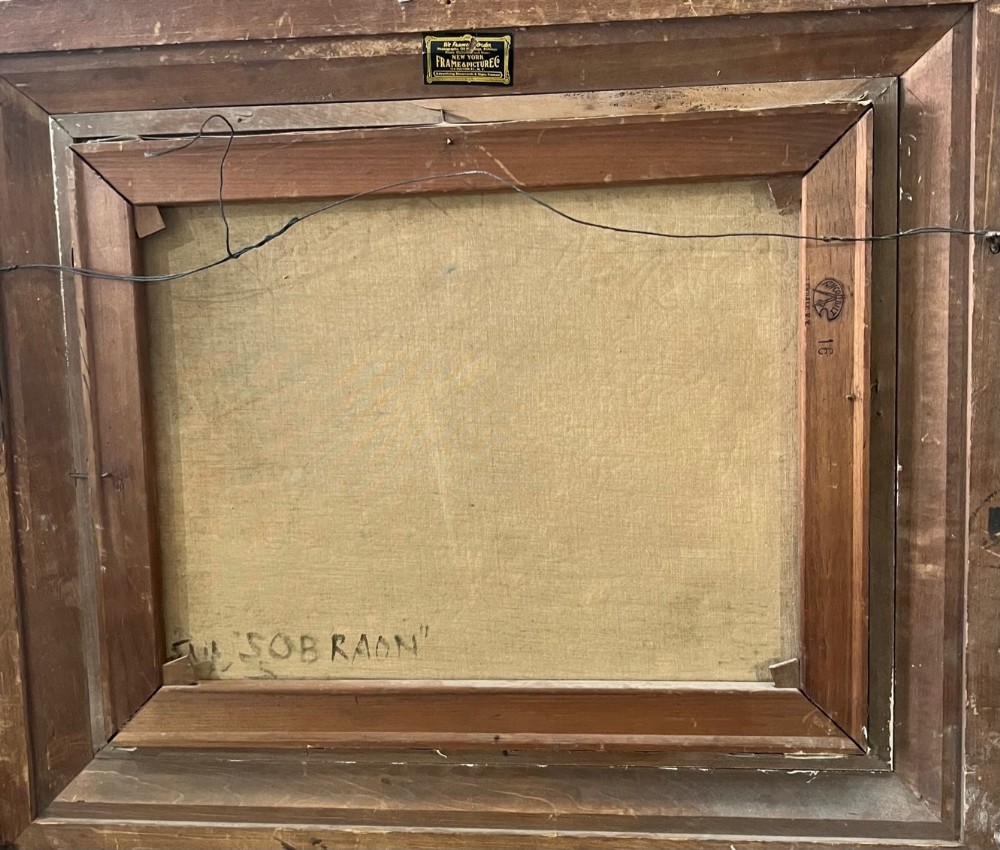
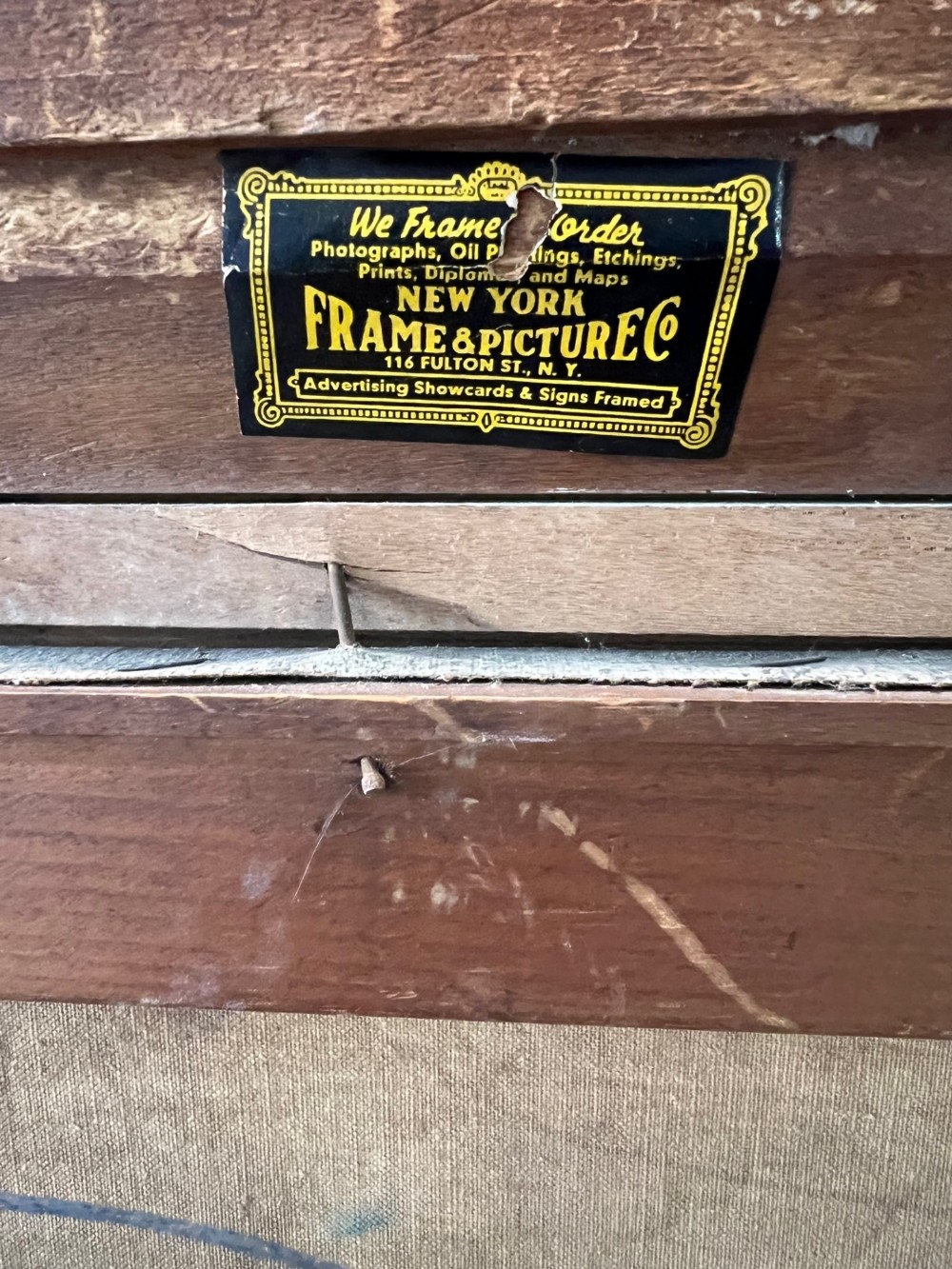
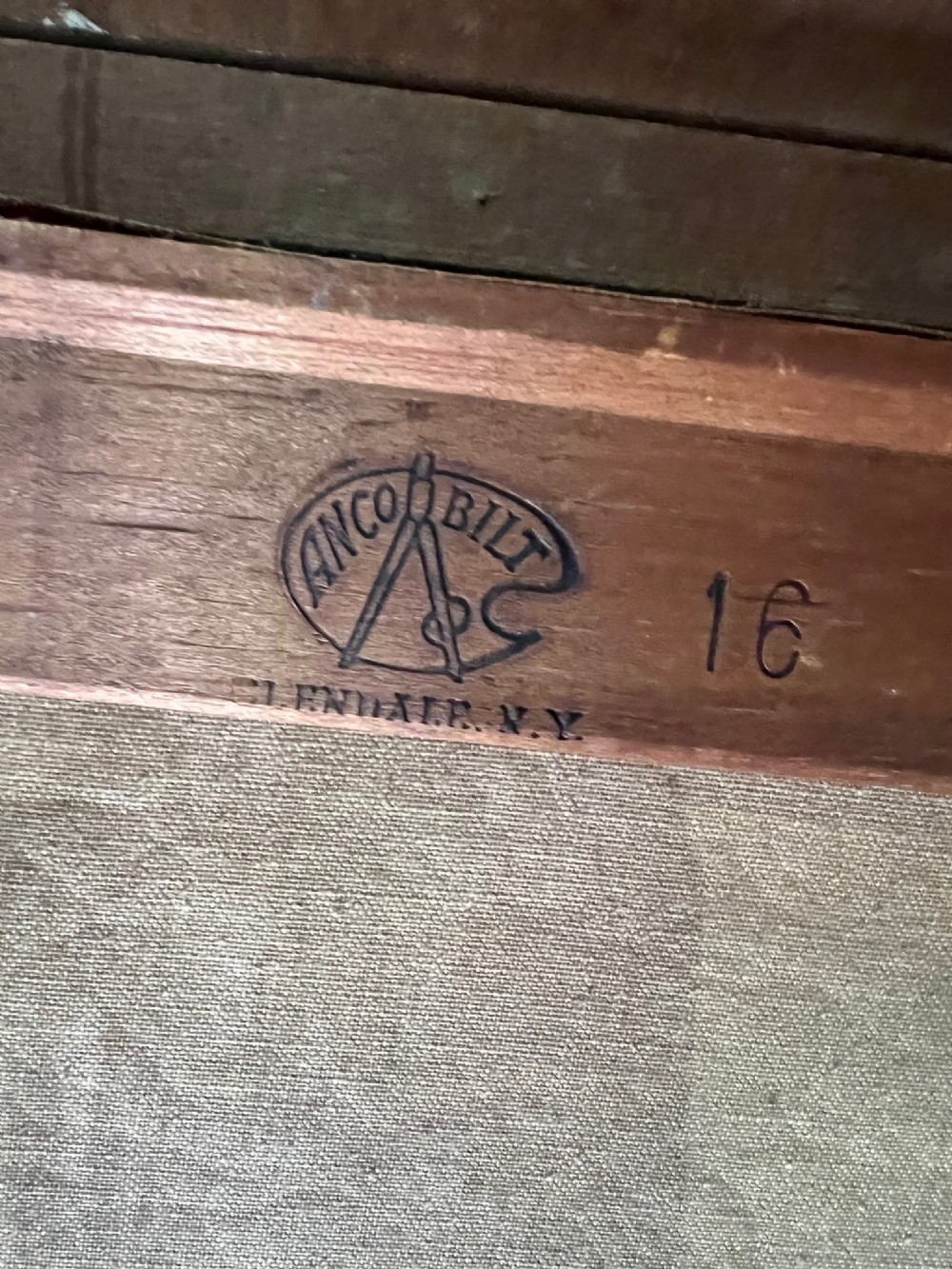
A beautifully painted late early 20th century oil on canvas of the Clipper Ship Sobraon. The painting is high quality but unfortunately we have not been able to work out the artist. At some stage in its life it has been framed by a New York framing company, similarly the stretcher has a stamp for an American company. Whilst this is possibly an American artist it could also be Australian as this is where the ship spent the latter part of its life.
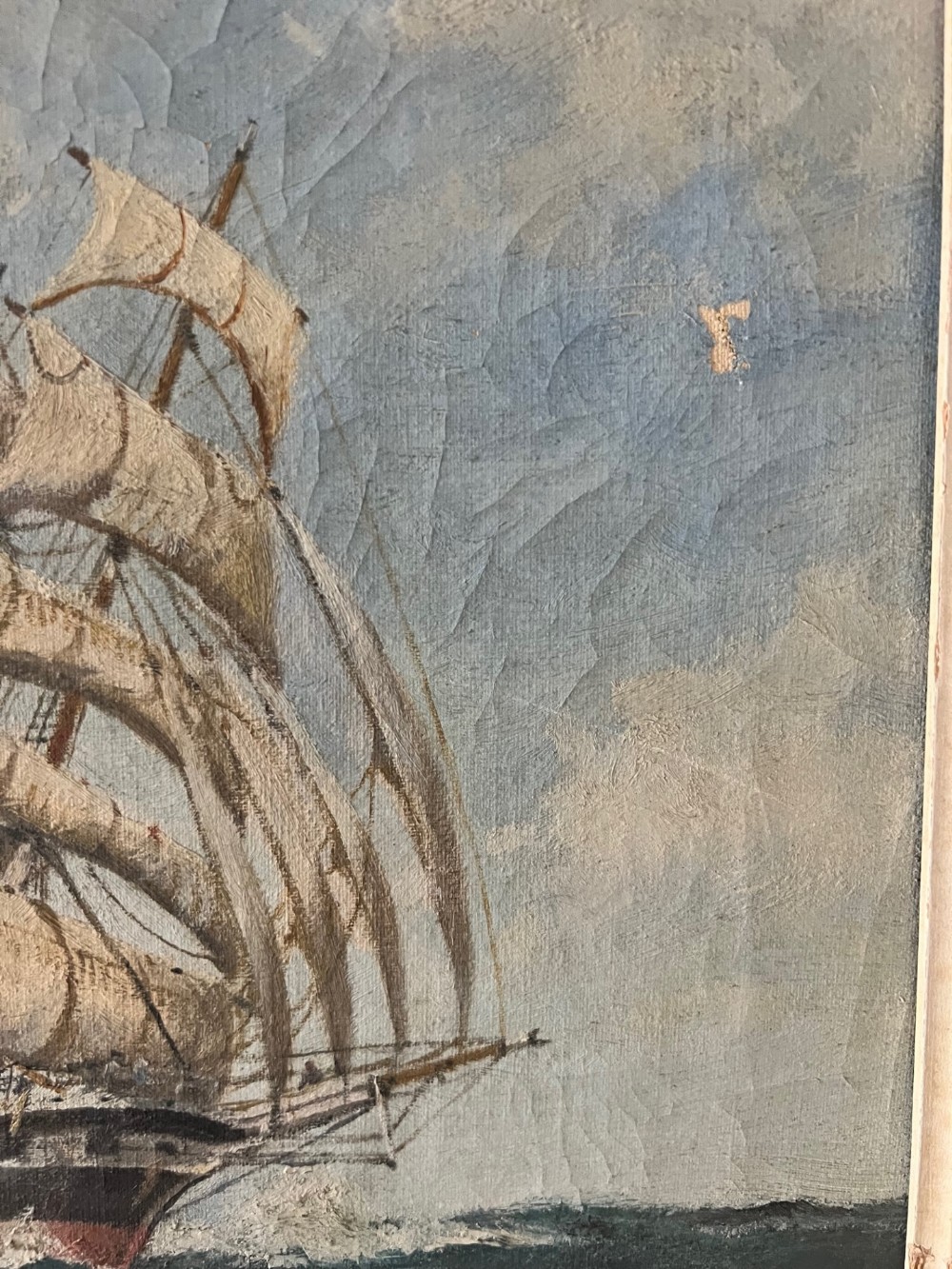
Condition is good although there is a small paint chip at middle left (see images) and a little craquelure.
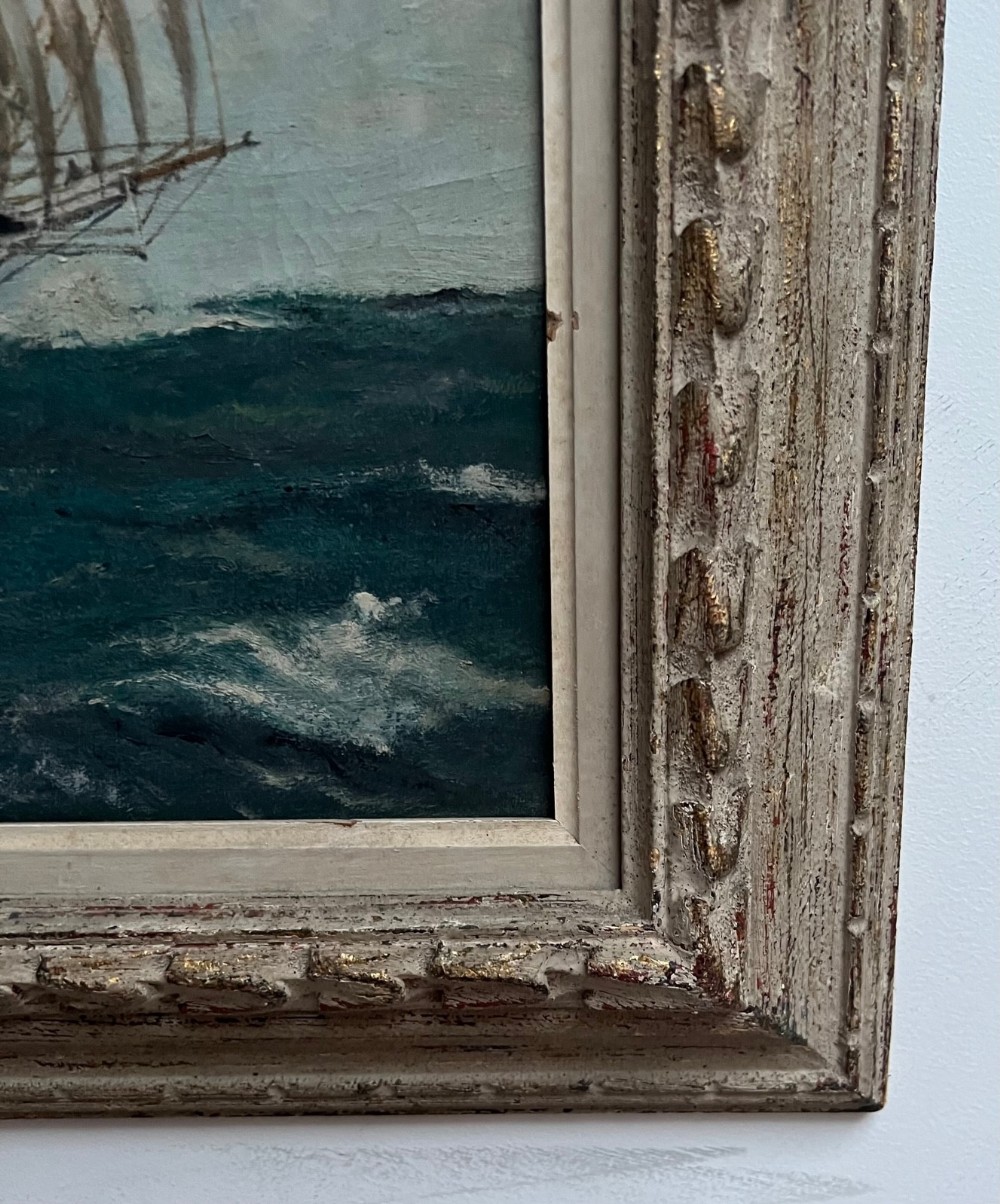
The painting is housed in a mid 20th century high quality carved frame.
Described as one of the finest sailing ships ever built, not only one of the fastest but by far the largest ship to
... be composite built (of iron frames and teak planking). SOBRAON was a very popular passenger ship because of her speed and comfort.
Many crew stayed with the vessel for her entire seagoing career, 1866 to 1891, and her equally popular second Captain, J. A. Emslie, served on her for 24 years from 1867 to 1891. The crew consisted of captain, 4 officers, 8 apprentices, carpenter, sailmaker, boatswain, engineer, 2 boatswain’s mates, 26 able-bodied seamen, 4 ordinary seamen, 2 boys, 16 stewards and 2 stewardesses – 69 crew in total.
Built for Shaw, Lowther, Maxton & Co. who also owned the famous tea clippers ARIEL and TITANIA she was in fact loaded as a Devitt & Moore ship and they eventually bought her in 1870. SOBRAON traded between London and Sydney (her route between 1866 – 1871) then later Melbourne (route from 1872 – 1891), carrying ninety first class and forty second class passengers, plus crew and sailing once a year leaving in September for the best of the weather.
Her fastest trip to Sydney was 73 days, to Melbourne in 68 days, always returning via the Cape of Good Hope instead of the Horn. She usually stopped at Cape Town on her return voyage and at St Helena, a break which was popular with passengers.
Her popularity as a passenger ship is proven by the clientele which chose to travel on her; Lord & Lady Belmore on their way to assume the Governorship of New South Wales and Mr Ducane, the Govenor of Tasmania all sailed on her. The Duke of Edinburgh had her made the flagship at the Sydney Regatta and was entertained onboard.
She was sold to the New South Wales Government in December 1891 as a reformatory ship and lay at anchor in Sydney harbour for the next twenty years. In 1911 she became a training ship for boys run by the federal government.
Commissioned as HMAS TINGIRA on 25th April 1912. The Australian federal government purchased the ship in 1911 for use as a training ship for the fledgling Royal Australian Navy. She was refitted, commissioned into the RAN as HMAS Tingira (an aboriginal word for “open sea”) on 25 April 1912, and moored in Rose Bay. Up to 250 boys between the ages of 14 1/2 and 16 could be trained at any time, although the trainee complement rarely exceeded 200. Between 1912 and 1927, 3,158 boys were trained for naval service. As Tingira was immobilised, the steam yacht HMAS Sleuth was attached to the training ship as a tender, and used to provide seagoing experience to recruits
Decommissioned 30th June 1927. Laid up at Kerosene Bay, Sydney and eventually broken up in 1941.
Internal Reference: sobraon
Antique ID Number (AIDN): SA994374
Dateline of this antique is 1930
Height is 61cm (24.0inches)Width is 71cm (28.0inches)Depth is 0cm (0.0inches)







Thank you.
Your comment has been sent to Sellingantiques.