
Roy Precious - Antiques & Fine Art has dated this piece to the Before 1700 period.
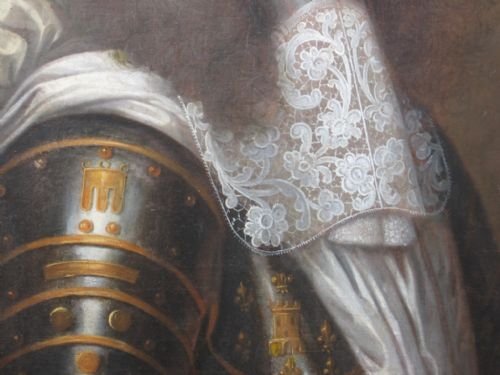
A fine portrait with a real sense of understanding of character to the sitter, and exquisite detailing to the beautiful lace and gilded decoration to the armour, which depicts symbols from Turenne's coat of arms...the tower and blazon of Auvergne and the lilies of France.
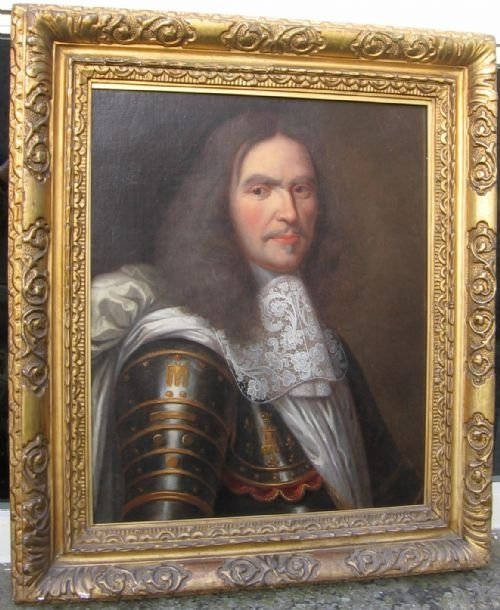
Turenne wears the Bourbon white silk sash of command tied in a huge bow on his right shoulder.
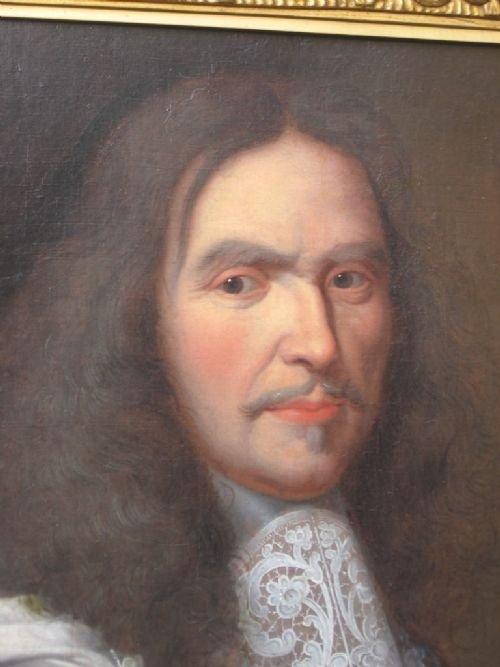
HENRI DE LA TOUR D'AUVERGNE, Vicomte de Turenne, often called simply Turenne (11 September 1611, Sedan, Ardennes – 27 July 1675) was the most illustrious member of the La Tour d'Auvergne family. He achieved military fame and became a Marshal of France. He was one of six marshals who have been made Marshal General of France.
His father, the Duke of Bouillon and Viscount de Turenne, was an ardent French Protestant, a scholar, and diplomat with close ties to the French royal court. He gained possession of an independent duchy called Sedan, near Verdun, from an advantageous first marriage. In 1602, widowed a year, the Duke married Elizabeth of Nassau, the intelligent, strongwilled daughter of an eminent Dutch prince. Turenne was the second son of this union.
Turenne was one of the most celebrated war heroes of French history in its pre-Napoleonic era. Of noble birth, he rejected much of the trappings of his station in life for the hardships of the battlefield. His courage under fire and the loyalty he inspired among his troops, helped France in several decisive military engagements during the era of Louis XIV.
On July 27, 1675, Turenne died at Sassbach against the armies of the Holy Roman Empire. Cannon shot felled him while astride his horse on a reconnaissance ride.
His body, taken to St Denis, was buried with the kings of France. Even the extreme revolutionaries of 1793 respected it, and, while they ignominiously reburied the bodies of the monarchs in a mass grave, they preserved the remains of Turenne at the Jardin des Plantes until 22 September 1800, when Napoleon had them removed to the church of the Invalides at Paris, where they still rest.
Napoleon recommended all soldiers to "read and re-read" the campaigns of Turenne as one of the great captains. His fame as a general rivalled that of any other in Europe at a period when the populace studied war more critically than ever before, for his military character epitomized the art of war of his time (Prince de Ligne). Strategic caution and logistic accuracy, combined with brilliant dash in small combats and constancy under all circumstances - of success or failure - perhaps emerge as the salient points of Turenne's genius for war.
(Our thanks to Loys de Colbert for his assistance).
CLAUDE LEFEVRE (LEFEBRE) (1633 - 25 April 1675) was a French painter and engraver.
Lefebvre was born at Fontainebleau. He studied art under Eustache Le Sueur (1617–1655) and Charles Le Brun (1619–1690) at Fontainebleau.
Lefebvre soon established himself as a leading portrait artist, and in 1663, at the age of thirty, he became a member of the Académie Royale de peinture et de sculpture. Some years later, Lefebvre visited London and was invited to paint at the Court of King Charles II of England. His work is included in major collections such as the National Portrait Gallery, London, and the Louvre. He died in Paris.
He was the master of François de Troy.
SIZE: 34.25 x 27.25 inches inc. frame.
PROVENANCE: by descent in a Dorset family from at least the 19th century.
Verso: inscription on the old lining "LE FEVEVRE"
Roy Precious - Antiques & Fine Art has dated this piece to the Before 1700 period.
Roy and nadine precious: specialists in portraiture from the 16th to the 20th century. Established in 1972.
You can view the stock and full dealer information on the Roy Precious - Antiques & Fine Art Profile Page
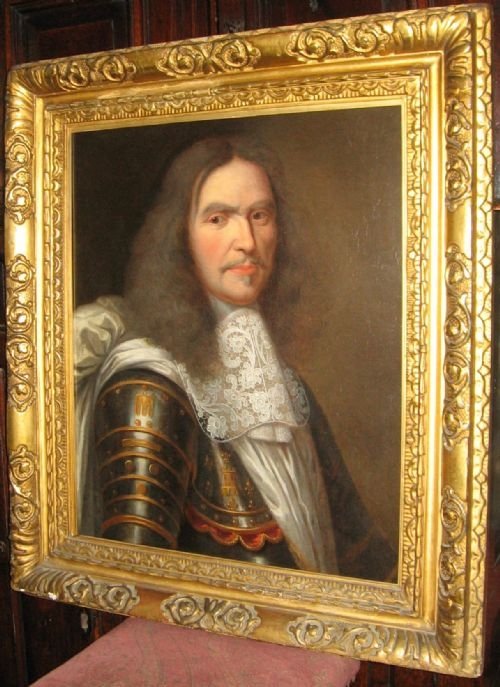
Sold....portrait of Henri De La Tour D'auvergne, Vicomte De Turenne C.1670; Attributed to Claude Lefevre
