
Artware Fineart has dated this Victorian Portrait Oil Painting to the 19th Century.
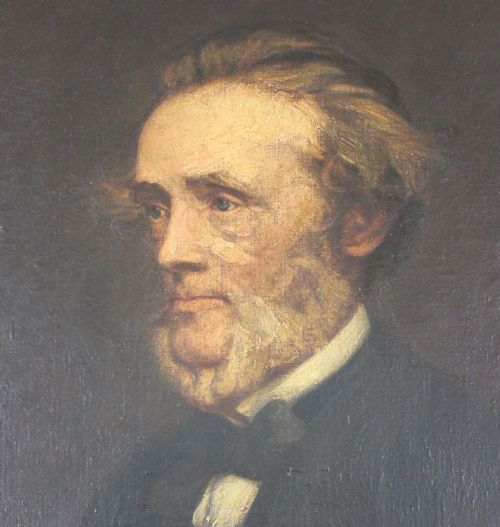
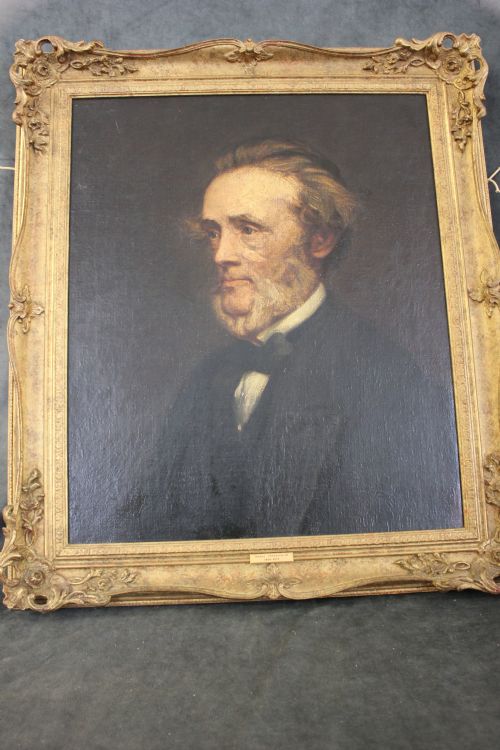
Portrait of Thomas Thomasson , political economist and a campaigner for the repeal of the Corn Laws
oil on canvas
59 x 49 cm.
The Thomassons were a Quaker family of cotton spinning industrialists.
The quarries provided the large flag stones used for block printing on calico fabric. A few years later, Thomasson decided to go into the cotton trade for himself, building a small mill on the Quarlton Road. The firm was not successful, and was dissolved at the beginning of the 19th century.Thomas Thomasson died in 1782 and his son John became manager of the Old Mill at Eagley Bridge. In 1821 he too went into the cotton trade on his own at Mill Hill. John Thomasson's son, Thomas, born in 1808, inherited the business on his father's death in 1837. In 1841 he built the first of the Mill Hill factories, adding additional factories in 1853 and 1859.
Thomas Thomasson was a free trader, active in the movement alongside Richard Cobden, John Bright and Mr Fox of Oldham. His eldest son, John Pennington Thomasson (1841-1904?), became a partner in the business and later married Katherine Lucus, niece of John Bright. Through their business the family amassed a considerable amount of money, which enabled JP Thomasson to buy Mere Hall for Bolton. He presented this and the adjoining estate to the Bolton Corporation in 1890 at a cost of £10,000 for the purpose of a public park, art gallery and museum, also donating a further £5,000 towards any necessary alterations. The Thomasson family also donated items for Bolton Museum's collection, including a bust of Samuel Crompton and natural history material including birds' eggs, nests and shells. After his death, JP Thomasson's widow provided money to enable the museum to buy the substantial Mason Herbarium for its collections.
Thomas Thomasson (1808 – 1876) was a political economist and a campaigner for the repeal of the Corn Laws who was one of Bolton's greatest benefactors.
Thomasson was born at Turton into a Bolton family and was grandson of one of the original cotton pioneers. He joined his father in the family business of John Thomasson and Son at Mill Hill, a cotton mill founded by Sir Robert Peel. In 1837 his father died and Thomasson took on the management of the firm. In 1841 he built the first of three new Mill Hill factories, a bold venture, as the mill was said to be huge, and the cotton industry was then in depression – a fact which was mentioned by the Prime Minister (Sir Robert Peel) in the House of Commons as evidence that persons did not hesitate to employ their capital in the further extension of the cotton trade, notwithstanding its condition. The firm built on this success, opening another new factory in 1853, and a third in 1859.
Thomasson was intimately associated with Richard Cobden in the repeal of the Corn Laws and was a good friend of John Bright who attended his funeral and bore testimony to his remarkable capacity as a man of business, saying, "He will be greatly missed by many who have been accustomed to apply to him for advice and help.". On an occasion in the Bolton Theatre, when the Corn Law question was contested, he may be said to have called Abraham Walter Paulton into public life, by sending him on to the platform to defend the cause of repeal. Mr. Paulton became the first effective platform advocate of that movement. Thomasson was the chief promoter of the Anti-Corn Law agitation, and the greatest subscriber to its funds. When the great subscription was raised in 1845, he was the first to put down £1,000. When it was proposed to make some national gift to Richard Cobden, Thomasson gave £5,000. He subsequently gave £5,000 to the second Cobden subscription.
Thomass helped secure the incorpor
Artware Fineart has dated this Victorian Portrait Oil Painting to the 19th Century.
You can view the stock and full dealer information on the Artware Fineart Profile Page
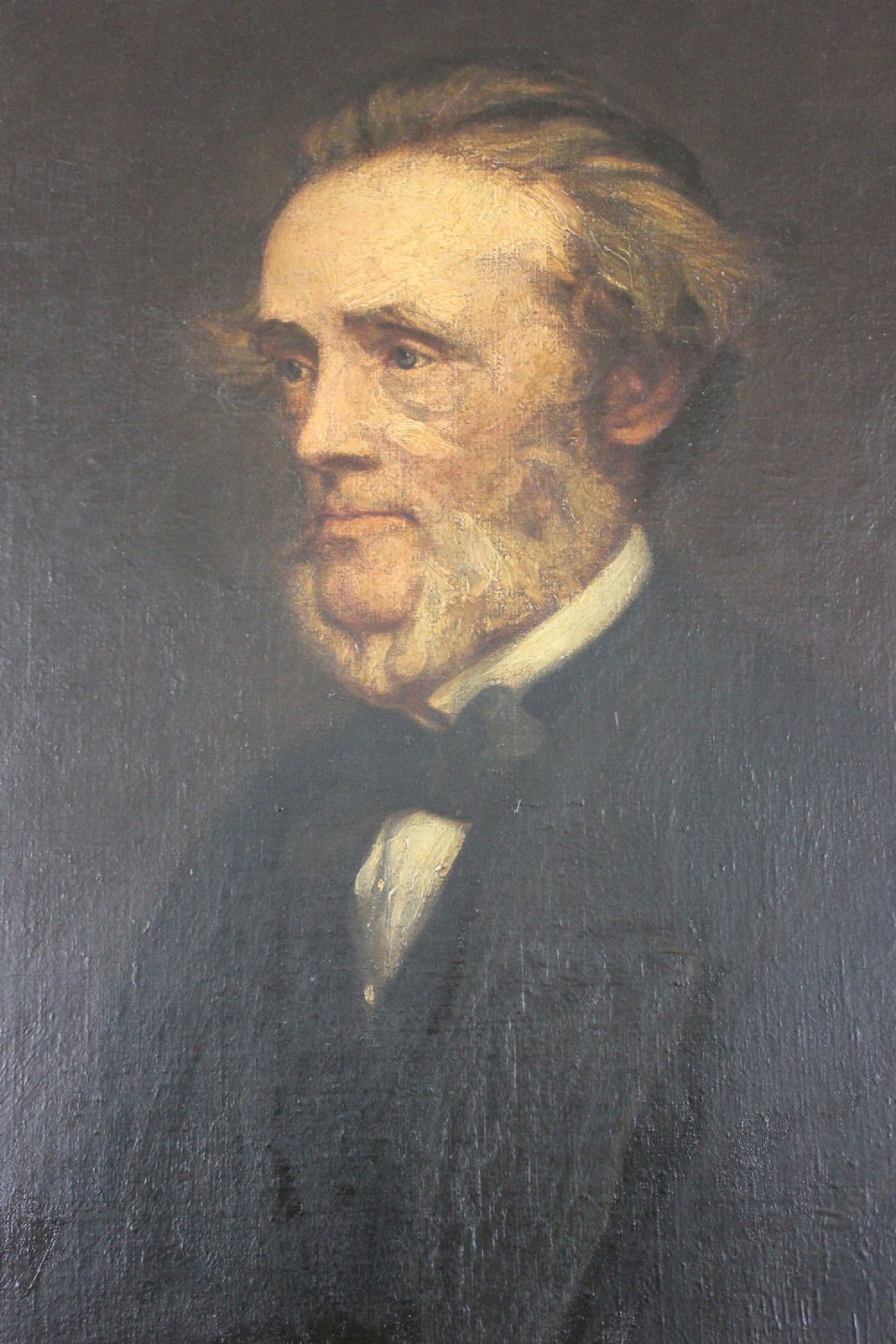
Thomas Robson 1798-1871 Portrait of Thomas Thomasson , Political Economist and a Campaigner for the Repeal of the Corn Laws


