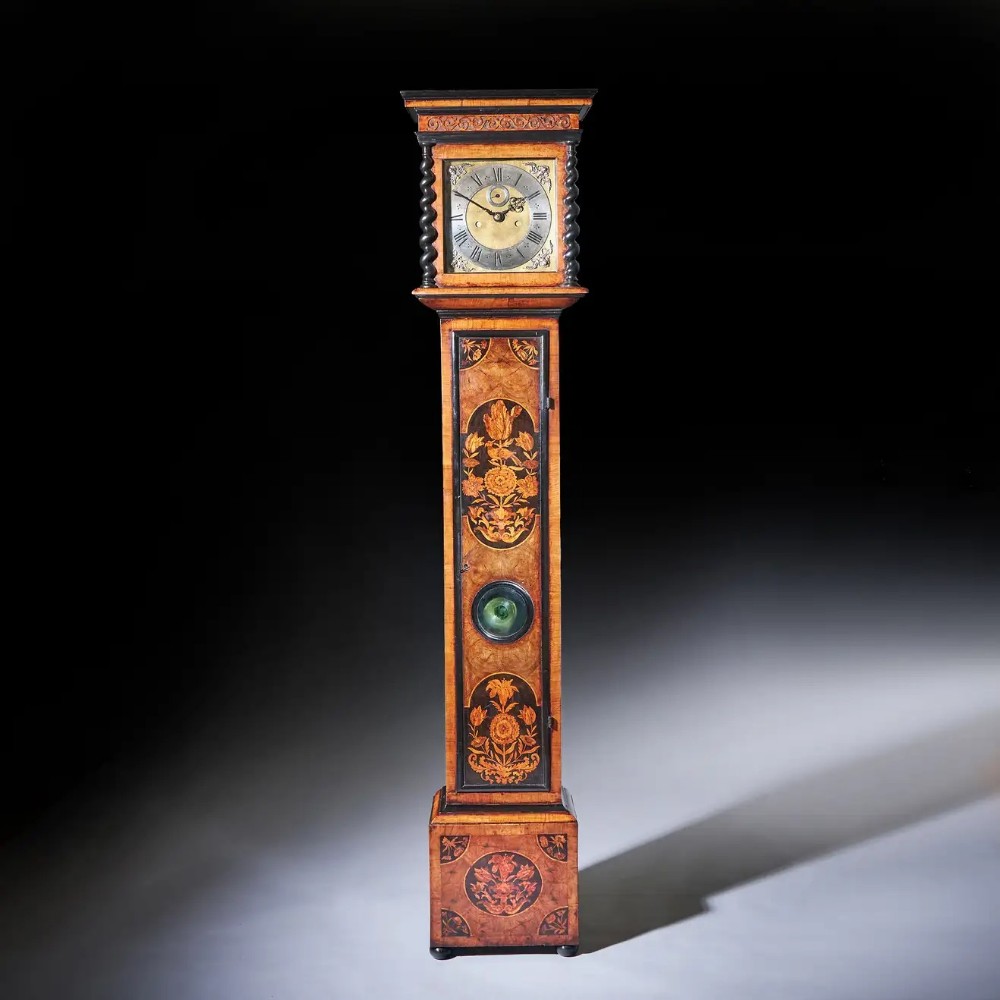
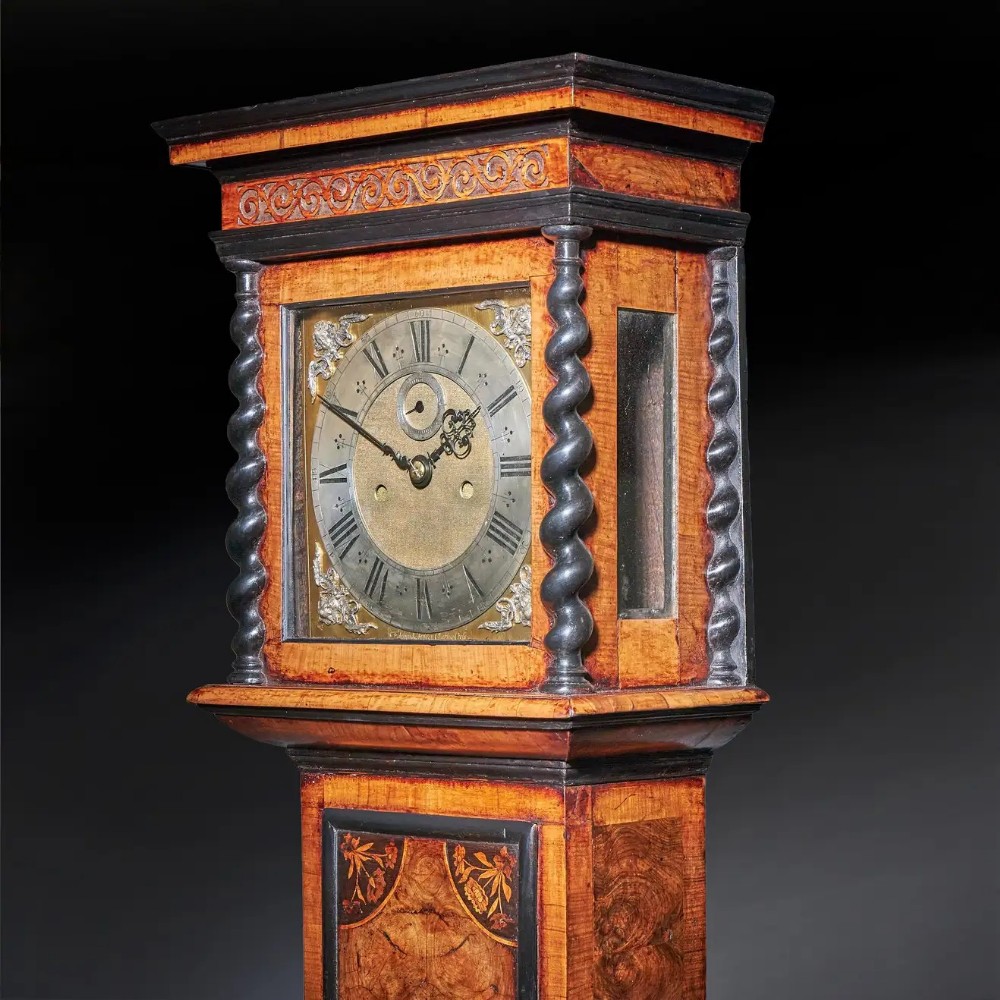
A wonderful late seventeenth century rising hood 10-inch William and Mary eight-day floral marquetry olive oyster longcase clock by Edmund Appley, London, c. 1680-1685.
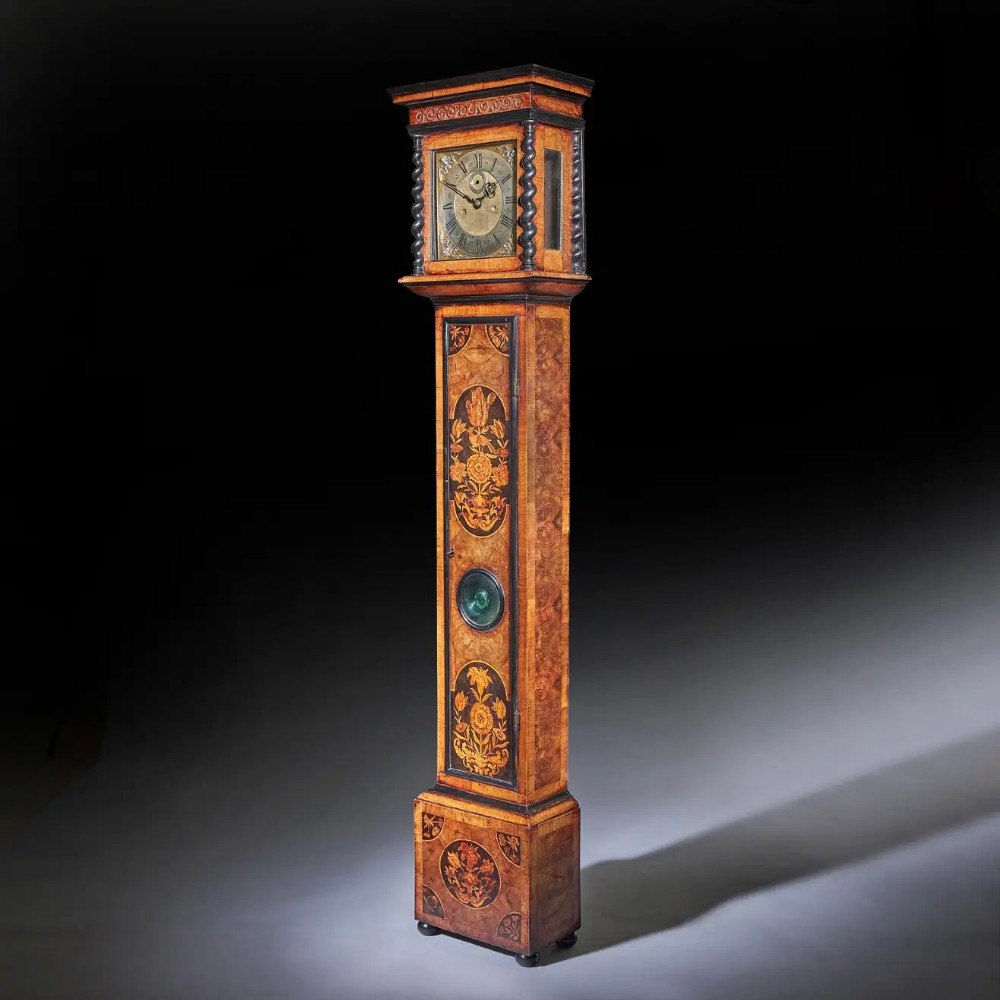
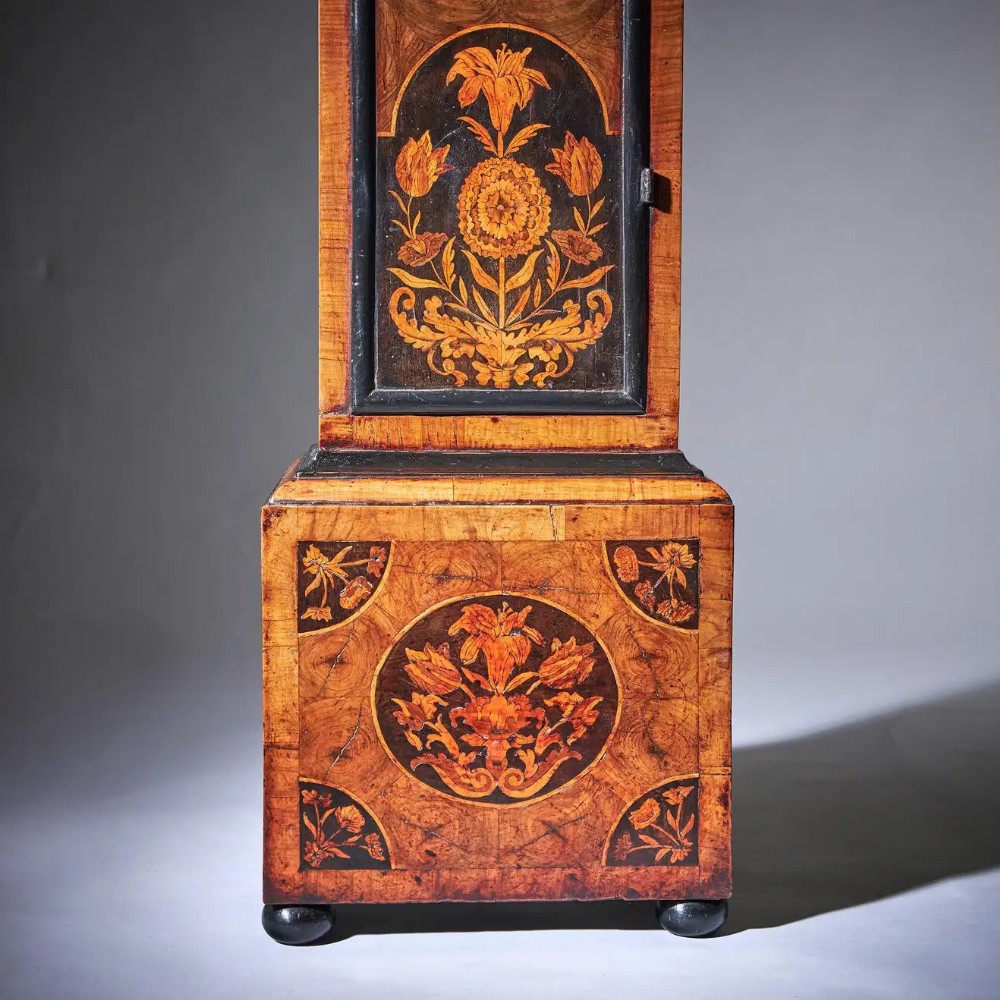
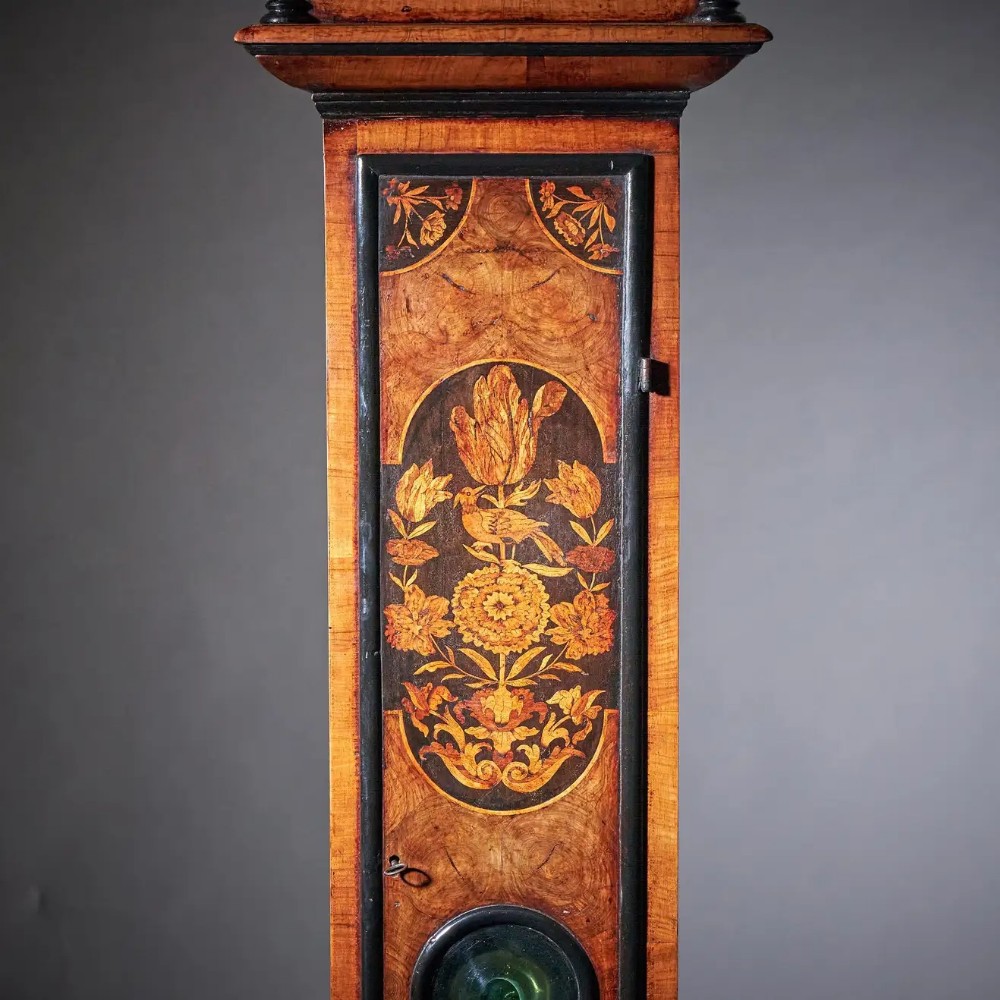
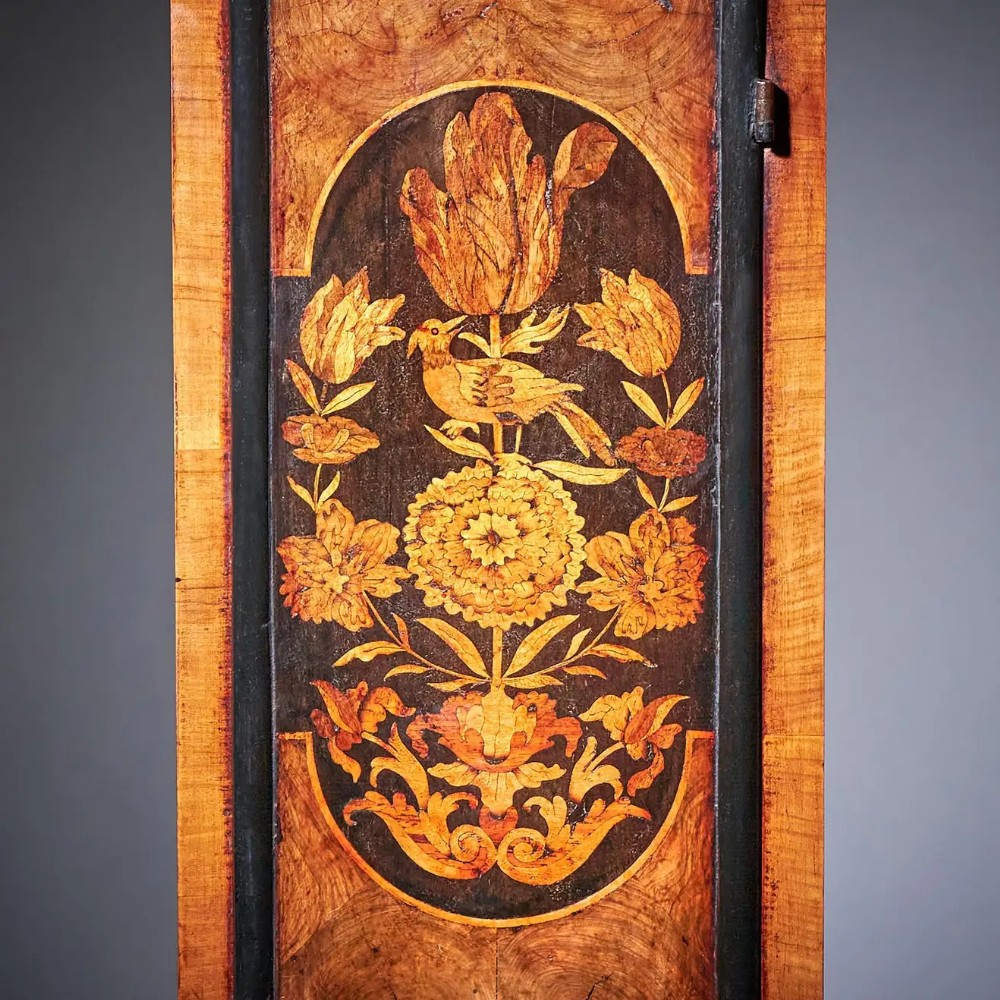
The attractive and fine olive oyster-veneered case is of the highest quality and decorated throughout in floral and leaf marquetry depicting spring flowers, a bird and scrolling foliage, each on a ground of ebony within a panel bordered with boxwood.
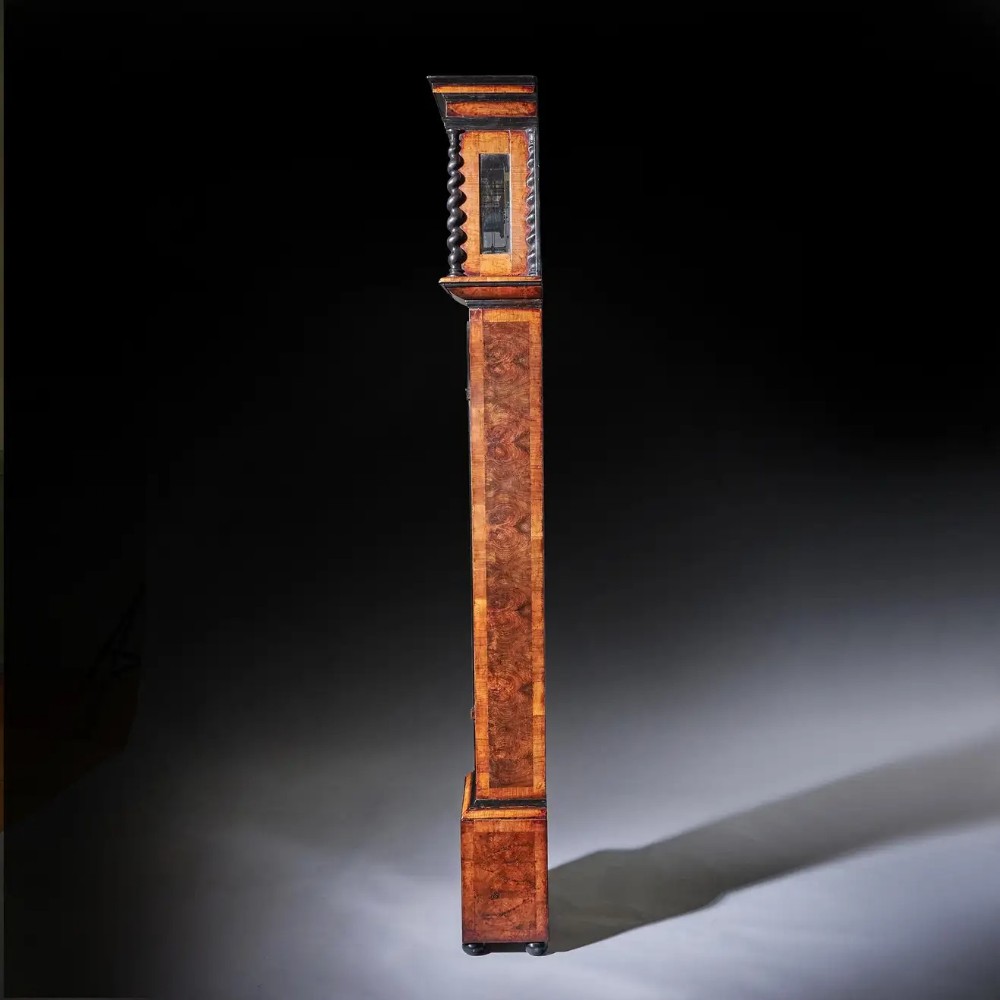
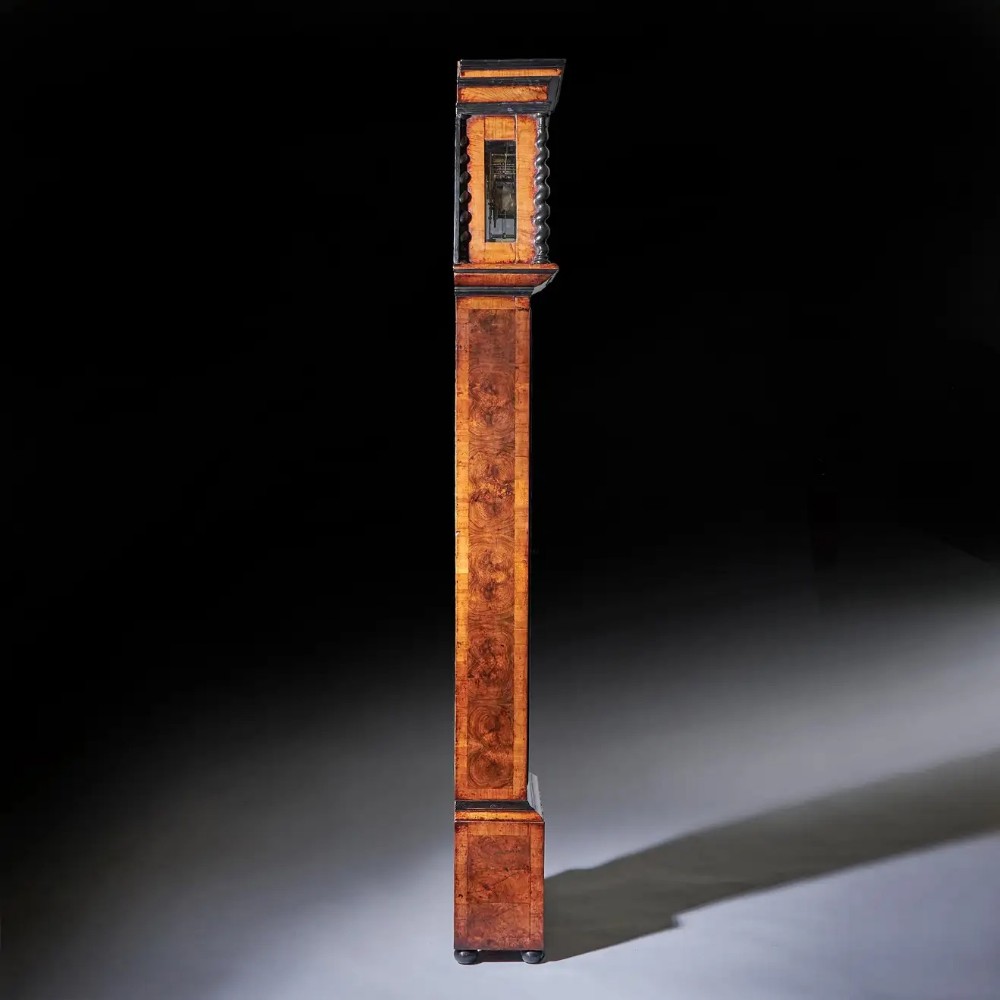
The trunk door reflects the ebonised mouldings and pillars on the hood and is bordered by an ebonised D-moulding with a circular lenticle set within an ebonised moulding. The rising hood is decorated with fine scrolling blind fretwork and cavetto moulding, flanked by tapering ebonised barley-twist columns. Large linear viewing windows of glass sit to each side of the hood.
The cross-banded sides have been carefully thought out too, with small sections of saw-cut olive oyster veneer, each carefully book-matched.
Raised on four ebonised bun feet.
The whole
...case is of extremely good colour and has the most lovely age-patinated surfaces.
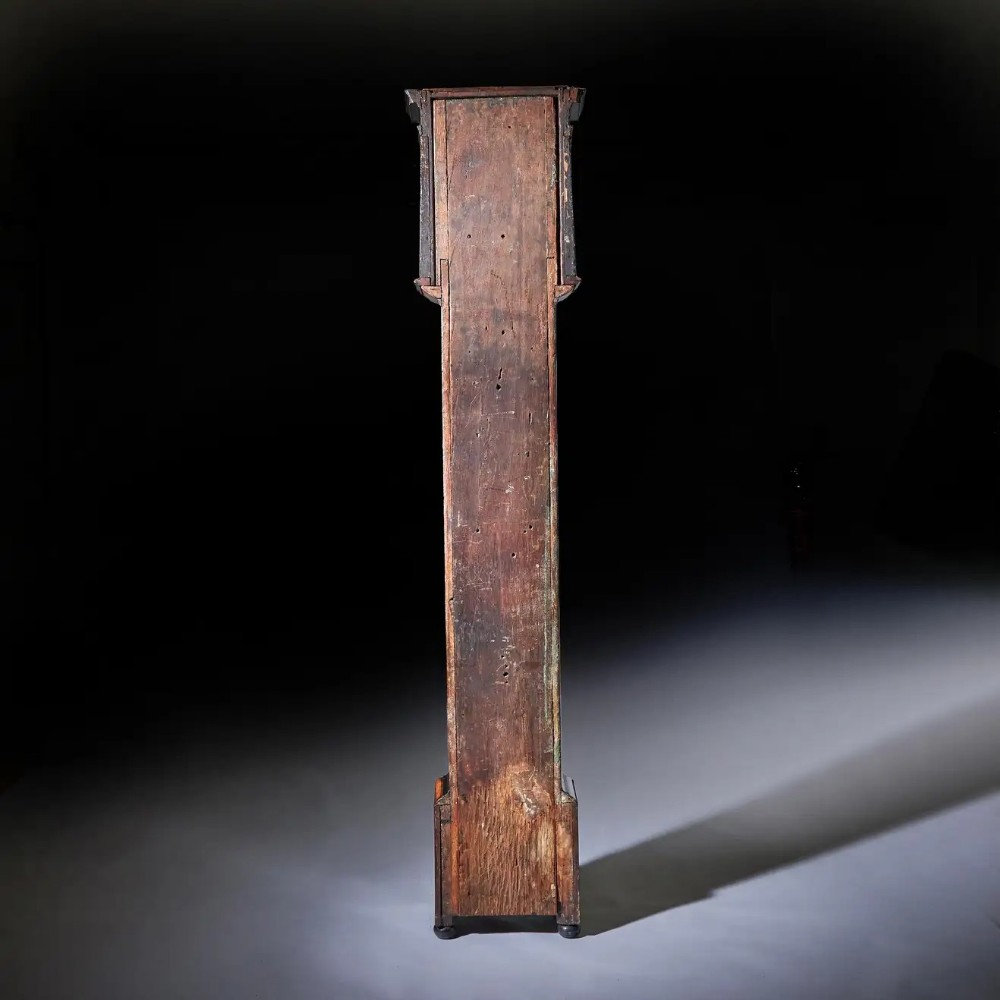
The eight-day five pillar movement has going and striking trains. The striking train is regulated by an inside countwheel (the detent mounted externally and engaging through a slot in the backplate). The going train has anchor escapement with bolt and shutter maintaining power and a seconds pendulum. The backplate is mounted with a brass L-shaped bracket located against a conforming iron bracket set into the backboard.
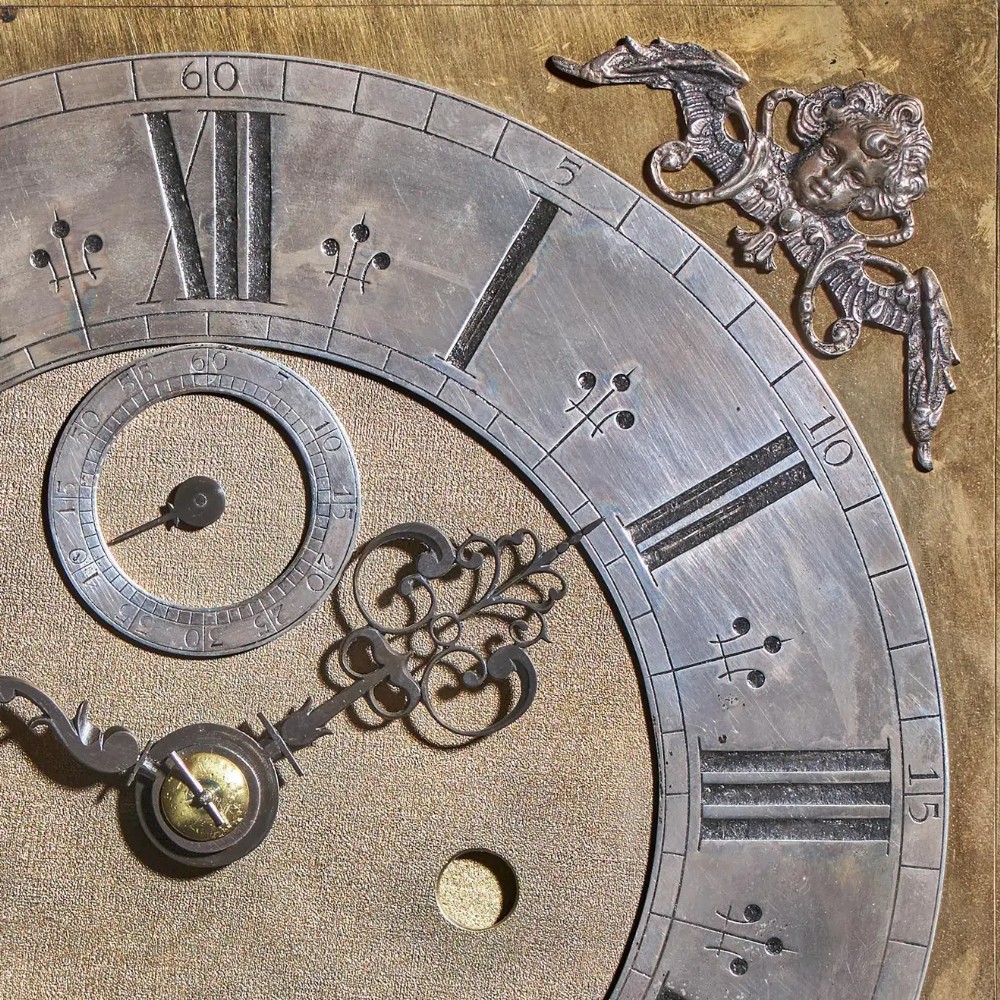
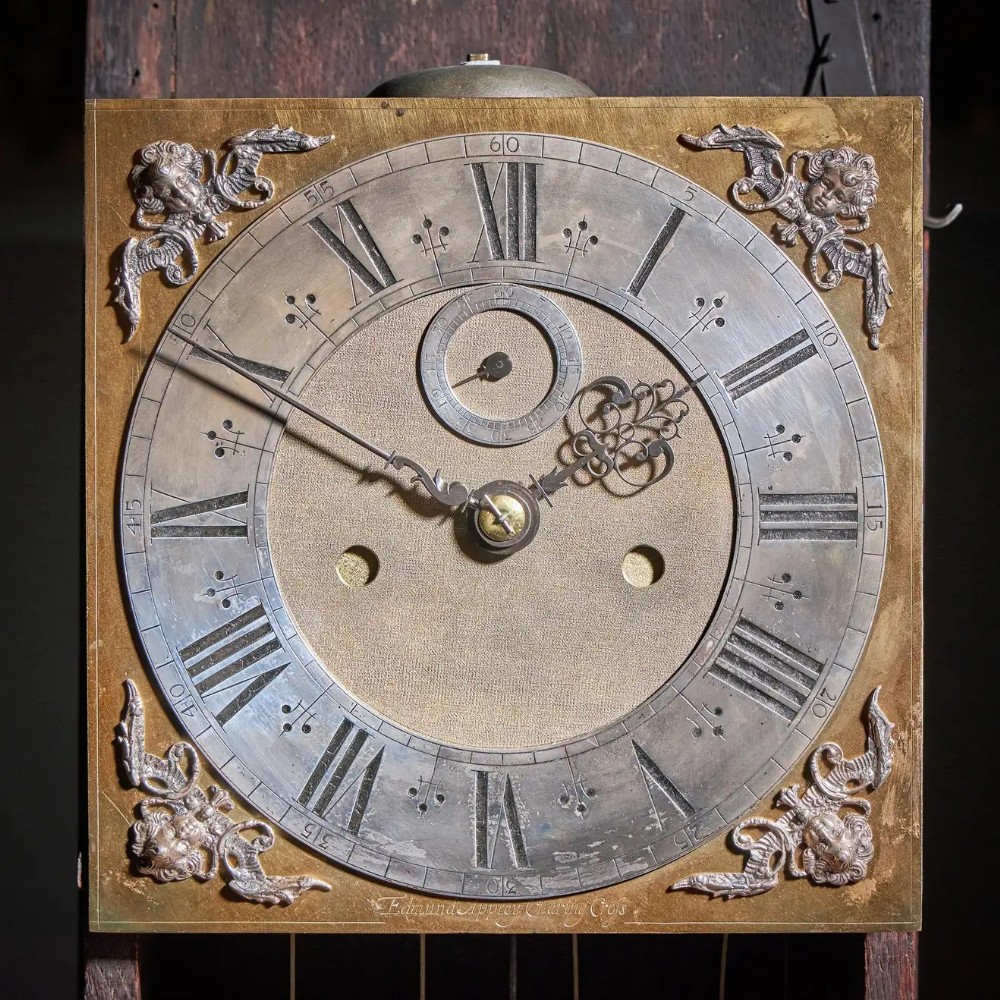
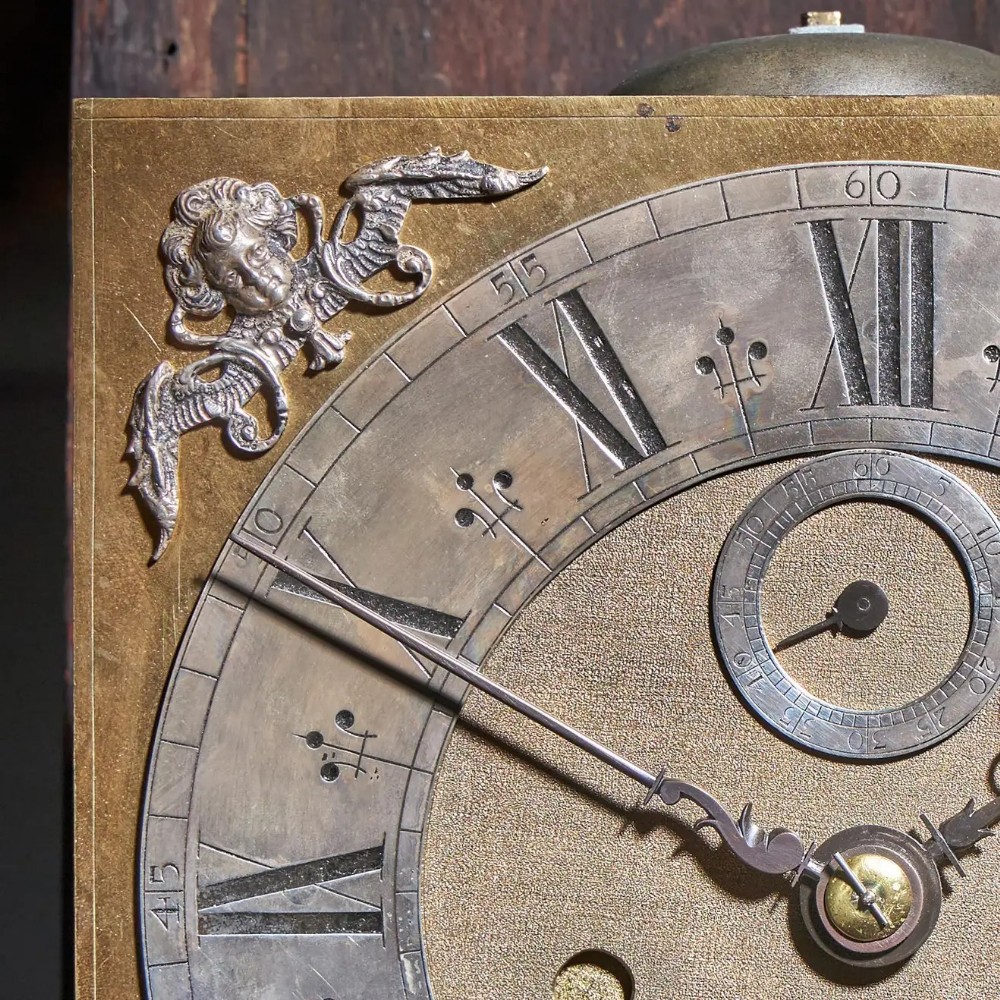
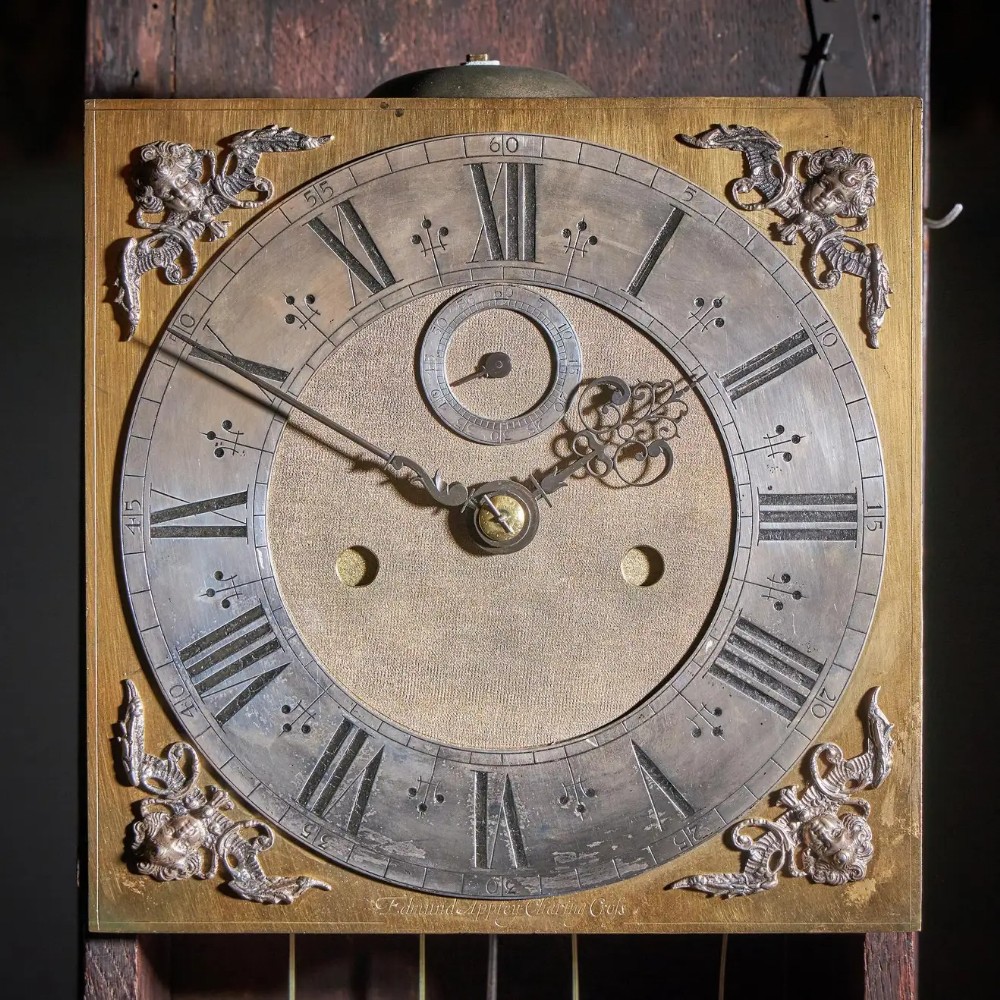
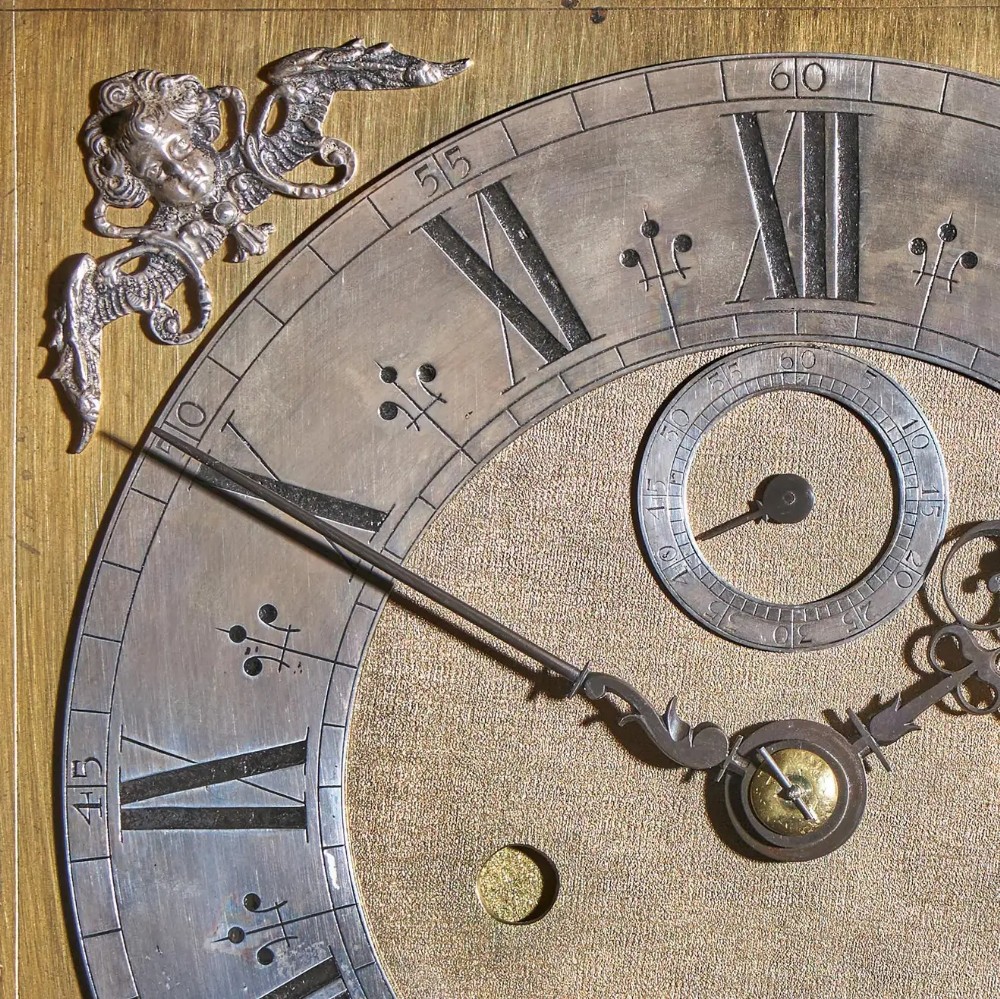
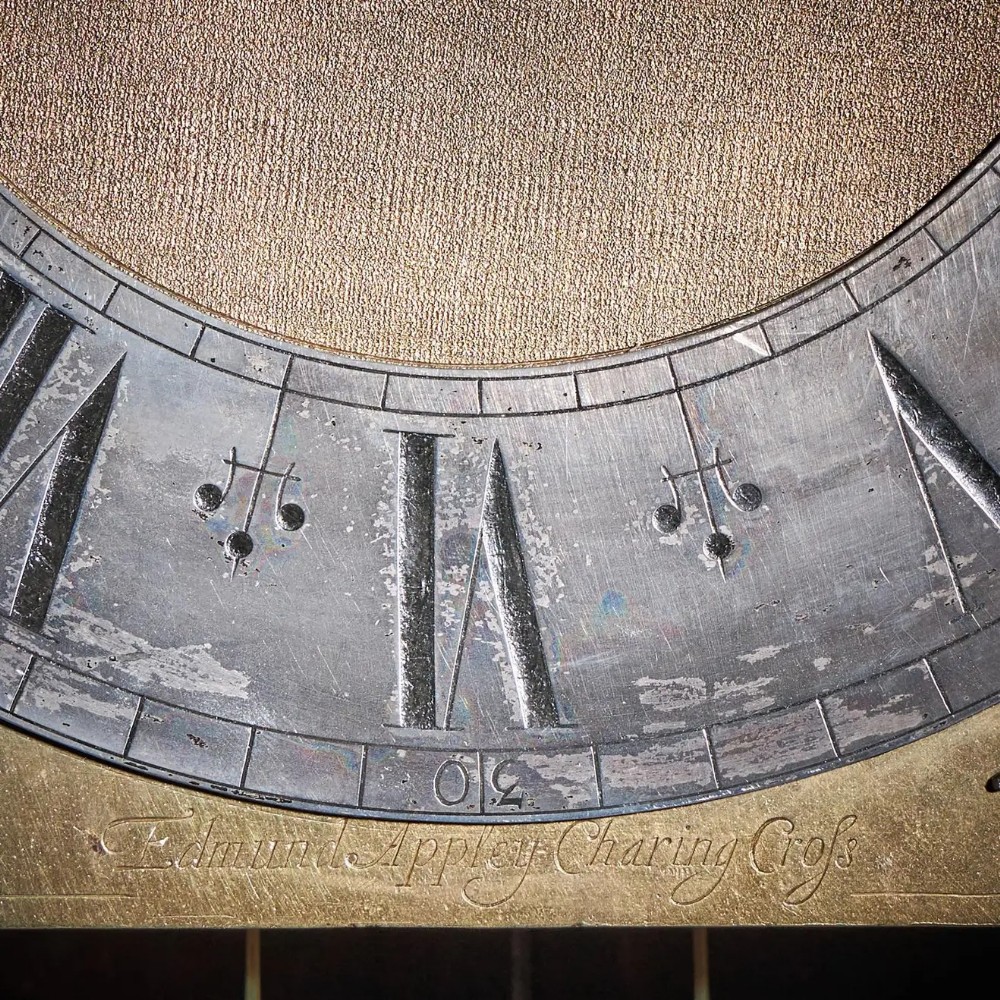
The 10-inch brass dial has a solid silver chapter ring, seconds ring and date aperture. A wonderful sign of quality. The silver chapter ring is divided into Roman hour numerals as well as quarter-hour, fleur-de-lys half-hour, Arabic five-minute and minute divisions. It is surrounded by solid silver winged cherub-head spandrels in the corners and is signed along the bottom of the brass plate ''Edmund Appley Charing Cross''. The centre is finely matted, showing the shutters in a closed position, whilst the time is indicated by a fine pair of richly pierced blued-steel hands.
The maker
Edmund Appley was born the son of Humphrey Appley, a weaver, in 1656. He was apprenticed to Jeffrey Bayley in 1670 and made free in London in 1677. From 1681 he took apprentices himself, working in Charing Cross. He died on a visit to Edinburgh in 1688 and was buried there. Longcase clocks, bracket clocks and lantern clocks by his hand are known.
Height 198 cm with a height of 225 cm with the hood raised to wind.''
Whether you are a collector or a first-time buyer the choice of pieces will inspire. Each has been carefully selected for its exceptional design and provenance, as well as in many instances its academic significance.
Originality and authenticity are paramount; and using our extensive knowledge and experience in furniture conservation and restoration we can ensure that our clients can buy with absolute confidence.Antique ID Number (AIDN): SA980027
Dateline of this antique is 17th Century
Height is 198cm (78.0inches)Width is 39cm (15.4inches)Depth is 22.5cm (8.9inches)







Thank you.
Your comment has been sent to Sellingantiques.