

Country Homes Antiques Stirling has dated this piece to the 19th Century.
JOHN SMITH FOR RETAIL BY CHARLES SMITH, LONDON, CIRCA 1830 The sphere applied with two sets of twelve hand-coloured engraved split half-gores incorporating oval panel inscribed A NEW, CELESTIAL GLOBE, COMPILED FROM THE WORKS OF, Wollaston, Flamsted, De la Caille, Havelius, Mayer, Bradley, Herschel, Maskelyne & c.
SMITH, Strand, & Sold by C. SMITH, 172 Strand, the axis through the celestial poles, with fully graduated equatorial and ecliptic and the constellations depicted by mythical beasts and figures with dotted boundaries, the stars shown to nine orders of magnitude with clusters and nebulæ, labelled and numbered corresponding to the British Catalogue, the upper pole with brass hour dial and pivoted within brass meridian circle divided for degrees, set within hand-coloured engraved paper horizon ring with compass points and degrees in both directions, Zodiac, calendar scales and wind directions, the tripod stand incorporating four quadrants supporting the meridian ring over reeded squat baluster upright and downcurved supports, with vacant compass stretcher between and terminating with tapered feet, John Smith is recorded in Clifton, Gloria Directory of British Scientific Instrument Makers 1550-1851 as a globe maker working from 1 Angel Court, Surrey Street, Strand, London 1829-30 then 35 Leicester Square 1830-36. Charles Smith was principally a map publisher who worked from 1799. He was engraver to the Prince of Wales and started producing pocket globes during the Regency period. The business expanded (in competition with the Cary family then Malby) to become one of the leading publishers and retailers of globes during the latter half of the 19th century, mostly under the stewardship of his son who succeeded him in 1845.
Condition Report: The globe generally presents as being in sound original unrestored condition with fairy light colouring and reasonably clear well-defined detail. The surface finish is flat and there is noticeable overall foxing most noticeably to the upper hemisphere. The top pivot has a small chip to the surface nearby and the lower has a small adjacent crack; globe is still solidly supported on the pivots. There is some noticeable browning to the joints between the gores which have opened slightly in a few areas. The stand is in good original condition with minimal spotting/discolouration to the horizon papers. There is no brass lower support for the Meridian ring present.
Country Homes Antiques Stirling has dated this piece to the 19th Century.
Fine period furniturnishings-timeless design
You can view the stock and full dealer information on the Country Homes Antiques Stirling Profile Page
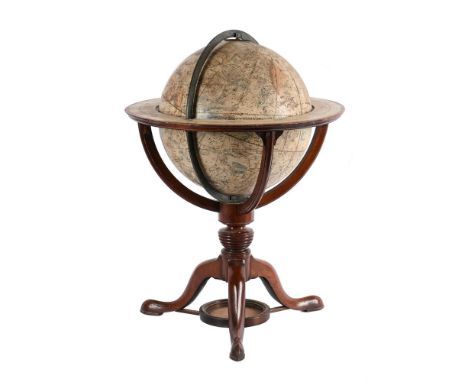
A George IV Twelve-inch Celestial Library Globe
