20,068  PAGES BROWSED TODAY PAGES TODAY 36  ANTIQUES UPLOADED TODAY NEW ARRIVALS
ID #SA950594
FOR SALE
£7,500
Email Buy
Save
Georgian Twin Fusee Balloon Bracket Clock by William Smith London - Retailed by Percy Webster
Jason Clarke Antiques
for sale €8,775     $9,525
£7,500
Jason Clarke Antiques

Jason Clarke Antiques

Sellingantiques Verified Since Jul 2015
View Dealers Stock Page
Relevant Links
Id #SA950594
PDF SHARE
SAVE

Georgian Twin Fusee Balloon Bracket Clock by William Smith London - Retailed by Percy Webster

18th century
Description

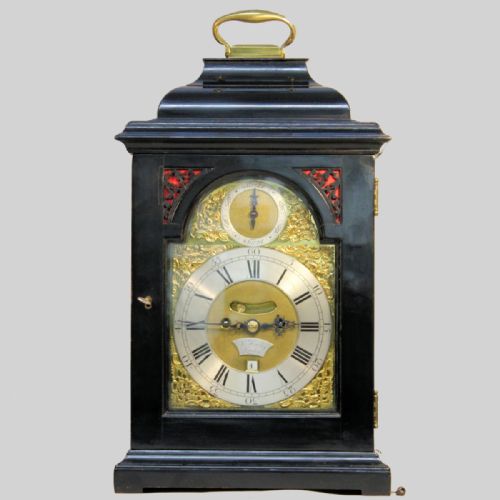
For sale, a large mid-Eighteenth century twin fusee balloon bracket clock by William Smith of London and retailed by Percy Webster.

This early and beautifully imposing example is comprised of an ebonised continental style case set upon a thick brass surround at the base and four well-proportioned brass ogee bracket feet. The hips of the case have an open section either side adorned with fine gilt brass filigree type inserts representing the Louis XIV sun god motif contrasted with striking red silk backing behind.

The front of the case below the dial has an elongated u-shaped open section following the curve of the bezel and has a thick gilt brass surround and central brasswork panel with rocaille detailing and red silk.

The clock face above is comprised of a 10.5” silvered and engraved dial with large and typical Eighteenth century minute markings around the outer circumference which surround the hours represented in roman numeral form. The centre of the dial is beautifully engraved with the clockmaker’s name, William Smith, London and has finely detailed blue steel hands typical of the period. Surrounding the dial is a superb, inch and a quarter wide hinged and graduated brass bezel with convex glass.

The reverse of the clock has a large, hinged door with original lock and key, revealing an unusual movement design incorporating the escapement onto the backplate behind the crutch. This may signify a slightly later conversion from a verge escapement to an anchor escapement, a common change intended to improve accuracy in similarity to the way In which lantern clocks were converted to pendulum as technology advanced a century earlier. The movement also incorporates a bell and striker at the top of the movement.

Of significant interest is a small ivorine plaque affixed to the inside of the case bearing the name Percy Webster, clockmaker, Great Portland Street with the inventory number: 6960. Webster was a notable antiques dealer and clockmaker who operated during the late Nineteenth and early Twentieth Centuries and is considered by some to be the first notable authority on antiquarian clocks and later took up the position of Master of the Worshipful Company of Clockmakers. His son, who followed his Father into business was equally respected and was responsible alongside Herbert Cescinsky for producing the book that became, and to some extend still is, the clock collector’s bible, “English Domestic Clocks”. With the addition of this plaque, we can be sure that at some point before 1938, this superb example was considered good enough to be included for sale at Webster’s London premises. Sadly, the inventory records for the Webster business do not seem to exist.

The maker, William Smith is known to have worked in Moorfields, London which had slowly established itself as a centre for clockmaking, engraving and clock brass founding in the years after the Great Fire of 1666. From around 1740, Smith had gained himself a good reputation as a maker of turret clocks and is known to have supplied one to Princess Amelia, the eldest daughter of George II. Little is known of Smith’s life other than his documented move to Bristol during the 1770’s and his subsequent death in 1789 but enough examples of his turret clocks exist to demonstrate his superior craftsmanship. His domestic clocks are exceedingly rare and so the culmination of this fact, the clock’s exquisite design and it being a rare exemplar of brasswork (and probably casework) emanating from the centre of the Moorfields clockmaking industry during its heyday, was likely enough to convince Webster of its historical merit.

Smith’s London working dates would also attest to this being a very early example of an English balloon clock, a design style that was originally imported from France and grew in popularity from around 1760 until about 1800. With Smith’s move to B

Physical Dimensions
Height
53cm (20.87")
Width
40cm (15.75")
Depth
22cm (8.66")
Declaration

Jason Clarke Antiques has dated this Georgian Balloon Bracket Clock to the 1750s.

Reference Numbers
Sellingantiques Reference
SA950594
Description
For sale, a large mid-Eighteenth century twin fusee balloon bracket clock by William Smith of London and retailed by Percy Webster.
This early and beautifully imposing example is comprised of an ebonised continental style case set upon a thick brass surround at the base and four well-proportioned brass ogee bracket feet.
Jason Clarke Antiques

The hips of the case have an open section either side adorned with fine gilt brass filigree type inserts representing the Louis XIV sun god motif contrasted with striking red silk backing behind.

fig 1. A Georgian ebonised balloon bracket clock featuring a silvered circular dial, polished brass bezel, and ornamental brass fretwork at the base.
fig 1. Georgian Twin Fusee Balloon Bracket Clock by William Smith London - Retailed by Percy Webster

The front of the case below the dial has an elongated u-shaped open section following the curve of the bezel and has a thick gilt brass surround and central brasswork panel with rocaille detailing and red silk.

fig 2. A Georgian ebonised balloon bracket clock featuring a silvered circular dial, polished brass bezel, and ornamental brass fretwork at the base.
fig 2. Georgian Twin Fusee Balloon Bracket Clock by William Smith London - Retailed by Percy Webster

The clock face above is comprised of a 10.5” silvered and engraved dial with large and typical Eighteenth century minute markings around the outer circumference which surround the hours represented in roman numeral form. The centre of the dial is beautifully engraved with the clockmaker’s name, William Smith, London and has finely detailed blue steel hands typical of the period. Surrounding the dial is a superb, inch and a quarter wide hinged and graduated brass bezel with convex glass.

fig 3. A Georgian ebonised balloon bracket clock featuring a silvered circular dial, polished brass bezel, and ornamental brass fretwork at the base.
fig 3. Georgian Twin Fusee Balloon Bracket Clock by William Smith London - Retailed by Percy Webster

The reverse of the clock has a large, hinged door with original lock and key, revealing an unusual movement design incorporating the escapement onto the backplate behind the crutch. This may signify a slightly later conversion from a verge escapement to an anchor escapement, a common change intended to improve accuracy in similarity to the way In which lantern clocks were converted to pendulum as technology advanced a century earlier. The movement also incorporates a bell and striker at the top of the movement.

fig 4. A Georgian ebonised balloon bracket clock featuring a silvered circular dial, polished brass bezel, and ornamental brass fretwork at the base.
fig 4. Georgian Twin Fusee Balloon Bracket Clock by William Smith London - Retailed by Percy Webster

Of significant interest is a small ivorine plaque affixed to the inside of the case bearing the name Percy Webster, clockmaker, Great Portland Street with the inventory number: 6960. Webster was a notable antiques dealer and clockmaker who operated during the late Nineteenth and early Twentieth Centuries and is considered by some to be the first notable authority on antiquarian clocks and later took up the position of Master of the Worshipful Company of Clockmakers. His son, who followed his Father into business was equally respected and was responsible alongside Herbert Cescinsky for producing the book that became, and to some extend still is, the clock collector’s bible, “English Domestic Clocks”. With the addition of this plaque, we can be sure that at some point before 1938, this superb example was considered good enough to be included for sale at Webster’s London premises. Sadly, the inventory records for the Webster business do not seem to exist.

fig 5. A Georgian ebonised balloon bracket clock featuring a silvered circular dial, polished brass bezel, and ornamental brass fretwork at the base.
fig 5. Georgian Twin Fusee Balloon Bracket Clock by William Smith London - Retailed by Percy Webster

The maker, William Smith is known to have worked in Moorfields, London which had slowly established itself as a centre for clockmaking, engraving and clock brass founding in the years after the Great Fire of 1666. From around 1740, Smith had gained himself a good reputation as a maker of turret clocks and is known to have supplied one to Princess Amelia, the eldest daughter of George II. Little is known of Smith’s life other than his documented move to Bristol during the 1770’s and his subsequent death in 1789 but enough examples of his turret clocks exist to demonstrate his superior craftsmanship. His domestic clocks are exceedingly rare and so the culmination of this fact, the clock’s exquisite design and it being a rare exemplar of brasswork (and probably casework) emanating from the centre of the Moorfields clockmaking industry during its heyday, was likely enough to convince Webster of its historical merit.

fig 6. A Georgian ebonised balloon bracket clock featuring a silvered circular dial, polished brass bezel, and ornamental brass fretwork at the base.
fig 6. Georgian Twin Fusee Balloon Bracket Clock by William Smith London - Retailed by Percy Webster

Smith’s London working dates would also attest to this being a very early example of an English balloon clock, a design style that was originally imported from France and grew in popularity from around 1760 until about 1800. With Smith’s move to B

Height
53cm (20.87")
Width
40cm (15.75")
Depth
22cm (8.66")
Date of Manufacture

Jason Clarke Antiques has dated this Georgian Balloon Bracket Clock to the 1750s.

Reference Numbers
Sellingantiques Ref
SA950594
Jason Clarke Antiques
Sellingantiques verified Since Jul 2015
Dealer Profile

You can view the stock and full dealer information on the Jason Clarke Antiques Profile Page

Relevant Links
PDF SHARE
SAVE
A Georgian ebonised balloon bracket clock featuring a silvered circular dial, polished brass bezel, and ornamental brass fretwork at the base.
1 / 14
Archive I A Georgian ebonised balloon bracket clock featuring a silvered circular dial, polished brass bezel, and ornamental brass fretwork at the base.

Georgian Twin Fusee Balloon Bracket Clock by William Smith London - Retailed by Percy Webster

Archive II A Georgian ebonised balloon bracket clock featuring a silvered circular dial, polished brass bezel, and ornamental brass fretwork at the base. View II
Archive III A Georgian ebonised balloon bracket clock featuring a silvered circular dial, polished brass bezel, and ornamental brass fretwork at the base. View III
Archive IV A Georgian ebonised balloon bracket clock featuring a silvered circular dial, polished brass bezel, and ornamental brass fretwork at the base. View IV
Archive V A Georgian ebonised balloon bracket clock featuring a silvered circular dial, polished brass bezel, and ornamental brass fretwork at the base. View V
Archive VI A Georgian ebonised balloon bracket clock featuring a silvered circular dial, polished brass bezel, and ornamental brass fretwork at the base. View VI
Archive VII A Georgian ebonised balloon bracket clock featuring a silvered circular dial, polished brass bezel, and ornamental brass fretwork at the base. View VII
Archive VIII A Georgian ebonised balloon bracket clock featuring a silvered circular dial, polished brass bezel, and ornamental brass fretwork at the base. View VIII
Archive IX A Georgian ebonised balloon bracket clock featuring a silvered circular dial, polished brass bezel, and ornamental brass fretwork at the base. View IX
Archive X A Georgian ebonised balloon bracket clock featuring a silvered circular dial, polished brass bezel, and ornamental brass fretwork at the base. View X
Archive XI A Georgian ebonised balloon bracket clock featuring a silvered circular dial, polished brass bezel, and ornamental brass fretwork at the base. View XI
Archive XII A Georgian ebonised balloon bracket clock featuring a silvered circular dial, polished brass bezel, and ornamental brass fretwork at the base. View XII
Archive XIII A Georgian ebonised balloon bracket clock featuring a silvered circular dial, polished brass bezel, and ornamental brass fretwork at the base. View XIII
Archive XIV A Georgian ebonised balloon bracket clock featuring a silvered circular dial, polished brass bezel, and ornamental brass fretwork at the base. View XIV
FURTHER BROWSING

Visitors also looked at these ⇣

Enlarged Archival View
Telephone 07815 046645
Location
Newbury
Berkshire
United Kingdom
Verified Since Jul 2015
Items For Sale 82
Items Sold 605
Jason Clarke Antiques
Verified Since Jul 2015
View Dealer Info
Location: Newbury, Berkshire, United Kingdom
Verified
Jul 2015
For Sale
82
Sold
605
A Georgian ebonised balloon bracket clock featuring a silvered circular dial, polished brass bezel, and ornamental brass fretwork at the base.
Georgian Twin Fusee Balloon Bracket Clock by William Smith London - Retailed by Percy Webster
Ref: SA950594
A Georgian ebonised balloon bracket clock featuring a silvered circular dial, polished brass bezel, and ornamental brass fretwork at the base.
Detail View 1
Detail View 2
Detail View 3
Detail View 4
Detail View 5
Detail View 6
Detail View 7
Detail View 8
Detail View 9
Detail View 10
Detail View 11
Detail View 12
Detail View 13
Archival Detail
Every single antique dealer on our platform is individually approved by our internal team. We verify their professional trade history, ethical standards, and photographic quality to ensure a secure, high-standard buying environment. Upon joining, every dealer agrees to a strict 9-point code of conduct. While issues can occasionally arise, our dealers typically resolve them swiftly and directly with the buyer. In fact, since our founding in 2002, Sellingantiques has only had to step in to help resolve an issue on roughly five occasions—a true testament to the quality of our dealers and their dedication to your happiness.
Our dealers are highly experienced in packing and shipping fragile, high-value antiques. Because you are in direct contact with the dealer, you will be able to easily go through all available shipping and insurance options together to ensure your item arrives safely.
Antiques are the ultimate green purchase. By choosing historical pieces over newly manufactured goods, you completely eliminate the carbon footprint of modern mass production while preserving exceptional, timeless craftsmanship.

Originating in late 18th-century Britain, balloon clocks feature a waist-shaped case tapering down from a rounded upper section, traditionally housing a spring-driven twin fusee mechanical movement for accurate timekeeping.

These timepieces combine ebonised or veneered timber cases with cast brass bezels, hand-engraved silvered brass dials, and ornamental gilt-brass fretwork panels lined with silk or fabric.

Authentic examples feature spring-driven movements linked via gut line or chain to a conical fusee barrel, period hand-engraved maker signatures on the dial or backplate, and cast brass fittings displaying age-appropriate patination.

Position the clock centrally on a grand fireplace mantelpiece, credenza, or console table where its architectural silhouette can serve as a focal anchor amidst understated contemporary decor.

Dust the wooden case with a dry microfibre cloth, avoid applying harsh polishing agents to original gilt-brass components, and have the mechanical movement lubricated and serviced by a professional horologist every five to seven years.
items
Add keywords to the filter
Price
£100
£250000
Era
Movements
Material
Origin
Stock Location
Freshness
Online Payments
Categories