The Antique Clock Co. has dated this piece to the Victorian era.
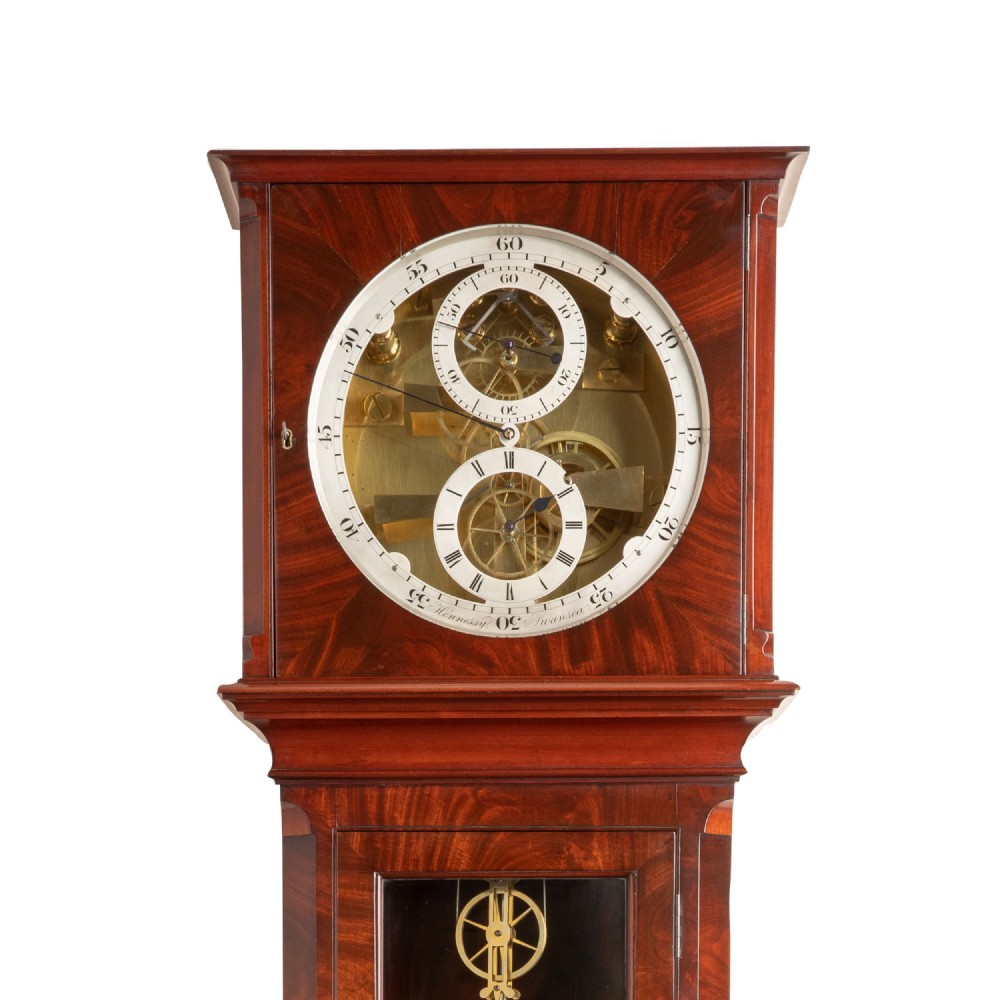
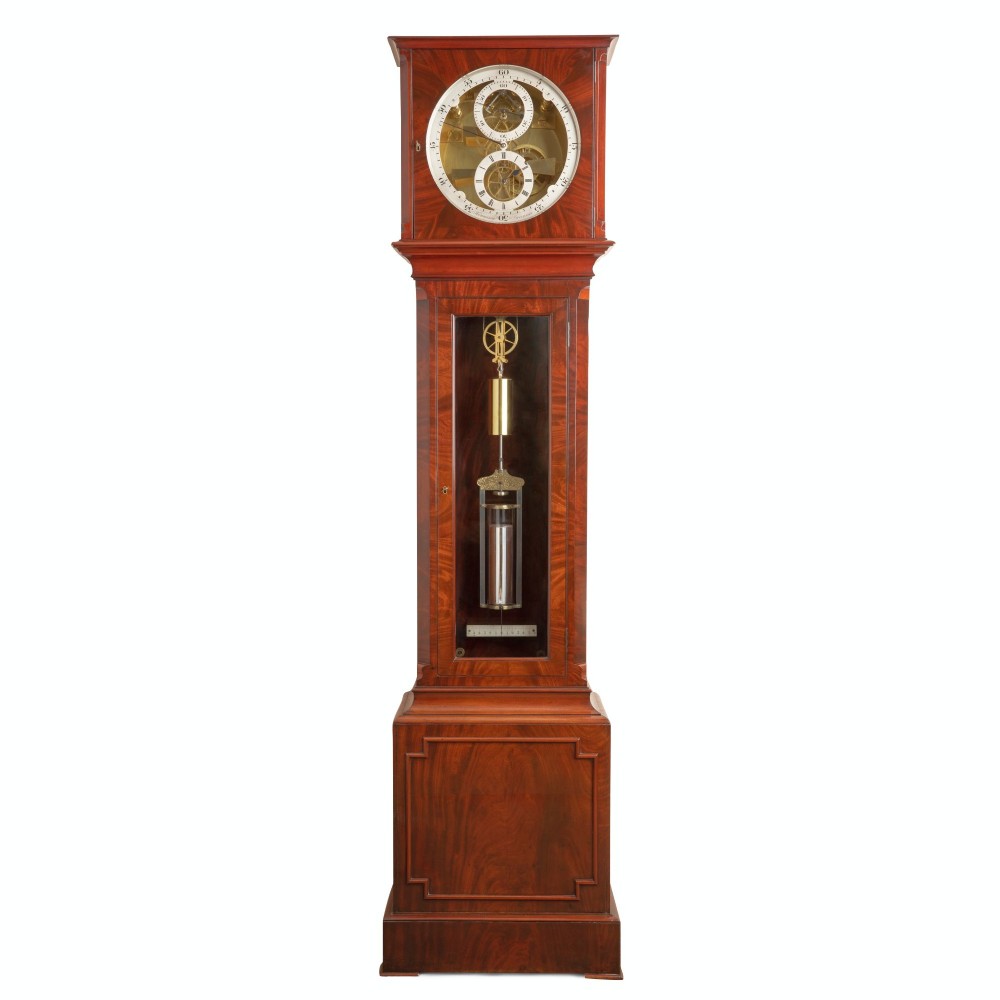
A fine and rare longcase regulator with a beautifully executed skeletonised dial and movement.
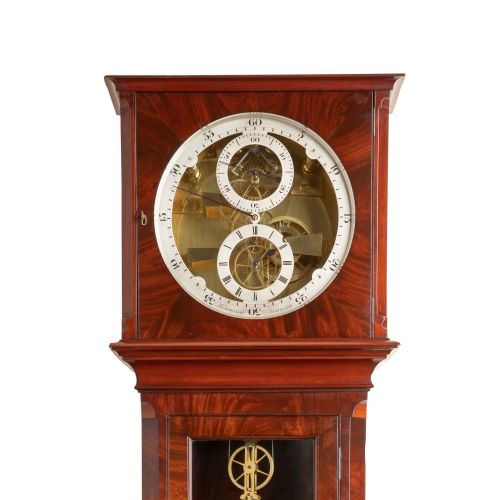
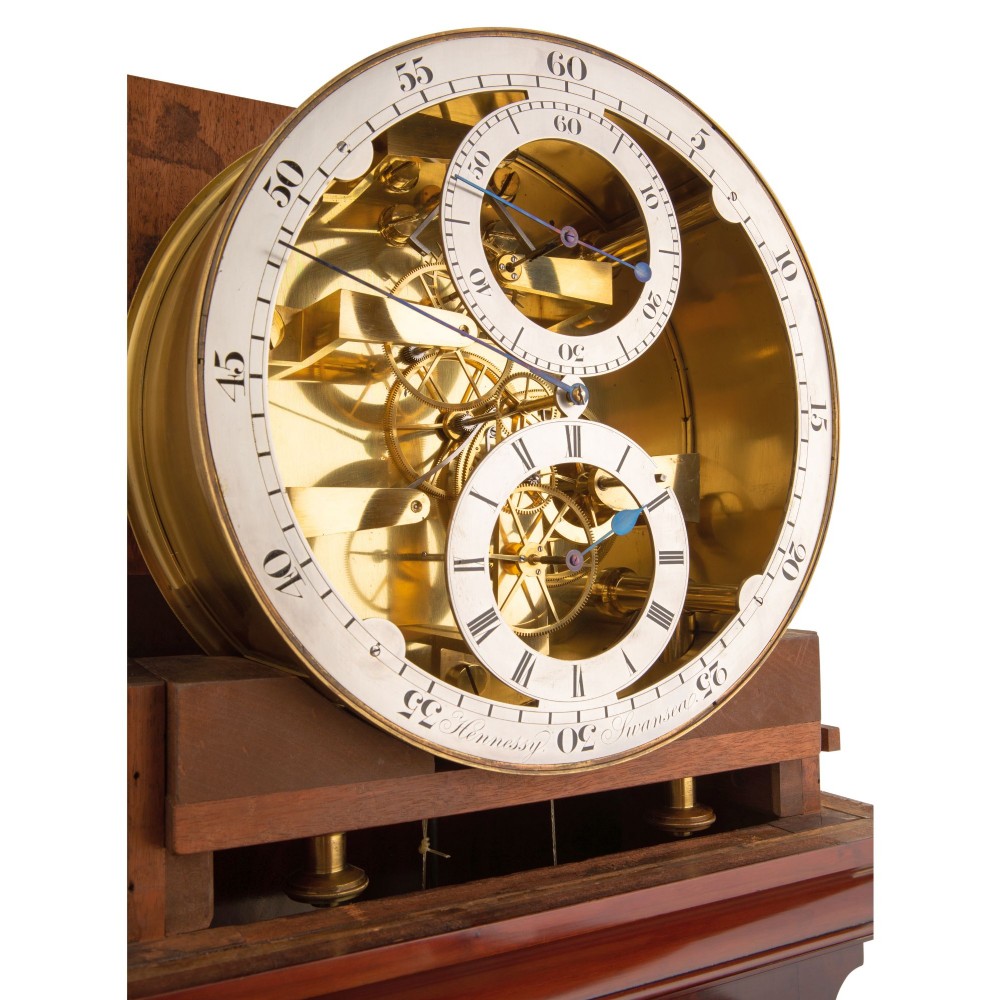
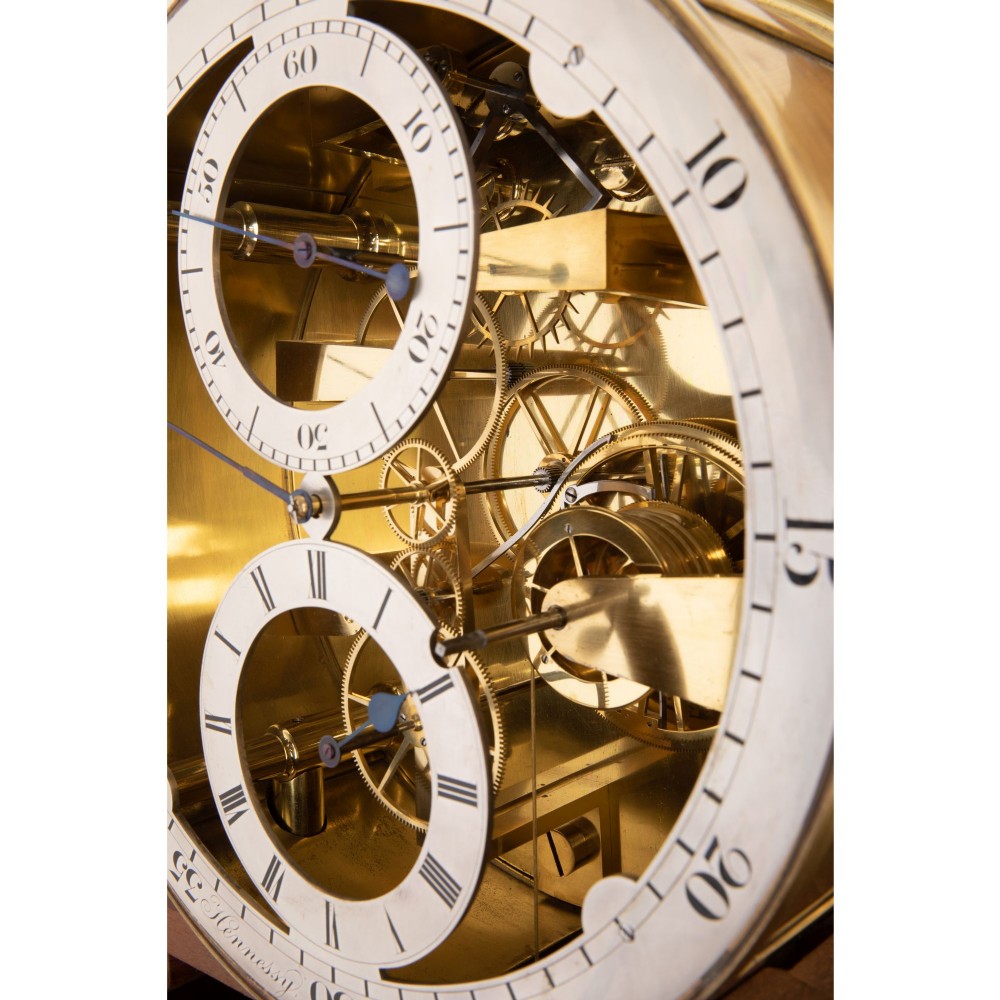
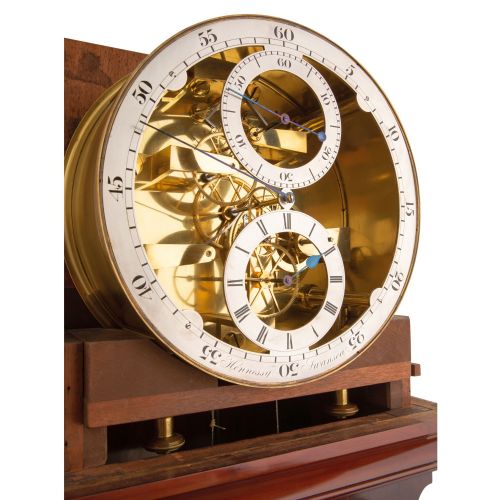
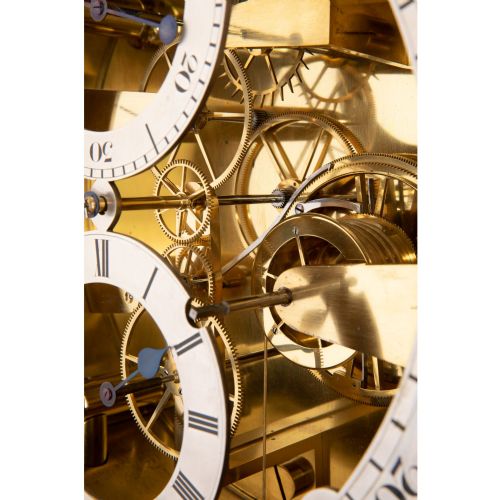
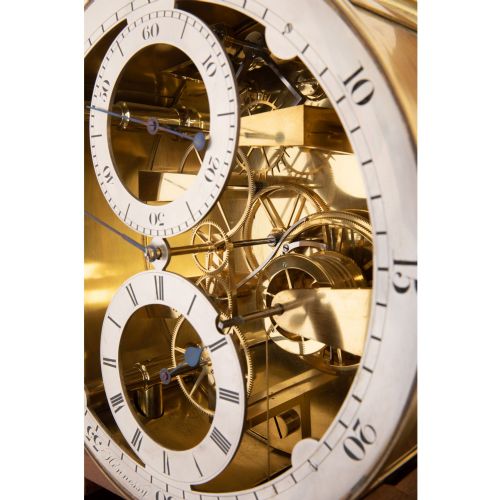
The very thick backplate is circular, being some 12” in diameter, and a circular brass drum shaped case encloses the movement. The engraved and silvered brass dial consists, in effect, of three chapter rings. The narrow outer one for the minutes has Arabic numerals as also does the seconds ring below 12 o’clock. Roman numerals are employed for the hours. The dial is screwed to the four very heavy stepped dial pillars which in turn are fixed to the backplate by four heavy screws.
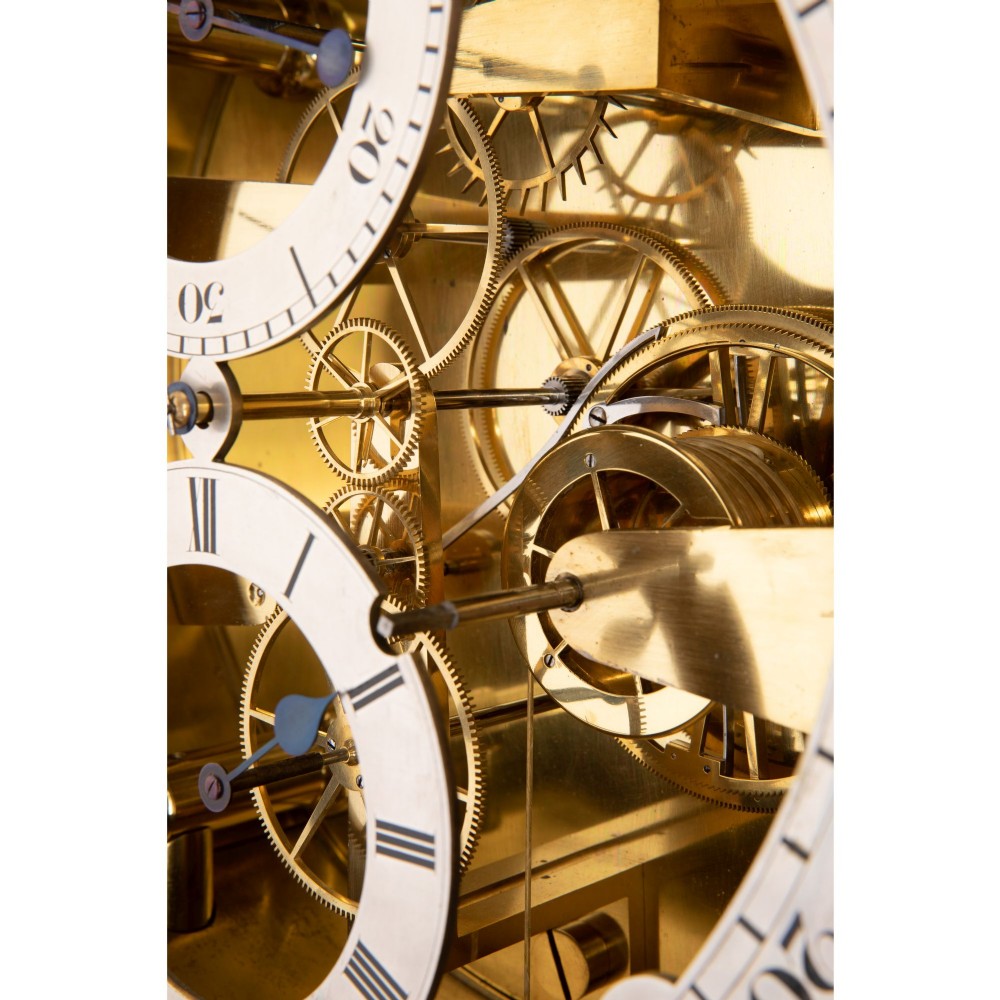
All the wheelwork is finely finished each having delicately tapered crossings; indeed even the barrel cover is skeletonised with six tapering crossings. The train, which is given below, is of very high count, employing beautifully finished 24 leaf pinions throughout.
WHEEL TEETH PINIONS
Great Wheel 288 24
Centre Wheel 192 24
Intermediate Wheel 180 24
Escape Wheel 30 24
The Minute is 68 : 68
The Hour is 12 to 144.
The dead-beat pallets are jewelled and are protected by ‘stop’ pins mounted on the backplate. An impressive feature is the long curving lever for the maintaining lever which snakes its way between a wheel and pinion.
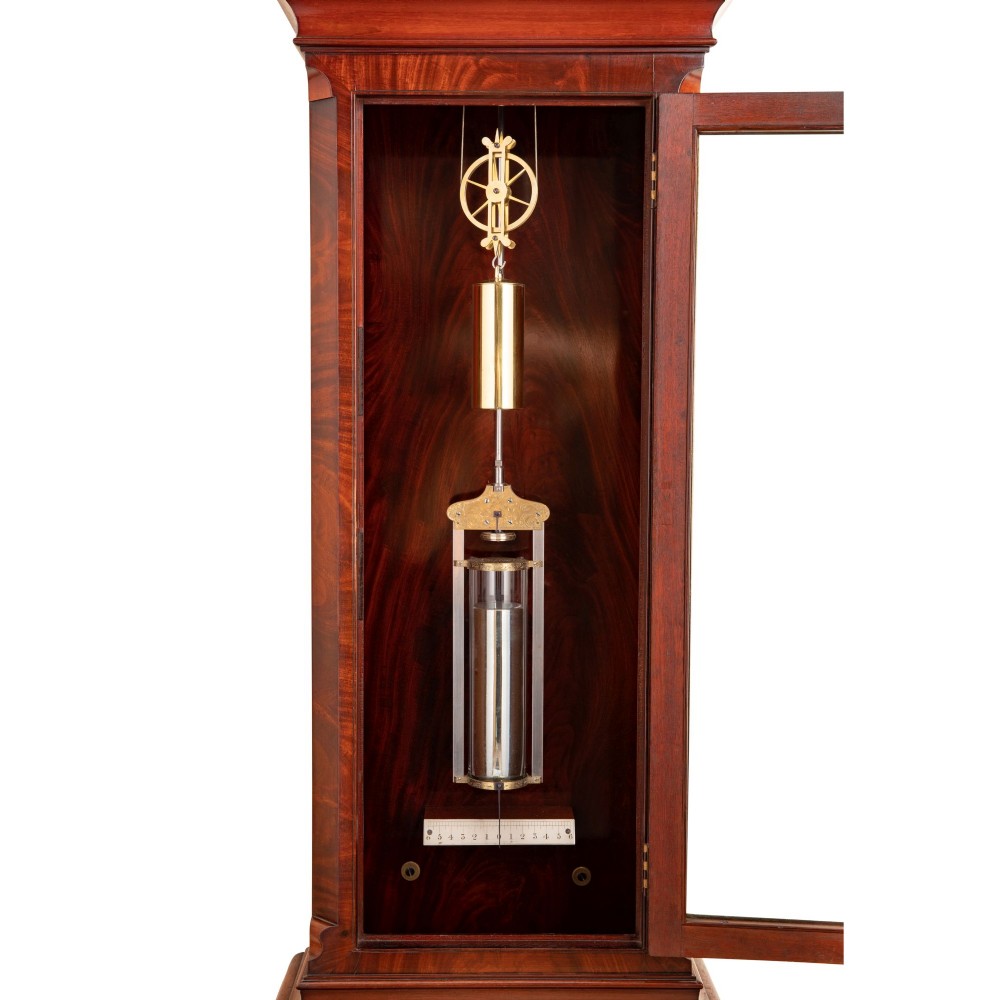
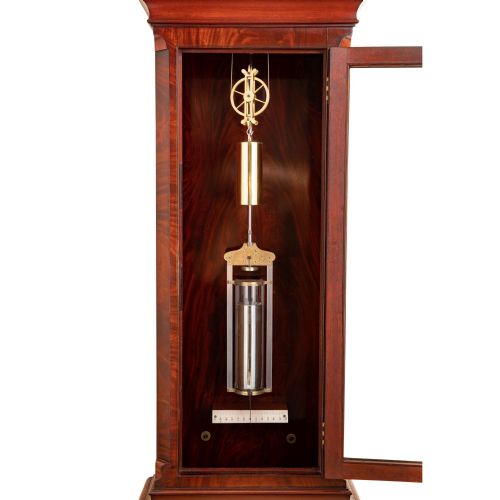
To complete the display, a very fine mercury compensated pendulum with beat plate is provided on which all the gilded brass work has been decorated with floral engraving and it is mounted on the backplate. The large ornamental pulley has six crossings.
The well figured mahogany case is in the Regency style with a flat top, canted front corners to the hood (which slides off) and trunk, and a panelled base. The door is glazed and crossbanded.
This clock is illustrated in ‘English Precision Pendulum Clocks’ by Derek Roberts on pages 236 and 237.
Bernard Rudkin Hennessy, Swansea.
Bernard Rudkin Hennessy was born in Dublin the son of an Irishman, Martin Hennessy, who opened a small academy in Swansea about 1840. Bernard Hennessy was the apprentice of John Jenkins, Clockmaker of Swansea, and, in this respect, he was fortunate indeed, since Jenkins was a very skilled scientist, being a Master of Arts and a Fellow of the Royal Astronomical Society. He abandoned his clock-making business in 1847 on being called to the Bar and, for the rest of his life, was a journalist and politician. His pupil, B. R. Hennessy, opened up business on his own account at 8 Wind Street, Swansea, in 1848, the time when Jenkins retired. I should imagine that he took over the business of John Jenkins. Later he moved to number 20 Wind Street. Mr Hennessy continued in business until 1875, when he retired with a very comfortable fortune. He was buried in Danygraig Cemetery, Swansea, on the 26th January 1887, leaving two sons, Marten and Charles Hennessy.
At the date of Hennessy’s marriage on the 11th May 1845 to Elizabeth, the daughter of Richard Collier of Warminster, Wilts, he is described in the local Press as ‘watch-finisher and escapement maker’. At this time, of course, he was still an understudy of Jenkins.
Hennessy was one of Swansea’s most celebrated Victorian horological and scientific entrepreneurs and everything he produced or sold was of the highest standard. He is recorded as being a Clockmaker, Watchmaker, Jeweller, Gunsmith, Optician, Supplier of Scientific Instruments and Contractor to the Admiralty.
Further details can be found in: –
The Antique Clock Co. has dated this piece to the Victorian era.
You can view the stock and full dealer information on the The Antique Clock Co. Profile Page
A Stunning Skeletonised Regulator Longcase Clock – Hennessy – Swansea