24,785  PAGES BROWSED TODAY PAGES TODAY 75  ANTIQUES UPLOADED TODAY NEW ARRIVALS
ID #SA933277
FOR SALE
£2,500
Email
Save
Charles Robert Leslie Ra 1794-1859 Portrait of Sir Isaac Newton Prs 1643-1727
Artware Fineart
for sale €2,925     $3,175
£2,500

Artware Fineart

Sellingantiques Verified Since Sep 2008
View Dealers Stock Page
Id #SA933277
PDF SHARE
SAVE

Charles Robert Leslie Ra 1794-1859 Portrait of Sir Isaac Newton Prs 1643-1727

19th century
For Sale by Artware Fineart
Description

Charles Robert Leslie RA 1794-1859

Portrait of Sir Isaac Newton PRS 1643-1727

oil on canvas

30 x 22 cm.

Sir Isaac Newton PRS (25 December 1642 – 20 March 1726/27 was an English mathematician, physicist, astronomer, alchemist, theologian, and author (described in his time as a "natural philosopher"), widely recognised as one of the greatest mathematicians and physicists of all time and among the most influential scientists. He was a key figure in the philosophical revolution known as the Enlightenment. His book Philosophiæ Naturalis Principia Mathematica (Mathematical Principles of Natural Philosophy), first published in 1687, established classical mechanics. Newton also made seminal contributions to optics, and shares credit with German mathematician Gottfried Wilhelm Leibniz for developing infinitesimal calculus.
In the Principia, Newton formulated the laws of motion and universal gravitation that formed the dominant scientific viewpoint until it was superseded by the theory of relativity. Newton used his mathematical description of gravity to derive Kepler's laws of planetary motion, account for tides, the trajectories of comets, the precession of the equinoxes and other phenomena, eradicating doubt about the Solar System's heliocentricity. He demonstrated that the motion of objects on Earth and celestial bodies could be accounted for by the same principles. Newton's inference that the Earth is an oblate spheroid was later confirmed by the geodetic measurements of Maupertuis, La Condamine, and others, convincing most European scientists of the superiority of Newtonian mechanics over earlier systems.

Newton built the first practical reflecting telescope and developed a sophisticated theory of colour based on the observation that a prism separates white light into the colours of the visible spectrum. His work on light was collected in his highly influential book Opticks, published in 1704. He also formulated an empirical law of cooling, made the first theoretical calculation of the speed of sound, and introduced the notion of a Newtonian fluid. In addition to his work on calculus, as a mathematician Newton contributed to the study of power series, generalised the binomial theorem to non-integer exponents, developed a method for approximating the roots of a function, and classified most of the cubic plane curves.

Newton was a fellow of Trinity College and the second Lucasian Professor of Mathematics at the University of Cambridge. He was a devout but unorthodox Christian who privately rejected the doctrine of the Trinity. He refused to take holy orders in the Church of England, unlike most members of the Cambridge faculty of the day. Beyond his work on the mathematical sciences, Newton dedicated much of his time to the study of alchemy and biblical chronology, but most of his work in those areas remained unpublished until long after his death. Politically and personally tied to the Whig party, Newton served two brief terms as Member of Parliament for the University of Cambridge, in 1689–1690 and 1701–1702. He was knighted by Queen Anne in 1705 and spent the last three decades of his life in London, serving as Warden (1696–1699) and Master (1699–1727) of the Royal Mint, as well as president of the Royal Society (1703–1727).

Isaac Newton was born (according to the Julian calendar in use in England at the time) on Christmas Day, 25 December 1642 (NS 4 January 1643), "an hour or two after midnight",at Woolsthorpe Manor in Woolsthorpe-by-Colsterworth, a hamlet in the county of Lincolnshire. His father, also named Isaac Newton, had died three months before. Born prematurely, Newton was a small child; his mother Hannah Ayscough reportedly said that he could have fit inside a quart mug. When Newton was three, his mother remarried and went to live with her new husband, the Reverend Barnabas Smith, leaving her son in t

Physical Dimensions
Height
30cm (11.81")
Width
22cm (8.66")
Depth
2cm (0.79")
Declaration

Artware Fineart has dated this Isaac Newton Oil Portrait to the 19th Century.

Reference Numbers
Sellingantiques Reference
SA933277
Dealers Internal Reference
4765
Description
Charles Robert Leslie RA 1794-1859

Portrait of Sir Isaac Newton PRS 1643-1727

oil on canvas

30 x 22 cm.

Sir Isaac Newton PRS (25 December 1642 – 20 March 1726/27 was an English mathematician, physicist, astronomer, alchemist, theologian, and author (described in his time as a "natural philosopher"), widely recognised as one of the greatest mathematicians and physicists of all time and among the most influential scientists. He was a key figure in the philosophical revolution known as the Enlightenment.

His book Philosophiæ Naturalis Principia Mathematica (Mathematical Principles of Natural Philosophy), first published in 1687, established classical mechanics.
Artware Fineart

Newton also made seminal contributions to optics, and shares credit with German mathematician Gottfried Wilhelm Leibniz for developing infinitesimal calculus.

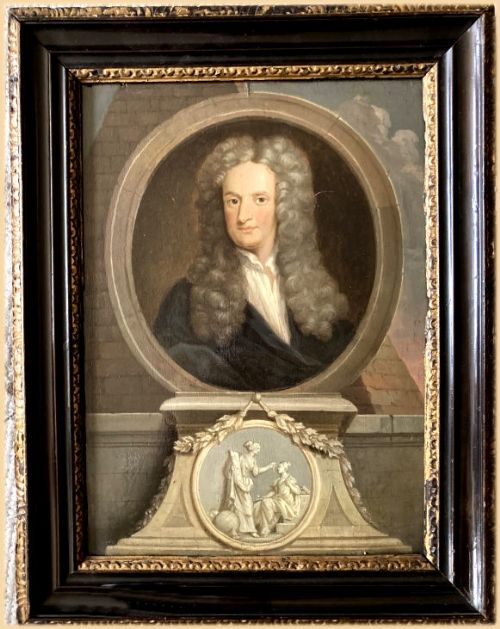
fig 1. An oil painting depicting a portrait of Sir Isaac Newton framed inside a simulated stone oval cartouche above a bas-relief pedestal.
fig 1. Charles Robert Leslie Ra 1794-1859 Portrait of Sir Isaac Newton Prs 1643-1727

In the Principia, Newton formulated the laws of motion and universal gravitation that formed the dominant scientific viewpoint until it was superseded by the theory of relativity. Newton used his mathematical description of gravity to derive Kepler's laws of planetary motion, account for tides, the trajectories of comets, the precession of the equinoxes and other phenomena, eradicating doubt about the Solar System's heliocentricity. He demonstrated that the motion of objects on Earth and celestial bodies could be accounted for by the same principles. Newton's inference that the Earth is an oblate spheroid was later confirmed by the geodetic measurements of Maupertuis, La Condamine, and others, convincing most European scientists of the superiority of Newtonian mechanics over earlier systems.

Newton built the first practical reflecting telescope and developed a sophisticated theory of colour based on the observation that a prism separates white light into the colours of the visible spectrum. His work on light was collected in his highly influential book Opticks, published in 1704. He also formulated an empirical law of cooling, made the first theoretical calculation of the speed of sound, and introduced the notion of a Newtonian fluid. In addition to his work on calculus, as a mathematician Newton contributed to the study of power series, generalised the binomial theorem to non-integer exponents, developed a method for approximating the roots of a function, and classified most of the cubic plane curves.

Newton was a fellow of Trinity College and the second Lucasian Professor of Mathematics at the University of Cambridge. He was a devout but unorthodox Christian who privately rejected the doctrine of the Trinity. He refused to take holy orders in the Church of England, unlike most members of the Cambridge faculty of the day. Beyond his work on the mathematical sciences, Newton dedicated much of his time to the study of alchemy and biblical chronology, but most of his work in those areas remained unpublished until long after his death. Politically and personally tied to the Whig party, Newton served two brief terms as Member of Parliament for the University of Cambridge, in 1689–1690 and 1701–1702. He was knighted by Queen Anne in 1705 and spent the last three decades of his life in London, serving as Warden (1696–1699) and Master (1699–1727) of the Royal Mint, as well as president of the Royal Society (1703–1727).

Isaac Newton was born (according to the Julian calendar in use in England at the time) on Christmas Day, 25 December 1642 (NS 4 January 1643), "an hour or two after midnight",at Woolsthorpe Manor in Woolsthorpe-by-Colsterworth, a hamlet in the county of Lincolnshire. His father, also named Isaac Newton, had died three months before. Born prematurely, Newton was a small child; his mother Hannah Ayscough reportedly said that he could have fit inside a quart mug. When Newton was three, his mother remarried and went to live with her new husband, the Reverend Barnabas Smith, leaving her son in t

Height
30cm (11.81")
Width
22cm (8.66")
Depth
2cm (0.79")
Date of Manufacture

Artware Fineart has dated this Isaac Newton Oil Portrait to the 19th Century.

Reference Numbers
Sellingantiques Ref
SA933277
Dealers Internal Ref
4765
Artware Fineart
Sellingantiques verified Since Sep 2008
Dealer Profile

You can view the stock and full dealer information on the Artware Fineart Profile Page

PDF SHARE
SAVE
An oil painting depicting a portrait of Sir Isaac Newton framed inside a simulated stone oval cartouche above a bas-relief pedestal.
1 / 2
Archive I An oil painting depicting a portrait of Sir Isaac Newton framed inside a simulated stone oval cartouche above a bas-relief pedestal.

Charles Robert Leslie Ra 1794-1859 Portrait of Sir Isaac Newton Prs 1643-1727

Archive II An oil painting depicting a portrait of Sir Isaac Newton framed inside a simulated stone oval cartouche above a bas-relief pedestal. View II
FURTHER BROWSING

Visitors also looked at these ⇣

Enlarged Archival View
Telephone 07958 699 645
Location
18 La Gare
51 Surrey Row
London
SE1 0BZ
United Kingdom
Verified Since Sep 2008
Items For Sale 243
Items Sold 223
Artware Fineart
Verified Since Sep 2008
View Dealer Info
Location: 18 La Gare , 51 Surrey Row , London , SE1 0BZ , United Kingdom
Verified
Sep 2008
For Sale
243
Sold
223
An oil painting depicting a portrait of Sir Isaac Newton framed inside a simulated stone oval cartouche above a bas-relief pedestal.
Charles Robert Leslie RA 1794-1859 Portrait of Sir Isaac Newton PRS 1643-1727
Ref: SA933277
An oil painting depicting a portrait of Sir Isaac Newton framed inside a simulated stone oval cartouche above a bas-relief pedestal.
Detail View 1
Archival Detail
Every single antique dealer on our platform is individually approved by our internal team. We verify their professional trade history, ethical standards, and photographic quality to ensure a secure, high-standard buying environment. Upon joining, every dealer agrees to a strict 9-point code of conduct. While issues can occasionally arise, our dealers typically resolve them swiftly and directly with the buyer. In fact, since our founding in 2002, Sellingantiques has only had to step in to help resolve an issue on roughly five occasions—a true testament to the quality of our dealers and their dedication to your happiness.
Our dealers are highly experienced in packing and shipping fragile, high-value antiques. Because you are in direct contact with the dealer, you will be able to easily go through all available shipping and insurance options together to ensure your item arrives safely.
Antiques are the ultimate green purchase. By choosing historical pieces over newly manufactured goods, you completely eliminate the carbon footprint of modern mass production while preserving exceptional, timeless craftsmanship.

Trompe loeil cartouche portraiture developed during the seventeenth and eighteenth centuries, using illusionistic painterly techniques to present sitters within simulated stone arches, pedestals, or sculpted frames.

Artists primarily utilised oil-based pigments derived from natural minerals and organic compounds, applied directly onto hand-stretched linen or cotton canvas held by timber stretcher bars.

Authenticity is assessed by evaluating natural craquelure in the paint layer, analysing timber stretcher construction, inspecting period canvas weaves, and examining brushwork under ultraviolet illumination.

Classical oil portraits serve as effective focal points when placed above mantelpieces, displayed within gallery walls, or paired with structured contemporary furniture to provide historical balance.

Oil paintings require stable atmospheric conditions free from direct sunlight and moisture, routine dusting with a soft natural brush, and conservation treatment by trained art professionals.
items
Add keywords to the filter
Price
£100
£250000
Era
Movements
Material
Origin
Stock Location
Freshness
Online Payments
Categories