48,957  PAGES BROWSED TODAY PAGES TODAY 185  ANTIQUES UPLOADED TODAY NEW ARRIVALS
ID #SA919318
FOR SALE
£3,500
Email
Save
Scottish Regency William Trotter Rosewood Tea Table
The Antique Furniture Company
for sale €4,095     $4,445
£3,500

The Antique Furniture Company

Sellingantiques Verified Since Sep 2013
View Dealers Stock Page
Id #SA919318
PDF SHARE
SAVE

Scottish Regency William Trotter Rosewood Tea Table

19th century
Description

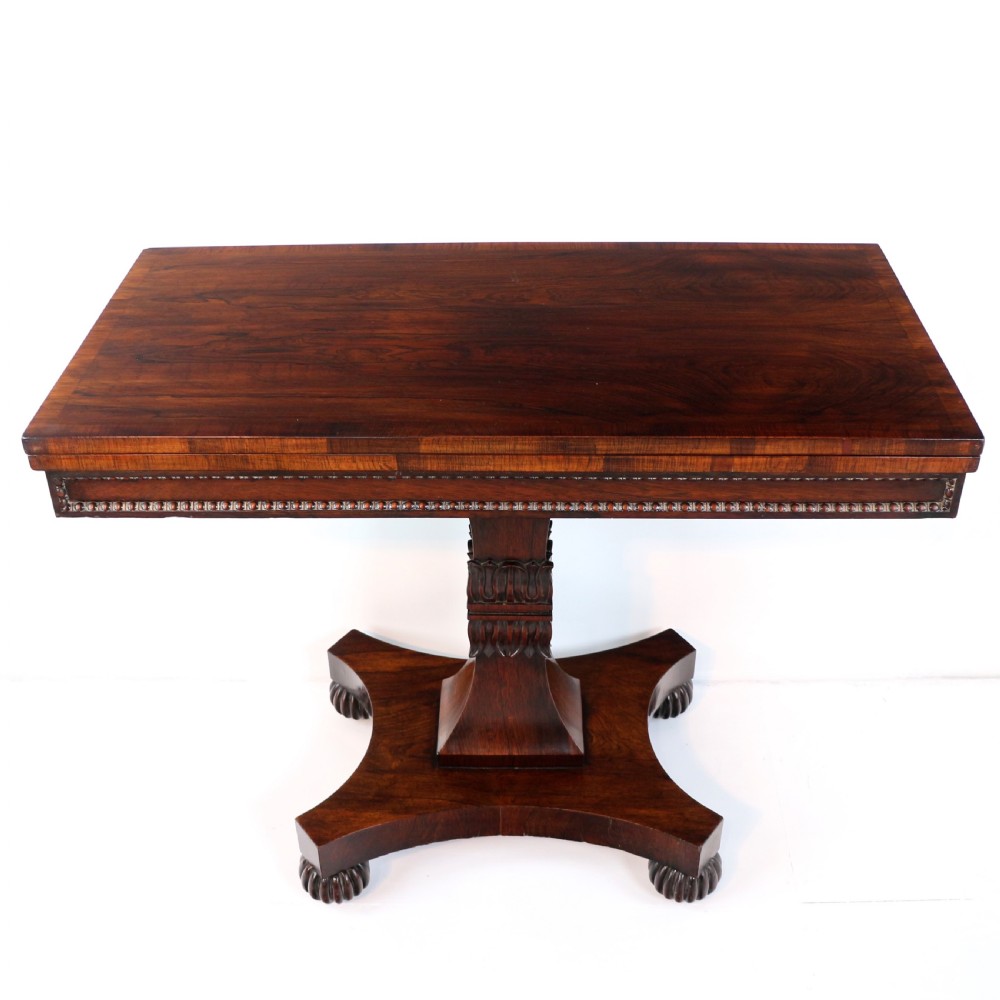
A Scottish Regency rosewood tea table, circa 1820, in the manner of William Trotter of Edinburgh. The rectangular crossbanded top above a frieze with typically Scottish sunken panels with bead moulding to all sides, on a waisted and lotus-clasped square section column with concave quadripartite platform base raised on fluted bun feet. The hinged swivel top concealing a green baize lined storage space and opening to a polished crossbanded surface. In good condition and super colour and grain, the interior baize has some fading & light spots.

Approximate dimensions at largest points

Width - 38in (96.5cm)

Depth - 18 3/4in (47.5cm)

Height - 30 1/8in (76.5cm)

Top closed - 38in x 18 3/4in (96.5cm x 47.5cm)

Top open - 38in x 37 5/8in (96.5cm x 95.5cm)

William Trotter

William Trotter was born into a family of merchants in 1772, descended on the maternal side from the family of John Knox. He became a member of The Merchant Company in 1797 and by 1809 he was sole proprietor of the firm Young & Trotter. Accounts from the firm survive for over fifty patrons including the marquesses of Graham and Tweeddale; the earls of Cassillis, Dumfries, Hopetoun, Lauderdale, Traquair and Panmure; the Lords Arniston, Hailes and Milton; the baronets James Clerk, William Forbes, John Hall and Alexander Kinloch; and the lairds of Ardwall, Balbirnie, Boqhan, Cairnfield, Drummelzior, Freswick, Kemnay, Kilbagie, Langton, Largo, Menziesfield, Moncraig, Newliston, Prestonhall, Saughton and Stair. 

Often regarded as the most eminent of all Scottish cabinet makers, his success was in part due to his appreciation for his client's taste. Using the finest quality materials, Trotter developed a distinctive Regency style typically characterised by bold carving, bead moulding and reeded legs and supplied furnishings to some of Scotland's most important houses and institutions including: numerous apartments in the Palace of Holyroodhouse; Dumfries House; Mount Stuart, Edinburgh's Parliament House, Assembly Rooms and Register House. Trotter worked with various partners in Princes Street until his death in 1833. The management of his shop continued under the title of 'Heirs of Wm Trotter' and later under the name of William's son, Charles, until it closed in 1852.

Ref: 0686

Physical Dimensions
Height
76.5cm (30.12")
Width
96.5cm (37.99")
Depth
47.5cm (18.70")
Declaration

The Antique Furniture Company has dated this Regency Rosewood Tea Table to the Regency era.

Reference Numbers
Sellingantiques Reference
SA919318
Dealers Internal Reference
0686
Dealers Notes

When buying it is important appreciate antiques have long histories of daily use and as such, over time they gain minor scratches, marks, knocks, shrinkage splits, signs of old woodworm, lifts and losses to veneer, which combine with care and years of polishing to create an individual character and patina. We describe the main flaws and those that fall outside of this bracket but cannot describe each marks separately and therefore suggest you do take the time to request extra photos. We do offer a 14 day money back guarantee if you are unhappy with your purchase but cannot refund the return shipping cost. If you are not sure please do not buy without clarifying or take the view that the only way to have it as near to new as possible is to have it fully and comprehensively restored.

For delivery we use a small carrier experience in carrying antique furniture. Delivery is usually within 31 days and the carrier will make arrangements with you directly. We can provide contact details of other carriers if required.

Description
A Scottish Regency rosewood tea table, circa 1820, in the manner of William Trotter of Edinburgh. The rectangular crossbanded top above a frieze with typically Scottish sunken panels with bead moulding to all sides, on a waisted and lotus-clasped square section column with concave quadripartite platform base raised on fluted bun feet.
The hinged swivel top concealing a green baize lined storage space and opening to a polished crossbanded surface.
The Antique Furniture Company

In good condition and super colour and grain, the interior baize has some fading & light spots.

fig 1. A Regency rosewood tea table featuring a rectangular fold-over top, bead moulding trim, a carved central pedestal, and a quadform base on carved feet.
fig 1. Scottish Regency William Trotter Rosewood Tea Table

Approximate dimensions at largest points

Width - 38in (96.5cm)

Depth - 18 3/4in (47.5cm)

Height - 30 1/8in (76.5cm)

Top closed - 38in x 18 3/4in (96.5cm x 47.5cm)

Top open - 38in x 37 5/8in (96.5cm x 95.5cm)

fig 2. A Regency rosewood tea table featuring a rectangular fold-over top, bead moulding trim, a carved central pedestal, and a quadform base on carved feet.
fig 2. Scottish Regency William Trotter Rosewood Tea Table

William Trotter

William Trotter was born into a family of merchants in 1772, descended on the maternal side from the family of John Knox. He became a member of The Merchant Company in 1797 and by 1809 he was sole proprietor of the firm Young & Trotter. Accounts from the firm survive for over fifty patrons including the marquesses of Graham and Tweeddale; the earls of Cassillis, Dumfries, Hopetoun, Lauderdale, Traquair and Panmure; the Lords Arniston, Hailes and Milton; the baronets James Clerk, William Forbes, John Hall and Alexander Kinloch; and the lairds of Ardwall, Balbirnie, Boqhan, Cairnfield, Drummelzior, Freswick, Kemnay, Kilbagie, Langton, Largo, Menziesfield, Moncraig, Newliston, Prestonhall, Saughton and Stair. 

fig 3. A Regency rosewood tea table featuring a rectangular fold-over top, bead moulding trim, a carved central pedestal, and a quadform base on carved feet.
fig 3. Scottish Regency William Trotter Rosewood Tea Table

Often regarded as the most eminent of all Scottish cabinet makers, his success was in part due to his appreciation for his client's taste. Using the finest quality materials, Trotter developed a distinctive Regency style typically characterised by bold carving, bead moulding and reeded legs and supplied furnishings to some of Scotland's most important houses and institutions including: numerous apartments in the Palace of Holyroodhouse; Dumfries House; Mount Stuart, Edinburgh's Parliament House, Assembly Rooms and Register House. Trotter worked with various partners in Princes Street until his death in 1833. The management of his shop continued under the title of 'Heirs of Wm Trotter' and later under the name of William's son, Charles, until it closed in 1852.

Ref: 0686

Height
76.5cm (30.12")
Width
96.5cm (37.99")
Depth
47.5cm (18.70")
Date of Manufacture

The Antique Furniture Company has dated this Regency Rosewood Tea Table to the Regency era.

Reference Numbers
Sellingantiques Ref
SA919318
Dealers Internal Ref
0686
The Antique Furniture Company
Sellingantiques verified Since Sep 2013
Dealer Profile

You can view the stock and full dealer information on the The Antique Furniture Company Profile Page
PDF SHARE
SAVE
A Regency rosewood tea table featuring a rectangular fold-over top, bead moulding trim, a carved central pedestal, and a quadform base on carved feet.
1 / 23
Archive I A Regency rosewood tea table featuring a rectangular fold-over top, bead moulding trim, a carved central pedestal, and a quadform base on carved feet.

Scottish Regency William Trotter Rosewood Tea Table

Archive II A Regency rosewood tea table featuring a rectangular fold-over top, bead moulding trim, a carved central pedestal, and a quadform base on carved feet. View II
Archive III A Regency rosewood tea table featuring a rectangular fold-over top, bead moulding trim, a carved central pedestal, and a quadform base on carved feet. View III
Archive IV Scale Reference for A Regency rosewood tea table featuring a rectangular fold-over top, bead moulding trim, a carved central pedestal, and a quadform base on carved feet.
Archive V A Regency rosewood tea table featuring a rectangular fold-over top, bead moulding trim, a carved central pedestal, and a quadform base on carved feet. View V
Archive VI A Regency rosewood tea table featuring a rectangular fold-over top, bead moulding trim, a carved central pedestal, and a quadform base on carved feet. View VI
Archive VII A Regency rosewood tea table featuring a rectangular fold-over top, bead moulding trim, a carved central pedestal, and a quadform base on carved feet. View VII
Archive VIII A Regency rosewood tea table featuring a rectangular fold-over top, bead moulding trim, a carved central pedestal, and a quadform base on carved feet. View VIII
Archive IX A Regency rosewood tea table featuring a rectangular fold-over top, bead moulding trim, a carved central pedestal, and a quadform base on carved feet. View IX
Archive X A Regency rosewood tea table featuring a rectangular fold-over top, bead moulding trim, a carved central pedestal, and a quadform base on carved feet. View X
Archive XI A Regency rosewood tea table featuring a rectangular fold-over top, bead moulding trim, a carved central pedestal, and a quadform base on carved feet. View XI
Archive XII A Regency rosewood tea table featuring a rectangular fold-over top, bead moulding trim, a carved central pedestal, and a quadform base on carved feet. View XII
Archive XIII A Regency rosewood tea table featuring a rectangular fold-over top, bead moulding trim, a carved central pedestal, and a quadform base on carved feet. View XIII
Archive XIV A Regency rosewood tea table featuring a rectangular fold-over top, bead moulding trim, a carved central pedestal, and a quadform base on carved feet. View XIV
Archive XV A Regency rosewood tea table featuring a rectangular fold-over top, bead moulding trim, a carved central pedestal, and a quadform base on carved feet. View XV
Archive XVI A Regency rosewood tea table featuring a rectangular fold-over top, bead moulding trim, a carved central pedestal, and a quadform base on carved feet. View XVI
Archive XVII A Regency rosewood tea table featuring a rectangular fold-over top, bead moulding trim, a carved central pedestal, and a quadform base on carved feet. View XVII
Archive XVIII A Regency rosewood tea table featuring a rectangular fold-over top, bead moulding trim, a carved central pedestal, and a quadform base on carved feet. View XVIII
Archive XIX A Regency rosewood tea table featuring a rectangular fold-over top, bead moulding trim, a carved central pedestal, and a quadform base on carved feet. View XIX
Archive XX A Regency rosewood tea table featuring a rectangular fold-over top, bead moulding trim, a carved central pedestal, and a quadform base on carved feet. View XX
Archive XXI A Regency rosewood tea table featuring a rectangular fold-over top, bead moulding trim, a carved central pedestal, and a quadform base on carved feet. View XXI
Archive XXII A Regency rosewood tea table featuring a rectangular fold-over top, bead moulding trim, a carved central pedestal, and a quadform base on carved feet. View XXII
Archive XXIII A Regency rosewood tea table featuring a rectangular fold-over top, bead moulding trim, a carved central pedestal, and a quadform base on carved feet. View XXIII
FURTHER BROWSING

Visitors also looked at these ⇣

Enlarged Archival View
Telephone 01337 920027
Location
Glasgow
Scotland
Verified Since Sep 2013
Items For Sale 72
Items Sold 264
The Antique Furniture Company
Verified Since Sep 2013
View Dealer Info
Location: Glasgow, Scotland
Verified
Sep 2013
For Sale
72
Sold
264
A Regency rosewood tea table featuring a rectangular fold-over top, bead moulding trim, a carved central pedestal, and a quadform base on carved feet.
Scottish Regency William Trotter Rosewood Tea Table
Ref: SA919318
A Regency rosewood tea table featuring a rectangular fold-over top, bead moulding trim, a carved central pedestal, and a quadform base on carved feet.
Detail View 1
Detail View 2
Detail View 3
Detail View 4
Detail View 5
Detail View 6
Detail View 7
Detail View 8
Detail View 9
Detail View 10
Detail View 11
Detail View 12
Detail View 13
Detail View 14
Detail View 15
Detail View 16
Detail View 17
Detail View 18
Detail View 19
Detail View 20
Detail View 21
Scale Reference
Archival Detail
Every single antique dealer on our platform is individually approved by our internal team. We verify their professional trade history, ethical standards, and photographic quality to ensure a secure, high-standard buying environment. Upon joining, every dealer agrees to a strict 9-point code of conduct. While issues can occasionally arise, our dealers typically resolve them swiftly and directly with the buyer. In fact, since our founding in 2002, Sellingantiques has only had to step in to help resolve an issue on roughly five occasions—a true testament to the quality of our dealers and their dedication to your happiness.
Our dealers are highly experienced in packing and shipping fragile, high-value antiques. Because you are in direct contact with the dealer, you will be able to easily go through all available shipping and insurance options together to ensure your item arrives safely.
Antiques are the ultimate green purchase. By choosing historical pieces over newly manufactured goods, you completely eliminate the carbon footprint of modern mass production while preserving exceptional, timeless craftsmanship.

A Regency tea table typically features a fold-over top designed to sit against a wall when closed and expand for serving tea when rotated and opened. Produced during the early 19th century, these tables incorporate central pedestal columns, concave quadform bases, and classical revival carving.

Cabinetmakers primarily used rosewood veneers or solid mahogany for primary visible surfaces on Regency tea tables. Internal frameworks utilised secondary softwoods like pine or oak, accompanied by brass hinges and swivel mechanism hardware.

Authentic Regency pieces feature early 19th-century construction indicators such as hand-cut dovetail joints, original swivel hardware, and natural timber shrinkage. Carved gadrooning, bead moulding, and carved foot designs on a platform base are typical of the era.

A fold-over tea table functions as a console or side table in contemporary interiors. Positioned against a hall wall beneath artwork or placed in a bay window, it offers surface space while retaining compact dimensions.

Keep rosewood furniture positioned away from direct sunlight and radiators to reduce timber movement and finish drying. Apply a clear beeswax polish annually along the direction of the wood grain to protect the surface.
items
Add keywords to the filter
Price
£100
£250000
Era
Movements
Material
Origin
Stock Location
Freshness
Online Payments
Categories