

W.R. Harvey & Co. (Antiques) Ltd has dated this piece to the 18th Century.

1754. The seats had been held, uncontested, by the Tories, since 1710. Then in 1752 the Whigs, who already held a large majority in Parliament, decided to contest the Oxfordshire seats and this heralded a two-year campaign characterised by unprecedented levels of bribery and corruption. These prints are based on the four paintings Hogarth started not long after the General Election. By this time the events in Oxfordshire had been widely publicised through journals and pamphlets. The paintings were bought from Hogarth by the actor David Garrick and later acquired by John Soane at an auction of the effects of Mrs Garrick in 1823. The Gentleman’s Magazine had been critical of Hogarth’s work calling it, ‘the very many disgusting, if not depraved exhibitions of human nature’ in the paintings. Fortunately Soane instead recognised them as the finest of Hogarth’s satirical works.

Circa1758 Price: £2,750-00p.
H:20.5”, 51.25 cms, W: 26.3”, 65.75 cms, D:1”, 2.5 cms.
We have taken the following from the book ‘Hogarth The Complete Engravings’ by Joseph Burke and Colin Caldwell, page 21, fourth paragraph:

The Four Prints of an Election (1755-8) is the supreme masterpiece of this period, his tour de force in mock-heroic baroque parody.
Notes on the Plates numbers 237-40:
The election satire was occasioned by the Oxfordshire election of 1754. The four prints were dedicated respectively to Henry Fox, later Baron Holland; Sir Charles Hanbury Williams; Sir Edward Walpole; and George Hay, MP, the first three being prominent in the Whig Party.

237. AN ELECTION ENTERTAINMENT. February 1755. Fourth State. By Hogarth, with assistance. Two Whig candidates for Parliament give a banquet to their supporters in the local inn while the rival Tory party parade outside the window. On this occasion there are no social distinctions between gentlemen and voter, and alcohol has contributed to the general sense of equality.
At the left of the first candidate, Sir Commodity Taxem, receives the confidence of a fat woman, a shoemaker pushes their heads closer together and turns his pipe out over the head of a knight, while a young girl admires his ring. In the next group a chimney sweep takes a similar opportunity to score off his social superior by squeezing painfully the hand of the second candidate in an affected demonstration of friendship and loyalty. A glutenous clergyman acts as the division between these groups and the two succeeding ones, in which the gentry are successfully amusing their social inferiors. At the other end of the table the Mayor is being bled by a surgeon after a surfeit of oysters. In front of the table a pedlar who has brought ribbons and knickknacks for sale as gifts looks with misgiving at a promissory note in lieu of cash. A butcher pours gin into the wound of a ruffian hired as a bodyguard, and the election agent is knocked down by a brick hurled through the window. Notice that the bodyguard is receiving gin both internally and externally. Before the door a Methodist refuses to accept a bribe, while his infuriated wife points to the ragged condition of their son.
The inscriptions, slogans, etc., refer to the rival policies of the Whigs and Tories, the former advocating ‘Liberty and Loyalty’ and the latter ‘Liberty and Property’. The Tories carry an effigy labelled ‘No Jews’ and oppose Excise Duty.
The scene is an illustration of the text, ‘He that dippeth his hand with me in the dish, shall betray me’ (Matthew, 26:23) and contains motives from the Last Supper o
W.R. Harvey & Co. (Antiques) Ltd has dated this piece to the 18th Century.
Specialists in 17th-18th and early 19th century fine english furniture, art, clocks and other objets d'art
You can view the stock and full dealer information on the W.R. Harvey & Co. (Antiques) Ltd Profile Page
W.R. Harvey & Co. (Antiques) Ltd is a registered member of LAPADA
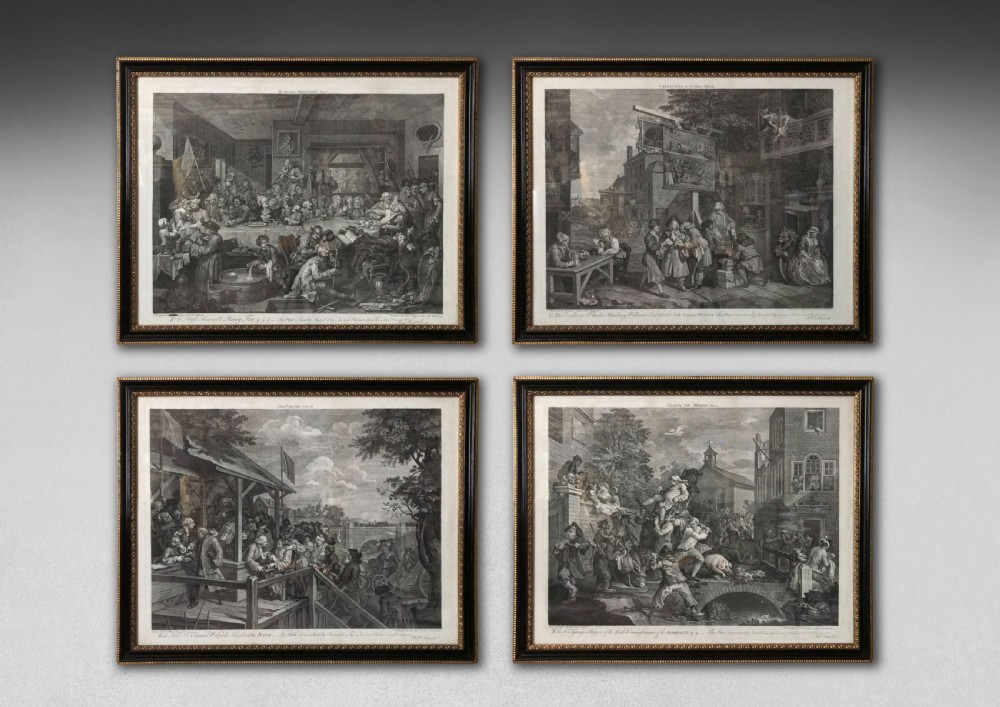

Set of 4 Hogarth Engravings - The 'Prints of an Election'


