12,535  PAGES BROWSED TODAY PAGES TODAY 36  ANTIQUES UPLOADED TODAY NEW ARRIVALS
ID #SA881288
FOR SALE
£1,295
Email Buy
Save
Large Victorian Carved Oak Wall Aneroid Barometer by James Pitkin London
Jason Clarke Antiques
for sale €1,515     $1,645
£1,295
Jason Clarke Antiques

Jason Clarke Antiques

Sellingantiques Verified Since Jul 2015
View Dealers Stock Page
Id #SA881288
PDF SHARE
SAVE

Large Victorian Carved Oak Wall Aneroid Barometer by James Pitkin London

19th century
Description

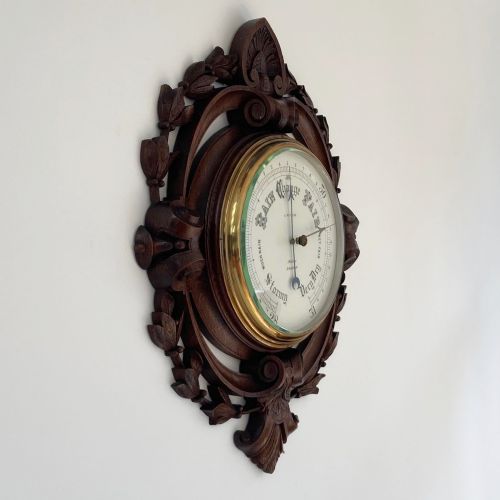
For sale a very large Victorian carved oak wall aneroid barometer by James Pitkin London.

Comprised of a large ten-inch porcelain dial with a large scale running around the outer circumference measuring 28 to 31 inches of barometric pressure. The inner ring displays Vidi type weather indications with main indicators in Gothic style typeface and the centre is marked to the maker, James Pitkin, Maker, London.

Given its size, the barometer is provided with a large and robust, blue steel, Breguet type pointer and brass set hand which may be operated through the centre of the bevelled glass front. The brass spun bezel is set onto a gloriously carved oak back with central circular section to hold the barometer and surrounded by a Gothic quarter scroll which repeats around the edge.

The top scroll is adorned with a wonderfully carved anthemion motif and a floral motif to the base and a delicately carved floral wreath which provides a frame and contrast against the wall behind.

This large wall barometer is 65cms high and 50cms wide.

The maker, James Pitkin had a long career as a scientific instrument and barometer maker, born in 1828 in Bethnal Green, London. Information on his early career is very scant but he was certainly in business as a barometer maker by 1858 at 3 Church Street in Mile End. By 1860, he moved to Red Lion Street where he would be based for the remainder of his career.

The first mention of Pitkin in the records is for a patent for “improvements in aneroid barometers” in February of 1862 and then in 1868 he formed a shortlived two year partnership with Thomas Watling Short of later Short & Mason fame. Short himself formed numerous partnerships during this period and was also working with JS Marratt at the same time, giving Short a superior grounding in the art of barometer making.

Nothing is known of the reason for the dissolution which appears in the London Gazette dated December 1870 but Banfield does relate a Henry Thomas Pitkin trading in the 1870’s from Red Lion Street which is likely to be James’s son. It is possible therefore that Pitkin took his son into partnership at this time in preference to Short. Although the dates are not perfectly clear, the company name did change to James Pitkin & Co so this occasion is the most likely point for this change to have happened.

These sporadic partnerships do not seem to have dented Pitkin’s business as from this point he is known to have undertaken work for Lord Kelvin and provided barometers to the Scottish Mountaineer, The Reverend Archibald Eneas Robertson whose Pitkin barometer is still treasured by The Scottish Mountaineering Club. He also invented a “portable electric lamp for mines” in 1887 and presented his invention to The Royal Society in 1889. The company also exhibited at the 1908 Physical Society Exhibition.

By 1892, a young Herbert Brandon White began working for Pitkin & Co and went on to become a partner in the firm. White continued with Pitkin’s business until 1911 whereafter he left to form The White Electrical Instrument Company which continued in business until 1990.
Pitkin was eighty three years old in 1911 and died the following year in 1912, White also died in 1915 at the young age of forty six. Nothing further is known of Pitkin’s son Henry but his name does not appear on the dissolution notice of 1911. It must be assumed that he left or pre-deceased his Father and the business was wound up at this point after fifty three years of trading.

Circa 1865

Physical Dimensions
Height
65cm (25.59")
Width
50cm (19.69")
Depth
7cm (2.76")
Declaration

Jason Clarke Antiques has dated this Victorian Carved Oak Barometer to the 1860s.

Reference Numbers
Sellingantiques Reference
SA881288
Description
For sale a very large Victorian carved oak wall aneroid barometer by James Pitkin London.
Comprised of a large ten-inch porcelain dial with a large scale running around the outer circumference measuring 28 to 31 inches of barometric pressure.
Jason Clarke Antiques

The inner ring displays Vidi type weather indications with main indicators in Gothic style typeface and the centre is marked to the maker, James Pitkin, Maker, London.

fig 1. A circular Victorian aneroid wall barometer housed within an intricately carved dark oak frame featuring scrollwork and foliate motifs.
fig 1. Large Victorian Carved Oak Wall Aneroid Barometer by James Pitkin London

Given its size, the barometer is provided with a large and robust, blue steel, Breguet type pointer and brass set hand which may be operated through the centre of the bevelled glass front. The brass spun bezel is set onto a gloriously carved oak back with central circular section to hold the barometer and surrounded by a Gothic quarter scroll which repeats around the edge.

fig 2. A circular Victorian aneroid wall barometer housed within an intricately carved dark oak frame featuring scrollwork and foliate motifs.
fig 2. Large Victorian Carved Oak Wall Aneroid Barometer by James Pitkin London

The top scroll is adorned with a wonderfully carved anthemion motif and a floral motif to the base and a delicately carved floral wreath which provides a frame and contrast against the wall behind.

This large wall barometer is 65cms high and 50cms wide.

fig 3. A circular Victorian aneroid wall barometer housed within an intricately carved dark oak frame featuring scrollwork and foliate motifs.
fig 3. Large Victorian Carved Oak Wall Aneroid Barometer by James Pitkin London

The maker, James Pitkin had a long career as a scientific instrument and barometer maker, born in 1828 in Bethnal Green, London. Information on his early career is very scant but he was certainly in business as a barometer maker by 1858 at 3 Church Street in Mile End. By 1860, he moved to Red Lion Street where he would be based for the remainder of his career.

fig 4. A circular Victorian aneroid wall barometer housed within an intricately carved dark oak frame featuring scrollwork and foliate motifs.
fig 4. Large Victorian Carved Oak Wall Aneroid Barometer by James Pitkin London

The first mention of Pitkin in the records is for a patent for “improvements in aneroid barometers” in February of 1862 and then in 1868 he formed a shortlived two year partnership with Thomas Watling Short of later Short & Mason fame. Short himself formed numerous partnerships during this period and was also working with JS Marratt at the same time, giving Short a superior grounding in the art of barometer making.

fig 5. A circular Victorian aneroid wall barometer housed within an intricately carved dark oak frame featuring scrollwork and foliate motifs.
fig 5. Large Victorian Carved Oak Wall Aneroid Barometer by James Pitkin London

Nothing is known of the reason for the dissolution which appears in the London Gazette dated December 1870 but Banfield does relate a Henry Thomas Pitkin trading in the 1870’s from Red Lion Street which is likely to be James’s son. It is possible therefore that Pitkin took his son into partnership at this time in preference to Short. Although the dates are not perfectly clear, the company name did change to James Pitkin & Co so this occasion is the most likely point for this change to have happened.

fig 6. A circular Victorian aneroid wall barometer housed within an intricately carved dark oak frame featuring scrollwork and foliate motifs.
fig 6. Large Victorian Carved Oak Wall Aneroid Barometer by James Pitkin London

These sporadic partnerships do not seem to have dented Pitkin’s business as from this point he is known to have undertaken work for Lord Kelvin and provided barometers to the Scottish Mountaineer, The Reverend Archibald Eneas Robertson whose Pitkin barometer is still treasured by The Scottish Mountaineering Club. He also invented a “portable electric lamp for mines” in 1887 and presented his invention to The Royal Society in 1889. The company also exhibited at the 1908 Physical Society Exhibition.

fig 7. A circular Victorian aneroid wall barometer housed within an intricately carved dark oak frame featuring scrollwork and foliate motifs.
fig 7. Large Victorian Carved Oak Wall Aneroid Barometer by James Pitkin London

By 1892, a young Herbert Brandon White began working for Pitkin & Co and went on to become a partner in the firm. White continued with Pitkin’s business until 1911 whereafter he left to form The White Electrical Instrument Company which continued in business until 1990.

fig 8. A circular Victorian aneroid wall barometer housed within an intricately carved dark oak frame featuring scrollwork and foliate motifs.
fig 8. Large Victorian Carved Oak Wall Aneroid Barometer by James Pitkin London

Pitkin was eighty three years old in 1911 and died the following year in 1912, White also died in 1915 at the young age of forty six. Nothing further is known of Pitkin’s son Henry but his name does not appear on the dissolution notice of 1911. It must be assumed that he left or pre-deceased his Father and the business was wound up at this point after fifty three years of trading.

Circa 1865

Height
65cm (25.59")
Width
50cm (19.69")
Depth
7cm (2.76")
Date of Manufacture

Jason Clarke Antiques has dated this Victorian Carved Oak Barometer to the 1860s.

Reference Numbers
Sellingantiques Ref
SA881288
Jason Clarke Antiques
Sellingantiques verified Since Jul 2015
Dealer Profile

You can view the stock and full dealer information on the Jason Clarke Antiques Profile Page

PDF SHARE
SAVE
A circular Victorian aneroid wall barometer housed within an intricately carved dark oak frame featuring scrollwork and foliate motifs.
1 / 11
Archive I A circular Victorian aneroid wall barometer housed within an intricately carved dark oak frame featuring scrollwork and foliate motifs.

Large Victorian Carved Oak Wall Aneroid Barometer by James Pitkin London

Archive II A circular Victorian aneroid wall barometer housed within an intricately carved dark oak frame featuring scrollwork and foliate motifs. View II
Archive III A circular Victorian aneroid wall barometer housed within an intricately carved dark oak frame featuring scrollwork and foliate motifs. View III
Archive IV A circular Victorian aneroid wall barometer housed within an intricately carved dark oak frame featuring scrollwork and foliate motifs. View IV
Archive V A circular Victorian aneroid wall barometer housed within an intricately carved dark oak frame featuring scrollwork and foliate motifs. View V
Archive VI A circular Victorian aneroid wall barometer housed within an intricately carved dark oak frame featuring scrollwork and foliate motifs. View VI
Archive VII A circular Victorian aneroid wall barometer housed within an intricately carved dark oak frame featuring scrollwork and foliate motifs. View VII
Archive VIII A circular Victorian aneroid wall barometer housed within an intricately carved dark oak frame featuring scrollwork and foliate motifs. View VIII
Archive IX A circular Victorian aneroid wall barometer housed within an intricately carved dark oak frame featuring scrollwork and foliate motifs. View IX
Archive X A circular Victorian aneroid wall barometer housed within an intricately carved dark oak frame featuring scrollwork and foliate motifs. View X
Archive XI A circular Victorian aneroid wall barometer housed within an intricately carved dark oak frame featuring scrollwork and foliate motifs. View XI
FURTHER BROWSING

Visitors also looked at these ⇣

Enlarged Archival View
Telephone 07815 046645
Location
Newbury
Berkshire
United Kingdom
Verified Since Jul 2015
Items For Sale 82
Items Sold 605
Jason Clarke Antiques
Verified Since Jul 2015
View Dealer Info
Location: Newbury, Berkshire, United Kingdom
Verified
Jul 2015
For Sale
82
Sold
605
A circular Victorian aneroid wall barometer housed within an intricately carved dark oak frame featuring scrollwork and foliate motifs.
Large Victorian Carved Oak Wall Aneroid Barometer by James Pitkin London
Ref: SA881288
A circular Victorian aneroid wall barometer housed within an intricately carved dark oak frame featuring scrollwork and foliate motifs.
Detail View 1
Detail View 2
Detail View 3
Detail View 4
Detail View 5
Detail View 6
Detail View 7
Detail View 8
Detail View 9
Detail View 10
Archival Detail
Every single antique dealer on our platform is individually approved by our internal team. We verify their professional trade history, ethical standards, and photographic quality to ensure a secure, high-standard buying environment. Upon joining, every dealer agrees to a strict 9-point code of conduct. While issues can occasionally arise, our dealers typically resolve them swiftly and directly with the buyer. In fact, since our founding in 2002, Sellingantiques has only had to step in to help resolve an issue on roughly five occasions—a true testament to the quality of our dealers and their dedication to your happiness.
Our dealers are highly experienced in packing and shipping fragile, high-value antiques. Because you are in direct contact with the dealer, you will be able to easily go through all available shipping and insurance options together to ensure your item arrives safely.
Antiques are the ultimate green purchase. By choosing historical pieces over newly manufactured goods, you completely eliminate the carbon footprint of modern mass production while preserving exceptional, timeless craftsmanship.

An aneroid barometer is a meteorological instrument developed in the nineteenth century that measures atmospheric pressure using a small, flexible metal capsule rather than liquid mercury. During the Victorian era, these instruments were frequently set into carved wooden wall mounts for home use.

Victorian wall barometers typically feature a solid timber frame, most commonly carved oak, walnut, or mahogany. The mechanical components consist of brass bezels, glass covers, and calibrated dials rendered on ceramic, paper, or silvered metal.

Authentic nineteenth-century examples often feature hand-carved timber surrounds with period details such as scrollwork or acanthus leaves, along with maker inscriptions from established London or regional instrument makers printed on the dial face.

An antique wall barometer serves as a focal accent when placed on a narrow wall space, within a hallway gallery wall, or above a sideboard. Pair it with dark painted backdrop walls or warm timber accents to complement its historical aesthetic.

Keep the timber housing dusted with a dry, soft cloth, and occasionally polish the brass trim with a non-abrasive cleaner applied sparingly to a cloth. Avoid exposing the instrument to high humidity or direct heat sources to preserve the internal mechanism and wood.
items
Add keywords to the filter
Price
£100
£250000
Era
Movements
Material
Origin
Stock Location
Freshness
Online Payments
Categories