6,821  PAGES BROWSED TODAY PAGES TODAY 0  ANTIQUES UPLOADED TODAY NEW ARRIVALS
ID #SA868400
FOR SALE
£2,500
Email
Save
George Perfect Harding , 1781 –1853 Portrait of Lucy Russell, Countess of Bedford (Née Harington) (1580–1627) Pencil and Watercolour
Artware Fineart
for sale €2,925     $3,175
£2,500

Artware Fineart

Sellingantiques Verified Since Sep 2008
View Dealers Stock Page
Id #SA868400
PDF SHARE
SAVE

George Perfect Harding , 1781 –1853 Portrait of Lucy Russell, Countess of Bedford (Née Harington) (1580–1627) Pencil and Watercolour

19th century
For Sale by Artware Fineart
Description

George Perfect Harding , 1781 –1853

Portrait of Lucy Russell, Countess of Bedford (née Harington) (1580–1627)

pencil and watercolour

Provenance

J. Heugh Esq., 1878

Picton Morris Collection

Notes

Lucy Russell, Countess of Bedford (née Harington) (1580–1627) was a major aristocratic patron of the arts and literature in the Elizabethan and Jacobean eras, the primary non-royal performer in contemporary court masques, a letter-writer, and a poet. She was an adventurer (shareholder) in the Somers Isles Company, investing in Bermuda, where Harrington Sound is named after her.

Lucy Harington was the daughter of Sir John Harington of Exton, and Anne Keilway. She was well-educated for a woman in her era, and knew French, Spanish, and Italian. She was a member of the Sidney/Essex circle from birth, through her father, first cousin to Sir Robert Sidney and Mary, Countess of Pembroke; she was a close friend of Essex's sisters Penelope Rich and Dorothy Percy, Countess of Northumberland, and the latter named one of her daughters Lucy after her.

Lucy Harington married Edward Russell, 3rd Earl of Bedford, on 12 December 1594, when she was thirteen years old and he was twenty-two, at St Dunstan's on Stepney Green. She miscarried her first child in February 1596 at Bedford House on the Strand in London.

The Earl of Bedford got himself into serious trouble in 1601 when he rode with the Earl of Essex in rebellion against Queen Elizabeth. The Bedford fortunes revived when the reign of James I began in 1603. Several English nobles secretly sent representatives into Scotland to try to gain favour and court appointments.The Countess of Bedford audaciously skipped the late queen's funeral and rode hard to the Scottish border, ahead of a party of gentlewomen appointed by the Privy Council, and got an audience in Scotland with the new king's wife Anne of Denmark. The new queen immediately made her a Lady of the Bedchamber and she became a trusted confidant.The queen came from Stirling Castle to Holyrood Palace with a convoy of English ladies who had come seeking attendance and on 31 May 1603 attended church in Edinburgh accompanied by these would-be companions.Some of the ladies stayed at John Kinloch's house in Edinburgh.

The Countess of Bedford travelled south with Anne of Denmark and Prince Henry and Princess Elizabeth. At Dingley, Northamptonshire she rode south to meet Lady Anne Clifford, perhaps at Wymondley Priory, and brought her to Dingley on 24 June.

Bedford performed in several of the masques staged at Court in the early 17th century, including The Masque of Blackness (1605), Hymenaei (1606), The Masque of Beauty (1608), The Masque of Queens, and The Vision of the Twelve Goddesses. On two occasions in 1617, she functioned as a theatrical producer, instigating and organising the 1617 Court performance of Robert White's masque Cupid's Banishment, acted by students from the first English girls' school, the Ladies Hall in Deptford. In February 1617 the masque by Ben Jonson presented by Lord Hay to the French ambassador Baron de Tour, the Lovers Made Men, was staged by the Countess of Bedford.

Jonson

She was a noted patron of Ben Jonson, who dedicated his play Cynthia's Revels (1600) to her and addressed several of his Epigrams to her, extolling her patronage. By his own admission, Jonson portrayed her as Ethra in his lost pastoral, The May Lord — though he may also have depicted her as Lady Haughty, president of the Collegiates in Epicene (1609). When Jonson was imprisoned in 1605 for his role in the Eastward Ho scandal, he wrote a letter to an unknown lady, who is thought by some scholars to have been the Countess of Bedford.

Others

In addition to Jonson, Bedford supported other significant poets of her era, including Michael Drayton, Samuel Daniel, George Chapman, and John Donne. She might be the "Idea" o

Physical Dimensions
Height
15.5cm (6.10")
Width
25.5cm (10.04")
Depth
2cm (0.79")
Declaration

Artware Fineart has dated this Antique Portrait Watercolour Painting to the 19th Century.

Reference Numbers
Sellingantiques Reference
SA868400
Dealers Internal Reference
4457
Description
George Perfect Harding , 1781 –1853

Portrait of Lucy Russell, Countess of Bedford (née Harington) (1580–1627)

pencil and watercolour

Provenance

J. Heugh Esq., 1878

Picton Morris Collection

Notes

Lucy Russell, Countess of Bedford (née Harington) (1580–1627) was a major aristocratic patron of the arts and literature in the Elizabethan and Jacobean eras, the primary non-royal performer in contemporary court masques, a letter-writer, and a poet.

She was an adventurer (shareholder) in the Somers Isles Company, investing in Bermuda, where Harrington Sound is named after her.
Artware Fineart
fig 1. A full-length watercolour portrait depicting an aristocratic noblewoman wearing a tiara, embroidered doublet, red cloak, and patterned skirt set against green velvet drapes.
fig 1. George Perfect Harding , 1781 –1853 Portrait of Lucy Russell, Countess of Bedford (Née Harington) (1580–1627) Pencil and Watercolour

Lucy Harington was the daughter of Sir John Harington of Exton, and Anne Keilway. She was well-educated for a woman in her era, and knew French, Spanish, and Italian. She was a member of the Sidney/Essex circle from birth, through her father, first cousin to Sir Robert Sidney and Mary, Countess of Pembroke; she was a close friend of Essex's sisters Penelope Rich and Dorothy Percy, Countess of Northumberland, and the latter named one of her daughters Lucy after her.
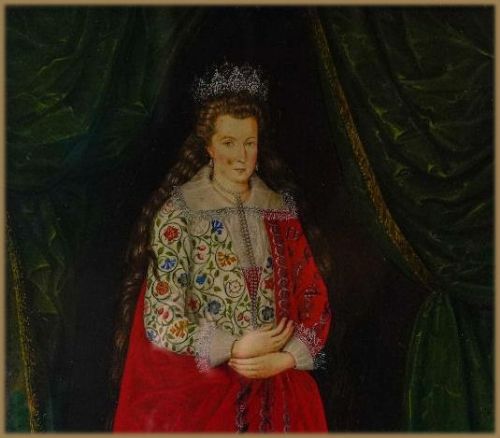
fig 2. A full-length watercolour portrait depicting an aristocratic noblewoman wearing a tiara, embroidered doublet, red cloak, and patterned skirt set against green velvet drapes.
fig 2. George Perfect Harding , 1781 –1853 Portrait of Lucy Russell, Countess of Bedford (Née Harington) (1580–1627) Pencil and Watercolour

Lucy Harington married Edward Russell, 3rd Earl of Bedford, on 12 December 1594, when she was thirteen years old and he was twenty-two, at St Dunstan's on Stepney Green. She miscarried her first child in February 1596 at Bedford House on the Strand in London.

fig 3. A full-length watercolour portrait depicting an aristocratic noblewoman wearing a tiara, embroidered doublet, red cloak, and patterned skirt set against green velvet drapes.
fig 3. George Perfect Harding , 1781 –1853 Portrait of Lucy Russell, Countess of Bedford (Née Harington) (1580–1627) Pencil and Watercolour

The Earl of Bedford got himself into serious trouble in 1601 when he rode with the Earl of Essex in rebellion against Queen Elizabeth. The Bedford fortunes revived when the reign of James I began in 1603. Several English nobles secretly sent representatives into Scotland to try to gain favour and court appointments.The Countess of Bedford audaciously skipped the late queen's funeral and rode hard to the Scottish border, ahead of a party of gentlewomen appointed by the Privy Council, and got an audience in Scotland with the new king's wife Anne of Denmark. The new queen immediately made her a Lady of the Bedchamber and she became a trusted confidant.The queen came from Stirling Castle to Holyrood Palace with a convoy of English ladies who had come seeking attendance and on 31 May 1603 attended church in Edinburgh accompanied by these would-be companions.Some of the ladies stayed at John Kinloch's house in Edinburgh.
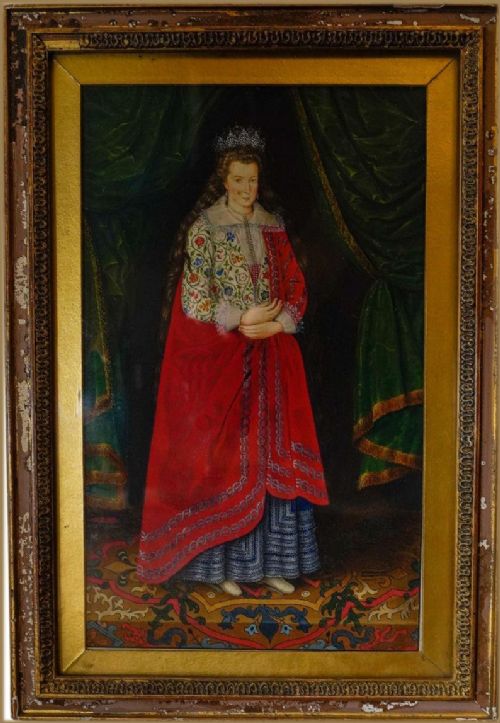
fig 4. A full-length watercolour portrait depicting an aristocratic noblewoman wearing a tiara, embroidered doublet, red cloak, and patterned skirt set against green velvet drapes.
fig 4. George Perfect Harding , 1781 –1853 Portrait of Lucy Russell, Countess of Bedford (Née Harington) (1580–1627) Pencil and Watercolour

The Countess of Bedford travelled south with Anne of Denmark and Prince Henry and Princess Elizabeth. At Dingley, Northamptonshire she rode south to meet Lady Anne Clifford, perhaps at Wymondley Priory, and brought her to Dingley on 24 June.

fig 5. A full-length watercolour portrait depicting an aristocratic noblewoman wearing a tiara, embroidered doublet, red cloak, and patterned skirt set against green velvet drapes.
fig 5. George Perfect Harding , 1781 –1853 Portrait of Lucy Russell, Countess of Bedford (Née Harington) (1580–1627) Pencil and Watercolour

Bedford performed in several of the masques staged at Court in the early 17th century, including The Masque of Blackness (1605), Hymenaei (1606), The Masque of Beauty (1608), The Masque of Queens, and The Vision of the Twelve Goddesses. On two occasions in 1617, she functioned as a theatrical producer, instigating and organising the 1617 Court performance of Robert White's masque Cupid's Banishment, acted by students from the first English girls' school, the Ladies Hall in Deptford. In February 1617 the masque by Ben Jonson presented by Lord Hay to the French ambassador Baron de Tour, the Lovers Made Men, was staged by the Countess of Bedford.

Jonson

She was a noted patron of Ben Jonson, who dedicated his play Cynthia's Revels (1600) to her and addressed several of his Epigrams to her, extolling her patronage. By his own admission, Jonson portrayed her as Ethra in his lost pastoral, The May Lord — though he may also have depicted her as Lady Haughty, president of the Collegiates in Epicene (1609). When Jonson was imprisoned in 1605 for his role in the Eastward Ho scandal, he wrote a letter to an unknown lady, who is thought by some scholars to have been the Countess of Bedford.

Others

In addition to Jonson, Bedford supported other significant poets of her era, including Michael Drayton, Samuel Daniel, George Chapman, and John Donne. She might be the "Idea" o

Height
15.5cm (6.10")
Width
25.5cm (10.04")
Depth
2cm (0.79")
Date of Manufacture

Artware Fineart has dated this Antique Portrait Watercolour Painting to the 19th Century.

Reference Numbers
Sellingantiques Ref
SA868400
Dealers Internal Ref
4457
Artware Fineart
Sellingantiques verified Since Sep 2008
Dealer Profile

You can view the stock and full dealer information on the Artware Fineart Profile Page

PDF SHARE
SAVE
A full-length watercolour portrait depicting an aristocratic noblewoman wearing a tiara, embroidered doublet, red cloak, and patterned skirt set against green velvet drapes.
1 / 6
Archive I A full-length watercolour portrait depicting an aristocratic noblewoman wearing a tiara, embroidered doublet, red cloak, and patterned skirt set against green velvet drapes.

George Perfect Harding , 1781 –1853 Portrait of Lucy Russell, Countess of Bedford (Née Harington) (1580–1627) Pencil and Watercolour

Archive II A full-length watercolour portrait depicting an aristocratic noblewoman wearing a tiara, embroidered doublet, red cloak, and patterned skirt set against green velvet drapes. View II
Archive III A full-length watercolour portrait depicting an aristocratic noblewoman wearing a tiara, embroidered doublet, red cloak, and patterned skirt set against green velvet drapes. View III
Archive IV A full-length watercolour portrait depicting an aristocratic noblewoman wearing a tiara, embroidered doublet, red cloak, and patterned skirt set against green velvet drapes. View IV
Archive V A full-length watercolour portrait depicting an aristocratic noblewoman wearing a tiara, embroidered doublet, red cloak, and patterned skirt set against green velvet drapes. View V
Archive VI A full-length watercolour portrait depicting an aristocratic noblewoman wearing a tiara, embroidered doublet, red cloak, and patterned skirt set against green velvet drapes. View VI
Enlarged Archival View
Telephone 07958 699 645
Location
18 La Gare
51 Surrey Row
London
SE1 0BZ
United Kingdom
Verified Since Sep 2008
Items For Sale 243
Items Sold 223
Artware Fineart
Verified Since Sep 2008
View Dealer Info
Location: 18 La Gare , 51 Surrey Row , London , SE1 0BZ , United Kingdom
Verified
Sep 2008
For Sale
243
Sold
223
A full-length watercolour portrait depicting an aristocratic noblewoman wearing a tiara, embroidered doublet, red cloak, and patterned skirt set against green velvet drapes.
George Perfect Harding , 1781 –1853 Portrait of Lucy Russell, Countess of Bedford (née Harington) (1580–1627) pencil and watercolour
Ref: SA868400
A full-length watercolour portrait depicting an aristocratic noblewoman wearing a tiara, embroidered doublet, red cloak, and patterned skirt set against green velvet drapes.
Detail View 1
Detail View 2
Detail View 3
Detail View 4
Detail View 5
Archival Detail
Every single antique dealer on our platform is individually approved by our internal team. We verify their professional trade history, ethical standards, and photographic quality to ensure a secure, high-standard buying environment. Upon joining, every dealer agrees to a strict 9-point code of conduct. While issues can occasionally arise, our dealers typically resolve them swiftly and directly with the buyer. In fact, since our founding in 2002, Sellingantiques has only had to step in to help resolve an issue on roughly five occasions—a true testament to the quality of our dealers and their dedication to your happiness.
Our dealers are highly experienced in packing and shipping fragile, high-value antiques. Because you are in direct contact with the dealer, you will be able to easily go through all available shipping and insurance options together to ensure your item arrives safely.
Antiques are the ultimate green purchase. By choosing historical pieces over newly manufactured goods, you completely eliminate the carbon footprint of modern mass production while preserving exceptional, timeless craftsmanship.

Nineteenth-century historical watercolours often copied earlier Tudor and Jacobean oil paintings to record noble lineages and historical costumes. Artists used fine graphite pencil underdrawing combined with precise transparent watercolours and opaque gouache detailing.

These works were executed on heavy woven paper or card using natural pigment watercolours, graphite pencils, and sometimes gum arabic to heighten luminosity in darker fabrics and drapery.

Authentic pieces display hand-painted brushwork under magnification, natural age toning or foxing on paper, and subtle variations in wash density, distinct from modern photographic reproductions.

Displaying historical portraits against moody wall shades, within classic gallery walls, or alongside contemporary furniture creates an engaging dialogue between historic art and modern design.

Protect watercolours by framing them under UV-filtering glass with acid-free mounting materials. Display them away from direct sunlight and areas prone to high humidity or temperature fluctuations.
items
Add keywords to the filter
Price
£100
£250000
Era
Movements
Material
Origin
Stock Location
Freshness
Online Payments
Categories