THEOBALD CHARTRAN, 1849-1907
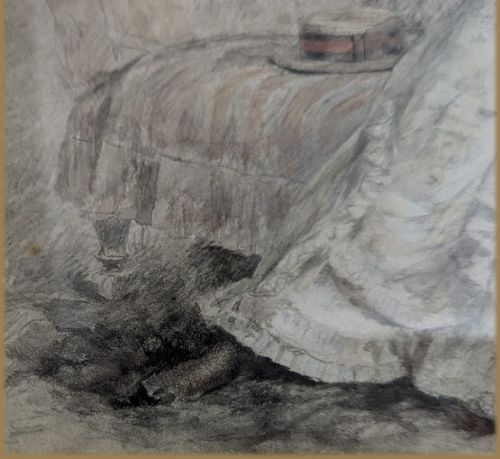
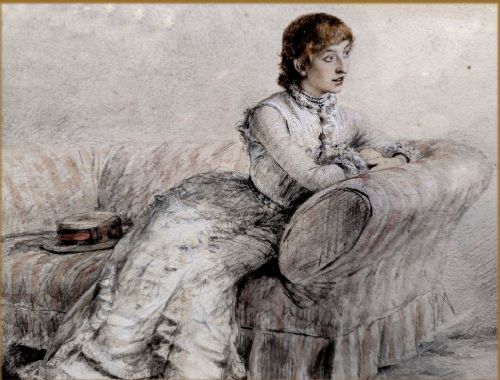
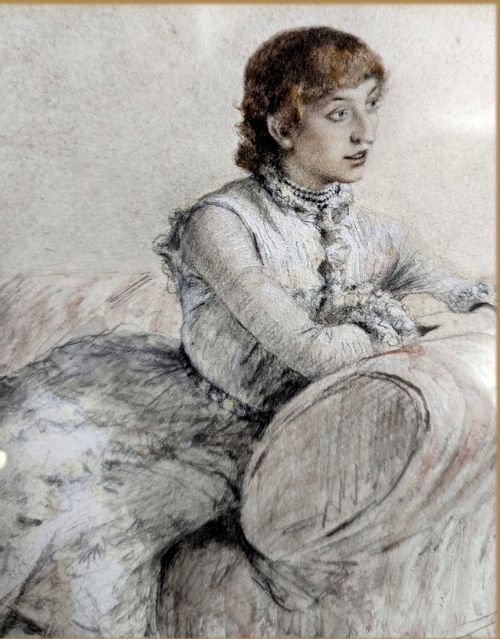
Portrait Lady Florence Caroline Dixie née Douglas, 1855 – 1905 , Scottish writer, war correspondent, and feminist
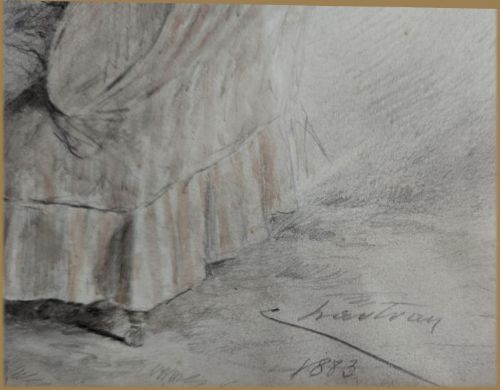
signed dated: ''1883'' and further signed with a monogram top left
pencil crayon and watercolour
Private Collection Swansea
Literature
Illustration of Dixie by Théobald Chartran, published in Vanity Fair, 5 January 1884. A more significant lithograph, by Théobald Chartran, printed in colour, appeared in Vanity Fair in 1884 and is one of the long series of caricatures published in the magazine between 1868 and 1914. These were all coloured illustrations featuring notable people of the day, and each was accompanied by a short (usually adulatory) biography. Of more than two thousand people so honoured, only eighteen were women. Featured in the magazine on 5 January 1884, Dixie joined this small band, which included Queen Isabella II of Spain (1869), Sarah Bernhardt (1879), the Princess of Wales (1882) and Angela Burdett-Coutts,
... 1st Baroness Burdett-Coutts (1883). Victoria, Princess Royal, and Elizabeth, Empress of Austria, followed later in 1884.
Notes
Lady Florence Caroline Dixie [née Douglas], (1855–1905), author and traveller, was born in Kinmount, Cummertrees, Dumfriesshire, on 24 May 1855, one of a pair of twins, the youngest of the six children of Archibald William Douglas, eighth marquess of Queensberry (1818–1858), and his wife, Caroline Margaret (d. 1904), younger daughter of General Sir William Robert Clayton, bt.
.
The Douglases were an ancient Scottish family, vigorous and combative, and in Florence''s generation they were haunted by disaster, dissension, and scandal: in 1858 Florence''s father died from an accidental shot while cleaning a gun, dent, but was widely believed to have been suicide ; her brother Francis was killed in 1865 on the first ascent of the Matterhorn; James, Florence''s twin, was to commit suicide in middle age in 1891; and their eldest brother, the ninth marquess of Queensberry (John Sholto Douglas), provoked the notorious Oscar Wilde case. Dissension affected the twins when they were seven years old and their mother alarmed their guardians by becoming a Roman Catholic and converting the children; she was threatened with the loss of her children, a real danger in an age which allowed a woman no rights over her own progeny, and an injustice against which Florence was to campaign in later life and which was the subject of her autobiographical The Story of Ijain (1903).
Their mother took the children abroad for two years and on their return, Florence was sent to a convent school where she hated the repressive regime and the dogmatism of the religious teaching. She found relief in poetry, writing Songs of a Child under the pseudonym Darling—verses which were not, however, published until 1902. Early in life she developed a passion for sport and travel. She was a firstrate horsewoman and a keen hunter of big game, one of the first women to take up this activity. She learned to swim and was a rapid walker. On 3 April 1875 she married Sir Alexander Beaumont Churchill Dixie, eleventh baronet (1851–1924), a strikingly handsome man, nicknamed Beau. They shared a taste for adventure and outdoor life, and the one flaw in an otherwise equal partnership seems to have been Beau''s love of gambling, which was to prove a constant threat to the family property at Bosworth Park in Leicestershire, eventually sold to pay his debts. They had two sons, George Douglas (1876–1948) and Albert Edward Wolston (1878–1940), godson of the prince of Wales.
Several members of the Queensberry family were affected by mental illness. As mentioned above, Lady Florence''s father is believed to have committed suicide. Her twin brother, Lord James Douglas (known to his family as Jim), was deeply attached to her and was heartbroken when she married. In 1885, he tried to
Internal Reference: 4456
Antique ID Number (AIDN): SA868399
Dateline of this antique is 19th Century
Height is 21cm (8.3inches)Width is 30cm (11.8inches)Depth is 2cm (0.8inches)





Thank you.
Your comment has been sent to Sellingantiques.