9,641  PAGES BROWSED TODAY PAGES TODAY 36  ANTIQUES UPLOADED TODAY NEW ARRIVALS
ID #SA841031
FOR SALE
£2,000
Email Buy
Save
The 1862 International Exhibition Prize Medal Awarded to De Grave Short & Fanner London
Jason Clarke Antiques
for sale €2,340     $2,540
£2,000
Jason Clarke Antiques

Jason Clarke Antiques

Sellingantiques Verified Since Jul 2015
View Dealers Stock Page
Id #SA841031
PDF SHARE
SAVE

The 1862 International Exhibition Prize Medal Awarded to De Grave Short & Fanner London

19th century
Description

For sale, the 1862 London International Exhibition bronze prize medal for the famous scale making company of De Grave, Short & Fanner.

This superbly executed medal was awarded and individually engraved to each of the 1862 Exhibitors that were bestowed with a prize for their efforts.

Struck entirely from bronze, the obverse face shows Britannia seated with shield to her side and a sleeping lion at her feet. She is surrounded by six women each individually representing Industry, Agriculture and The Arts. The rim below the lion is marked with, D. Maclise R.A. DES. & Leonard C. Wyon FEC.

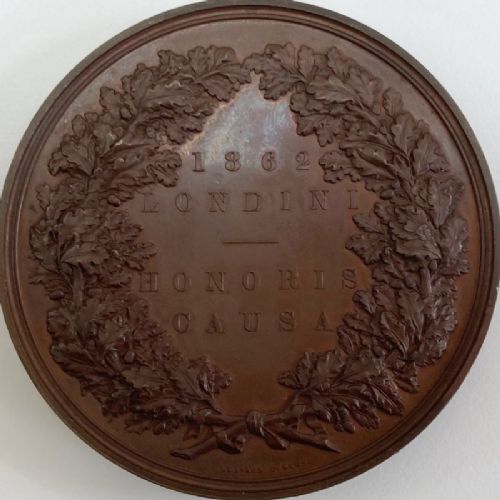
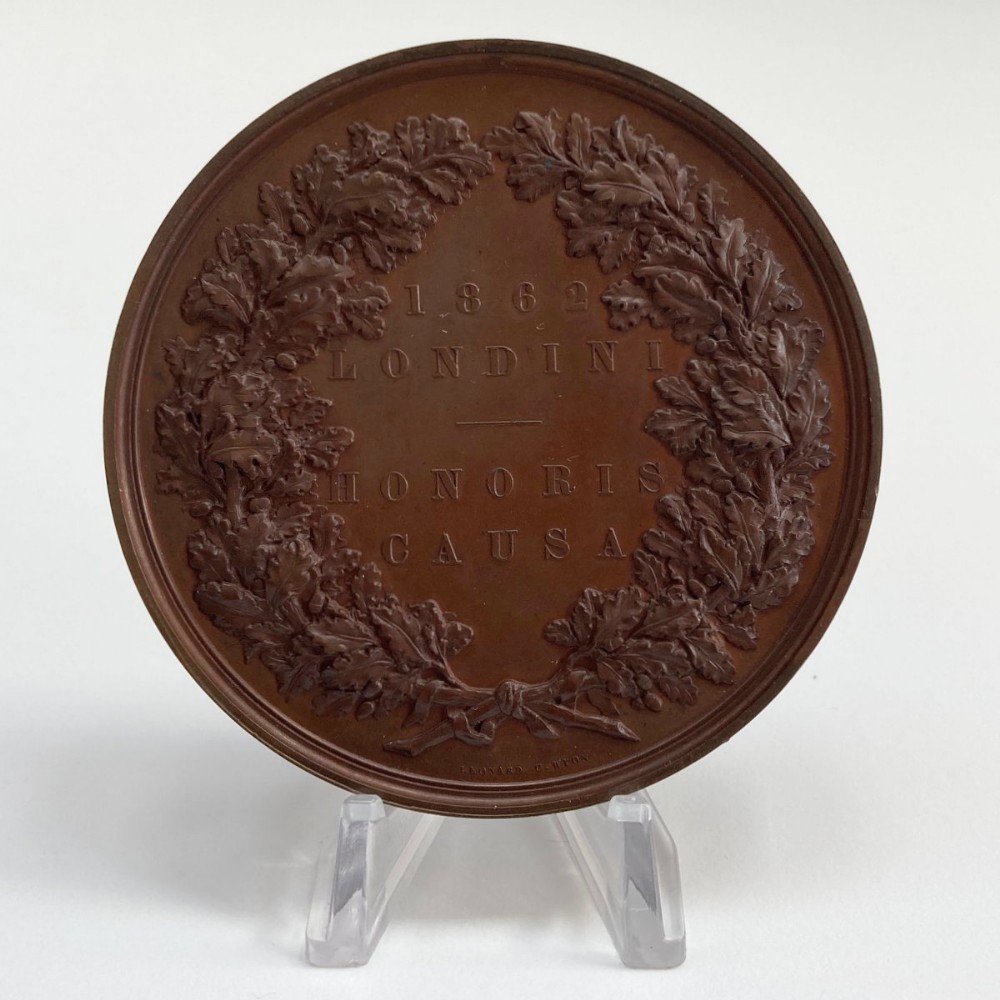
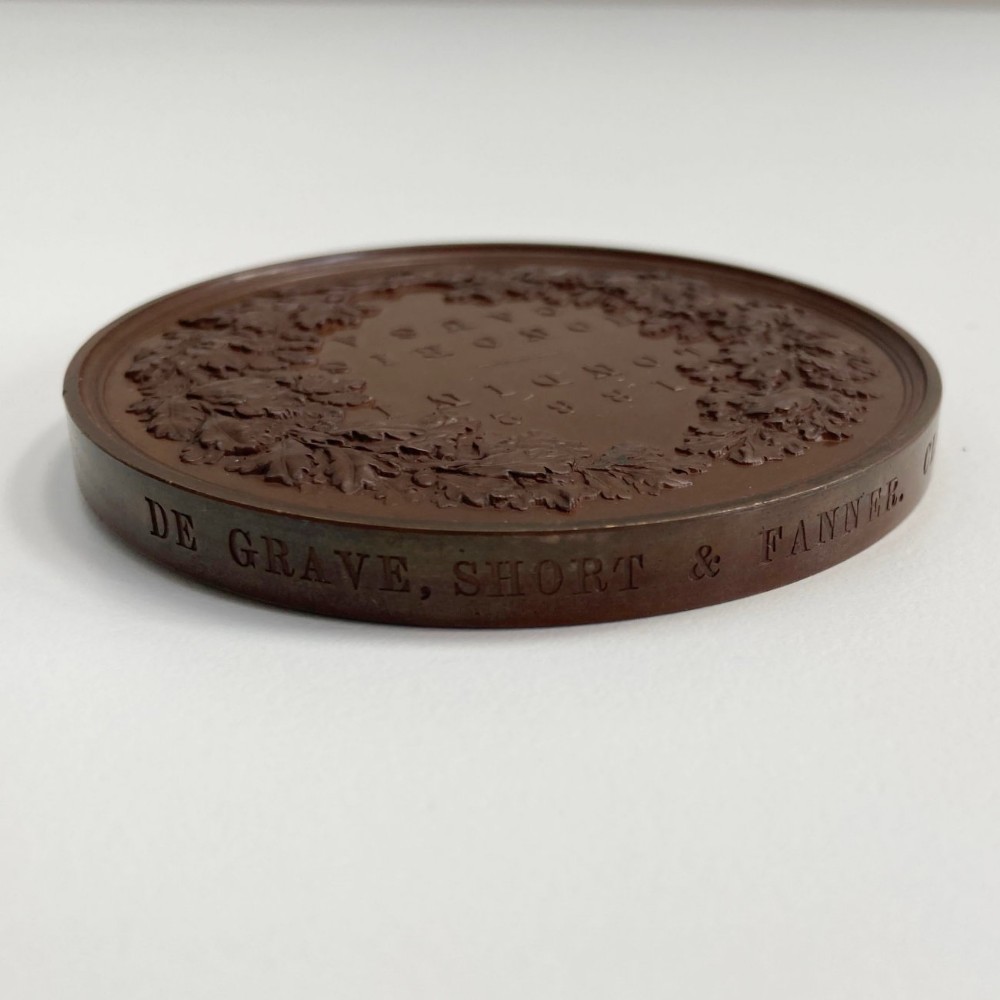
The reverse shows a wreath of oak running around the inner circumference with the words, 1862 Londini Honoris Causa which effectively translates to “London, a mark of esteem or respect” to the centre. In small letters to the base, the name of L.C. Wyon FEC is repeated.

The edge of the medal is further engraved to De Grave, Short & Fanner. Class XIII.

The International Exhibition was declared open by The Duke of Cambridge on the 1st of May 1862 in South Kensington on a site which is now occupied by The Natural History Museum. To give some idea of its scale, it featured nearly thirty thousand exhibitors from thirty six countries throughout the six months of its existence and welcomed over six million visitors.

This second exhibition was meant to follow up on the huge success of the 1851 Exhibition, originally intended to have been opened in 1861, it was delayed due to the Italian War of Independence, the Civil War in America and not least because of the death of Prince Albert, its Chief Patron and supporter. The latter reason is of course why Queen Victoria was not present at the delayed opening in 1862.

The building that housed the Exhibition was designed using brick and iron by the architect Captain Francis Fowke and contracted out to the firm of Kelk & Lucas. Sadly, Parliament declined the Government’s wishes to purchase the building after the Exhibition but the materials which were reclaimed were eventually put to use in the building of Alexandra Palace. Fowke was also responsible for proposing the building of The Natural history Museum which was eventually constructed in 1881 and remains on the site to this day.

De Grave, Short & Fanner’s appearance at The 1851 Exhibition cemented the company’s already fine reputation and they gained numerous Governmental and international commissions thereafter. Their appearance at the 1862 Exhibition just eleven years later was therefore inevitable and they followed up their previous success with this medal which according to the catalogue, was awarded, “For balances of good workmanship”.

The company was placed within Class XIII – Philosophical Instruments and it is worth mentioned some of the other names with whom De Grave exhibited alongside. Patrick Adie, Charles Babbage, Louis Casella, T. Cooke & Sons, JH Dallmeyer, JB Dancer, Elliott Brothers, J. Hicks, Kew Observatory, Negretti & Zambra, Pastorelli, Pillischer and Smith Beck & Beck were just a few of the names that appeared and like De Grave, won medals for their fine products. To see all of these great makers in the same room would have been simply astonishing!

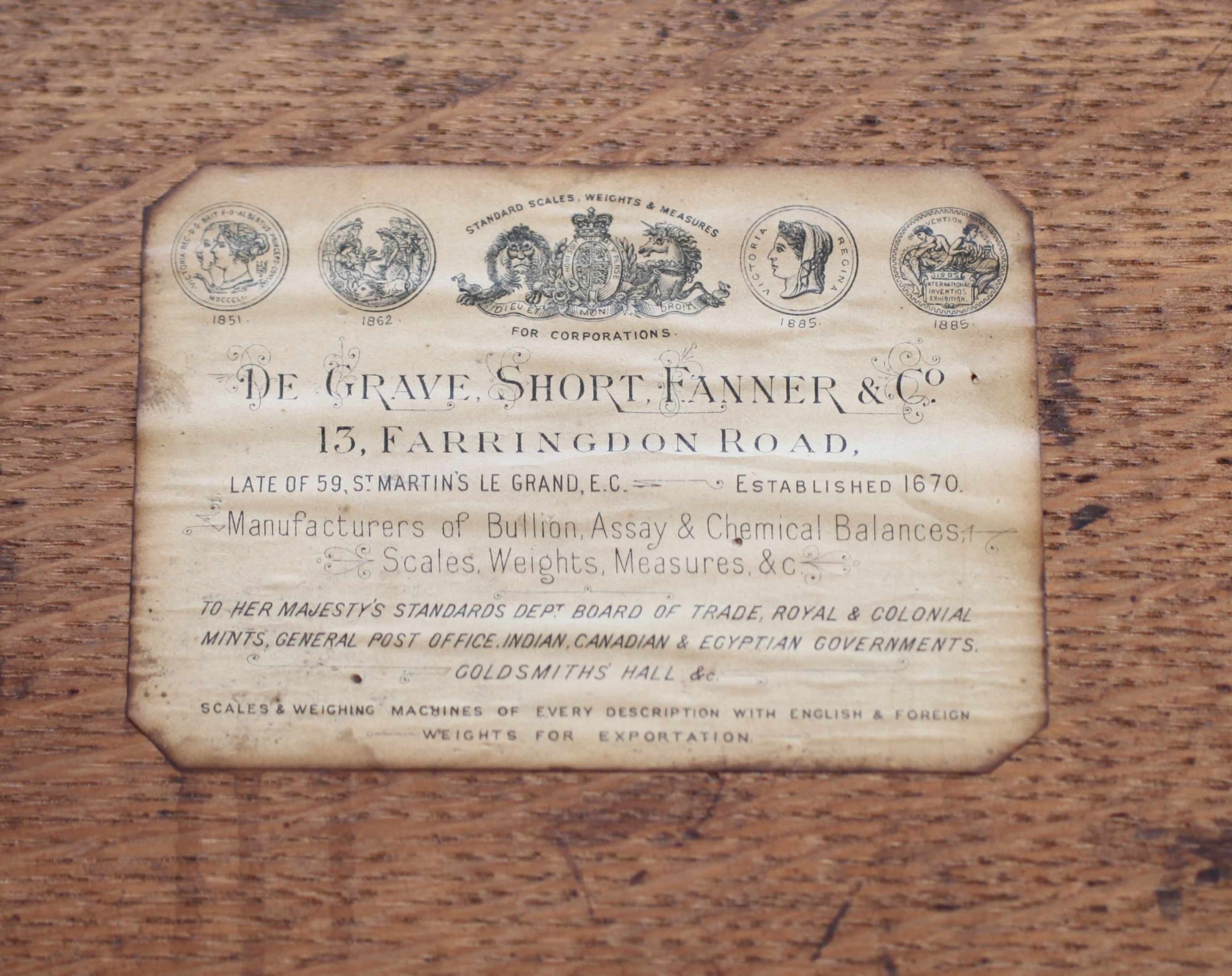
Almost all of the Victorian scientific instrument making exhibitors made great use of this medal’s image on letterheads, trade cards, catalogues and other associated ephemera, to find an example of the original medal for one of these makers is extraordinarily rare.

Note: The images which support this piece also include an image of one of the company’s later trade cards which was pasted to a scale case I have previously sold. The image of the medal can be seen to the top right of the image.

The De Grave dynasty are perhaps one of the earliest and most recognisable of all the scalemakers. Their later trade labels confidently boast of a history dating back to

Physical Dimensions
Height
8cm (3.15")
Width
8cm (3.15")
Depth
0.8cm (0.31")
Declaration

Jason Clarke Antiques has dated this 1862 Bronze Prize Medal to the 1860s.
Reference Numbers
Sellingantiques Reference
SA841031
Description
For sale, the 1862 London International Exhibition bronze prize medal for the famous scale making company of De Grave, Short & Fanner.
This superbly executed medal was awarded and individually engraved to each of the 1862 Exhibitors that were bestowed with a prize for their efforts.
Jason Clarke Antiques
fig 1. A circular dark brown bronze medallion featuring high-relief classical allegorical figures surrounding a seated Britannia with a recumbent lion at her feet.
fig 1. The 1862 International Exhibition Prize Medal Awarded to De Grave Short & Fanner London

Struck entirely from bronze, the obverse face shows Britannia seated with shield to her side and a sleeping lion at her feet. She is surrounded by six women each individually representing Industry, Agriculture and The Arts. The rim below the lion is marked with, D. Maclise R.A. DES. & Leonard C. Wyon FEC.
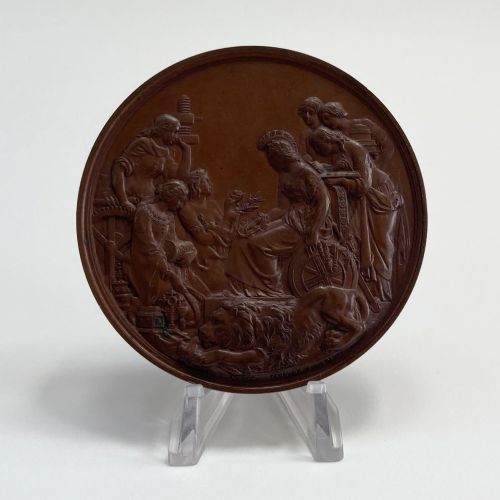
fig 2. A circular dark brown bronze medallion featuring high-relief classical allegorical figures surrounding a seated Britannia with a recumbent lion at her feet.
fig 2. The 1862 International Exhibition Prize Medal Awarded to De Grave Short & Fanner London

The reverse shows a wreath of oak running around the inner circumference with the words, 1862 Londini Honoris Causa which effectively translates to “London, a mark of esteem or respect” to the centre. In small letters to the base, the name of L.C. Wyon FEC is repeated.
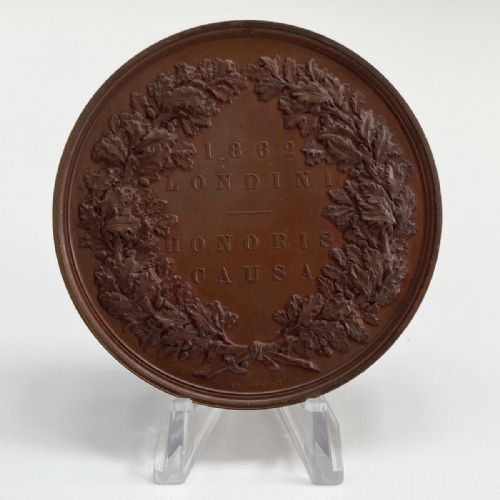
fig 3. A circular dark brown bronze medallion featuring high-relief classical allegorical figures surrounding a seated Britannia with a recumbent lion at her feet.
fig 3. The 1862 International Exhibition Prize Medal Awarded to De Grave Short & Fanner London

The edge of the medal is further engraved to De Grave, Short & Fanner. Class XIII.

The International Exhibition was declared open by The Duke of Cambridge on the 1st of May 1862 in South Kensington on a site which is now occupied by The Natural History Museum. To give some idea of its scale, it featured nearly thirty thousand exhibitors from thirty six countries throughout the six months of its existence and welcomed over six million visitors.
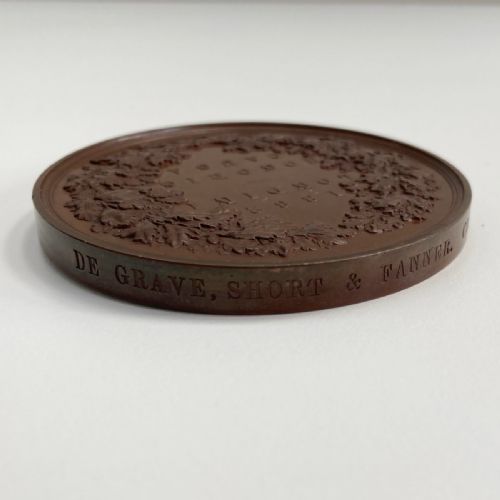
fig 4. A circular dark brown bronze medallion featuring high-relief classical allegorical figures surrounding a seated Britannia with a recumbent lion at her feet.
fig 4. The 1862 International Exhibition Prize Medal Awarded to De Grave Short & Fanner London

This second exhibition was meant to follow up on the huge success of the 1851 Exhibition, originally intended to have been opened in 1861, it was delayed due to the Italian War of Independence, the Civil War in America and not least because of the death of Prince Albert, its Chief Patron and supporter. The latter reason is of course why Queen Victoria was not present at the delayed opening in 1862.
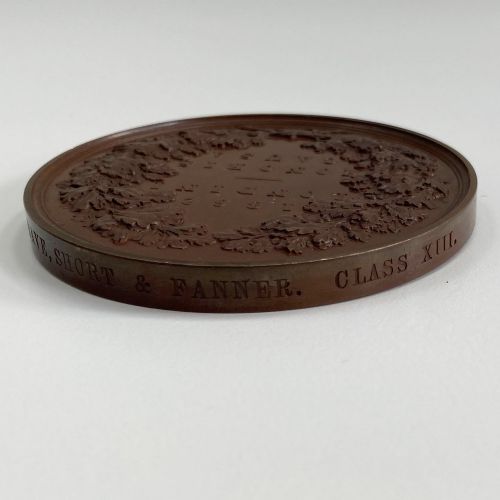
fig 5. A circular dark brown bronze medallion featuring high-relief classical allegorical figures surrounding a seated Britannia with a recumbent lion at her feet.
fig 5. The 1862 International Exhibition Prize Medal Awarded to De Grave Short & Fanner London

The building that housed the Exhibition was designed using brick and iron by the architect Captain Francis Fowke and contracted out to the firm of Kelk & Lucas. Sadly, Parliament declined the Government’s wishes to purchase the building after the Exhibition but the materials which were reclaimed were eventually put to use in the building of Alexandra Palace. Fowke was also responsible for proposing the building of The Natural history Museum which was eventually constructed in 1881 and remains on the site to this day.
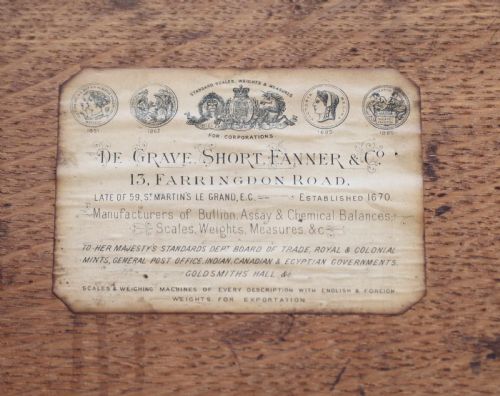
fig 6. A circular dark brown bronze medallion featuring high-relief classical allegorical figures surrounding a seated Britannia with a recumbent lion at her feet.
fig 6. The 1862 International Exhibition Prize Medal Awarded to De Grave Short & Fanner London

De Grave, Short & Fanner’s appearance at The 1851 Exhibition cemented the company’s already fine reputation and they gained numerous Governmental and international commissions thereafter. Their appearance at the 1862 Exhibition just eleven years later was therefore inevitable and they followed up their previous success with this medal which according to the catalogue, was awarded, “For balances of good workmanship”.

The company was placed within Class XIII – Philosophical Instruments and it is worth mentioned some of the other names with whom De Grave exhibited alongside. Patrick Adie, Charles Babbage, Louis Casella, T. Cooke & Sons, JH Dallmeyer, JB Dancer, Elliott Brothers, J. Hicks, Kew Observatory, Negretti & Zambra, Pastorelli, Pillischer and Smith Beck & Beck were just a few of the names that appeared and like De Grave, won medals for their fine products. To see all of these great makers in the same room would have been simply astonishing!

Almost all of the Victorian scientific instrument making exhibitors made great use of this medal’s image on letterheads, trade cards, catalogues and other associated ephemera, to find an example of the original medal for one of these makers is extraordinarily rare.

Note: The images which support this piece also include an image of one of the company’s later trade cards which was pasted to a scale case I have previously sold. The image of the medal can be seen to the top right of the image.

The De Grave dynasty are perhaps one of the earliest and most recognisable of all the scalemakers. Their later trade labels confidently boast of a history dating back to

Height
8cm (3.15")
Width
8cm (3.15")
Depth
0.8cm (0.31")
Date of Manufacture

Jason Clarke Antiques has dated this 1862 Bronze Prize Medal to the 1860s.

Reference Numbers
Sellingantiques Ref
SA841031
Jason Clarke Antiques
Sellingantiques verified Since Jul 2015
Dealer Profile

You can view the stock and full dealer information on the Jason Clarke Antiques Profile Page

PDF SHARE
SAVE
A circular dark brown bronze medallion featuring high-relief classical allegorical figures surrounding a seated Britannia with a recumbent lion at her feet.
1 / 7
Archive I A circular dark brown bronze medallion featuring high-relief classical allegorical figures surrounding a seated Britannia with a recumbent lion at her feet.

The 1862 International Exhibition Prize Medal Awarded to De Grave Short & Fanner London
Archive II A circular dark brown bronze medallion featuring high-relief classical allegorical figures surrounding a seated Britannia with a recumbent lion at her feet. View II
Archive III A circular dark brown bronze medallion featuring high-relief classical allegorical figures surrounding a seated Britannia with a recumbent lion at her feet. View III
Archive IV A circular dark brown bronze medallion featuring high-relief classical allegorical figures surrounding a seated Britannia with a recumbent lion at her feet. View IV
Archive V A circular dark brown bronze medallion featuring high-relief classical allegorical figures surrounding a seated Britannia with a recumbent lion at her feet. View V
Archive VI A circular dark brown bronze medallion featuring high-relief classical allegorical figures surrounding a seated Britannia with a recumbent lion at her feet. View VI
Archive VII A circular dark brown bronze medallion featuring high-relief classical allegorical figures surrounding a seated Britannia with a recumbent lion at her feet. View VII
Enlarged Archival View
Telephone 07815 046645
Location
Newbury
Berkshire
United Kingdom
Verified Since Jul 2015
Items For Sale 82
Items Sold 605
Jason Clarke Antiques
Verified Since Jul 2015
View Dealer Info
Location: Newbury, Berkshire, United Kingdom
Verified
Jul 2015
For Sale
82
Sold
605
A circular dark brown bronze medallion featuring high-relief classical allegorical figures surrounding a seated Britannia with a recumbent lion at her feet.
The 1862 International Exhibition Prize Medal Awarded to De Grave Short & Fanner London
Ref: SA841031
A circular dark brown bronze medallion featuring high-relief classical allegorical figures surrounding a seated Britannia with a recumbent lion at her feet.
Detail View 1
Detail View 2
Detail View 3
Detail View 4
Detail View 5
Detail View 6
Archival Detail
Every single antique dealer on our platform is individually approved by our internal team. We verify their professional trade history, ethical standards, and photographic quality to ensure a secure, high-standard buying environment. Upon joining, every dealer agrees to a strict 9-point code of conduct. While issues can occasionally arise, our dealers typically resolve them swiftly and directly with the buyer. In fact, since our founding in 2002, Sellingantiques has only had to step in to help resolve an issue on roughly five occasions—a true testament to the quality of our dealers and their dedication to your happiness.
Our dealers are highly experienced in packing and shipping fragile, high-value antiques. Because you are in direct contact with the dealer, you will be able to easily go through all available shipping and insurance options together to ensure your item arrives safely.
Antiques are the ultimate green purchase. By choosing historical pieces over newly manufactured goods, you completely eliminate the carbon footprint of modern mass production while preserving exceptional, timeless craftsmanship.

Prize medals from the 1862 London International Exhibition were awarded to exhibitors for achievements in industrial, artistic, and scientific endeavours, representing global technological progress during the mid-Victorian era.

These medals were struck predominantly in solid bronze, copper, or silver, featuring high-relief die-engraved imagery that was hand-finished to preserve fine detail.

Authentic pieces exhibit sharp high-relief detail, maker signatures near the rim, and edge lettering detailing the category or recipient, along with natural surface patination.

A bronze medallion can be displayed on a dark wood bookshelf using a small brass easel, framed within an acrylic shadow box on a gallery wall, or styled atop stacked art books.

Dust the surface gently using a soft camel-hair brush and store in a low-humidity environment; avoid chemical solvents or abrasive polish to maintain the original surface oxidisation.
items
Add keywords to the filter
Price
£100
£250000
Era
Movements
Material
Origin
Stock Location
Freshness
Online Payments
Categories