5,199  PAGES BROWSED TODAY PAGES TODAY 0  ANTIQUES UPLOADED TODAY NEW ARRIVALS
ID #SA837763
FOR SALE
£1,200
Email
Save
Cuthbert Edmund Swan, 1870-1931 A Leopard with a Peacock in a Tree
Artware Fineart
for sale €1,404     $1,524
£1,200

Artware Fineart

Sellingantiques Verified Since Sep 2008
View Dealers Stock Page
Id #SA837763
PDF SHARE
SAVE

Cuthbert Edmund Swan, 1870-1931 A Leopard with a Peacock in a Tree

19th century
For Sale by Artware Fineart
Description

Cuthbert Edmund Swan, 1870-1931

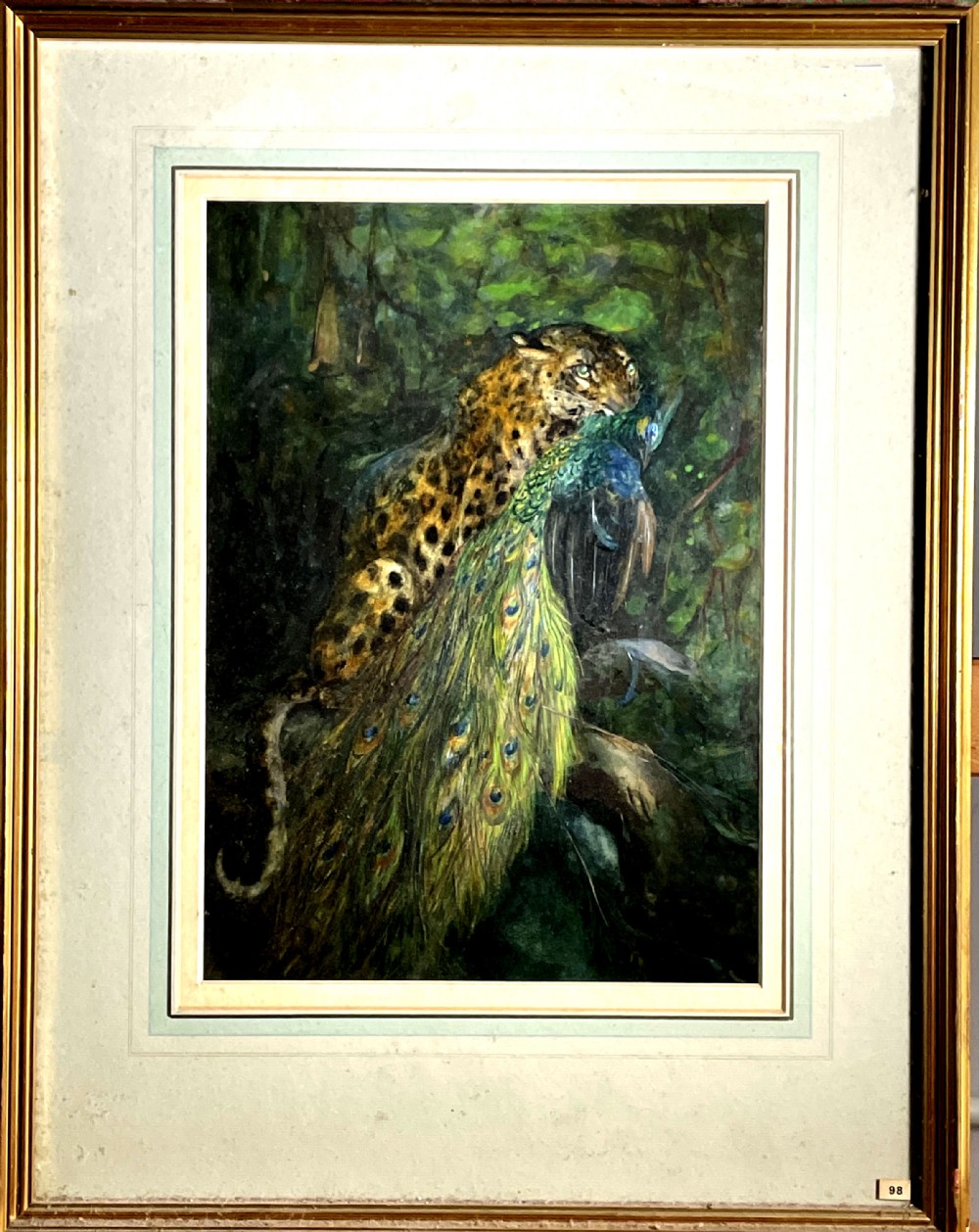
A Leopard with a Peacock in a Tree

Signed and dated 1918 Inscribed as title on a label verso

pencil and watercolour

35 x 25 cm. (14 x 10 in.)

The green peafowl is native to Burma and Java, while the blue comes from India and Sri Lanka. These countries are home to a wide range of large hunters that are potential peacock predators, and peacocks have fallen prey to the likes of large jungle cats such as leopards and tigers, but also to smaller animals, like the mongoose or stray dogs.

Indian peacocks (Pavo cristatus) are some of the globe's most unforgettable and physically stunning animals, what with their vivid decorative trains. The females of the species are nowhere near as showy in the feather department -- and they're known as peahens, rather than peacocks. When talking about both of the genders, the term is peafowl. Indian peahens are visually a lot more lackluster than peacocks, and for good reason pertaining to the survival of offspring. While the males have to be conspicuous to gain the attentions of females for breeding, the goal of the females is to stay as far under the radar as possible. If peahens can mix in seamlessly with the rest of their environment, potential predators might miss them while egg incubation is going on. The differences in plumage are a practical survival adaptation against predation.
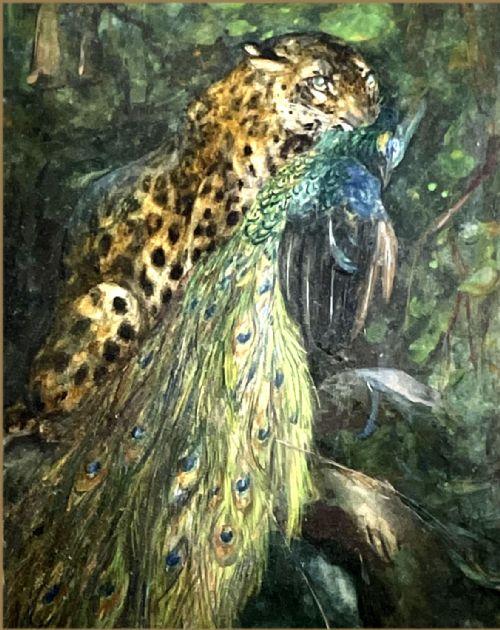
Spotting Indian peacocks remotely is often a piece of cake for their predators. Some of their most common predators are tigers, leopards, civets, wild canines and mongooses. The train is extremely problematic for Indian peacocks, as it sometimes blocks them from being able to see dangerous predators that might be coming up to them from the back. When predators try to tug on their trains, the fowl sometimes get lucky. Their feathers often simply drop to the ground -- enabling the peacocks to bolt the scene immediately.
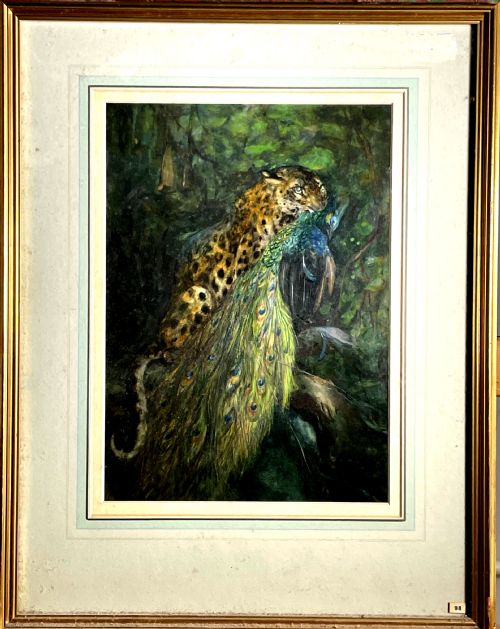
Although peacocks are more vulnerable to predation by these animals, peahens experience it, too. Flying isn't a common behavior in Indian peafowls, although running is. When they're trying to escape predators, they do often resort to flying, however. Indian peafowl are also extremely vocal when in protective mode. If they suspect impending peril, they alert others around them by partaking in lots of noisy and shrill squawking. This also comes in handy for alerting different animals that might be nearby, such as deer. Indian peafowl also retreat to high trees at night -- another means of staying away from predators. The diurnal birds roost in sizable groups.

Artist Biography

Cuthbert Edmund Swan was born in Ballyragget, Co Kilkenny, Ireland. He was educated at Seaford College, Sussex before he and his brother Edwin went on to study at the Academie Julien in Paris. On their return to London they settled in Camden Town. Cuthbert Edmund Swan was a teacher of drawing at the Central School of Arts and Crafts, especially animals. The latter was Irish, the son of John Macallan Swan, who had himself built up a career as a painter of animals, mainly big cats. Cuthbert followed in his father’s footsteps and he, too, was preoccupied with the study and depiction of zoo animals, notably the lions, jaguars, pumas and other big cats, which he regularly exhibited at the RA and other venues.It seems that Cuthbert and his brother, Edwin Swan, probably in the late 1880s, had studied at the Académie Julian in Paris - part of that tide of British students washing over the Channel, eager to become acquainted with some of the most radical art and art teaching available in western Europe at the time. Here, of course, students would meet fellow artists from many different countries and would also encounter some of the most exciting art of the day, notably, the work of the Impressionists. Within the Académie, the emphasis was on scrutinising an image, memorising, recalli

Physical Dimensions
Height
35cm (13.78")
Width
25cm (9.84")
Depth
1cm (0.39")
Declaration

Artware Fineart has dated this Victorian Leopard Oil Painting to the 19th Century.

Reference Numbers
Sellingantiques Reference
SA837763
Dealers Internal Reference
4449
Description
Cuthbert Edmund Swan, 1870-1931

A Leopard with a Peacock in a Tree

Signed and dated 1918 Inscribed as title on a label verso

pencil and watercolour

35 x 25 cm. (14 x 10 in.)

The green peafowl is native to Burma and Java, while the blue comes from India and Sri Lanka. These countries are home to a wide range of large hunters that are potential peacock predators, and peacocks have fallen prey to the likes of large jungle cats such as leopards and tigers, but also to smaller animals, like the mongoose or stray dogs.

Indian peacocks (Pavo cristatus) are some of the globe's most unforgettable and physically stunning animals, what with their vivid decorative trains.
Artware Fineart

The females of the species are nowhere near as showy in the feather department -- and they're known as peahens, rather than peacocks. When talking about both of the genders, the term is peafowl. Indian peahens are visually a lot more lackluster than peacocks, and for good reason pertaining to the survival of offspring. While the males have to be conspicuous to gain the attentions of females for breeding, the goal of the females is to stay as far under the radar as possible. If peahens can mix in seamlessly with the rest of their environment, potential predators might miss them while egg incubation is going on. The differences in plumage are a practical survival adaptation against predation.

fig 1. An oil painting depicting a spotted leopard perched in dense foliage holding a peacock with long green and blue tail feathers in its mouth.
fig 1. Cuthbert Edmund Swan, 1870-1931 A Leopard with a Peacock in a Tree

Spotting Indian peacocks remotely is often a piece of cake for their predators. Some of their most common predators are tigers, leopards, civets, wild canines and mongooses. The train is extremely problematic for Indian peacocks, as it sometimes blocks them from being able to see dangerous predators that might be coming up to them from the back. When predators try to tug on their trains, the fowl sometimes get lucky. Their feathers often simply drop to the ground -- enabling the peacocks to bolt the scene immediately.

fig 2. An oil painting depicting a spotted leopard perched in dense foliage holding a peacock with long green and blue tail feathers in its mouth.
fig 2. Cuthbert Edmund Swan, 1870-1931 A Leopard with a Peacock in a Tree

Although peacocks are more vulnerable to predation by these animals, peahens experience it, too. Flying isn't a common behavior in Indian peafowls, although running is. When they're trying to escape predators, they do often resort to flying, however. Indian peafowl are also extremely vocal when in protective mode. If they suspect impending peril, they alert others around them by partaking in lots of noisy and shrill squawking. This also comes in handy for alerting different animals that might be nearby, such as deer. Indian peafowl also retreat to high trees at night -- another means of staying away from predators. The diurnal birds roost in sizable groups.

Artist Biography

Cuthbert Edmund Swan was born in Ballyragget, Co Kilkenny, Ireland. He was educated at Seaford College, Sussex before he and his brother Edwin went on to study at the Academie Julien in Paris. On their return to London they settled in Camden Town. Cuthbert Edmund Swan was a teacher of drawing at the Central School of Arts and Crafts, especially animals. The latter was Irish, the son of John Macallan Swan, who had himself built up a career as a painter of animals, mainly big cats. Cuthbert followed in his father’s footsteps and he, too, was preoccupied with the study and depiction of zoo animals, notably the lions, jaguars, pumas and other big cats, which he regularly exhibited at the RA and other venues.It seems that Cuthbert and his brother, Edwin Swan, probably in the late 1880s, had studied at the Académie Julian in Paris - part of that tide of British students washing over the Channel, eager to become acquainted with some of the most radical art and art teaching available in western Europe at the time. Here, of course, students would meet fellow artists from many different countries and would also encounter some of the most exciting art of the day, notably, the work of the Impressionists. Within the Académie, the emphasis was on scrutinising an image, memorising, recalli

Height
35cm (13.78")
Width
25cm (9.84")
Depth
1cm (0.39")
Date of Manufacture

Artware Fineart has dated this Victorian Leopard Oil Painting to the 19th Century.

Reference Numbers
Sellingantiques Ref
SA837763
Dealers Internal Ref
4449
Artware Fineart
Sellingantiques verified Since Sep 2008
Dealer Profile

You can view the stock and full dealer information on the Artware Fineart Profile Page
PDF SHARE
SAVE
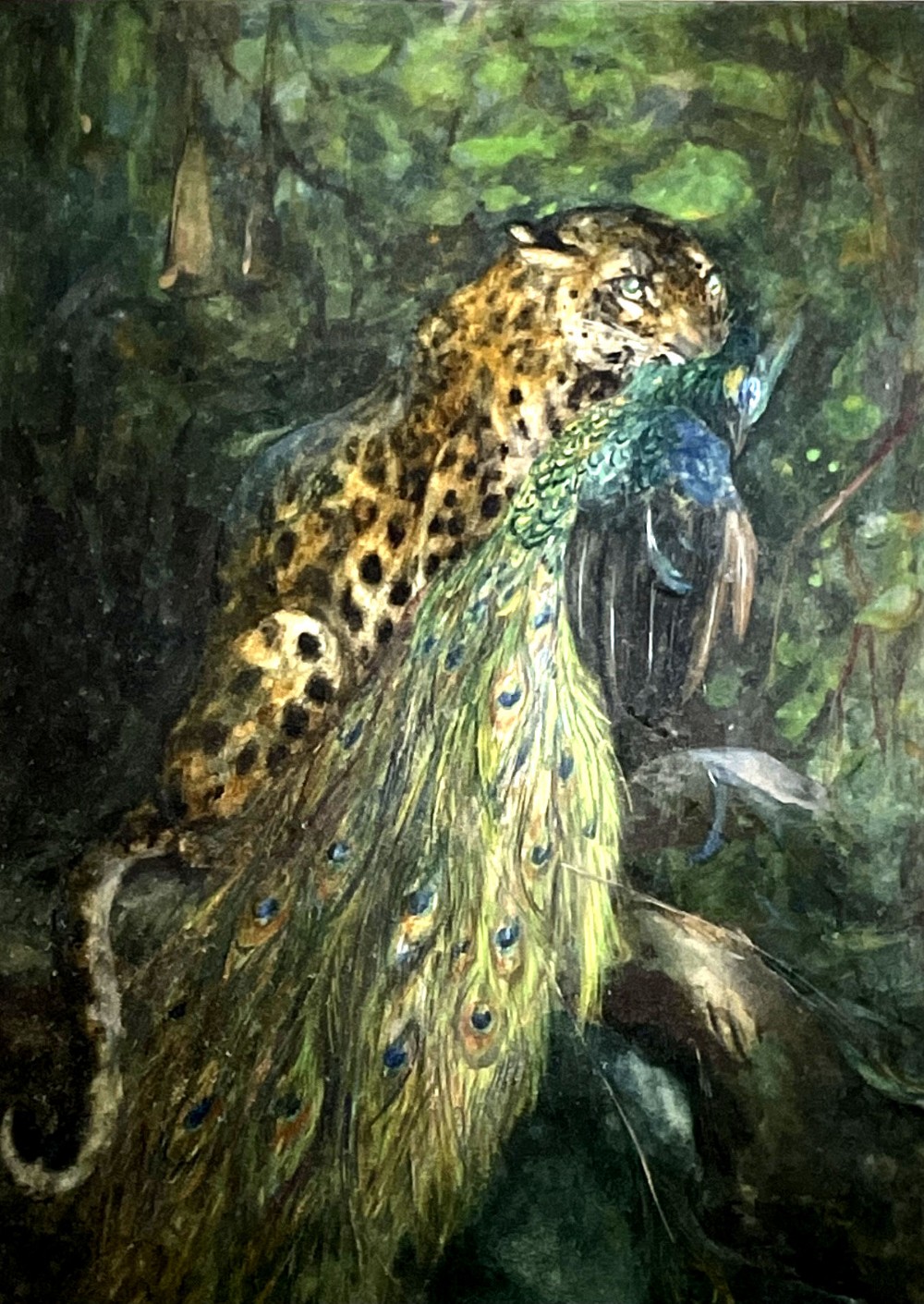
An oil painting depicting a spotted leopard perched in dense foliage holding a peacock with long green and blue tail feathers in its mouth.
1 / 3
Archive I An oil painting depicting a spotted leopard perched in dense foliage holding a peacock with long green and blue tail feathers in its mouth.

Cuthbert Edmund Swan, 1870-1931 A Leopard with a Peacock in a Tree
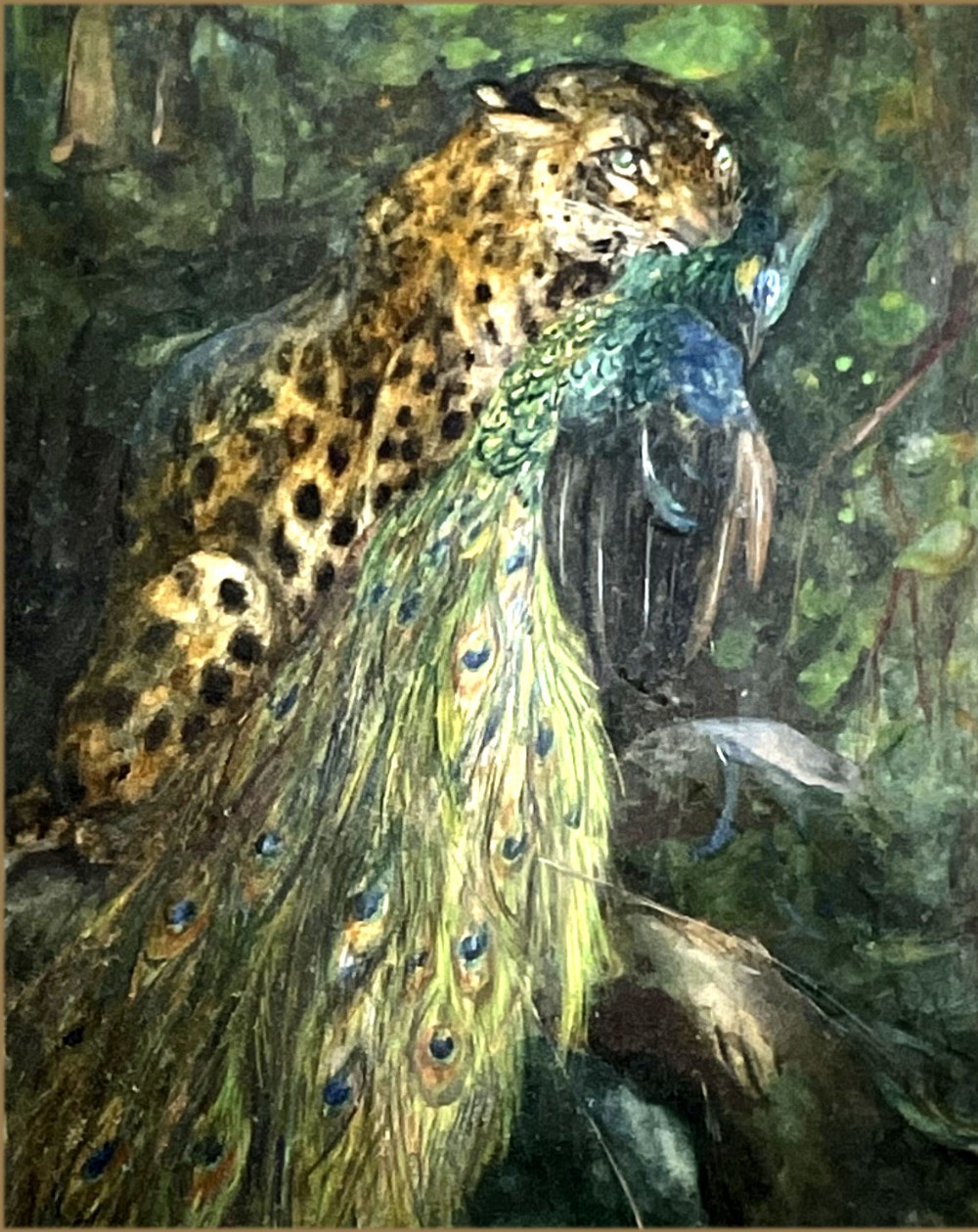
Archive II An oil painting depicting a spotted leopard perched in dense foliage holding a peacock with long green and blue tail feathers in its mouth. View II
Archive III An oil painting depicting a spotted leopard perched in dense foliage holding a peacock with long green and blue tail feathers in its mouth. View III
Enlarged Archival View
Telephone 07958 699 645
Location
18 La Gare
51 Surrey Row
London
SE1 0BZ
United Kingdom
Verified Since Sep 2008
Items For Sale 243
Items Sold 223
Artware Fineart
Verified Since Sep 2008
View Dealer Info
Location: 18 La Gare , 51 Surrey Row , London , SE1 0BZ , United Kingdom
Verified
Sep 2008
For Sale
243
Sold
223
An oil painting depicting a spotted leopard perched in dense foliage holding a peacock with long green and blue tail feathers in its mouth.
Cuthbert Edmund Swan, 1870-1931 A Leopard with a Peacock in a Tree
Ref: SA837763
An oil painting depicting a spotted leopard perched in dense foliage holding a peacock with long green and blue tail feathers in its mouth.
Detail View 1
Detail View 2
Archival Detail
Every single antique dealer on our platform is individually approved by our internal team. We verify their professional trade history, ethical standards, and photographic quality to ensure a secure, high-standard buying environment. Upon joining, every dealer agrees to a strict 9-point code of conduct. While issues can occasionally arise, our dealers typically resolve them swiftly and directly with the buyer. In fact, since our founding in 2002, Sellingantiques has only had to step in to help resolve an issue on roughly five occasions—a true testament to the quality of our dealers and their dedication to your happiness.
Our dealers are highly experienced in packing and shipping fragile, high-value antiques. Because you are in direct contact with the dealer, you will be able to easily go through all available shipping and insurance options together to ensure your item arrives safely.
Antiques are the ultimate green purchase. By choosing historical pieces over newly manufactured goods, you completely eliminate the carbon footprint of modern mass production while preserving exceptional, timeless craftsmanship.

The animalier movement emerged in the nineteenth century, focusing on anatomically precise depictions of wild and domestic animals within natural habitats. Artists emphasized realistic textures, dramatic compositions, and atmospheric lighting to capture animal behaviour.

Paintings from this period were typically executed using natural pigment-based oil paints applied to stretched flax linen or cotton canvas. The works were finished with natural tree resin varnishes, such as dammar or mastic, to seal and protect the paint layers.

Authentic period paintings display uniform age-related craquelure, natural darkening or oxidisation of the varnish layer, and historical stretching hardware on the timber stretcher bars. Signatures, inscriptions, and brushwork techniques consistent with known artist catalogues further verify authenticity.

A dark oil painting creates a focal point when mounted above dark wood panelling, a fireplace mantel, or painted accent walls in moody tones. Dedicated picture lighting highlights the subtle colour variations and detailed brushwork within dark compositions.

Keep the canvas away from direct sunlight, extreme temperature fluctuations, and high humidity to prevent cracking or warping. Dust gently with a soft, dry camel-hair brush, and consult a professional art conservator for varnish cleaning or structural repairs.
items
Add keywords to the filter
Price
£100
£250000
Era
Movements
Material
Origin
Stock Location
Freshness
Online Payments
Categories