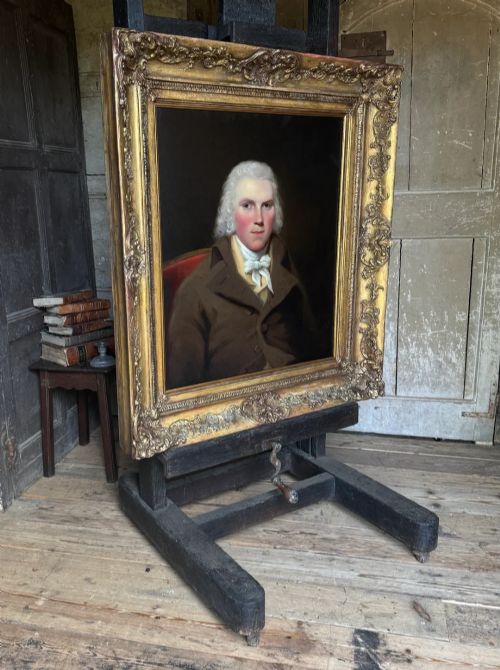
Artware Fineart has dated this Georgian Oil Portrait Painting to the 18th Century.
Portrait of Thomas Heath (1705-1759) Alderman and Merchant of Exeter
C.L. / B 1705 D 1759". "Thomas Heath / of Exeter / Alderman of Exeter / Portrait of / Benjamin Heath / D.C.L. / B 1705 D 1759"
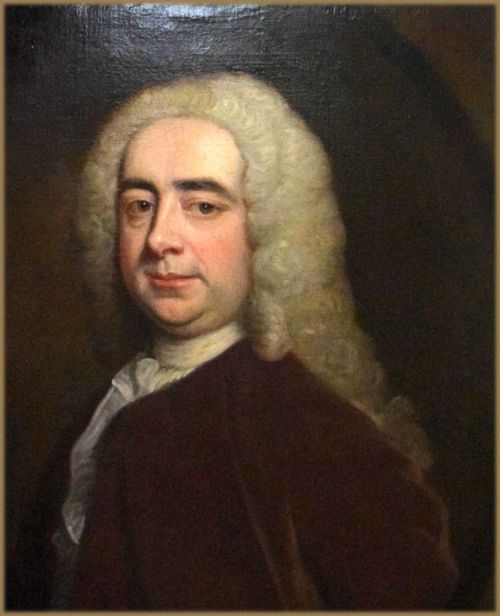
oil on canvas
30 x 25in. (76 x 64 cm.)
Thomas heath was born in 1705 and died in 1759. He had a brother, Benjamin who became a merchant and fuller in Exeter. He married Elizabeth Kelland. They had 5 children. One was a Thomas again. He was mentioned in his father's will in 1725 when he, Thomas, was still a minor. However, his birth date seems to be unknown although he was baptised on 11th October 1729 at St Leonard's, Exeter. He was a merchant and then an Alderman. He became Sheriff in 1732 and then Mayor in 1738 and 1749. He died on the 5th and buried on the 12th July, 1759. Thomas Heath had three wives: Anne Philip Pyne, m.19th December 1730 but died 29th December 1736. Next was Anne Maria Pyne, m.1737 and buried in St Leonards on 16th February 1754. Finally, there was Ann Gandy who he married on 17th July 1753. She was buried at St Leonard's, Exeter on 9th April 1754.
Benjamin Heath, 1704-1766, critic and book-collector, born at Exeter on 20 April 1704, was eldest son of Benjamin Heath, fuller and merchant of Exeter (born at Exeter about 1672, and died 28 May 1728), who married Elizabeth Kelland (buried at St. Leonard's, Exeter, in October 1723). His parents were probably nonconformists, as he was not baptised in St. Leonard's Church until 11 Oct. 1729, when both of them had died. He was educated at the Exeter grammar school, and is said to have been admitted as a student of the Middle Temple in 1721, and again in 1729. The family records assert that he completed his education at the university of Oxford, but his name does not appear in the printed matriculation lists. On his father's death he inherited the handsome fortune of 30,000l., and about 1730 set out on the ‘grand tour.’ His travels took him to Geneva, where he married Rose Marie, daughter of Jean Michelet, a Genevese merchant, on 12 Aug. 1732, less than two months after she had passed the age of fourteen. In 1725 he had been sworn as a freeman of the Weavers' Company at Exeter, but his taste was not for business or a profession, and when he returned to England he abandoned his intention of being called to the bar, and settled in Exeter, where his chief pleasures lay in literature and book-collecting. Dibdin prints in the ‘Bibliomania’ (pp. 554-62) a long letter written by Heath from that city in 1738, with a lengthy list of books that he wished to buy. In 1740 he made his first appearance as an author with ‘An Essay towards a Demonstrative Proof of the Divine Existence, Unity, and Attributes,’ dedicated to William Oliver, a physician at Bath. It is said to have followed the lines laid down in the ‘Living Temple’ of John Howe, the puritan divine. He was elected on 23 March 1752 to the post of town clerk of Exeter, and held it until his death. All his life he studied the classical writers, and the fruit of his labours was shown in the volume of ‘Notæ, sive Lectiones ad Æschyli, Sophoclis, Euripidis quæ supersunt dramata deperditorumque relliquias,’ which was published at Oxford in 1762. On 31 March in the same year the university of Oxford conferred on him the degree of D.C.L. Parr, in a letter to Gilbert Wakefield (WAKEFIELD, Memoirs, ii. 439), speaks with indignation of the ‘arrogant and contemptuous’ terms applied to Heath by the German scholar Hermann in his ‘Observationes Criticæ’ (p. 59), and his note on verse 1002 of the ‘Hecuba.’ Heath's object was to restore the metre of the Greek tragedies. At home his observations were highly valued, and he was asked to furnish the notes for the Greek tragedies in use
Artware Fineart has dated this Georgian Oil Portrait Painting to the 18th Century.
You can view the stock and full dealer information on the Artware Fineart Profile Page

Thomas Hudson, 1701 - 1779 Portrait of Thomas Heath (1705-1759) Alderman and Merchant of Exeter