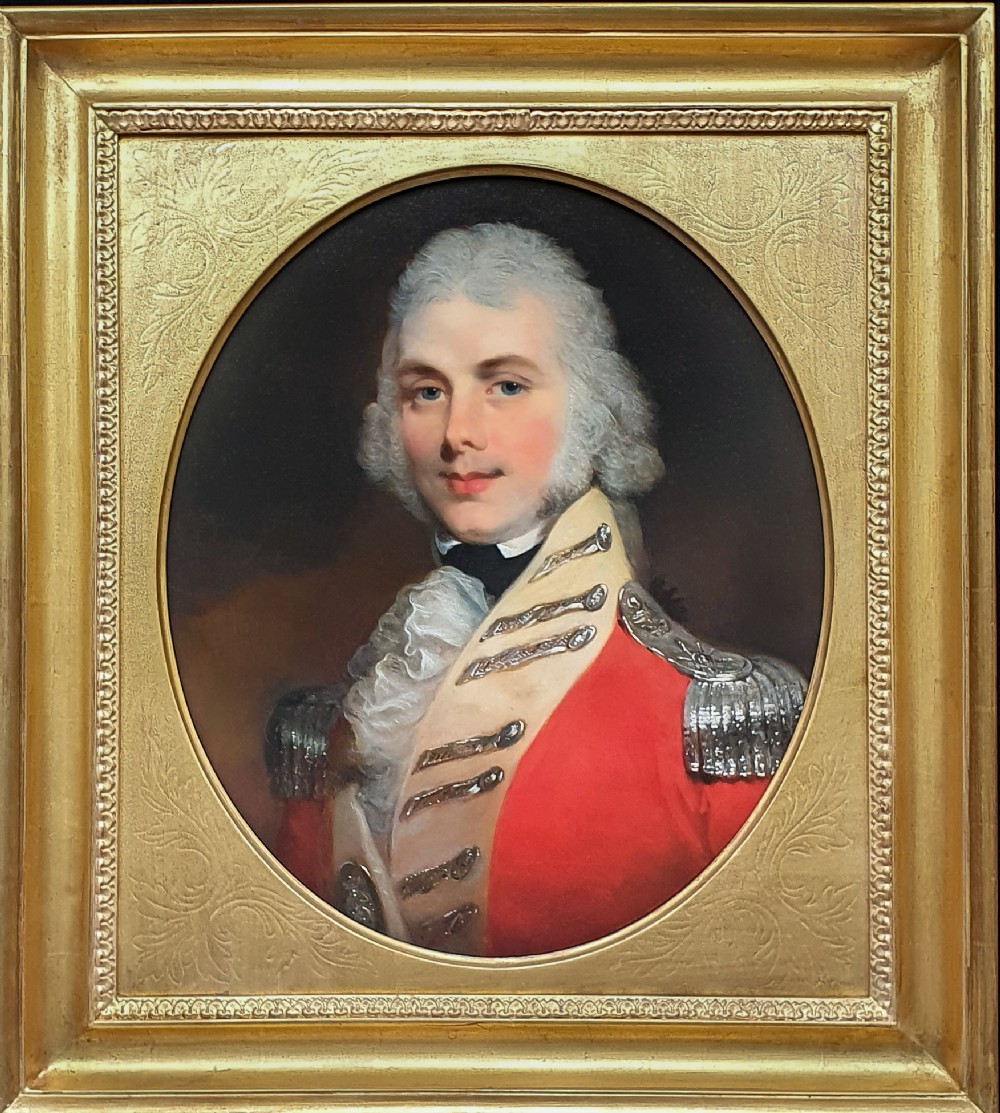
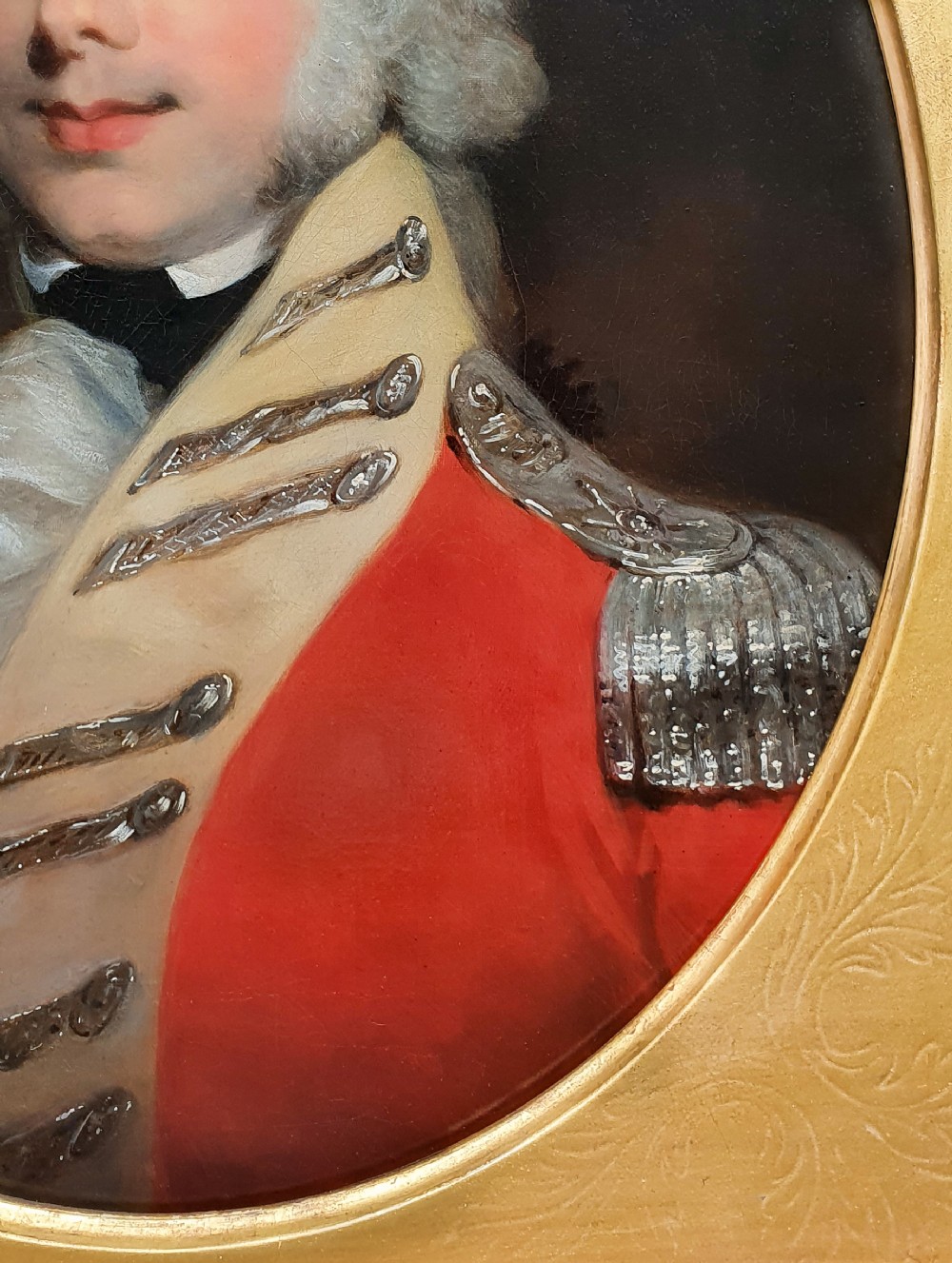
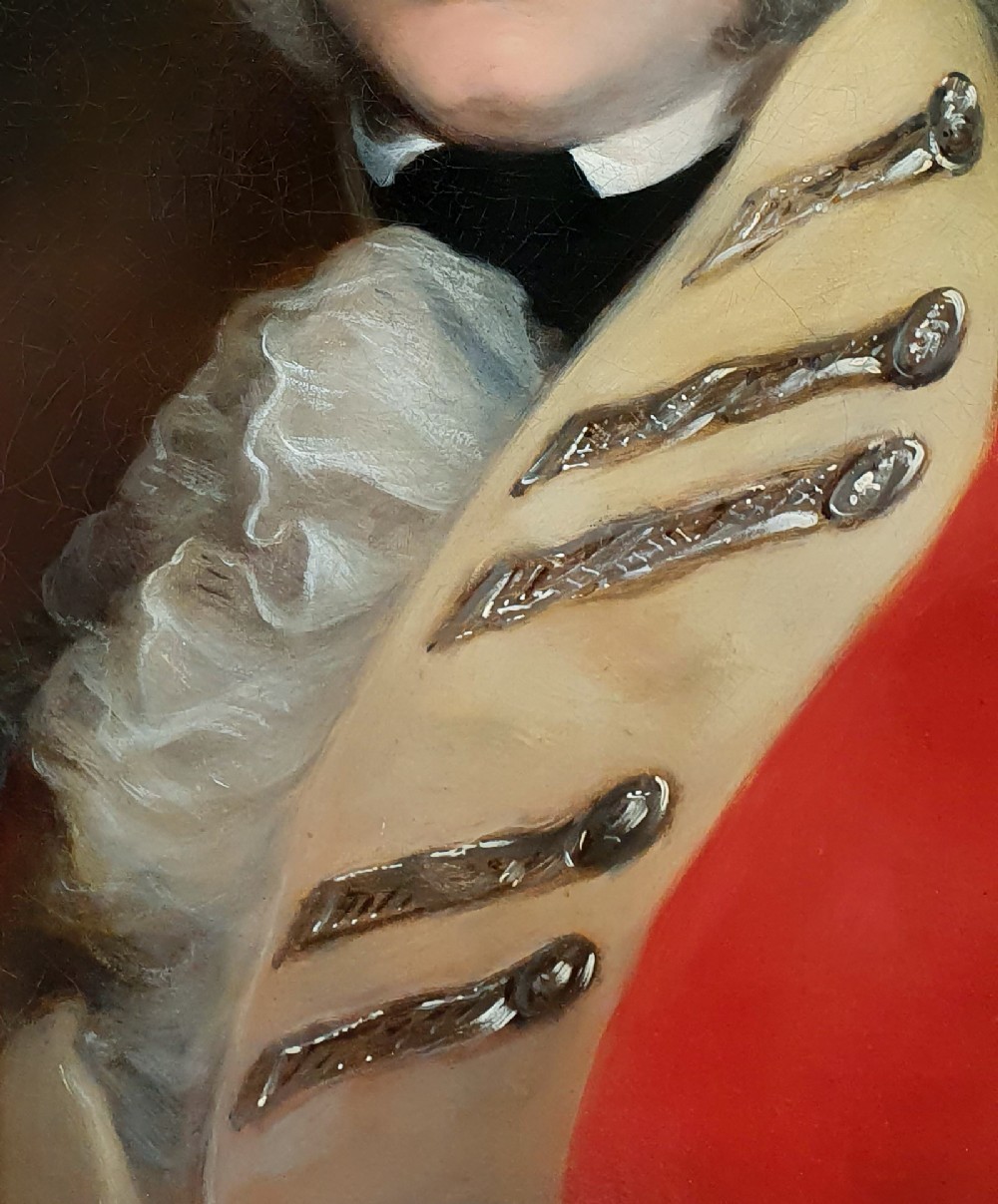
This exquisite portrait bears testimony to the artist’s ability to convey not just a likeness but something of the character of the sitter – self-assured, but there is also a sense of warmth. The red scarlet cloth and the silver detail against the dark background are an apparently effortless harmonisation of tones, and they create a striking image.
The dashing young officer wears an elaborate scarlet coat with a high standing collar dark mustard lapels worn over a white linen shirt with a sheer frill down the front - popular in the late 18th century. He also wears a sash and badge over his right shoulder and fringed silver epaulettes, denoting his rank, which is thought to be Captain.
During this period, younger men of fashion began to wear their hair in short curls, often with long sideburns. In our portrait, rather than a wig, the sitter wears his own hair, long, powdered and, brushed back from the forehead and tied at the nape of the neck (clubbed) with a black ribbon, whic
...h became fashionable by c.1795. However, a hair powder tax in 1795 effectively ended the fashion for wigs and powder but older men, military officers, and those in conservative professions such as lawyers, judges, physicians, and servants retained their wigs and powder. This portrait can be dated between 1795 and 1808 when the army stopped using the queue.
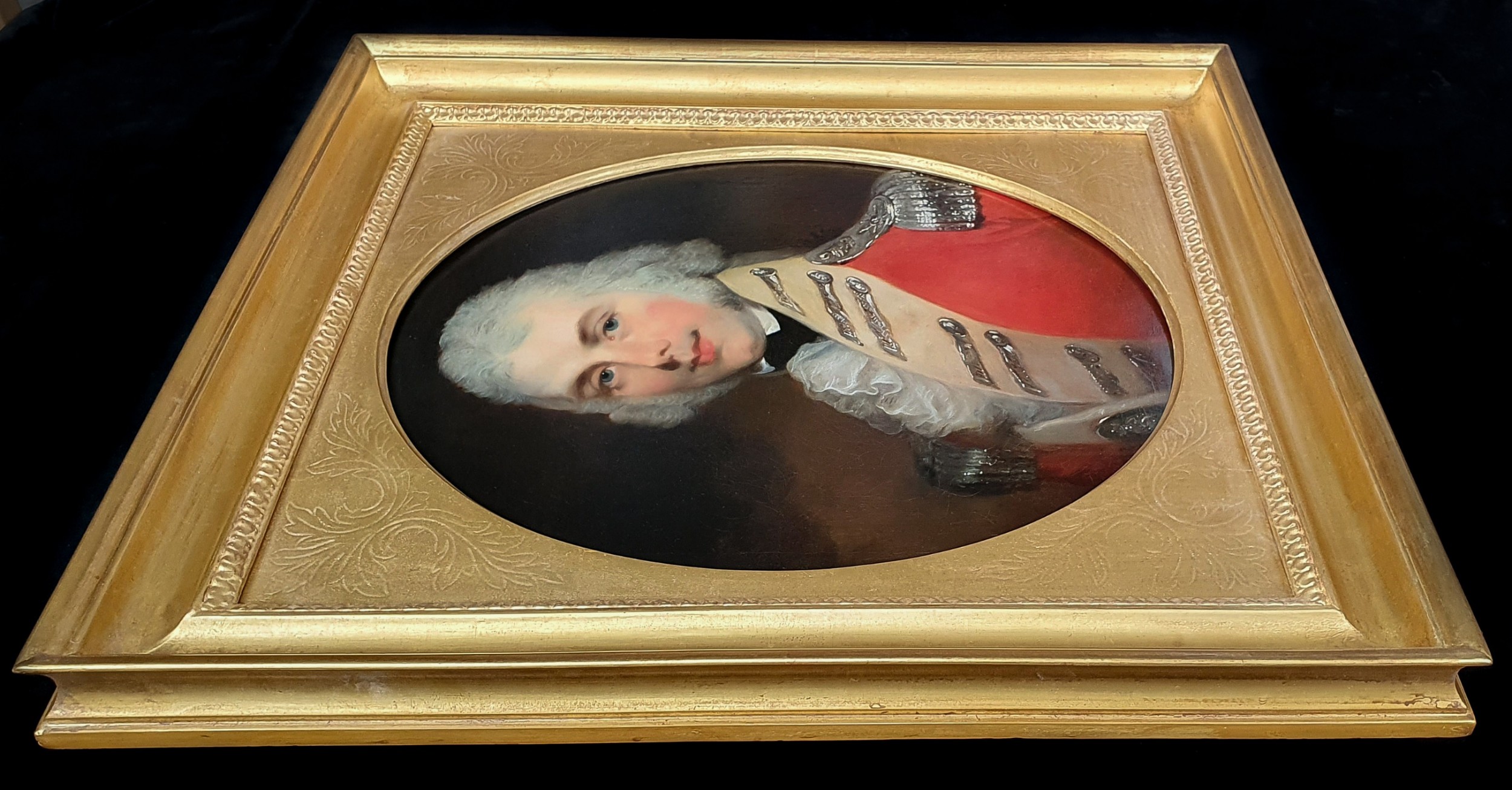
Held in a good quality gilded antique frame.
Sir William Beechey was a successful portrait painter with unparalleled royal patronage. His intended legal career was cut short by a chance meeting with students of the Royal Academy Schools and in 1772 Beechey entered the schools himself. He first exhibited at the Royal Academy in 1776. After five years in Norwich, he moved back to London in 1787 where he stepped into the vacuum left by Gainsborough’s death and Reynolds’ retirement. He gained a reputation for straight-forward, unpretentious and careful portraiture and in 1793 he was appointed painter to Queen Charlotte. Not long afterwards he was made a member of the Royal Academy – on King George’s request, it was rumoured – but he fell from royal favour in 1806. He continued to exhibit at the Academy until the year before his death.
An old label on the reverse from John Mathieson & Co, 20 Frederick Street, Edinburgh EH2 2JS (John Mathieson & Co. operated in the early 1930’s and continued to at least the 1940’s).
Provenance: Private collection in the south of England for at least three generations
Much more info about this item at: www.titanfineart.com
In a market saturated with available paintings, Titan Fine Art offers a distinct advantage: we sift through thousands of works to provide a specially curated selection. Each piece is meticulously chosen based on technical merit, provenance, and decorative appeal, ensuring our clients view only the finest examples of British and European art.
With over 20 years of expertise and 1,000+ works placed with collectors and institutions, we are one of the most prolific specialists in 17th and 18th-century portraiture. We combine a scholarly approach with museum-level rigor to replace the uncertainty of the open market with absolute confidence.
Why Buy From Titan Fine Art?
• Expertly Curated Selection
We act as your expert eye, selecting only high-quality works that offer genuine historical and artistic value.
• Museum-Level Research
Each portrait is supported by extensive academic research, often exceeding 40 hours, to establish attribution, sitter identity, and historical context.
• Professional Conservation
All paintings are carefully cleaned and stabilised by professional conservators, and are presented ready to hang.
• Transparent Pricing
No buyer’s premium or hidden fees—unlike auction houses, where additional costs can add 25–35%.
• Export Pricing Advantage
Reduced pricing is available for works exported outside the UK.
• Specialist Global Shipping
We manage the entire process, including custom crating, export documentation, and fully tracked delivery worldwide.
• Buy with Confidence
A 7-day return policy and the option to pay in GBP, USD, or EUR for convenience and transparency.
• Original Period Frames
Many works retain their original carved and gilded frames, which are works of art in their own right and enhance both historical authenticity and decorative impact.
• Personal Advisory Service
We work directly with collectors and interior designers, offering guidance on selection, scale, and placement—including bespoke room mock-ups on request.
Subscribe to our monthly 'new item alert' to be the first to hear about new worksAntique ID Number (AIDN): SA822966
Dateline of this antique is 1800
Height is 71cm (28.0inches)Width is 64cm (25.2inches)Depth is 8cm (3.1inches)







Thank you.
Your comment has been sent to Sellingantiques.