
/18th c.
The portrait is not an exact copy of any known Van Dyck portrait of the queen, but is clearly based on Van Dyck's work.
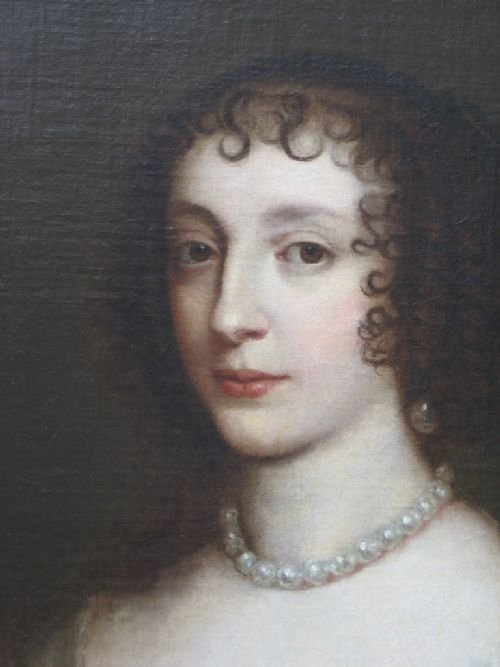
HENRIETTA MARIA of France (1609 – 1669) was the Queen consort of England, Scotland and Ireland as the wife of King Charles I. She was mother of two kings, Charles II and James II and grandmother of two queens and one king, Mary II, William III and Anne of Great Britain as well as paternal aunt of Louis XIV of France.
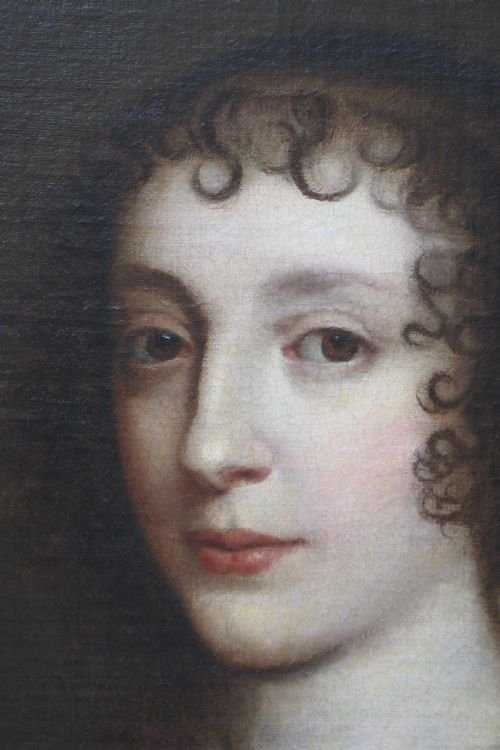
Her Catholic religion made her unpopular in England, and also prohibited her from being crowned in an Anglican service; therefore she never had a coronation. She began to immerse herself in national affairs as civil war loomed on the horizon, when the English Civil War began in 1642, Henrietta Maria was in Europe.
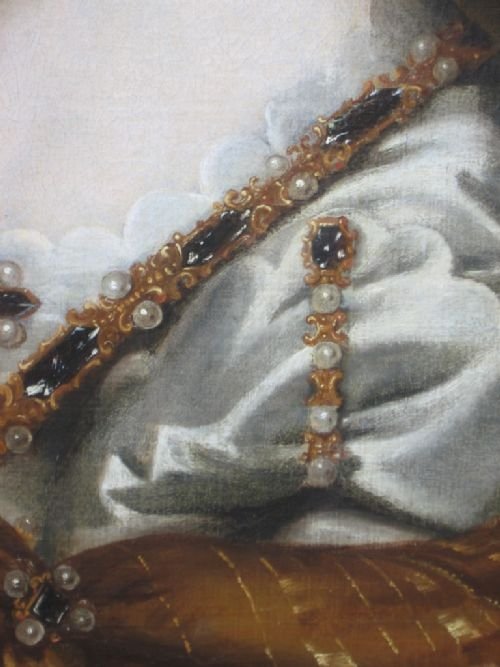
She returned to England in 1643 when she landed in Yorkshire with troops. She joined up with Royalist forces in the north and made her headquarters in York. She moved to Oxford to be with Charles but fled to France in July 1644 following the birth of her youngest daughter, Henrietta Anne when the position of the Royalists looked bleak; here she remained along with her sons.
Her husband's execution in 1649 was a terrible blow. She brought up her youngest child Henrietta in her own faith, but her efforts to persuade her youngest son, the Duke of Gloucester, to take the same course only produced discomfort in the exiled family.
The story of her marriage with her attached servant Lord Jermyn needs more confirmation than it has yet received to be accepted, but all the information which has reached us of her relations with her children points to the estrangement which had grown up between them.
After the Restoration she returned to England when she found that she had no place in the new world. She received from Parliament a grant of £30,000 a year in compensation for the loss of her dower-lands, and the King added a similar sum as a pension from himself.
In January 1661 she returned to France to be present at the marriage of her daughter Henrietta to the Duke of Orleans.
In July 1662 she set out again for England, and took up her residence once more at Somerset House. Her health failed her, and on the 24th of June 1665, she departed in search of the clearer air of her native country.
She died on the 31st of August 1666, at Colombes, not far from Paris.
SIZE: Canvas 28 x 23 inches (old extension top and right)
Framed 33.5 x 25.25 inches
PROVENANCE:
Printed label verso 'DASHWOOD HEIRLOOM No. 74'. Old handwritten label 'Lord Lansdens(?) 7'.
Presumably by descent to John Vernon of Wherstead Park (1776-1818) from his uncle General Charles Vernon (1719-1810) "all my family pictures together with all those of Royal Personages to be kept and preserved by him as heirlooms".
By inheritance at Wherstead Park, to his sister
Lady Harland (née Arethusa Vernon) (1777-1860), wife of Sir Richard Harland, Bt. (d. 1848), Wherstead Park,
to her first cousin Charles Vernon, formerly Charles Jenkin (1790-1863), Wherstead Park, and by inheritance to
Charles Edmund Dashwood (1857-1935), Wherstead Park, Ipswich ('The Dashwood Heirlooms'); Christie's, London, 26 June 1914.
Christie's London 20 October 1967 £84
Christie's London 29 January 1988 £1050
Roy and nadine precious: specialists in portraiture from the 16th to the 20th century. Established in 1972.
You can view the stock and full dealer information on the Roy Precious - Antiques & Fine Art Profile Page
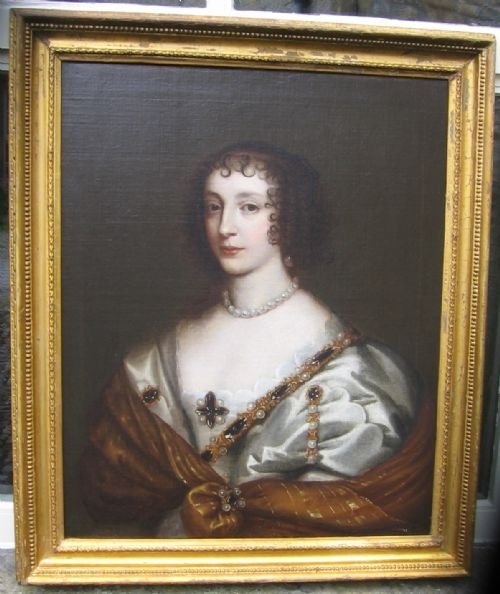
Sold...portrait of Queen Henrietta Maria; Follower of Van Dyck
