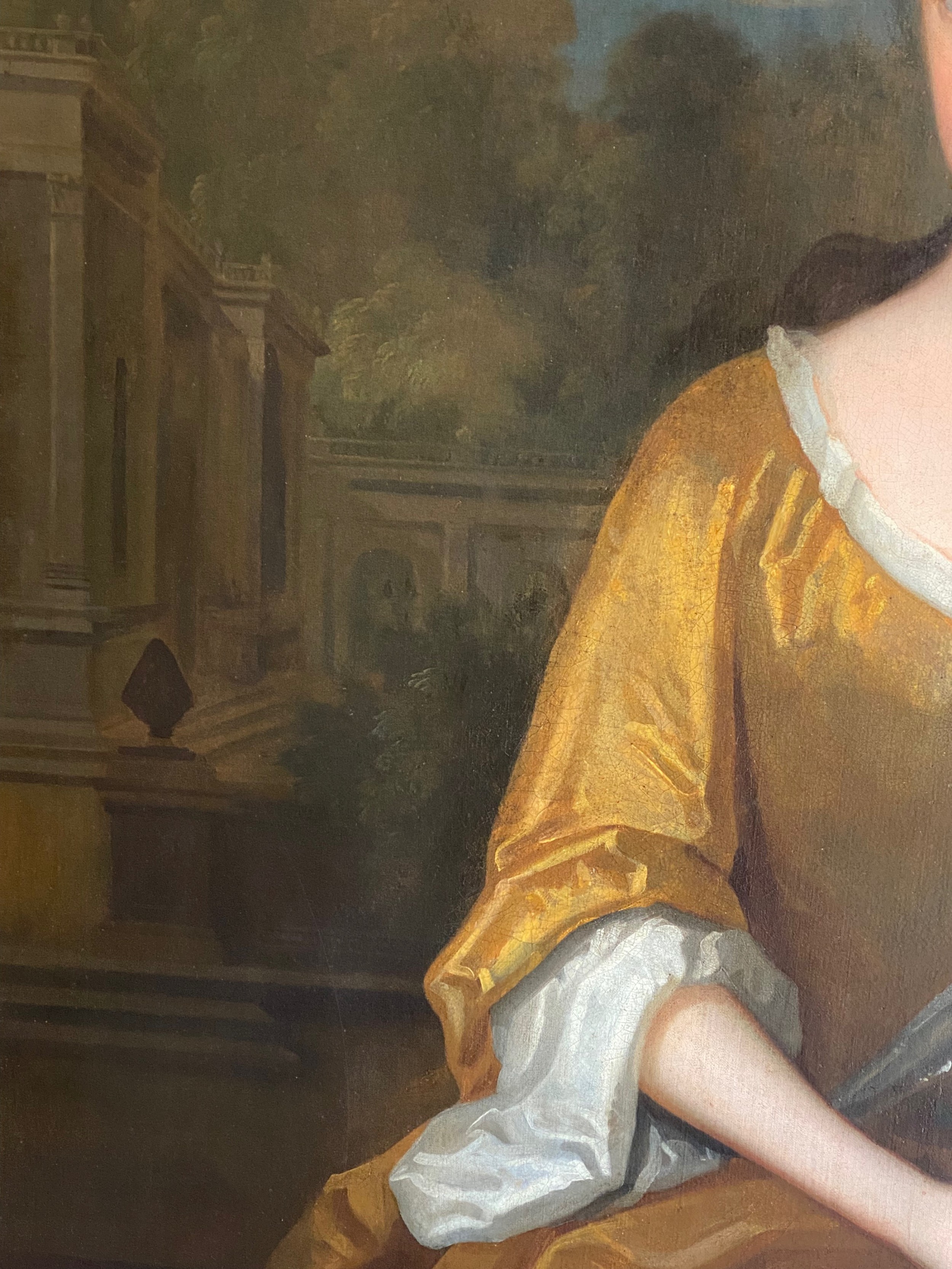
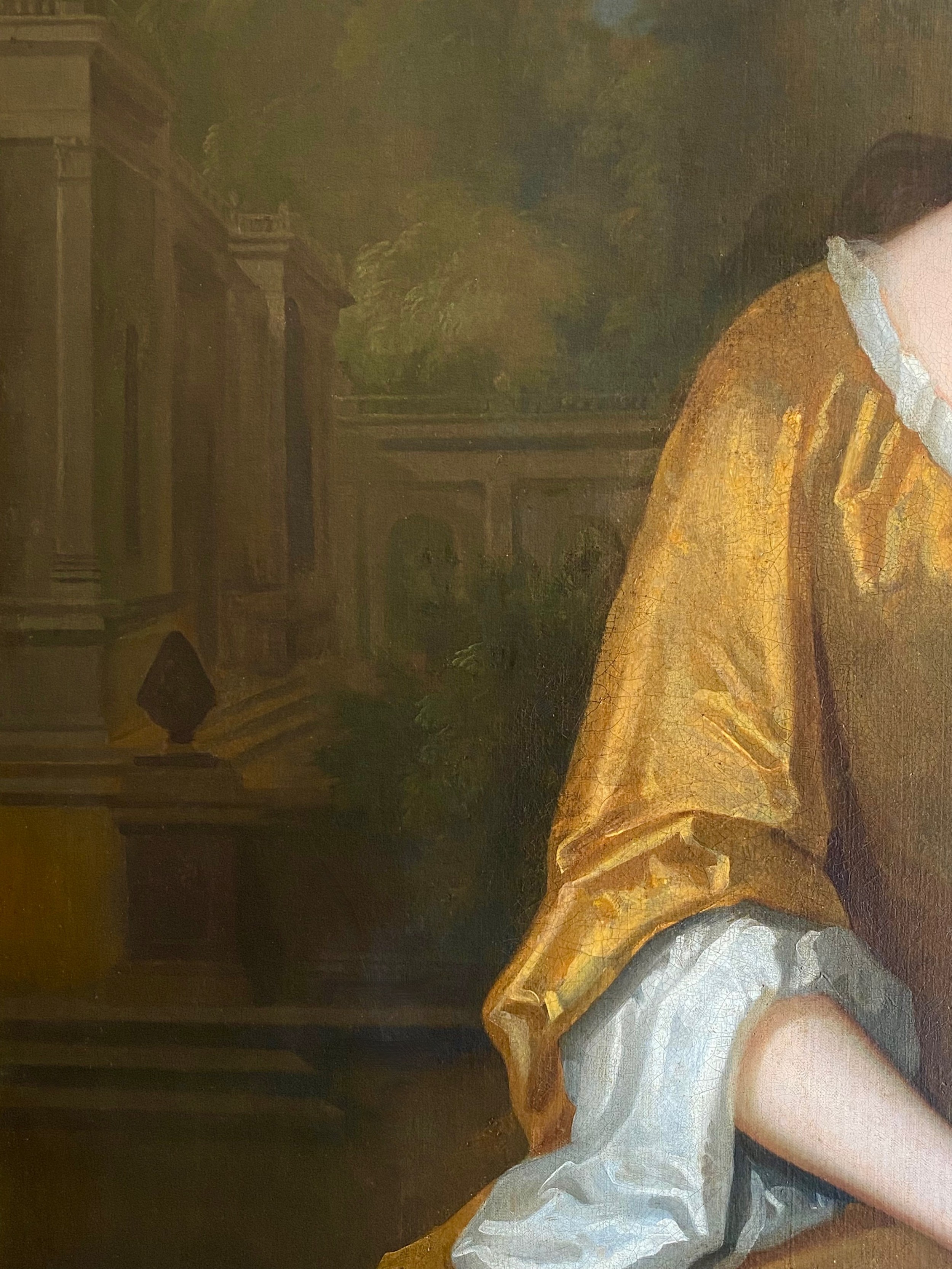
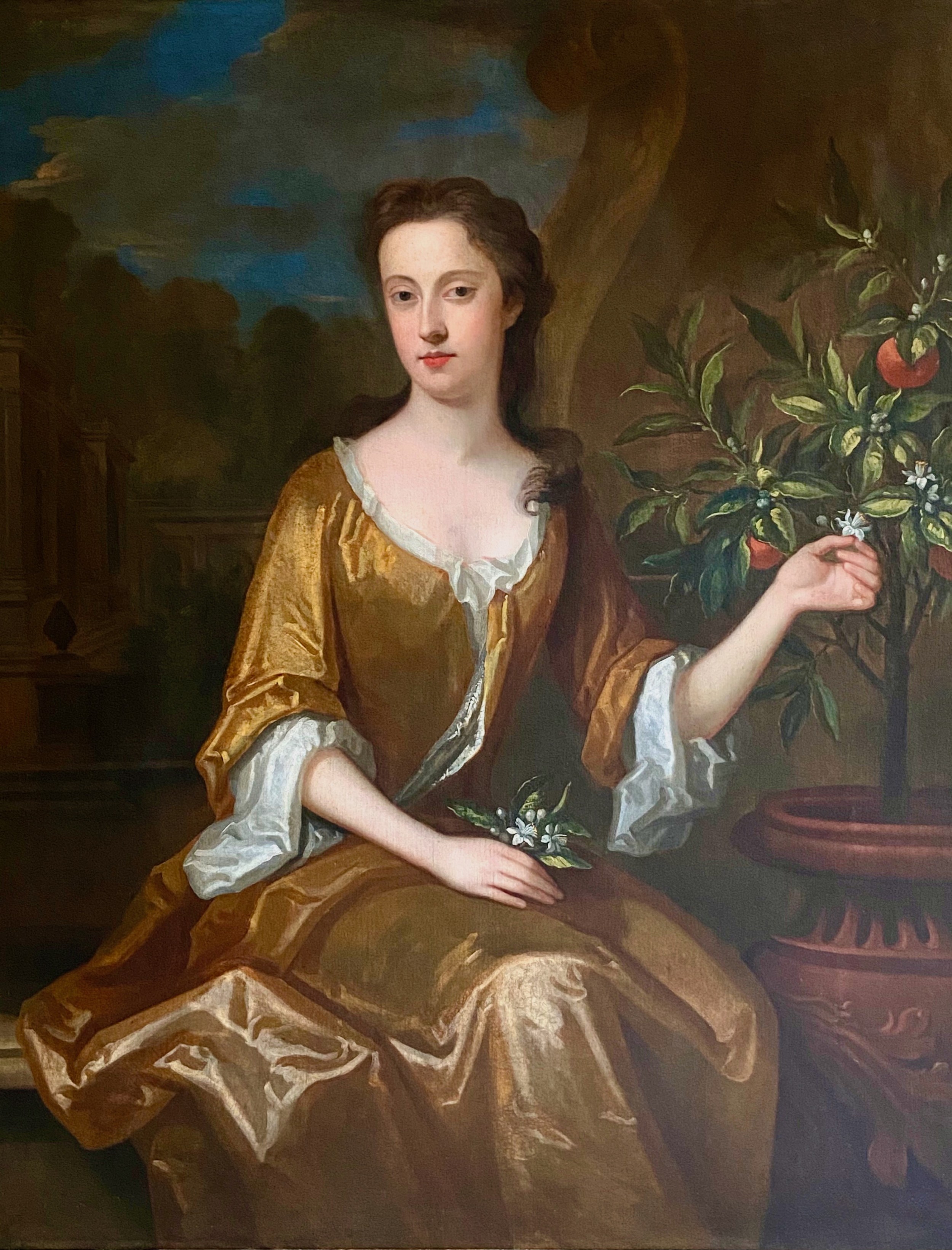
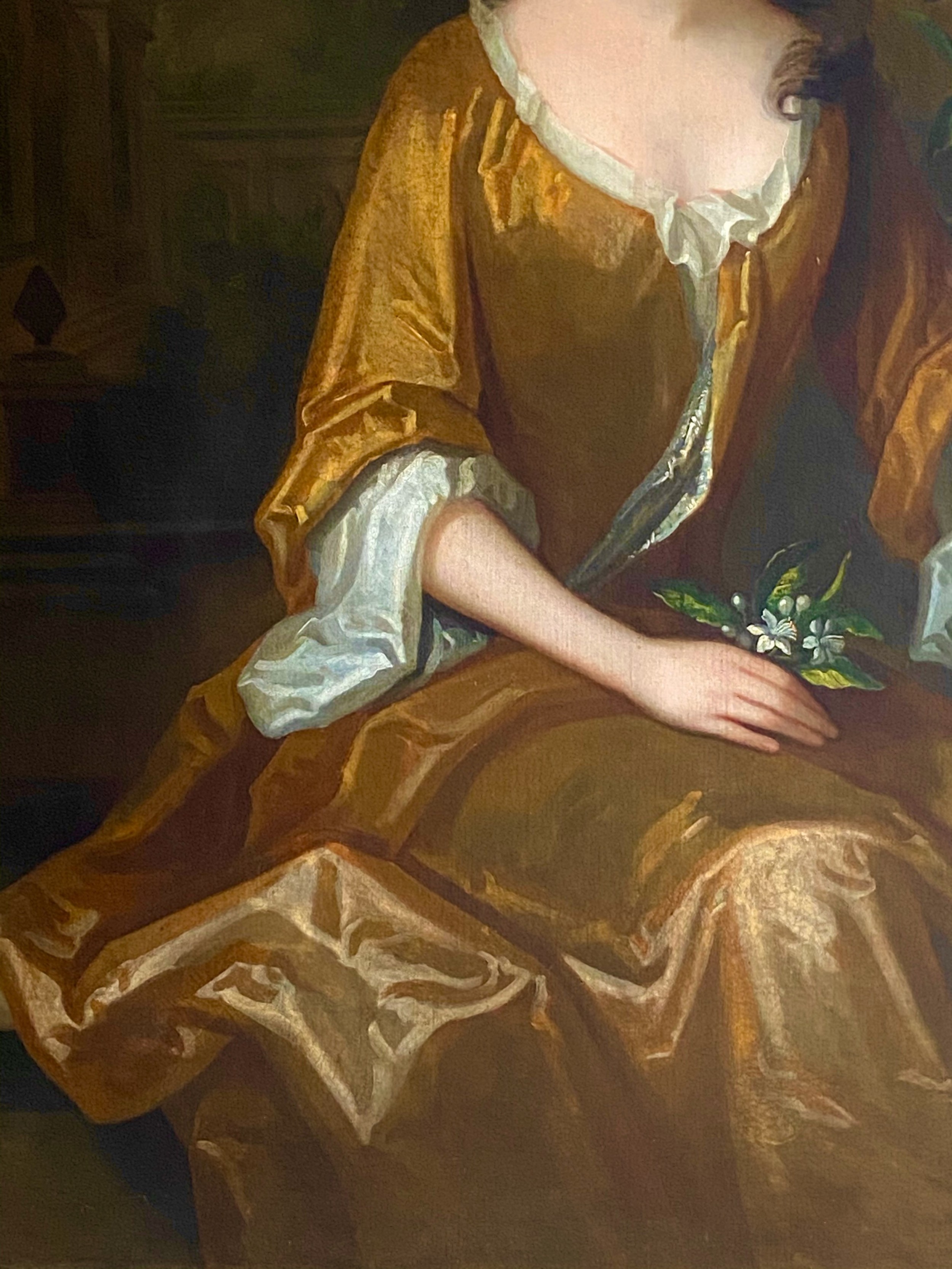
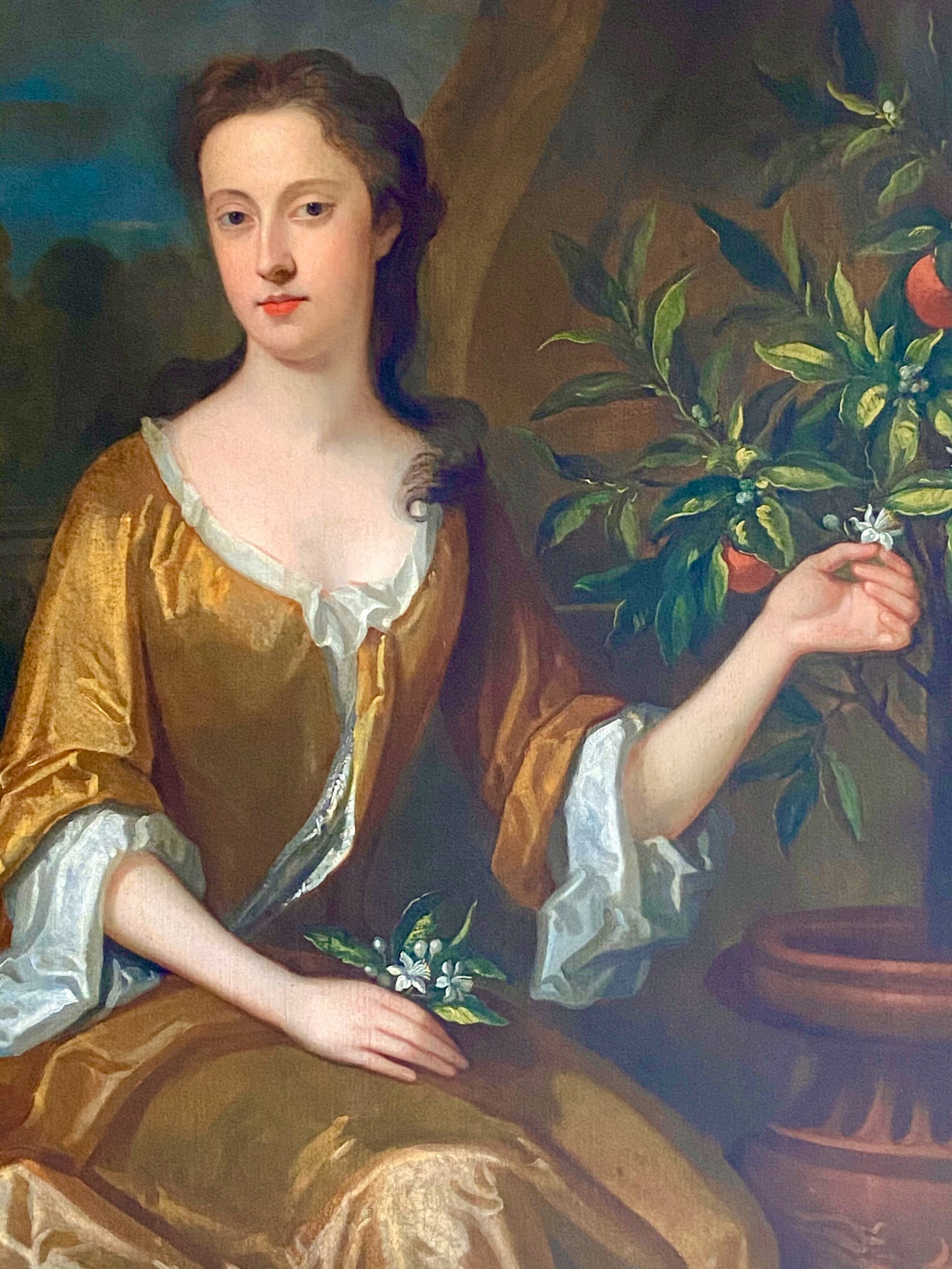
Fine, richly coloured and sensitively rendered late 17th century English portrait of a beauty. The elegant dark haired sitter is pictured three quarter length within a landscape wearing a gold dress and white chemise.
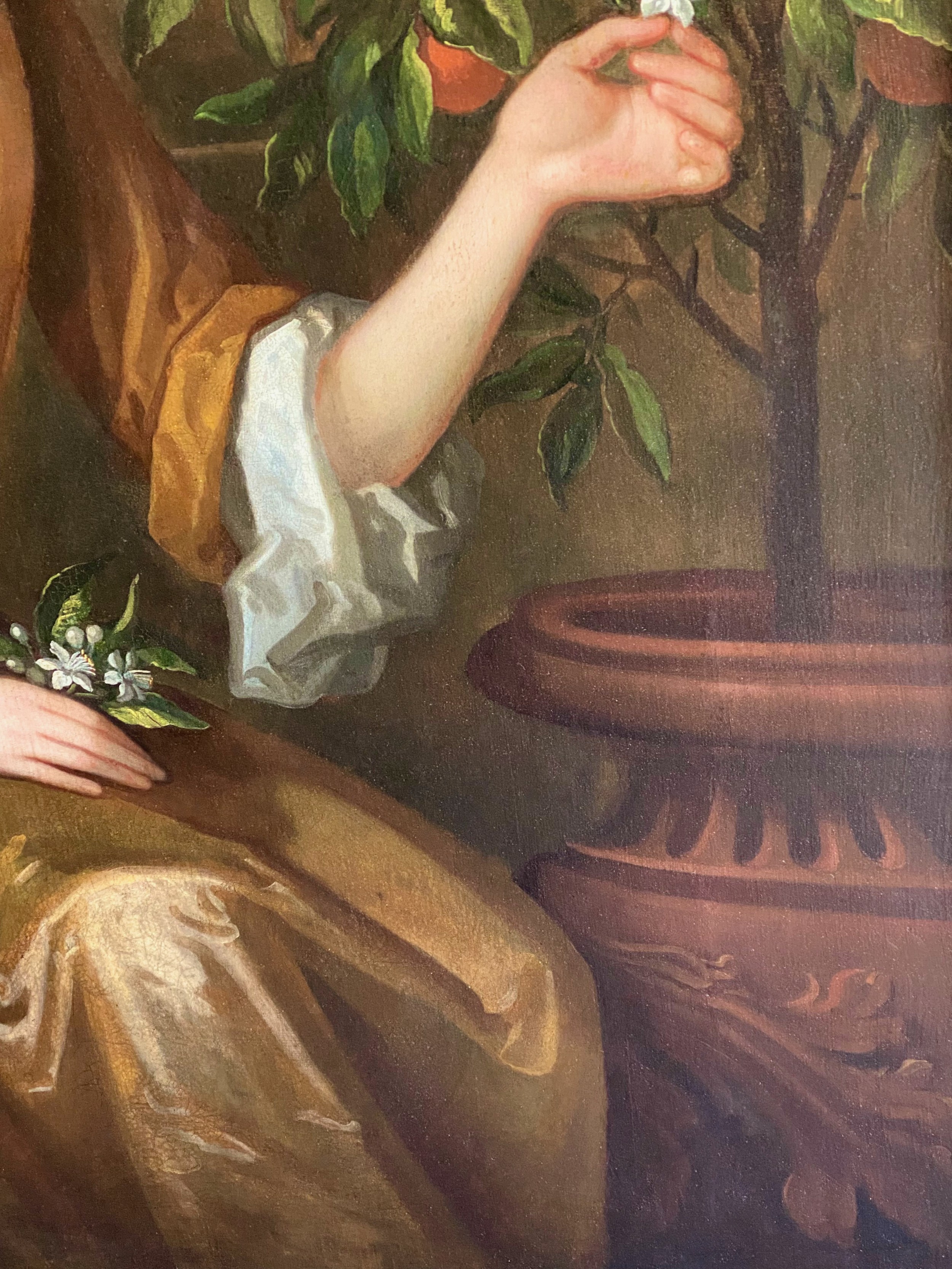
Gesturing towards an urn containing any orange tree she plucks a prominent piece of blossom and a dainty spring is also placed upon her lap.With her neck slightly inclined to the left she fixes us with the most pleasing of expressions.
Behind her is an extensive landscape with architectural details and topiary.
In seventeenth century England, citrus trees such as the example seen here were often grown in large pots which were kept outside in the summer and wheeled back indoors into a heated orangery to over winter.
The fact that she is plucking the blossom may itself be an allusion to marriage. In art orange blossom signifies eternal love. It also speaks of youth and freshness, whilst the fruit itself speaks of fertility
So the inclusion of such fruit i
...n this portrait is also an indication of the sitters wealth and and social status by virtue of the great expense and difficulty with with which it was grown in England in the seventeenth century, to great wealth. he blossom she holds is possibly orange blossom which was often used to symbolise the purity and youth of the sitter and her availability for marriage.
Charles Jervas (c. 1675 – 1739)
Jervas was an Irish portrait painter, translator, and art collector.
Born in County Offaly, Ireland around 1675, Jervas studied in London, England as an assistant under Sir Godfrey Kneller between 1694 and 1695.
Painting portraits of the city''s intellectuals, among them such personal friends as Jonathan Swift and the poet Alexander Pope (both now in the National Portrait Gallery, London), Charles Jervas became a popular artist often referred to in the works of literary figures of the period.
Jervas gave painting lessons to Pope at his house in Cleveland Court, St James''s, which Pope mentions in his poem, To Belinda on the Rape of the Lock, written 1713, published 1717 in ''Poems on Several Occasions''.
With his growing reputation, Jervas succeeded Kneller as Principal Portrait Painter to King George I in 1723, and continued to live in London until his death in 1739, although he made made lengthy visits to Ireland.
Higher resolution images on request.
Worldwide shipping available
Canvas: 50” x 40'' / 127cm x 102cm.
Frame: 56,5” x 46,5” / 144cm x 118cm.
Internal Reference: REF. PP000146
Antique ID Number (AIDN): SA805312
Dateline of this antique is 17th Century
Height is 144cm (56.7inches)Width is 118cm (46.5inches)Depth is 5cm (2.0inches)






Thank you.
Your comment has been sent to Sellingantiques.