

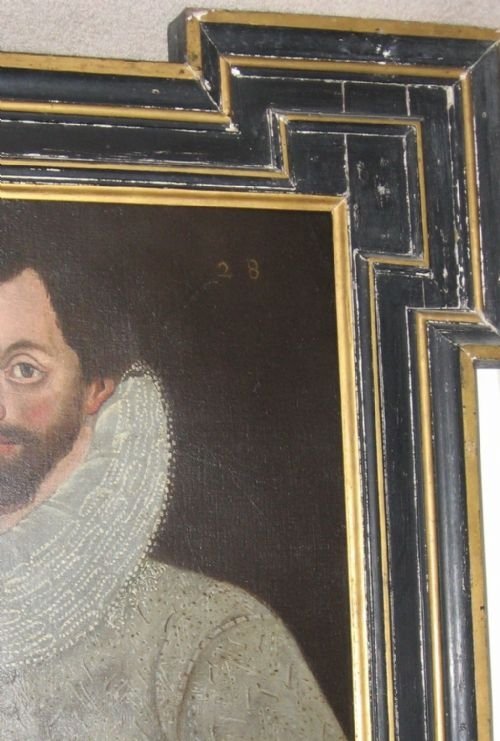
To the right, the number 28, almost certainly the age of the sitter.
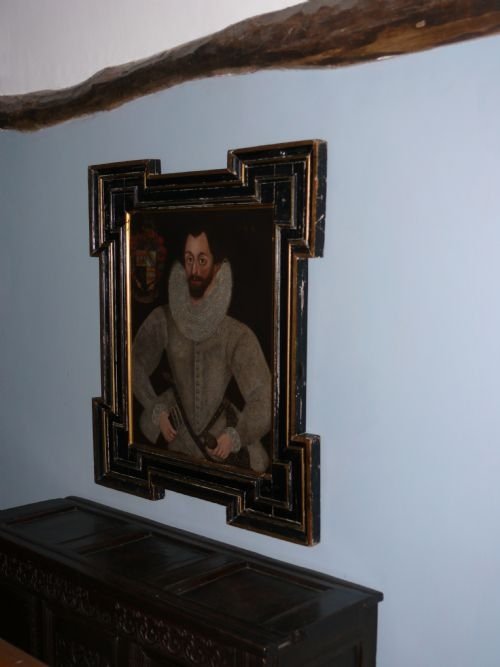
The portrait sits within a good, distressed, black and gilt 'cassetta' frame.
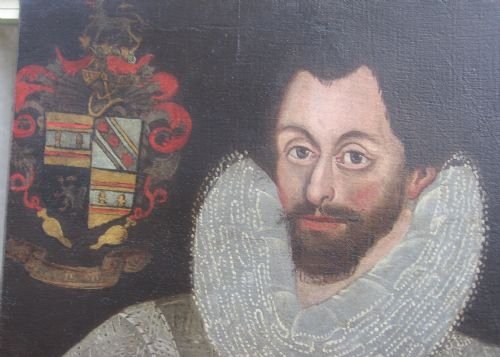
This charming naïve portrait would have been painted by an itinerant painter moving from town to town. Self taught, they made portraits of the local gentry, and also painted inn signs.
Elizabethan and Jacobean 'primitive' portraits are very rare indeed as few have survived; they have a real directness and sense of period, as well as being highly decorative.
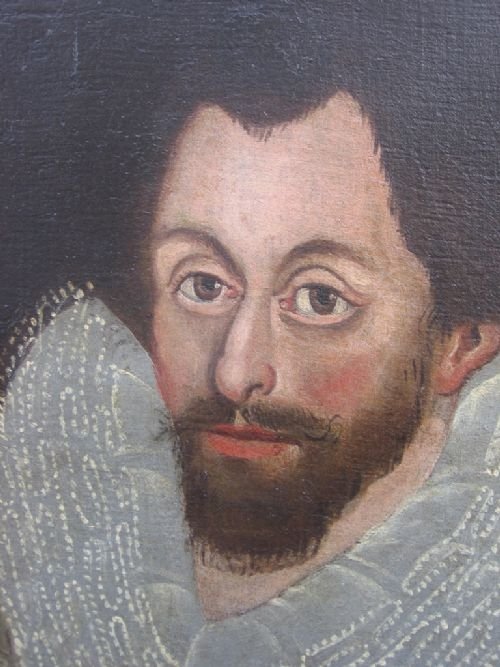
In all Elizabethan portraiture, including that of the Court, the image was always iconic, symbolising power, wealth and lineage and all these factors are present in this limner painting.
The family's heraldry is proudly emblazoned to the left and the sitter's expensive clothing and sword and dagger are shown whilst he holds his gloves in his right hand.
Weapons show that this is a gentleman, legally entitled to bear arms, and the gloves were a very expensive item and very important in Elizabethan upper class society being used as gifts, love tokens and even to issue a challenge.
Naïve though this portrait is the untutored artist has managed to capture a real sense of this young man's strong character; his eyes look directly at the viewer, with just a hint of the poetic melancholy so fashionable at the time.
The WEAVER FAMILY were of Norman extraction; they came to England in 1066 and were in Wales before 1200.
Humphrey Weaver was the first to use the Weaver name in c.1265 in Radnorshire, Wales.
The family were, for centuries, to be found principally in the three counties bordering Wales, viz. Cheshire, Shropshire and Herefordshire, but were also in London.
Their name was taken from the Manor of Weever, near Middlewick, Cheshire, held by the service of providing two fully equipped men-at-arms to help garrison Aldford Castle for forty days in time of war. They had a chapel in the churchyard of Middlewick, of which nothing remains, and the manor was sold in 1720 to the Wilbraham family by the Stanleys of Alderley Park, into whose possession it had come by descent.
A branch of the family moved to America in 1590 – Clement Weaver was settled in Waterton, Massachusetts by 1635.
Thomas Weaver, Attorney General in the Leeward Islands, West Indies became governor of Fort James in the Gambia, Africa where he was killed during a French raid in 1705.
Samuel Weaver became a freeman of the city of New York, April 10 1722.
SIZE: 30 x 24 inches unframed
42 x 36 inches framed
PROVENANCE: By repute, by descent through the family;
Welsh Private Collection since 1999.
Roy and nadine precious: specialists in portraiture from the 16th to the 20th century. Established in 1972.
You can view the stock and full dealer information on the Roy Precious - Antiques & Fine Art Profile Page
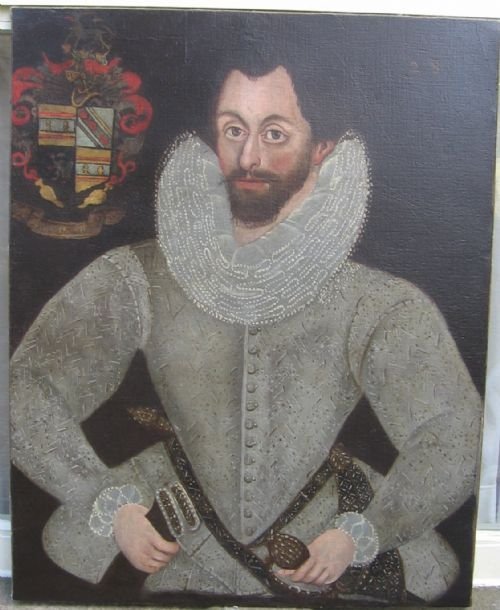
Sold....portrait of a Gentleman of the Weaver Family, C.1590-1610, British School.
