30,256  PAGES BROWSED TODAY PAGES TODAY 77  ANTIQUES UPLOADED TODAY NEW ARRIVALS
ID #SA77040
FOR SALE
£2,500
Email
Save
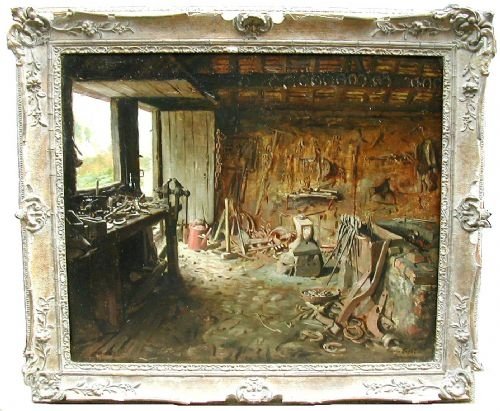
The Blacksmith's Forge by George Harcourt Sephton (1885-1923)
Artware Fineart
for sale €2,925     $3,175
£2,500

Artware Fineart

Sellingantiques Verified Since Sep 2008
View Dealers Stock Page
Id #SA77040
PDF SHARE
SAVE

The Blacksmith's Forge by George Harcourt Sephton (1885-1923)

1900 - 1920
For Sale by Artware Fineart
Description

Oil on canvas

Size: 50.80 x 60.96cm; 20.00 x 24.00ins

signed

A forge is both the workplace and hearth of a smith or a blacksmith. The workplace is sometimes referred to as a smithy. The basic smithy contains a forge, also known as a hearth, for heating metals. The forge heats the workpiece to a malleable temperature (a temperature where the metal becomes easier to shape) or to the point where work hardening no longer occurs. The workpiece is transported to and from the forge using tongs. The tongs are also used to hold the workpiece on the smithy's anvil while the smith works it with a hammer. Finally the workpiece is transported to the slack tub, which rapidly cools the workpiece in a large body of water. The slack tub also provides water to control the fire in the forge. A forge typically uses bituminous coal, industrial coke or charcoal as the fuel to heat metal. The designs of these forges have varied over time, but whether the fuel is coal, coke or charcoal the basic design has remained the same.
A forge of this type is essentially a hearth or fireplace designed to allow a fire to be controlled such that metal introduced to the fire may be brought to a malleable state or to bring about other metallurgical effects (hardening, annealing, and drawing temper as examples). The forge fire in this type of forge is controlled in three ways: 1) amount of air, 2) volume of fuel, and 3) shape of the fuel/fire. A forge fire for hot working of metalOver thousands of years of forging, these devices have evolved in one form or another as the essential features of this type of forge:
Tuyere -- a pipe through which air can be forced into the fire

Bellows or blower -- a means for forcing air into the tuyere

Firepot or hearth -- a place where the burning fuel can be contained over or against the tuyere opening.
During operation, fuel is placed in or on the hearth and ignited. A source of moving air, such as a fan or bellows, introduces additional air into the fire through the tuyere. With additional air, the fire consumes more fuel and burns hotter.

A typical Scottish smithy at Auchentiber, North Ayrshire, Scotland.A blacksmith balances the fuel and air in the fire to suit particular kinds of work. Often this involves adjusting and maintaining the shape of the fire. In a typical, but by no means universal, coal forge, a firepot will be centered in a flat hearth. The tuyere will enter the firepot at the bottom. In operation, the hot core of the fire will be a ball of burning coke in and above the firepot. The heart of the fire will be surrounded by a layer of hot but not burning coke. Around the unburnt coke will be a transitional layer of coal being transformed into coke by the heat of the fire. Surrounding all is a ring or horseshoe-shaped layer of raw coal, usually kept damp and tightly packed to maintain the shape of the fire's heart and to keep the coal from burning directly so that it "cooks" into coke first. If a larger fire is necessary, the smith increases the air flowing into the fire as well as feeding and deepening the coke heart. The smith can also adjust the length and width of the fire in such a forge to accommodate different shapes of work. The major variation from the forge and fire just described is a 'back draft' where there is no fire pot, and the tuyere enters the hearth horizontally from the back wall. Coke and charcoal may be burned in the same forges that use coal, but since there is no need to convert the raw fuel at the heart of the fire (as with coal), the fire is handled differently. Individual smiths and specialized applications have fostered development of a variety of forges of this type, from the coal forge described above, to simpler constructions amounting to a hole in the ground with a pipe leading into it.

Physical Dimensions
Height
57cm (22.44")
Width
67cm (26.38")
Depth
2cm (0.79")
Declaration

Artware Fineart has dated this Antique Blacksmith Forge Painting to the 1900s.

Reference Numbers
Sellingantiques Reference
SA77040
Dealers Internal Reference
3354
Description
Oil on canvas

Size: 50.80 x 60.96cm; 20.00 x 24.00ins

signed

A forge is both the workplace and hearth of a smith or a blacksmith. The workplace is sometimes referred to as a smithy. The basic smithy contains a forge, also known as a hearth, for heating metals.

The forge heats the workpiece to a malleable temperature (a temperature where the metal becomes easier to shape) or to the point where work hardening no longer occurs.
Artware Fineart

The workpiece is transported to and from the forge using tongs. The tongs are also used to hold the workpiece on the smithy's anvil while the smith works it with a hammer. Finally the workpiece is transported to the slack tub, which rapidly cools the workpiece in a large body of water. The slack tub also provides water to control the fire in the forge. A forge typically uses bituminous coal, industrial coke or charcoal as the fuel to heat metal. The designs of these forges have varied over time, but whether the fuel is coal, coke or charcoal the basic design has remained the same.

fig 1. An oil painting depicting the sunlit interior of a blacksmith forge, filled with ironworking tools, an anvil, and a central workbench.
fig 1. The Blacksmith's Forge by George Harcourt Sephton (1885-1923)

A forge of this type is essentially a hearth or fireplace designed to allow a fire to be controlled such that metal introduced to the fire may be brought to a malleable state or to bring about other metallurgical effects (hardening, annealing, and drawing temper as examples). The forge fire in this type of forge is controlled in three ways: 1) amount of air, 2) volume of fuel, and 3) shape of the fuel/fire. A forge fire for hot working of metalOver thousands of years of forging, these devices have evolved in one form or another as the essential features of this type of forge:

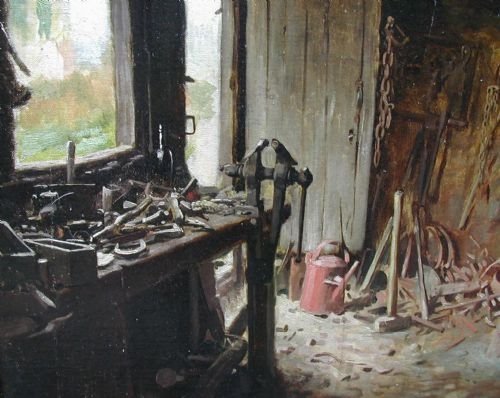
fig 2. An oil painting depicting the sunlit interior of a blacksmith forge, filled with ironworking tools, an anvil, and a central workbench.
fig 2. The Blacksmith's Forge by George Harcourt Sephton (1885-1923)

Tuyere -- a pipe through which air can be forced into the fire

Bellows or blower -- a means for forcing air into the tuyere

Firepot or hearth -- a place where the burning fuel can be contained over or against the tuyere opening.

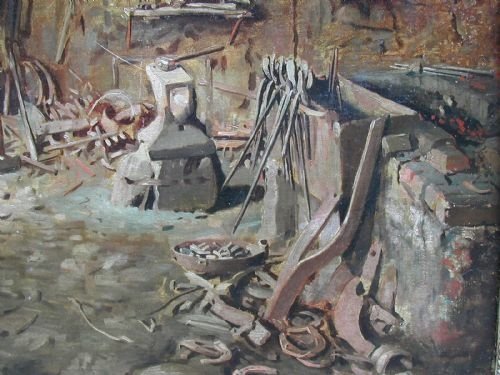
fig 3. An oil painting depicting the sunlit interior of a blacksmith forge, filled with ironworking tools, an anvil, and a central workbench.
fig 3. The Blacksmith's Forge by George Harcourt Sephton (1885-1923)

During operation, fuel is placed in or on the hearth and ignited. A source of moving air, such as a fan or bellows, introduces additional air into the fire through the tuyere. With additional air, the fire consumes more fuel and burns hotter.

A typical Scottish smithy at Auchentiber, North Ayrshire, Scotland.A blacksmith balances the fuel and air in the fire to suit particular kinds of work. Often this involves adjusting and maintaining the shape of the fire. In a typical, but by no means universal, coal forge, a firepot will be centered in a flat hearth. The tuyere will enter the firepot at the bottom. In operation, the hot core of the fire will be a ball of burning coke in and above the firepot. The heart of the fire will be surrounded by a layer of hot but not burning coke. Around the unburnt coke will be a transitional layer of coal being transformed into coke by the heat of the fire. Surrounding all is a ring or horseshoe-shaped layer of raw coal, usually kept damp and tightly packed to maintain the shape of the fire's heart and to keep the coal from burning directly so that it "cooks" into coke first. If a larger fire is necessary, the smith increases the air flowing into the fire as well as feeding and deepening the coke heart. The smith can also adjust the length and width of the fire in such a forge to accommodate different shapes of work. The major variation from the forge and fire just described is a 'back draft' where there is no fire pot, and the tuyere enters the hearth horizontally from the back wall. Coke and charcoal may be burned in the same forges that use coal, but since there is no need to convert the raw fuel at the heart of the fire (as with coal), the fire is handled differently. Individual smiths and specialized applications have fostered development of a variety of forges of this type, from the coal forge described above, to simpler constructions amounting to a hole in the ground with a pipe leading into it.

Height
57cm (22.44")
Width
67cm (26.38")
Depth
2cm (0.79")
Date of Manufacture

Artware Fineart has dated this Antique Blacksmith Forge Painting to the 1900s.

Reference Numbers
Sellingantiques Ref
SA77040
Dealers Internal Ref
3354
Artware Fineart
Sellingantiques verified Since Sep 2008
Dealer Profile

You can view the stock and full dealer information on the Artware Fineart Profile Page

PDF SHARE
SAVE
An oil painting depicting the sunlit interior of a blacksmith forge, filled with ironworking tools, an anvil, and a central workbench.
1 / 4
Archive I An oil painting depicting the sunlit interior of a blacksmith forge, filled with ironworking tools, an anvil, and a central workbench.

The Blacksmith's Forge by George Harcourt Sephton (1885-1923)

Archive II An oil painting depicting the sunlit interior of a blacksmith forge, filled with ironworking tools, an anvil, and a central workbench. View II
Archive III An oil painting depicting the sunlit interior of a blacksmith forge, filled with ironworking tools, an anvil, and a central workbench. View III
Archive IV An oil painting depicting the sunlit interior of a blacksmith forge, filled with ironworking tools, an anvil, and a central workbench. View IV
FURTHER BROWSING

Visitors also looked at these ⇣

Enlarged Archival View
Telephone 07958 699 645
Location
18 La Gare
51 Surrey Row
London
SE1 0BZ
United Kingdom
Verified Since Sep 2008
Items For Sale 243
Items Sold 223
Artware Fineart
Verified Since Sep 2008
View Dealer Info
Location: 18 La Gare , 51 Surrey Row , London , SE1 0BZ , United Kingdom
Verified
Sep 2008
For Sale
243
Sold
223
An oil painting depicting the sunlit interior of a blacksmith forge, filled with ironworking tools, an anvil, and a central workbench.
The Blacksmith's Forge by George Harcourt Sephton (1885-1923)
Ref: SA77040
An oil painting depicting the sunlit interior of a blacksmith forge, filled with ironworking tools, an anvil, and a central workbench.
Detail View 1
Detail View 2
Detail View 3
Archival Detail
Every single antique dealer on our platform is individually approved by our internal team. We verify their professional trade history, ethical standards, and photographic quality to ensure a secure, high-standard buying environment. Upon joining, every dealer agrees to a strict 9-point code of conduct. While issues can occasionally arise, our dealers typically resolve them swiftly and directly with the buyer. In fact, since our founding in 2002, Sellingantiques has only had to step in to help resolve an issue on roughly five occasions—a true testament to the quality of our dealers and their dedication to your happiness.
Our dealers are highly experienced in packing and shipping fragile, high-value antiques. Because you are in direct contact with the dealer, you will be able to easily go through all available shipping and insurance options together to ensure your item arrives safely.
Antiques are the ultimate green purchase. By choosing historical pieces over newly manufactured goods, you completely eliminate the carbon footprint of modern mass production while preserving exceptional, timeless craftsmanship.

Victorian genre painting often documented daily labour, trades, and industrial environments with realistic detail and naturalistic light. Artists captured traditional crafts, such as blacksmithing, during an era of rapid technological transition.

Nineteenth-century paintings typically utilised hand-mixed oil pigments applied to stretched linen canvas or timber panels, often prepared with a gesso priming coat.

Authentic period works display natural age craquelure, surface oxidisation, authentic stretcher wear, and period-appropriate framing techniques alongside artist signatures or gallery labels.

Position traditional oil paintings above architectural fireplaces, within contemporary gallery walls, or against dark, saturated wall tones to create focused visual contrast.

Display oil paintings away from direct sunlight, maintain stable humidity levels, and clean surfaces exclusively with soft, dry brushes or via professional art restorers.
items
Add keywords to the filter
Price
£100
£250000
Era
Movements
Material
Origin
Stock Location
Freshness
Online Payments
Categories