60,878  PAGES BROWSED TODAY PAGES TODAY 103  ANTIQUES UPLOADED TODAY NEW ARRIVALS
ID #SA75922
FOR SALE
£3,500
Email
Save
A Steeplechase, a Horse and Jockey Taking a Ditch, English School 19th Century
Artware Fineart
for sale €4,095     $4,445
£3,500

Artware Fineart

Sellingantiques Verified Since Sep 2008
View Dealers Stock Page
Id #SA75922
PDF SHARE
SAVE

A Steeplechase, a Horse and Jockey Taking a Ditch, English School 19th Century

19th century
For Sale by Artware Fineart
Description

Oil on Canvas

39.00 x 60.00 cm; 15.35 x 23.62 ins

dated 1839 lower right

The steeplechase is a form of horse racing (primarily conducted in the United Kingdom, Canada, United States, Australia, France and Ireland) and derives its name from early races in which orientation of the course was by reference to a church steeple, jumping fences and ditches and generally traversing the many intervening obstacles in the countryside. In the UK and Ireland the official term now used for the sport is National Hunt racing. It is a term now used to refer to a distance horse race with diverse fence and ditch obstacles; the most famous of these is the Grand National run annually at Aintree Racecourse, in Liverpool, since its inception in 1836 (the official race was held 3 years later).

The steeplechase originated in Ireland in the 18th century as an analogue to cross-country thoroughbred horse races which went from church steeple to church steeple, hence "steeplechase". The first steeplechase is said to have been the result of a wager in 1752 between Mr. Cornelius O'Callaghan and Mr. Edmund Blake, racing four miles (6 km) cross-country from Buttevant Church to St. Leger Church in Doneraile, in Cork, Ireland. An account of the race was believed to have been in the library of the O'Brien's of Dromoland Castle. Most of the earlier steeplechases were contested cross-country rather than on a track, and resembled English cross country as it exists today. The first recorded steeplechase over a prepared track with fences was run in Bedlam, North Yorkshire in 1810.The first recognised English National Steeplechase took place on Monday 8th March 1830. The 4 mile race, organised by Thomas Coleman of St Albans, was run from Bury Orchard, Harlington in Bedfordshire to the Obelisk in Wrest Park, Bedfordshire. The winner was Captain Macdowall on "The Wonder", owned by Lord Ranelagh, who won in a time of 16 mins 25 seconds. Reports of the event appeared in the May and July editions of the Sporting Magazine in 1830.
Collectively Great Britain and Ireland account for over 50% of all jump races world wide, carding 4800 races over fences in 2008. Jump racing Great Britain and Ireland is refereed to colloquially as National Hunt Racing. See separate Wikipedia entry for National Hunt racing.

Physical Dimensions
Height
47cm (18.50")
Width
68cm (26.77")
Depth
3cm (1.18")
Declaration

Artware Fineart has dated this Antique Equestrian Oil Painting to the 19th Century.

Reference Numbers
Sellingantiques Reference
SA75922
Dealers Internal Reference
3098
Description
Oil on Canvas

39.00 x 60.00 cm; 15.35 x 23.62 ins

dated 1839 lower right

The steeplechase is a form of horse racing (primarily conducted in the United Kingdom, Canada, United States, Australia, France and Ireland) and derives its name from early races in which orientation of the course was by reference to a church steeple, jumping fences and ditches and generally traversing the many intervening obstacles in the countryside. In the UK and Ireland the official term now used for the sport is National Hunt racing. It is a term now used to refer to a distance horse race with diverse fence and ditch obstacles; the most famous of these is the Grand National run annually at Aintree Racecourse, in Liverpool, since its inception in 1836 (the official race was held 3 years later).

The steeplechase originated in Ireland in the 18th century as an analogue to cross-country thoroughbred horse races which went from church steeple to church steeple, hence "steeplechase".
Artware Fineart

The first steeplechase is said to have been the result of a wager in 1752 between Mr. Cornelius O'Callaghan and Mr. Edmund Blake, racing four miles (6 km) cross-country from Buttevant Church to St. Leger Church in Doneraile, in Cork, Ireland. An account of the race was believed to have been in the library of the O'Brien's of Dromoland Castle. Most of the earlier steeplechases were contested cross-country rather than on a track, and resembled English cross country as it exists today. The first recorded steeplechase over a prepared track with fences was run in Bedlam, North Yorkshire in 1810.The first recognised English National Steeplechase took place on Monday 8th March 1830. The 4 mile race, organised by Thomas Coleman of St Albans, was run from Bury Orchard, Harlington in Bedfordshire to the Obelisk in Wrest Park, Bedfordshire. The winner was Captain Macdowall on "The Wonder", owned by Lord Ranelagh, who won in a time of 16 mins 25 seconds. Reports of the event appeared in the May and July editions of the Sporting Magazine in 1830.

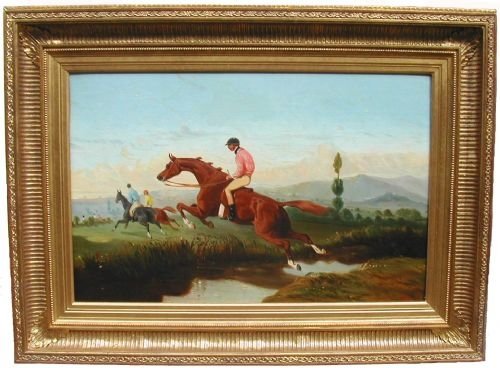
fig 1. A 19th-century English School oil painting depicting a jockey in a pink jacket riding a chestnut horse jumping over a water ditch during a steeplechase.
fig 1. A Steeplechase, a Horse and Jockey Taking a Ditch, English School 19th Century

Collectively Great Britain and Ireland account for over 50% of all jump races world wide, carding 4800 races over fences in 2008. Jump racing Great Britain and Ireland is refereed to colloquially as National Hunt Racing. See separate Wikipedia entry for National Hunt racing.

Height
47cm (18.50")
Width
68cm (26.77")
Depth
3cm (1.18")
Date of Manufacture

Artware Fineart has dated this Antique Equestrian Oil Painting to the 19th Century.

Reference Numbers
Sellingantiques Ref
SA75922
Dealers Internal Ref
3098
Artware Fineart
Sellingantiques verified Since Sep 2008
Dealer Profile

You can view the stock and full dealer information on the Artware Fineart Profile Page

PDF SHARE
SAVE
A 19th-century English School oil painting depicting a jockey in a pink jacket riding a chestnut horse jumping over a water ditch during a steeplechase.
1 / 3
Archive I A 19th-century English School oil painting depicting a jockey in a pink jacket riding a chestnut horse jumping over a water ditch during a steeplechase.

A Steeplechase, a Horse and Jockey Taking a Ditch, English School 19th Century
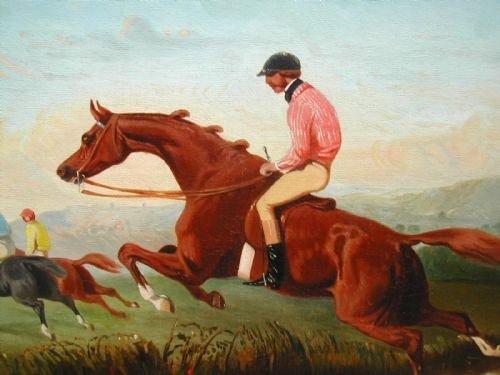
Archive II A 19th-century English School oil painting depicting a jockey in a pink jacket riding a chestnut horse jumping over a water ditch during a steeplechase. View II
Archive III A 19th-century English School oil painting depicting a jockey in a pink jacket riding a chestnut horse jumping over a water ditch during a steeplechase. View III
FURTHER BROWSING

Visitors also looked at these ⇣

Enlarged Archival View
Telephone 07958 699 645
Location
18 La Gare
51 Surrey Row
London
SE1 0BZ
United Kingdom
Verified Since Sep 2008
Items For Sale 243
Items Sold 223
Artware Fineart
Verified Since Sep 2008
View Dealer Info
Location: 18 La Gare , 51 Surrey Row , London , SE1 0BZ , United Kingdom
Verified
Sep 2008
For Sale
243
Sold
223
A 19th-century English School oil painting depicting a jockey in a pink jacket riding a chestnut horse jumping over a water ditch during a steeplechase.
A Steeplechase, a horse and jockey taking a ditch, English School 19th Century
Ref: SA75922
A 19th-century English School oil painting depicting a jockey in a pink jacket riding a chestnut horse jumping over a water ditch during a steeplechase.
Detail View 1
Detail View 2
Archival Detail
Every single antique dealer on our platform is individually approved by our internal team. We verify their professional trade history, ethical standards, and photographic quality to ensure a secure, high-standard buying environment. Upon joining, every dealer agrees to a strict 9-point code of conduct. While issues can occasionally arise, our dealers typically resolve them swiftly and directly with the buyer. In fact, since our founding in 2002, Sellingantiques has only had to step in to help resolve an issue on roughly five occasions—a true testament to the quality of our dealers and their dedication to your happiness.
Our dealers are highly experienced in packing and shipping fragile, high-value antiques. Because you are in direct contact with the dealer, you will be able to easily go through all available shipping and insurance options together to ensure your item arrives safely.
Antiques are the ultimate green purchase. By choosing historical pieces over newly manufactured goods, you completely eliminate the carbon footprint of modern mass production while preserving exceptional, timeless craftsmanship.

English School sporting art of the 19th century typically depicts hunting, racing, and steeplechase scenes with anatomical attention, dynamic movement, and realistic British landscape backdrops.

Artists during this period primarily utilised oil paints applied to natural flax or linen canvas stretched over wooden strainers, or painted directly onto wooden panels.

Authentic period works display natural craquelure patterns across the paint film, age-related darkening or yellowing of the varnish layer, and historical construction on the stretcher bars and canvas reverse.

Position equestrian paintings above a mantelpiece or sideboard, pairing them with dark wood furniture, leather upholstery, or brass accents to complement a classic interior aesthetic.

Keep oil paintings away from direct sunlight, high humidity, and extreme temperature fluctuations, dusting gently with a soft dry brush and consulting a professional conservator for deep cleaning.
items
Add keywords to the filter
Price
£100
£250000
Era
Movements
Material
Origin
Stock Location
Freshness
Online Payments
Categories