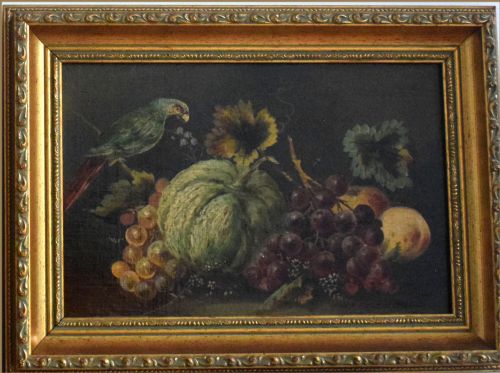
Artware Fineart has dated this Victorian Fruit Still Life to the 19th Century.
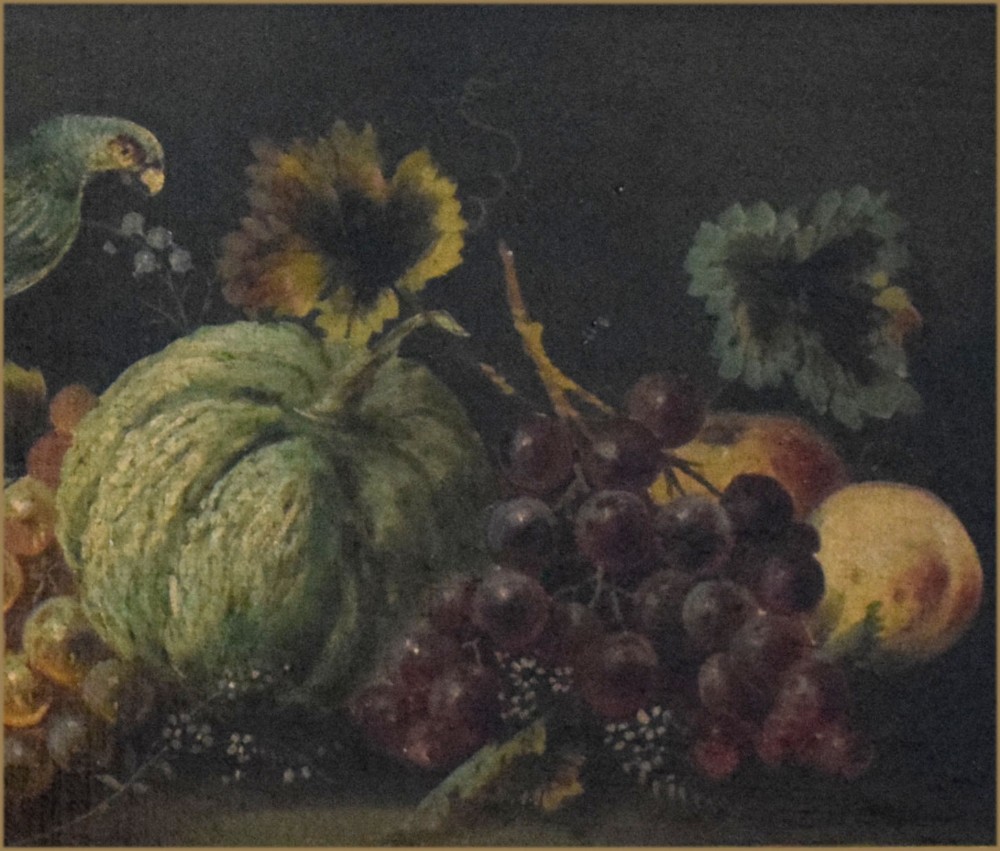
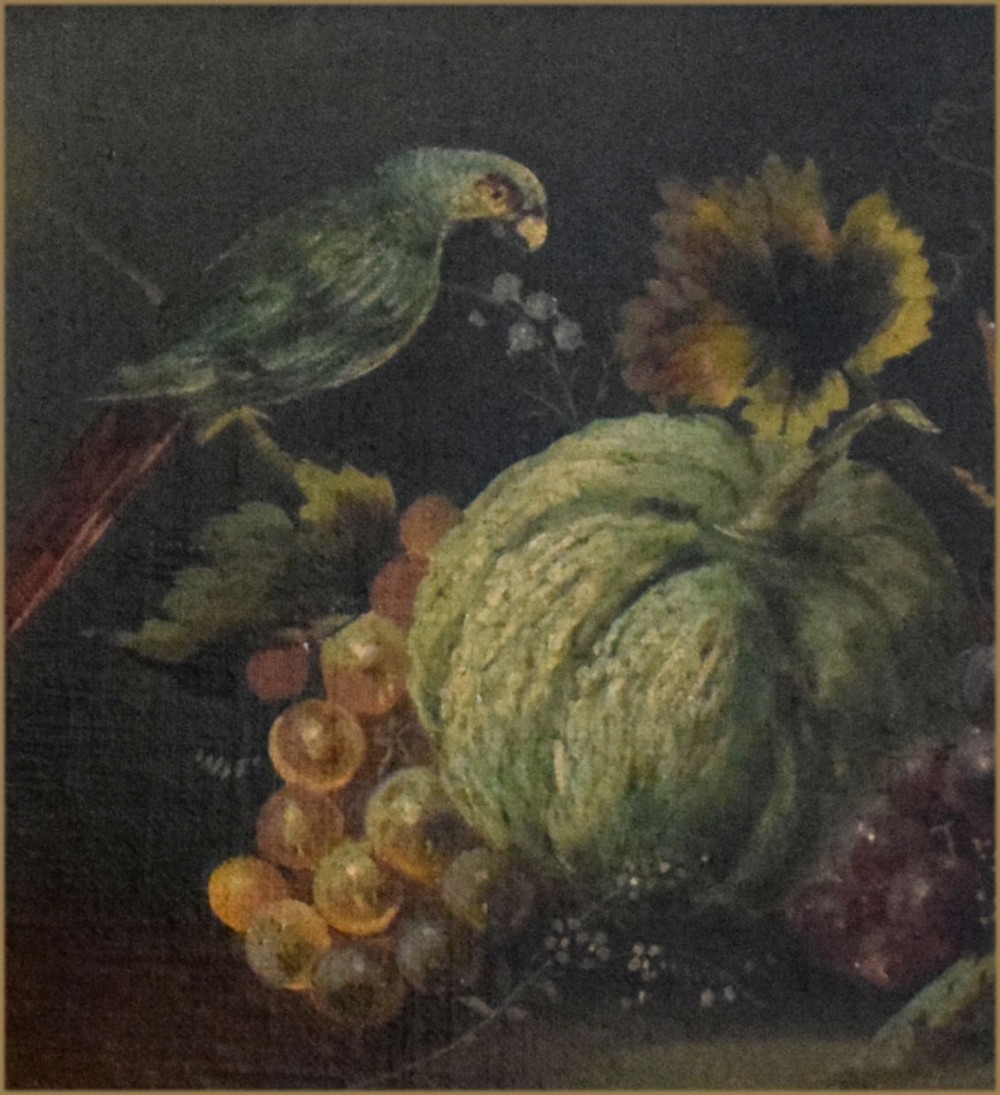
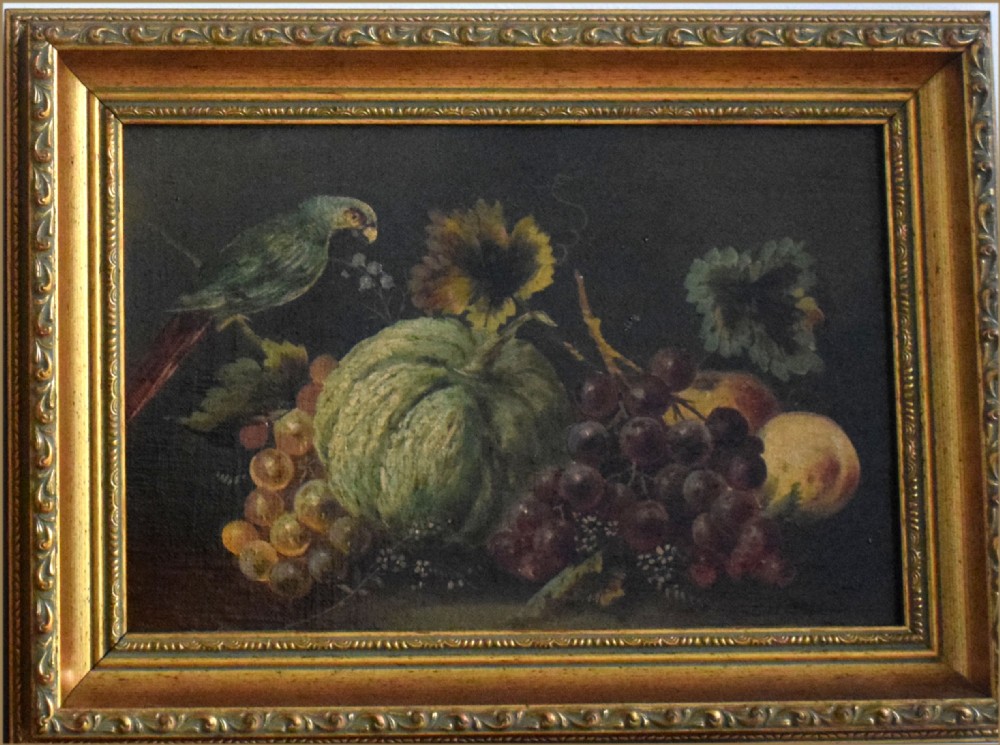
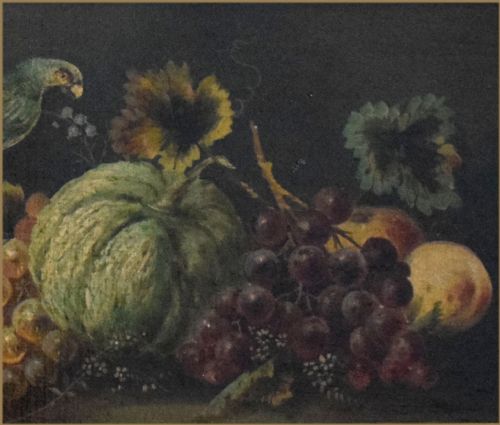
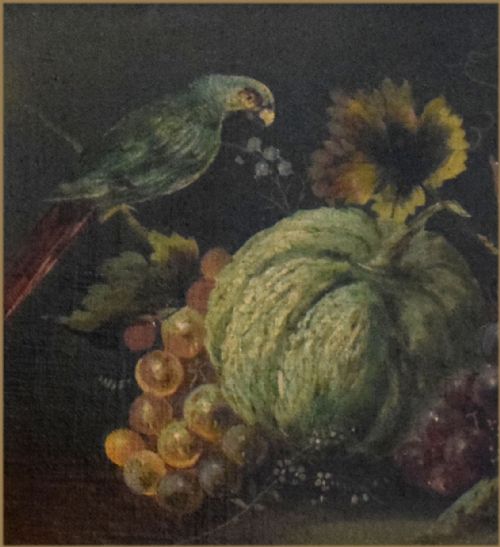
A Still Life of a White Fronted Amazon Parrot, with grapes, Mellon and Peaches
oil on canvas
20.50 x 31 cm.
The white-fronted amazon, at about 25 cm (9.8 in) long, is the smallest of the amazon parrots.
They have mostly green plumage with some blue colouring on their outspread wings. They have bright red colouring around their eyes (in some individuals almost like spectacles) and blue colouring behind the patch of white on their foreheads. Together with the red-spectacled amazon and the yellow-lored amazon, it is the only amazon species in which adult males and females easily can be distinguished by external appearance (sexual dimorphism): Males have bright red feathers on their "shoulders" (alula), while females have green "shoulders". Juveniles have pale grey irises and less red on their face and the white area is replaced with a smaller yellowish area.
The white-fronted amazon is native to Central America and Mexico; and is most often seen in small flocks of up to 20 birds. They are seen in a variety of different habitats from wet regions such as rainforests, to drier areas such as cactus savannahs. In the wild, they are not shy and people are often able to approach them. Flocks may congregate and people have seen groups that number into the hundreds. These groups may also contain flocks from other species such as the red-lored amazon. A population has been seen in southern Texas, probably escapees, and a small feral population has been observed living in southern California . Introduced breeding populations have also been reported in Puerto Rico .
The white-fronted amazon nests in tree cavities. Their breeding season is usually in the spring, starting in February and ending in the summer (in June and July in most areas). After breeding, the female will lay an average of three to four white eggs. Eggs are incubated for about 26 days and chicks leave the nest at the age of about 60 days from hatching.
Artist Biography
Lance was born at the old manor-house in Little Easton in Essex. His father was William Lance who had previously served in a regiment of light horse and was at the time of Lance's birth an adjutant in the Essex yeomanry; afterwards he became the inspector of the Bow Street horse-patrol. His mother, Louisa Lucy (née) Constable, with whom his father had eloped from boarding-school, was the daughter of Colonel Constable of Beverley in Yorkshire.Although Lance showed a predilection for art at a very early age, his friends placed him, when under the age of fourteen, in a factory in Leeds. However, the uncongenial work injured his health and he returned to London. Wandering one day into the British Museum, he casually started a conversation with Charles Landseer, who happened to be drawing there. On learning that Landseer was a pupil of Benjamin Haydon, he went early next morning to that painter's residence, and asked to become a pupil. Haydon replied that if his drawings promised future success he would instruct him for nothing. Not many days later Lance, still under fourteen, entered Haydon's studio, and remained there seven years, at the same time studying in the schools of the Royal Academy. While designing a picture inspired by Homer's 'Iliad', he decided, before putting on the colours, to paint some fruit and vegetables, in order to improve his execution. His work attracted the notice of Sir George Beaumont, who purchased it, and this success led him to paint another fruit-piece, which he sold to the Earl of Shaftesbury. He then painted two fruit-pieces for the Duke of Bedford as decorations for a summer-house at Woburn Abbey, and his work proved so profitable that he decided to devote himself to the painting of still-life.
Artware Fineart has dated this Victorian Fruit Still Life to the 19th Century.
You can view the stock and full dealer information on the Artware Fineart Profile Page
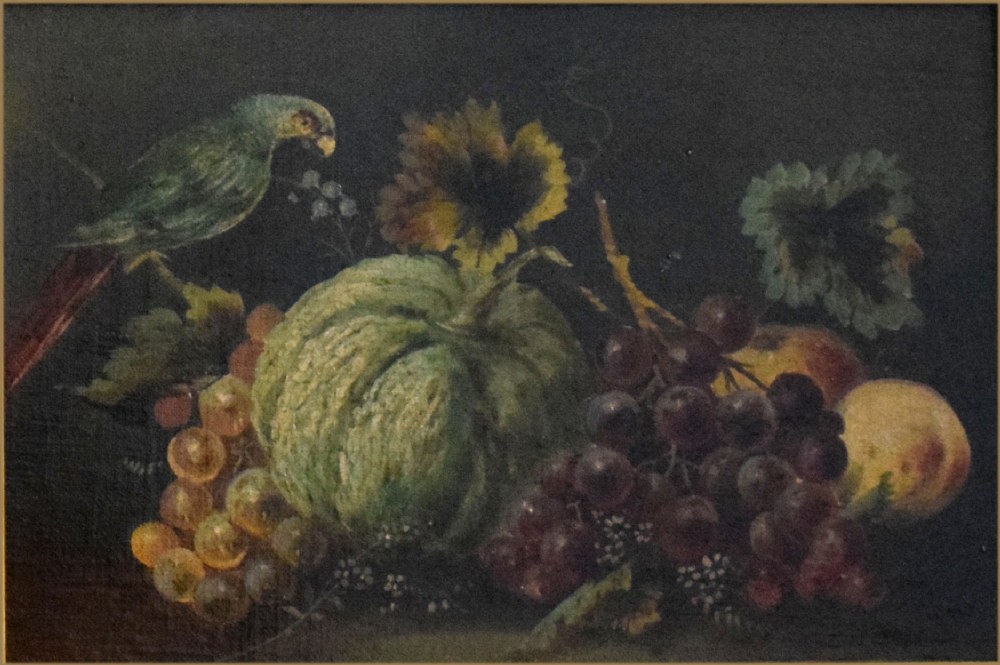
George Lance, 1802 - 1864 A Still Life of a White Fronted Amazon Parrot, with grapes, Mellon and Peaches oil on canvas