60,761  PAGES BROWSED TODAY PAGES TODAY 103  ANTIQUES UPLOADED TODAY NEW ARRIVALS
ID #SA712956
FOR SALE
£6,500
Email
Save
Stephen Elmer, 1715 – 1796 Black Game in a Highland Landscape
Artware Fineart
for sale €7,605     $8,255
£6,500

Artware Fineart

Sellingantiques Verified Since Sep 2008
View Dealers Stock Page
Id #SA712956
PDF SHARE
SAVE

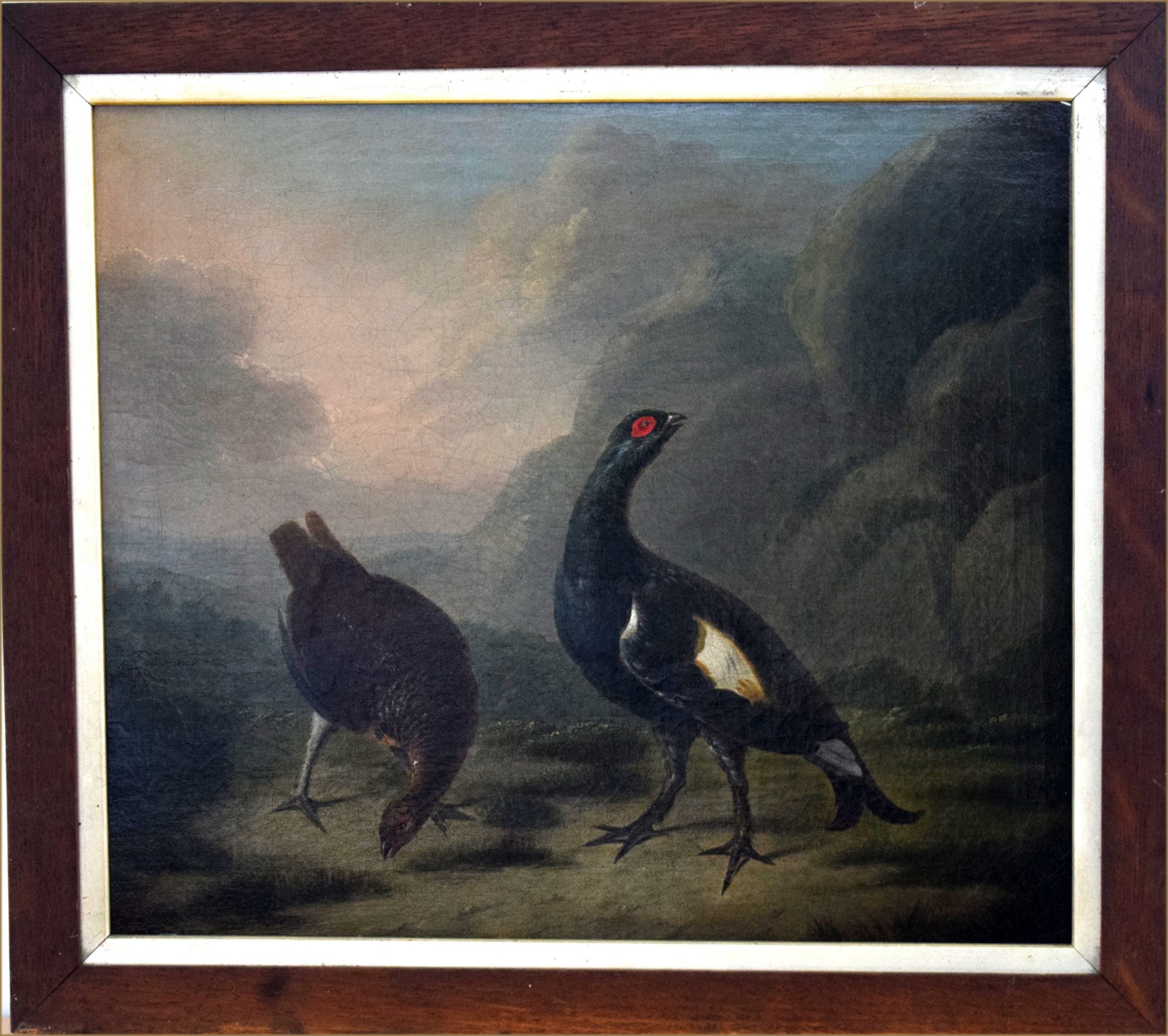
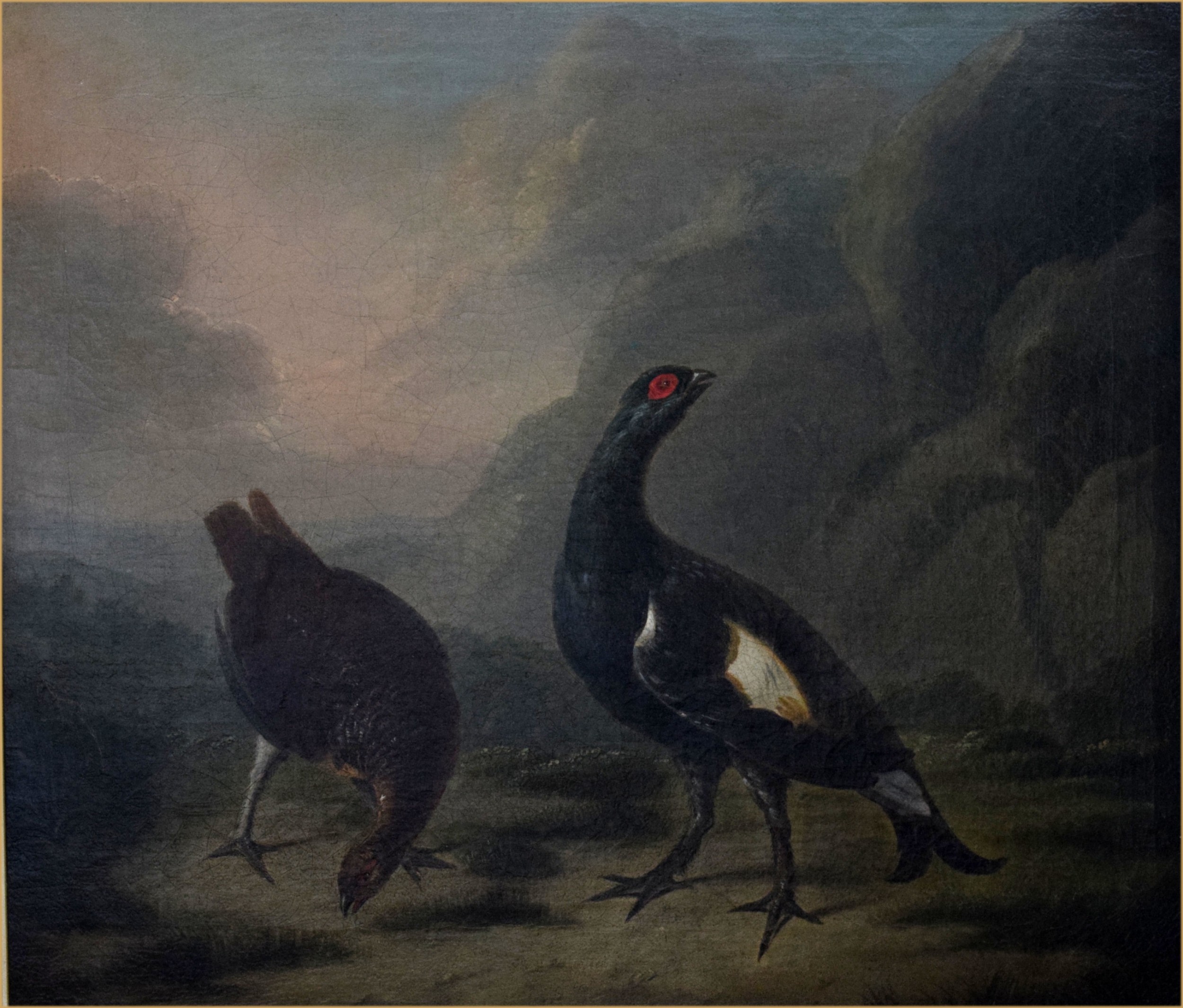
Stephen Elmer, 1715 – 1796 Black Game in a Highland Landscape

18th century
For Sale by Artware Fineart
Description

Stephen Elmer, 1715 – 1796

Black Game in a Highland Landscape

oil on canvas

37 x 43 cm.

The black grouse or blackgame or blackcock (Tetrao tetrix) is a large game bird in the grouse family. It is a sedentary species, breeding across northern Eurasia in moorland and bog areas near to woodland, mostly boreal. The black grouse is closely related to the Caucasian grouse.
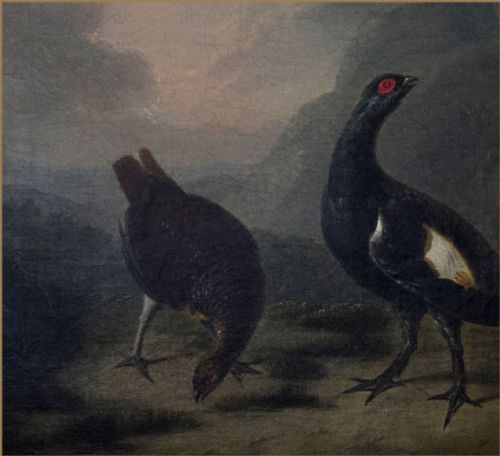
In the Uk there was a dramatic decline in Black Grouse from the 18th century, when birds were found in nearly all British counties, to the current situation where they cling to existence in a few corners of upland Britain.
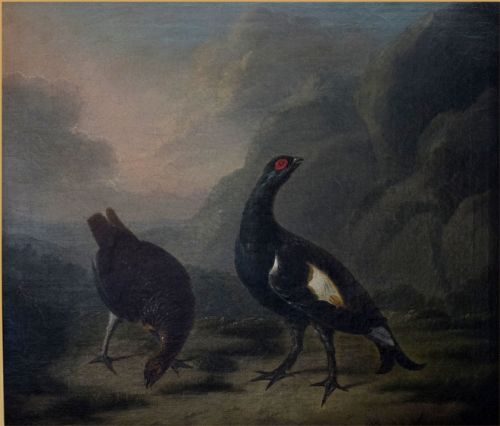
The female is greyish-brown and has a cackling call. She takes all responsibility for nesting and caring for the chicks, as is typical with gamebirds. The black grouse's genome was sequenced in 2014. The black grouse is one of the many species first described in the 10th edition of Systema Naturae in 1758 by Carl Linnaeus, and still bears its original binomial name. Both Tetrao and tetrix come from Ancient Greek words referring to some form of game bird.
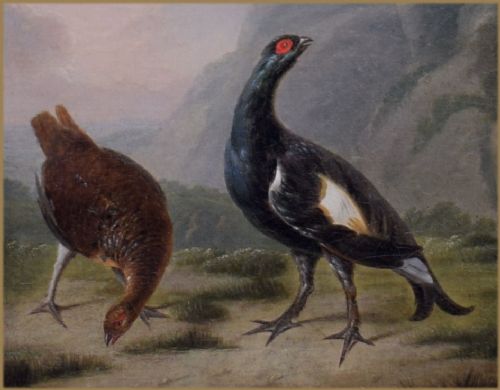
The male and female are sometimes referred to by their folk names, blackcock and greyhen respectively. These names first occur in the literature with John Ray in 1674. Heathcock and Heathhen are also common names.The black grouse is a large bird with males being around 53 centimetres (21 in) long and weighing 1,000–1,450 g (2.20–3.20 lb) and females approximately 40 cm (16 in) and weighing 750–1,110 g (1.65–2.45 lb). The cock is very distinctive, with black plumage, apart from red wattles and a white wingbar, and a lyre-shaped tail, which appears forked in flight. His song is loud, bubbling and somewhat dove-like.
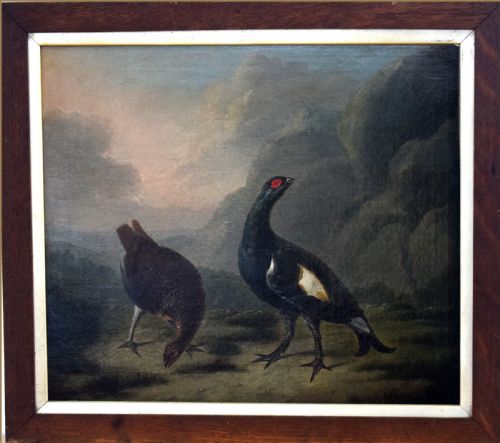
Black grouse can be found across Europe (Swiss-Italian-French Alps specially) from Great Britain (but not Ireland) through Scandinavia and Estonia into Russia. In Eastern Europe they can be found in Hungary, Latvia, Lithuania, Poland, Belarus, Romania and Ukraine. There is a population in the Alps, and isolated remnants in Germany, France, Belgium and the Netherlands. It formerly occurred in Denmark, but the Danish Ornithological Society (DOF) has considered it extinct since 2001. The species disappeared from Bulgaria in the 19th century.
Although this species is declining in western Europe, it is not considered to be vulnerable globally due to the large population (global estimate is 15-40 million individuals) and slow rate of decline. Its decline is due to loss of habitat, disturbance, predation by foxes, crows, etc., and small populations gradually dying out. The IUCN implemented a Black Grouse Action Plan 2007–2010. This has looked at local populations that are vulnerable to the extinction vortex. For example, in Styria in Austria. In the United Kingdom black grouse are found in upland areas of Wales, the Pennines and most of Scotland. Best looked for on farmland and moorland with nearby forestry or scattered trees. They have traditional lek sites where the males display.
They have declined in some parts of the UK (especially England), having disappeared from many of their former haunts. They are now extirpated in Lancashire, Derbyshire, Exmoor, East Yorkshire, New Forest, Nottinghamshire, Worcestershire, Quantock Hills, Cornwall, Dartmoor, Kent, Wiltshire and Surrey.
A programme to re-introduce black grouse into the wild started in 2003 in the Upper Derwent Valley area of the Peak District in England. 30 grouse were released in October 2003, followed by 10 male grouse in December 2004 and a further 10 males and 10 females in April 2005. The programme is being run jointly by the National Trust, Severn Trent Water and Peak District National Park. Conservation groups helping to revive the black grouse include the RSPB and the Game & Wildlife Conservation Trust. In France there has been much work regarding the birds and their risk of flying into ski-lifts.

Physical Dimensions
Height
37cm (14.57")
Width
43cm (16.93")
Depth
2cm (0.79")
Declaration

Artware Fineart has dated this Georgian Game Bird Painting to the 18th Century.

Reference Numbers
Sellingantiques Reference
SA712956
Dealers Internal Reference
4230
Description
Stephen Elmer, 1715 – 1796

Black Game in a Highland Landscape

oil on canvas

37 x 43 cm.

The black grouse or blackgame or blackcock (Tetrao tetrix) is a large game bird in the grouse family.
Artware Fineart

It is a sedentary species, breeding across northern Eurasia in moorland and bog areas near to woodland, mostly boreal. The black grouse is closely related to the Caucasian grouse.

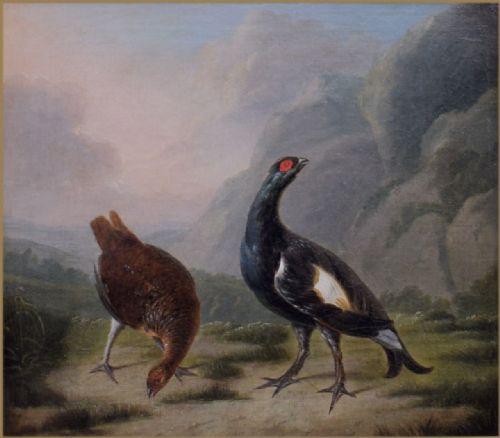
fig 1. An 18th-century oil painting depicting a black cock grouse and female greyhen standing on rocky terrain in a Highland landscape.
fig 1. Stephen Elmer, 1715 – 1796 Black Game in a Highland Landscape

In the Uk there was a dramatic decline in Black Grouse from the 18th century, when birds were found in nearly all British counties, to the current situation where they cling to existence in a few corners of upland Britain.

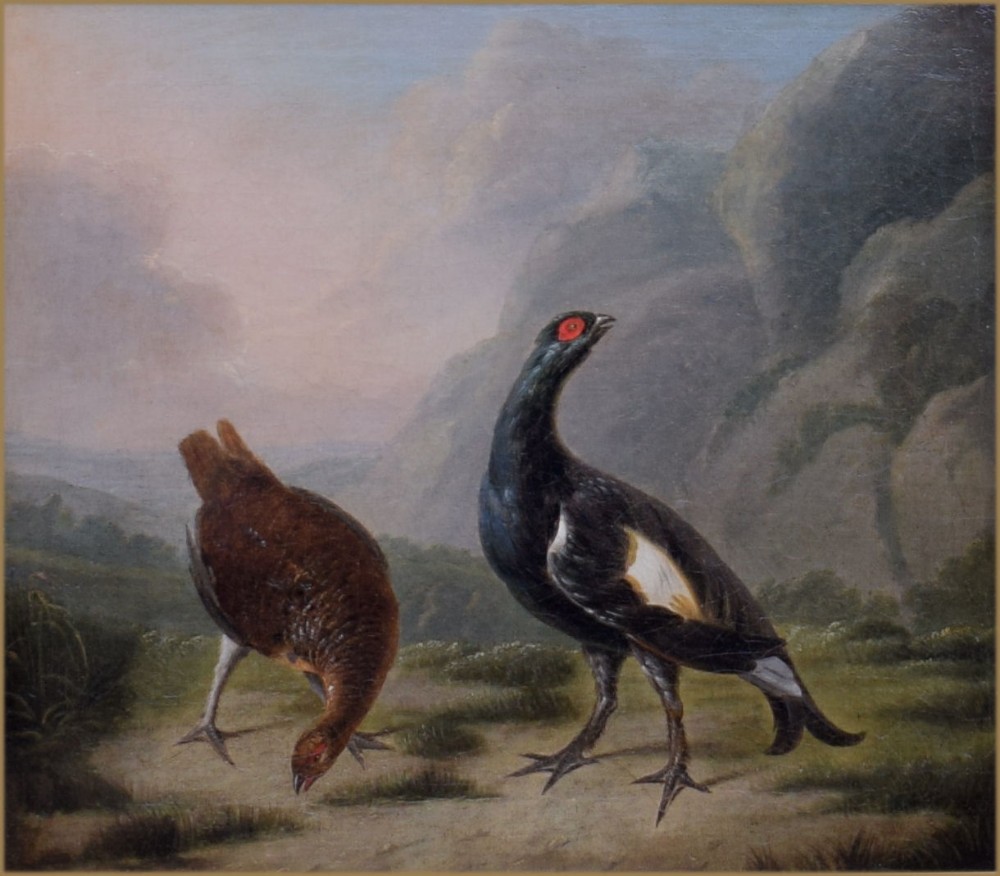
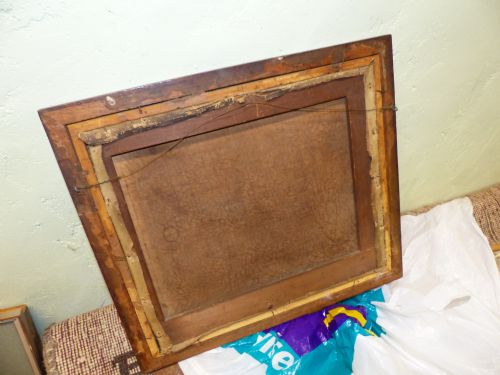
fig 2. An 18th-century oil painting depicting a black cock grouse and female greyhen standing on rocky terrain in a Highland landscape.
fig 2. Stephen Elmer, 1715 – 1796 Black Game in a Highland Landscape

The female is greyish-brown and has a cackling call. She takes all responsibility for nesting and caring for the chicks, as is typical with gamebirds. The black grouse's genome was sequenced in 2014. The black grouse is one of the many species first described in the 10th edition of Systema Naturae in 1758 by Carl Linnaeus, and still bears its original binomial name. Both Tetrao and tetrix come from Ancient Greek words referring to some form of game bird.

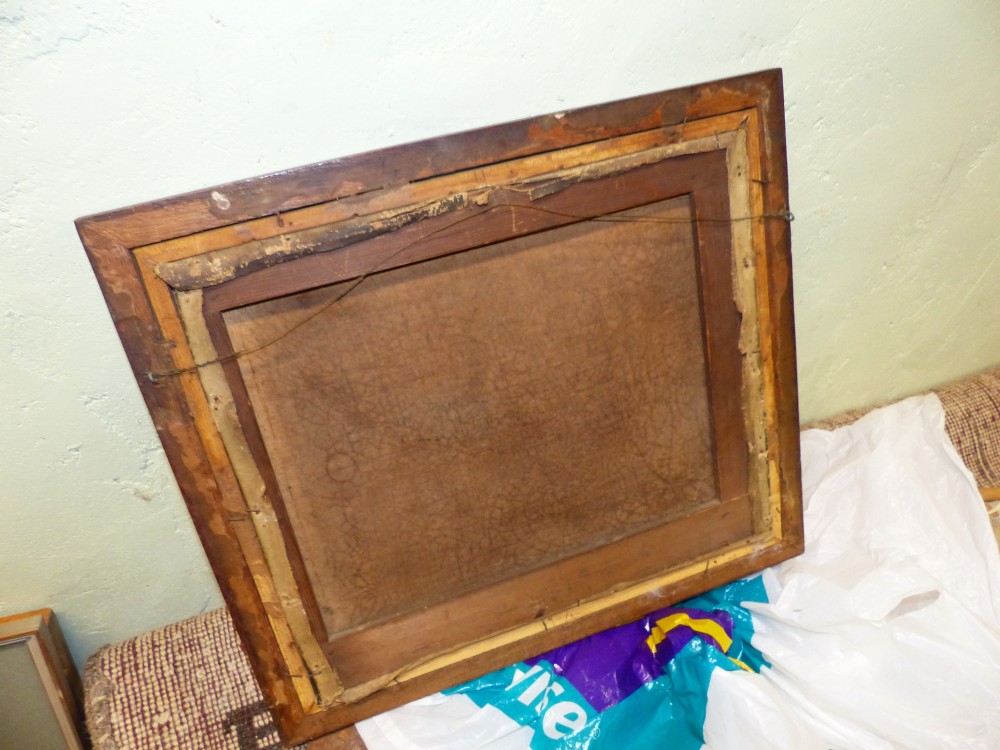
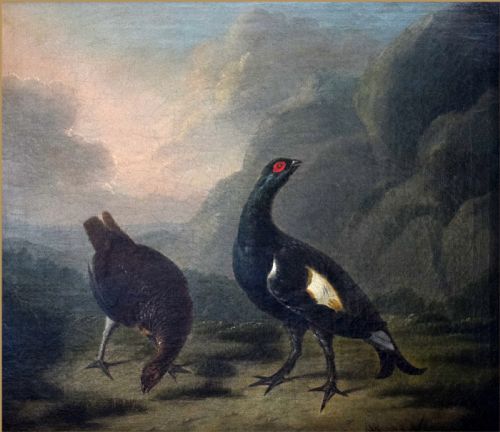
fig 3. An 18th-century oil painting depicting a black cock grouse and female greyhen standing on rocky terrain in a Highland landscape.
fig 3. Stephen Elmer, 1715 – 1796 Black Game in a Highland Landscape

The male and female are sometimes referred to by their folk names, blackcock and greyhen respectively. These names first occur in the literature with John Ray in 1674. Heathcock and Heathhen are also common names.The black grouse is a large bird with males being around 53 centimetres (21 in) long and weighing 1,000–1,450 g (2.20–3.20 lb) and females approximately 40 cm (16 in) and weighing 750–1,110 g (1.65–2.45 lb). The cock is very distinctive, with black plumage, apart from red wattles and a white wingbar, and a lyre-shaped tail, which appears forked in flight. His song is loud, bubbling and somewhat dove-like.

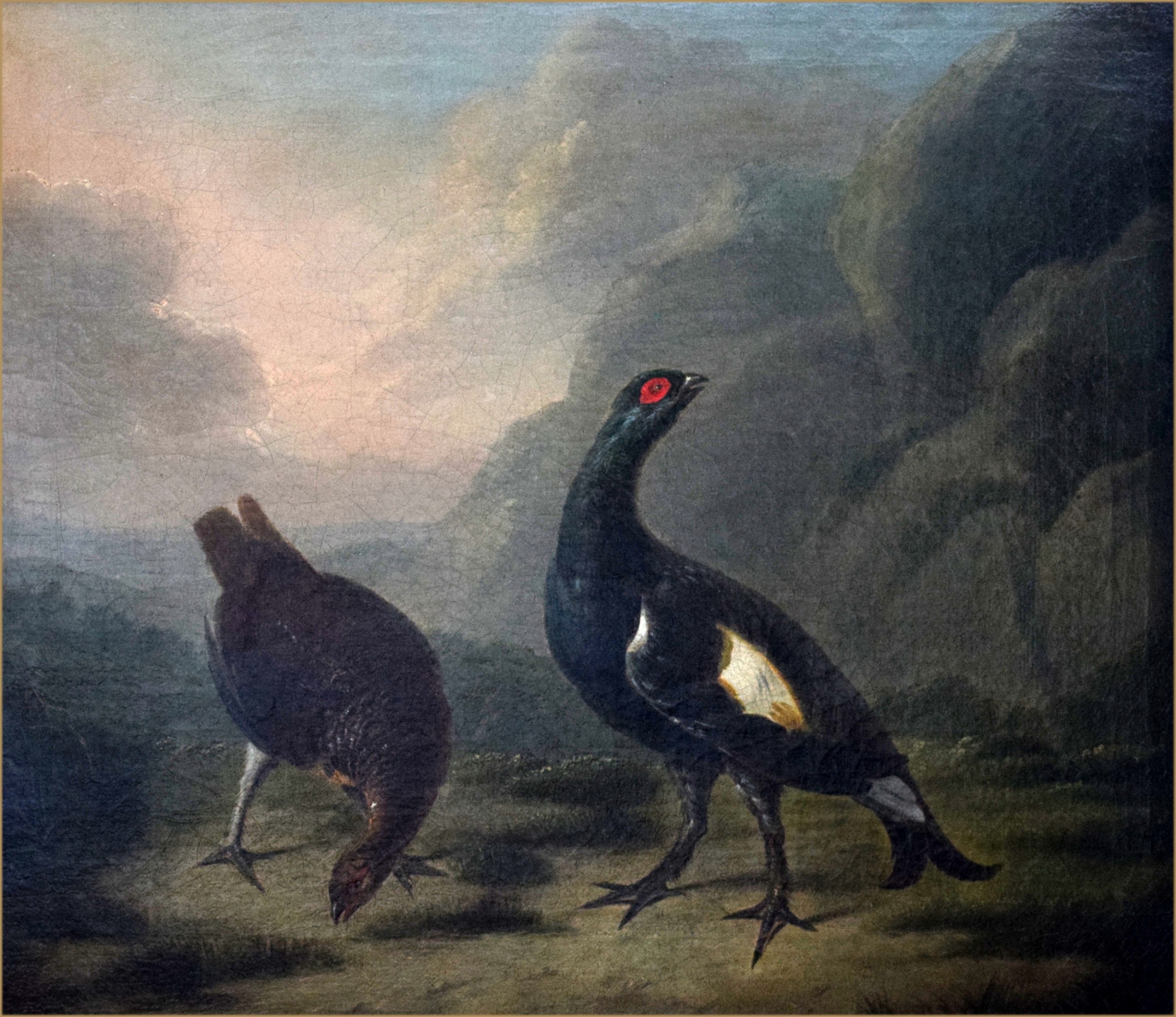
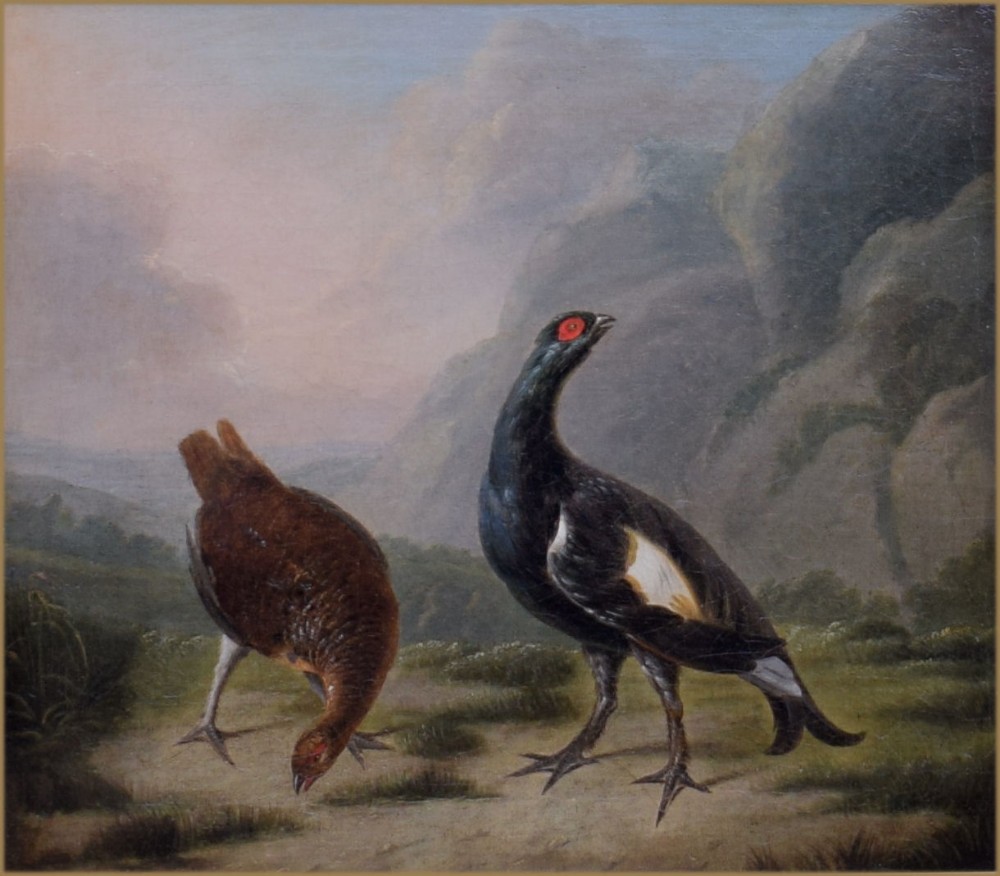
fig 4. An 18th-century oil painting depicting a black cock grouse and female greyhen standing on rocky terrain in a Highland landscape.
fig 4. Stephen Elmer, 1715 – 1796 Black Game in a Highland Landscape

Black grouse can be found across Europe (Swiss-Italian-French Alps specially) from Great Britain (but not Ireland) through Scandinavia and Estonia into Russia. In Eastern Europe they can be found in Hungary, Latvia, Lithuania, Poland, Belarus, Romania and Ukraine. There is a population in the Alps, and isolated remnants in Germany, France, Belgium and the Netherlands. It formerly occurred in Denmark, but the Danish Ornithological Society (DOF) has considered it extinct since 2001. The species disappeared from Bulgaria in the 19th century.

fig 5. An 18th-century oil painting depicting a black cock grouse and female greyhen standing on rocky terrain in a Highland landscape.
fig 5. Stephen Elmer, 1715 – 1796 Black Game in a Highland Landscape

Although this species is declining in western Europe, it is not considered to be vulnerable globally due to the large population (global estimate is 15-40 million individuals) and slow rate of decline. Its decline is due to loss of habitat, disturbance, predation by foxes, crows, etc., and small populations gradually dying out. The IUCN implemented a Black Grouse Action Plan 2007–2010. This has looked at local populations that are vulnerable to the extinction vortex. For example, in Styria in Austria. In the United Kingdom black grouse are found in upland areas of Wales, the Pennines and most of Scotland. Best looked for on farmland and moorland with nearby forestry or scattered trees. They have traditional lek sites where the males display.

fig 6. An 18th-century oil painting depicting a black cock grouse and female greyhen standing on rocky terrain in a Highland landscape.
fig 6. Stephen Elmer, 1715 – 1796 Black Game in a Highland Landscape

They have declined in some parts of the UK (especially England), having disappeared from many of their former haunts. They are now extirpated in Lancashire, Derbyshire, Exmoor, East Yorkshire, New Forest, Nottinghamshire, Worcestershire, Quantock Hills, Cornwall, Dartmoor, Kent, Wiltshire and Surrey.

fig 7. An 18th-century oil painting depicting a black cock grouse and female greyhen standing on rocky terrain in a Highland landscape.
fig 7. Stephen Elmer, 1715 – 1796 Black Game in a Highland Landscape

A programme to re-introduce black grouse into the wild started in 2003 in the Upper Derwent Valley area of the Peak District in England. 30 grouse were released in October 2003, followed by 10 male grouse in December 2004 and a further 10 males and 10 females in April 2005. The programme is being run jointly by the National Trust, Severn Trent Water and Peak District National Park. Conservation groups helping to revive the black grouse include the RSPB and the Game & Wildlife Conservation Trust. In France there has been much work regarding the birds and their risk of flying into ski-lifts.

Height
37cm (14.57")
Width
43cm (16.93")
Depth
2cm (0.79")
Date of Manufacture

Artware Fineart has dated this Georgian Game Bird Painting to the 18th Century.

Reference Numbers
Sellingantiques Ref
SA712956
Dealers Internal Ref
4230
Artware Fineart
Sellingantiques verified Since Sep 2008
Dealer Profile

You can view the stock and full dealer information on the Artware Fineart Profile Page
PDF SHARE
SAVE
An 18th-century oil painting depicting a black cock grouse and female greyhen standing on rocky terrain in a Highland landscape.
1 / 8
Archive I An 18th-century oil painting depicting a black cock grouse and female greyhen standing on rocky terrain in a Highland landscape.

Stephen Elmer, 1715 – 1796 Black Game in a Highland Landscape
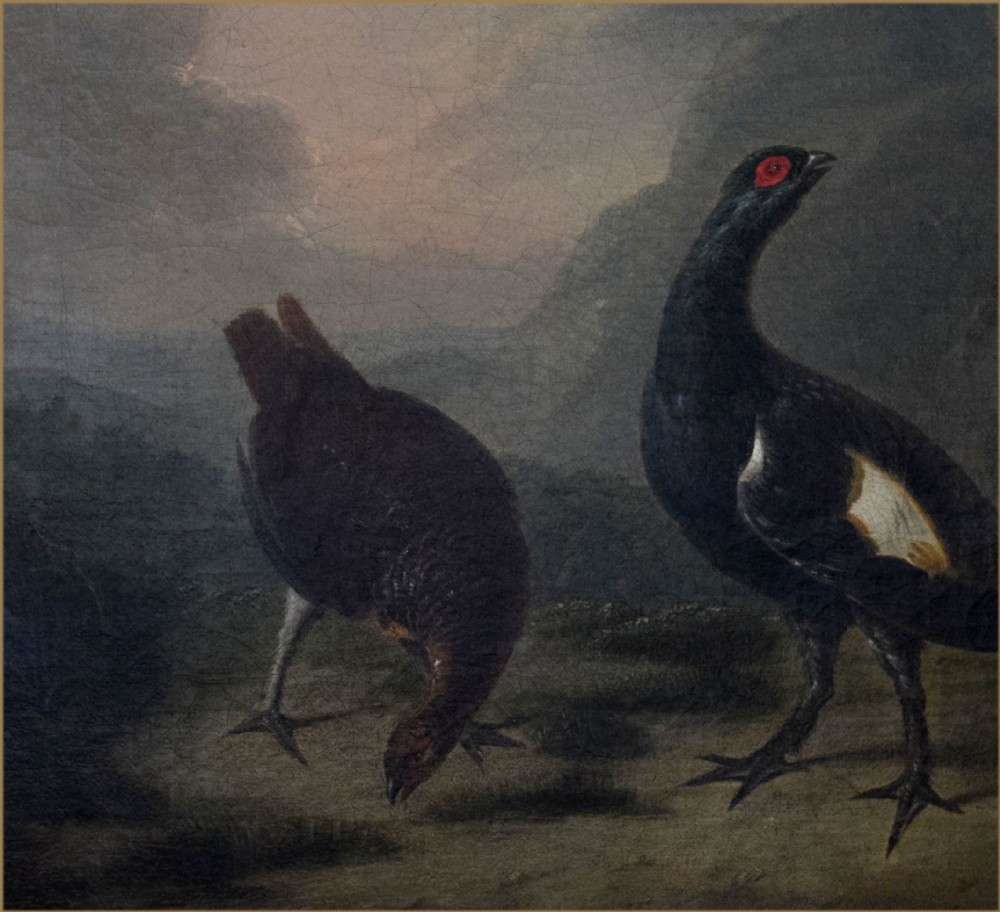
Archive II An 18th-century oil painting depicting a black cock grouse and female greyhen standing on rocky terrain in a Highland landscape. View II
Archive III An 18th-century oil painting depicting a black cock grouse and female greyhen standing on rocky terrain in a Highland landscape. View III
Archive IV An 18th-century oil painting depicting a black cock grouse and female greyhen standing on rocky terrain in a Highland landscape. View IV
Archive V An 18th-century oil painting depicting a black cock grouse and female greyhen standing on rocky terrain in a Highland landscape. View V
Archive VI An 18th-century oil painting depicting a black cock grouse and female greyhen standing on rocky terrain in a Highland landscape. View VI
Archive VII An 18th-century oil painting depicting a black cock grouse and female greyhen standing on rocky terrain in a Highland landscape. View VII
Archive VIII An 18th-century oil painting depicting a black cock grouse and female greyhen standing on rocky terrain in a Highland landscape. View VIII
Enlarged Archival View
Telephone 07958 699 645
Location
18 La Gare
51 Surrey Row
London
SE1 0BZ
United Kingdom
Verified Since Sep 2008
Items For Sale 243
Items Sold 223
Artware Fineart
Verified Since Sep 2008
View Dealer Info
Location: 18 La Gare , 51 Surrey Row , London , SE1 0BZ , United Kingdom
Verified
Sep 2008
For Sale
243
Sold
223
An 18th-century oil painting depicting a black cock grouse and female greyhen standing on rocky terrain in a Highland landscape.
Stephen Elmer, 1715 – 1796 Black Game in a Highland Landscape
Ref: SA712956
An 18th-century oil painting depicting a black cock grouse and female greyhen standing on rocky terrain in a Highland landscape.
Detail View 1
Detail View 2
Detail View 3
Detail View 4
Detail View 5
Detail View 6
Detail View 7
Archival Detail
Every single antique dealer on our platform is individually approved by our internal team. We verify their professional trade history, ethical standards, and photographic quality to ensure a secure, high-standard buying environment. Upon joining, every dealer agrees to a strict 9-point code of conduct. While issues can occasionally arise, our dealers typically resolve them swiftly and directly with the buyer. In fact, since our founding in 2002, Sellingantiques has only had to step in to help resolve an issue on roughly five occasions—a true testament to the quality of our dealers and their dedication to your happiness.
Our dealers are highly experienced in packing and shipping fragile, high-value antiques. Because you are in direct contact with the dealer, you will be able to easily go through all available shipping and insurance options together to ensure your item arrives safely.
Antiques are the ultimate green purchase. By choosing historical pieces over newly manufactured goods, you completely eliminate the carbon footprint of modern mass production while preserving exceptional, timeless craftsmanship.

18th-century British sporting art typically depicts game birds, hunting scenes, and livestock set within naturalistic British landscapes, reflecting the rural interests and field sports of the Georgian gentry.

Artists during this period predominantly worked with hand-ground oil pigments bound in linseed oil, painted onto stretched flax canvas or wood panels, and finished with natural resin varnishes.

Authentic works from this era display natural age-related craquelure across the paint surface, historic wooden stretcher oxidation, traditional hand-loomed canvas weave, and period-appropriate pigment application.

These traditional oil paintings integrate into country house, traditional, or dark academia interior schemes when positioned above a fireplace mantelpiece, hung in a library, or placed within a gallery wall.

Display the artwork away from direct sunlight, fluctuating humidity, and heat sources. Dust the surface gently with a dry soft brush and consult a professional painting conservator for varnish restoration or deep cleaning.
items
Add keywords to the filter
Price
£100
£250000
Era
Movements
Material
Origin
Stock Location
Freshness
Online Payments
Categories