
Artware Fineart has dated this Tudor Oil Portrait Painting to the 17th Century.
medium: oil on panel
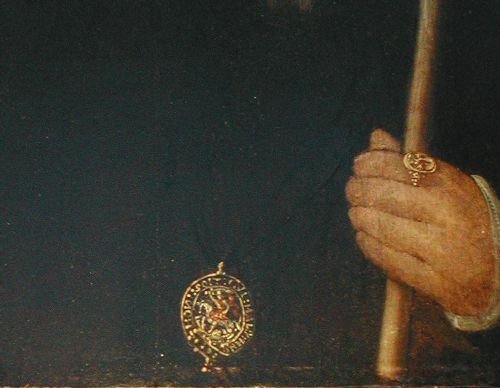
holding the Treasurer’s white wand of office and wearing the badge of the Order of the Garter. Sir William Paulet is wearing the lesser George on a ribbon (the Garter badge).
Sir William Paulet (c. 1483 – 10 March 1572) was an English Secretary of State and statesman who attained several peerages throughout his lifetime: Baron St John (9 March 1539), Earl of Wiltshire (19 January 1550), and Marquess of Winchester (11 October 1551).
There is some disagreement over his date of birth, authorities quoting 1483 or 1485. Also a claim he was ninety-seven at his death would place his birth in 1474 or 1475.

His father, who had held a command against the Cornish rebels in 1497, was the head of a younger branch of an ancient Somerset family seated in the fourteenth century at Pawlett or Paulet and Road, close to Bridgwater. William's great-grandfather acquired the Hampshire estates by his marriage with Constance, granddaughter and coheiress of Thomas Poynings, baron St John of Basing (d. 1428). William Paulet was sheriff of Hampshire in 1512, 1519, 1523, and again in 1527 (Letters and Papers). Knighted before the end of 1525, he was appointed master of the king's wards in November 1526 and he appears in the privy council in the same year. Paulet was twice married, and lived to see 103 of his own descendants. His first wife was Elizabeth (d. 25 Dec 1558), daughter of Sir William Capel, Lord Mayor of London in 1503, by whom he had four sons: (1) John; (2) Thomas; (3) Chediok, governor of Southampton under Mary and Elizabeth; (4) Giles, and four daughters: Elizabeth, Margaret, Margerie, and Eleanor, the last of whom married Sir Richard Pecksall, master of the buckhounds, and died on 26 Sept. 1558. By his second wife, Winifrid ( - 1586), daughter of Sir John Bruges, alderman of London, and widow of Sir Richard Sackville, under-treasurer of the Exchequer, he left no issue. Paulet was still in harness when he died, a very old man, at Basing House on 10 March 1572, a house that he held to rebuild and fortify. His tomb is on the south side of the chancel of Basing church.Paulet's political career began in 1529, when he became MP for Hampshire. In 1532, he accompanied King Henry VIII to Calais, France, and the following spring, he accompanied the Duke of Norfolk to join King Francis I of France in a proposed audience with the Pope, to discuss Henry's divorce with Catherine of Aragon. In 1536, he was granted the keepership of Pamber Forest, and was soon created Baron St John. He became steward of the bishopric of Winchester, and became a close associate of Cardinal Thomas Wolsey and a friend of Thomas Cromwell. He was also Comptroller of the Royal Household, and held many other high positions.
In 1535 and 1536, he served as one of the judges for the trials of John Fisher, Sir Thomas More, and the alleged accomplices of Anne Boleyn; in 1535, he became Lord Chamberlain. He partially led the royal forces against the Pilgrimage of Grace, a rebellion that broke out in the autumn of 1536, and in 1538, he became Treasurer of the Household. In 1540, he became the master of Henry's Court of Wards and Liveries, a Knight of the Garter in 1543, and Governor of Portsmouth and Lord Steward of the Household in 1545. In 1546, he became Lord President of the Council, and in Henry's will, he was mentioned as one of the eighteen men who would serve as the council of regency during Henry's son's minority. He continued his political maneuvers in 1550 by supporting the Earl of Warwick against the Duke of Somerset — in reward, he was given the Earldom of Winchester and Somerset's position of Lord Treasurer. When Lord Warwick was created Duke of Northumberland in 1551, Paulet received the Marquessate of Winchester. Six weeks later, he served as Lord High Steward in the Duke of Somerset's trial.
Artware Fineart has dated this Tudor Oil Portrait Painting to the 17th Century.
You can view the stock and full dealer information on the Artware Fineart Profile Page

Portrait of Sir William Paulet, 1st Marquess of Winchester 1474/5 - 1572, English School 16th Century
