9,157  PAGES BROWSED TODAY PAGES TODAY 36  ANTIQUES UPLOADED TODAY NEW ARRIVALS
ID #SA678190
FOR SALE
£4,500
Email
Save
Cowan Dobson, Rba, Rp,, 1893 - 1980 Portrait of Sir John Alexander Hammerton 1871-1949 Writer and Editor
Artware Fineart
for sale €5,265     $5,715
£4,500

Artware Fineart

Sellingantiques Verified Since Sep 2008
View Dealers Stock Page
Id #SA678190
PDF SHARE
SAVE

Cowan Dobson, Rba, Rp,, 1893 - 1980 Portrait of Sir John Alexander Hammerton 1871-1949 Writer and Editor

1920 - 1940
For Sale by Artware Fineart
Description

Cowan Dobson, RBA, RP,, 1893 - 1980

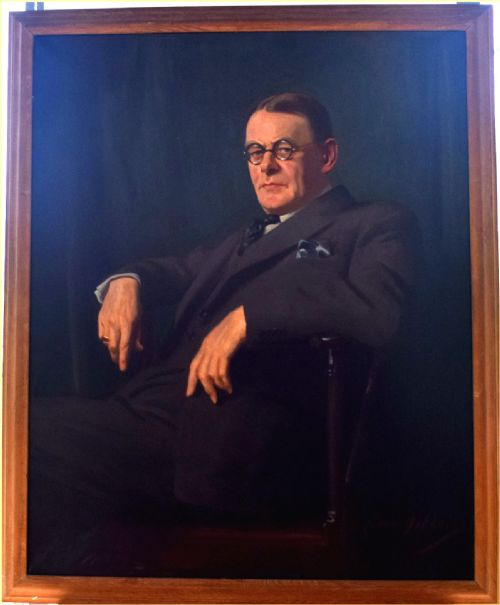
Portrait of Sir John Alexander Hammerton 1871-1949 Writer and Editor

Signed/Inscribed:

"Cowan Dobson"

oil on canvas

112 x 92 cm. (44 x 36 in.)

Sir John Alexander Hammerton, (1871–1949), author and editor of reference works, was born in Alexandria, Dunbartonshire, on 27 February 1871, the second in a family of two sons and one daughter of James Hammerton (1832/3–1874/5), clog maker of Oldham, and his second wife, Janet (b. 1841/2), shopwoman, daughter of Alexander Lang, mason. His father died when he was aged three, and the family, then living in Manchester, returned to the home of their maternal grandmother in Scotland. He attended first the Freeland School, Glasgow, and then Alexander's endowed school in the same city. As the breadwinner in the family, he left school at fourteen, and for the next four years he was apprenticed as a sculptor and tomb-cutter to the firm of stonemasons J. & G. Mossman. During this time he attended evening classes at the City School and at Glasgow University. He was known to his friends as Sandy.
The most successful creator of large-scale works of reference that Britain has known, Hammerton began his journalistic career in 1889 as a reporter on the Scottish temperance paper The Reformer. His light, humorous sketches began to appear regularly in London newspapers and in periodicals such as Punch. A succession of posts in journalism took him to Bolton, Blackpool, Nottingham, and Birmingham. While working in Blackpool, he married, on 3 January 1895, Rhoda (1871/2–1948), daughter of Colin Gibb Lawrence, of Glasgow. In 1900 he settled in London, where his lively, robust style of writing caught the eye of the founder of modern popular journalism, Alfred Harmsworth. In 1905 Hammerton was invited to join Harmsworth's Amalgamated Press, then the largest periodical-publishing empire in the world, and for the next seventeen years his employer's energetic and 'radium-like personality', as described by Hammerton, provided him with the background to his life's work. Of the more than ten million bound editions that bear his name as editor or author, he was proudest of the fortnightly Harmsworth's Universal Encyclopedia (1920–22) which, under the slogan of 'a penny a day's subscription', sold twelve million copies throughout the English-speaking world and was translated into six languages, including Japanese.

In 1911–13 Hammerton lived in Buenos Aires, where he edited El diccionario encyclopédico Hispano-Americano. He also wrote under pseudonyms, most notably a novel, The Call of the Town (1904), light reminiscences, and biographies of, among others, Arthur Mee and Sir J. M. Barrie. Despite the shortage of paper and the requisitioning of most commercial photographic glass negatives for the war effort, he was never happier, as he recounts in his autobiography, Books and Myself (1944), than during those days in the First World War when he worked late into the night to the background of a pavement barrel-organ in the Farringdon Road, alert to imminent air attacks on the city.

Hammerton's formative influence as a boy had been John Cassell's Popular Educator, first published in 1852. In 1934 he was able to consummate, in his own words, 'one of the romances of modern publishing', by revising and reissuing the work under the new title Practical Knowledge for All, which was, in turn, to become the most familiar series of educational books in millions of homes for a new generation.

To Hammerton's gifts of communication must also be attributed that most popular of all gestures of the twentieth century: the ‘V’ sign. In late 1940 he reported in the War Illustrated his sighting of a 'V' for victory sign apparently blazed by a Hawker Hurricane in the sky over the village of Firle in Sussex. Within months the sign had replaced the customary ‘thumbs-up’

Physical Dimensions
Height
112cm (44.09")
Width
92cm (36.22")
Depth
2cm (0.79")
Declaration

Artware Fineart has dated this Antique Male Oil Portrait to the 1940s.

Reference Numbers
Sellingantiques Reference
SA678190
Dealers Internal Reference
4165
Description
Cowan Dobson, RBA, RP,, 1893 - 1980

Portrait of Sir John Alexander Hammerton 1871-1949 Writer and Editor

Signed/Inscribed:

"Cowan Dobson"

oil on canvas

112 x 92 cm. (44 x 36 in.)

Sir John Alexander Hammerton, (1871–1949), author and editor of reference works, was born in Alexandria, Dunbartonshire, on 27 February 1871, the second in a family of two sons and one daughter of James Hammerton (1832/3–1874/5), clog maker of Oldham, and his second wife, Janet (b. 1841/2), shopwoman, daughter of Alexander Lang, mason.

His father died when he was aged three, and the family, then living in Manchester, returned to the home of their maternal grandmother in Scotland.
Artware Fineart

He attended first the Freeland School, Glasgow, and then Alexander's endowed school in the same city. As the breadwinner in the family, he left school at fourteen, and for the next four years he was apprenticed as a sculptor and tomb-cutter to the firm of stonemasons J. & G. Mossman. During this time he attended evening classes at the City School and at Glasgow University. He was known to his friends as Sandy.

fig 1. A 20th-century oil painting on canvas showing a seated gentleman with spectacles wearing a dark suit against a navy blue backdrop.
fig 1. Cowan Dobson, Rba, Rp,, 1893 - 1980 Portrait of Sir John Alexander Hammerton 1871-1949 Writer and Editor

The most successful creator of large-scale works of reference that Britain has known, Hammerton began his journalistic career in 1889 as a reporter on the Scottish temperance paper The Reformer. His light, humorous sketches began to appear regularly in London newspapers and in periodicals such as Punch. A succession of posts in journalism took him to Bolton, Blackpool, Nottingham, and Birmingham. While working in Blackpool, he married, on 3 January 1895, Rhoda (1871/2–1948), daughter of Colin Gibb Lawrence, of Glasgow. In 1900 he settled in London, where his lively, robust style of writing caught the eye of the founder of modern popular journalism, Alfred Harmsworth. In 1905 Hammerton was invited to join Harmsworth's Amalgamated Press, then the largest periodical-publishing empire in the world, and for the next seventeen years his employer's energetic and 'radium-like personality', as described by Hammerton, provided him with the background to his life's work. Of the more than ten million bound editions that bear his name as editor or author, he was proudest of the fortnightly Harmsworth's Universal Encyclopedia (1920–22) which, under the slogan of 'a penny a day's subscription', sold twelve million copies throughout the English-speaking world and was translated into six languages, including Japanese.

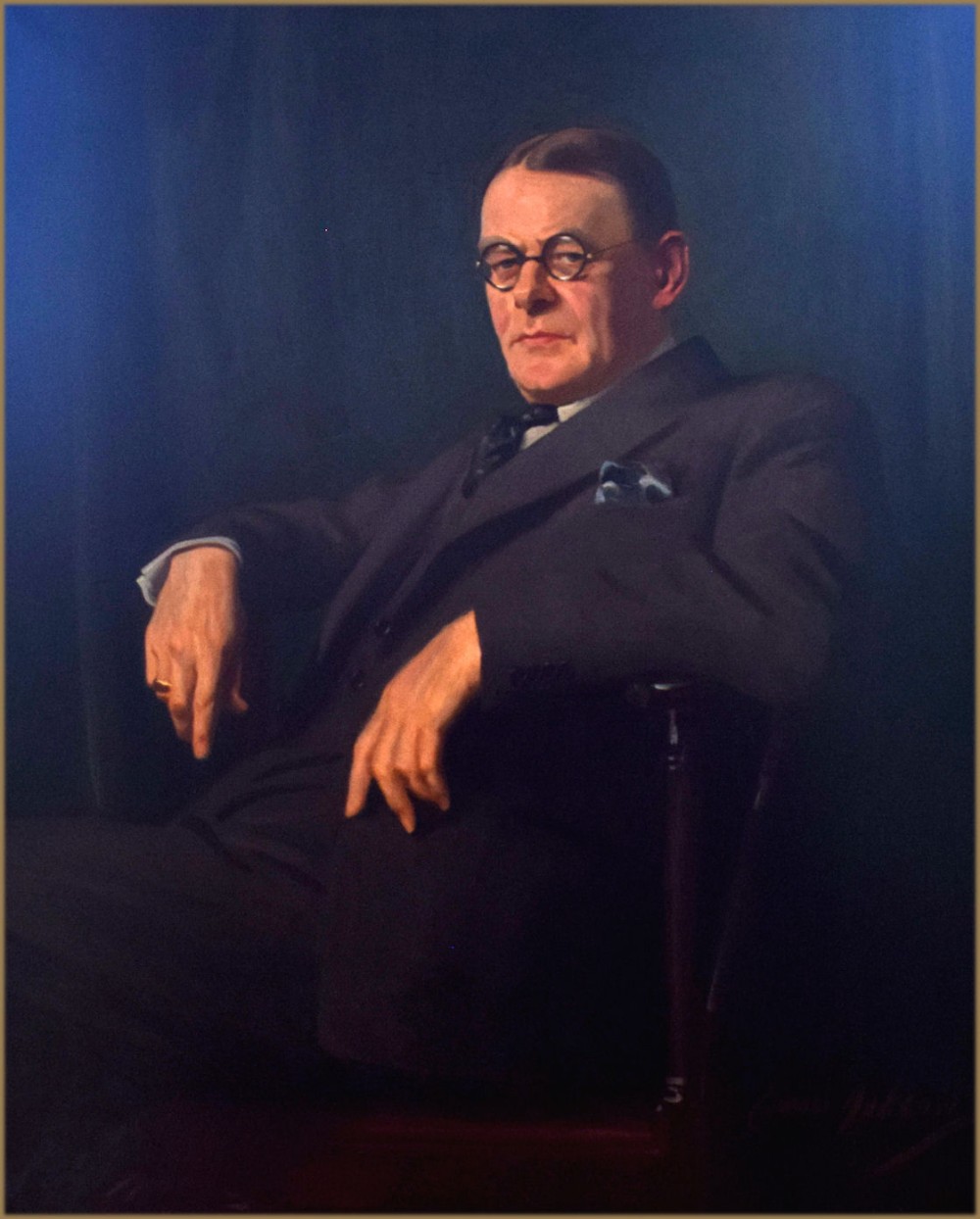
fig 2. A 20th-century oil painting on canvas showing a seated gentleman with spectacles wearing a dark suit against a navy blue backdrop.
fig 2. Cowan Dobson, Rba, Rp,, 1893 - 1980 Portrait of Sir John Alexander Hammerton 1871-1949 Writer and Editor

In 1911–13 Hammerton lived in Buenos Aires, where he edited El diccionario encyclopédico Hispano-Americano. He also wrote under pseudonyms, most notably a novel, The Call of the Town (1904), light reminiscences, and biographies of, among others, Arthur Mee and Sir J. M. Barrie. Despite the shortage of paper and the requisitioning of most commercial photographic glass negatives for the war effort, he was never happier, as he recounts in his autobiography, Books and Myself (1944), than during those days in the First World War when he worked late into the night to the background of a pavement barrel-organ in the Farringdon Road, alert to imminent air attacks on the city.

fig 3. A 20th-century oil painting on canvas showing a seated gentleman with spectacles wearing a dark suit against a navy blue backdrop.
fig 3. Cowan Dobson, Rba, Rp,, 1893 - 1980 Portrait of Sir John Alexander Hammerton 1871-1949 Writer and Editor

Hammerton's formative influence as a boy had been John Cassell's Popular Educator, first published in 1852. In 1934 he was able to consummate, in his own words, 'one of the romances of modern publishing', by revising and reissuing the work under the new title Practical Knowledge for All, which was, in turn, to become the most familiar series of educational books in millions of homes for a new generation.

fig 4. A 20th-century oil painting on canvas showing a seated gentleman with spectacles wearing a dark suit against a navy blue backdrop.
fig 4. Cowan Dobson, Rba, Rp,, 1893 - 1980 Portrait of Sir John Alexander Hammerton 1871-1949 Writer and Editor

To Hammerton's gifts of communication must also be attributed that most popular of all gestures of the twentieth century: the ‘V’ sign. In late 1940 he reported in the War Illustrated his sighting of a 'V' for victory sign apparently blazed by a Hawker Hurricane in the sky over the village of Firle in Sussex. Within months the sign had replaced the customary ‘thumbs-up’

Height
112cm (44.09")
Width
92cm (36.22")
Depth
2cm (0.79")
Date of Manufacture

Artware Fineart has dated this Antique Male Oil Portrait to the 1940s.

Reference Numbers
Sellingantiques Ref
SA678190
Dealers Internal Ref
4165
Artware Fineart
Sellingantiques verified Since Sep 2008
Dealer Profile

You can view the stock and full dealer information on the Artware Fineart Profile Page
PDF SHARE
SAVE
A 20th-century oil painting on canvas showing a seated gentleman with spectacles wearing a dark suit against a navy blue backdrop.
1 / 7
Archive I A 20th-century oil painting on canvas showing a seated gentleman with spectacles wearing a dark suit against a navy blue backdrop.

Cowan Dobson, Rba, Rp,, 1893 - 1980 Portrait of Sir John Alexander Hammerton 1871-1949 Writer and Editor

Archive II A 20th-century oil painting on canvas showing a seated gentleman with spectacles wearing a dark suit against a navy blue backdrop. View II
Archive III A 20th-century oil painting on canvas showing a seated gentleman with spectacles wearing a dark suit against a navy blue backdrop. View III
Archive IV A 20th-century oil painting on canvas showing a seated gentleman with spectacles wearing a dark suit against a navy blue backdrop. View IV
Archive V A 20th-century oil painting on canvas showing a seated gentleman with spectacles wearing a dark suit against a navy blue backdrop. View V
Archive VI A 20th-century oil painting on canvas showing a seated gentleman with spectacles wearing a dark suit against a navy blue backdrop. View VI
Archive VII A 20th-century oil painting on canvas showing a seated gentleman with spectacles wearing a dark suit against a navy blue backdrop. View VII
Enlarged Archival View
Telephone 07958 699 645
Location
18 La Gare
51 Surrey Row
London
SE1 0BZ
United Kingdom
Verified Since Sep 2008
Items For Sale 243
Items Sold 223
Artware Fineart
Verified Since Sep 2008
View Dealer Info
Location: 18 La Gare , 51 Surrey Row , London , SE1 0BZ , United Kingdom
Verified
Sep 2008
For Sale
243
Sold
223
A 20th-century oil painting on canvas showing a seated gentleman with spectacles wearing a dark suit against a navy blue backdrop.
Cowan Dobson, RBA, RP,, 1893 - 1980 Portrait of Sir John Alexander Hammerton 1871-1949 Writer and Editor
Ref: SA678190
A 20th-century oil painting on canvas showing a seated gentleman with spectacles wearing a dark suit against a navy blue backdrop.
Detail View 1
Detail View 2
Detail View 3
Detail View 4
Detail View 5
Detail View 6
Archival Detail
Every single antique dealer on our platform is individually approved by our internal team. We verify their professional trade history, ethical standards, and photographic quality to ensure a secure, high-standard buying environment. Upon joining, every dealer agrees to a strict 9-point code of conduct. While issues can occasionally arise, our dealers typically resolve them swiftly and directly with the buyer. In fact, since our founding in 2002, Sellingantiques has only had to step in to help resolve an issue on roughly five occasions—a true testament to the quality of our dealers and their dedication to your happiness.
Our dealers are highly experienced in packing and shipping fragile, high-value antiques. Because you are in direct contact with the dealer, you will be able to easily go through all available shipping and insurance options together to ensure your item arrives safely.
Antiques are the ultimate green purchase. By choosing historical pieces over newly manufactured goods, you completely eliminate the carbon footprint of modern mass production while preserving exceptional, timeless craftsmanship.

Twentieth-century British portraiture often blends traditional academic realism with modern observational techniques, focussing on character study, direct lighting, and formal composition.

Formal portraits of this period were typically painted using oil pigments bound with linseed oil on stretched linen canvas, supported by wooden strainer frames and protected with varnish.

Authentic oil paintings show period-appropriate canvas weave, natural craquelure in the paint layers, artist signatures or inscriptions, and age-consistent oxidisation on the wooden stretchers.

A vintage portrait can be hung above a sideboard, fireplace, or desk to create a strong focal point, harmonising well with dark wood furniture, neutral walls, or rich paint tones.

Keep oil paintings away from direct sunlight, extreme temperature changes, and high humidity, dusting the frame lightly with a soft brush rather than liquid cleaners.
items
Add keywords to the filter
Price
£100
£250000
Era
Movements
Material
Origin
Stock Location
Freshness
Online Payments
Categories