28,780  PAGES BROWSED TODAY PAGES TODAY 74  ANTIQUES UPLOADED TODAY NEW ARRIVALS
ID #SA677005
FOR SALE
£3,500
Email
Save
Attributed to Sir James Guthrie, 1859 – 1930 Portrait of David Lloyd George, 1st Earl Lloyd-george of Dwyfor, Om, Pc, 1863 – 1945
Artware Fineart
for sale €4,095     $4,445
£3,500

Artware Fineart

Sellingantiques Verified Since Sep 2008
View Dealers Stock Page
Id #SA677005
PDF SHARE
SAVE

Attributed to Sir James Guthrie, 1859 – 1930 Portrait of David Lloyd George, 1st Earl Lloyd-george of Dwyfor, Om, Pc, 1863 – 1945

1900 - 1920
For Sale by Artware Fineart
Description

Attributed to Sir James Guthrie, 1859 – 1930

Portrait of David Lloyd George, 1st Earl Lloyd-George of Dwyfor, OM, PC, 1863 – 1945

oil on canvas

46 x 36 cm. (18.1/4 x 14.1/4 in.)

David Lloyd George, first Earl Lloyd-George of Dwyfor (1863–1945), prime minister, was born at 5 New York Place, Chorlton upon Medlock, Manchester, on 17 January 1863, the second child and elder son of William George (1820–1864), schoolmaster, and his wife, Elizabeth (1828–1896), daughter of David Lloyd, shoemaker and Baptist pastor, of Llanystumdwy, Caernarvonshire. Failing health led his father to return to farm in his native Pembrokeshire, and he died there in 1864. The family were then brought back to Llanystumdwy by Elizabeth's unmarried brother, Richard Lloyd, a master shoemaker. The children soon numbered three—Mary Ellen, the eldest, David, and a second son, William, born posthumously in 1865. Richard Lloyd proved to be a towering influence on the infant David. An autodidact of broad culture, he was also a strong Liberal politically and a lay preacher in the local church of the Campbellite Baptists, a radical offshoot of the main Baptist denomination. His role guided David Lloyd George's early steps in the law and politics. Indeed ‘Uncle Lloyd’ remained an influence in the shadows down to his death at the age of eighty-three in February 1917. By that time, his nephew David was prime minister of Great Britain.
The boy David's political ascent was almost pre-ordained. At the age of five he was carried on his uncle's shoulders at meetings during the dramatic Liberal victories in Caernarvonshire and elsewhere in Wales at the ‘great general election’ of 1868. Lloyd George went to the local village school at Llanystumdwy, where he stayed until July 1878 when he was fifteen. He was admirably taught mathematics and geography by the headmaster, David Evans. But even here politics intruded. The school was an Anglican foundation and when the children were invited to recite the catechism before a local landowner, Ellis Nanney, Lloyd George led a strike by the pupils. When his brother, William, broke the silence by intoning 'I believe', according to legend (later denied) he received a thrashing from his elder brother. Ellis Nanney was destined to be Lloyd George's opponent at his first parliamentary election in Caernarfon Boroughs. In 1878 Lloyd George was attached to a solicitor's firm in nearby Portmadoc, Breese, Jones, and Casson. In 1884 he passed the Law Society final examinations with honours. He could now set up practice on his own in Cricieth (brother William was shortly to join him there), a platform for a future political career.
It was a time of great political excitement in Wales. The impact of democracy after theReform Acts of 1867 and 1884 fired campaigns by radical Liberals against landlordism and the established status of the Church of England in Wales. They fought for civic equality for nonconformists, social equality for tenant farmers and labourers—and increasingly national equality for Wales. Lloyd George plunged into political life while still in his teens. He took part in the debates of the Portmadoc debating society and spoke in local temperance and foreign mission gatherings. He proved to be a naturally graphic and compelling speaker with a rare gift of imagery. His political ambitions were kindled by a visit to London in 1881 at which he saw the House of Commons for the first time. He noted in his diary for 12 November 1881 (W. R. P. George, Making of Lloyd George, 101), 'I will not say but that I eyed the assembly in a spirit similar to that in which William the Conqueror eyed England on his visit to Edward the Confessor, as the region of his future domain. Oh, vanity!' By 1885 he had established a reputation as a fiery young orator on Liberal platforms. He took some part in the Merioneth contest in the general

Physical Dimensions
Height
46cm (18.11")
Width
36cm (14.17")
Depth
2cm (0.79")
Declaration

Artware Fineart has dated this Antique Oil Portrait Painting to the 1920s.

Reference Numbers
Sellingantiques Reference
SA677005
Dealers Internal Reference
4031
Description
Attributed to Sir James Guthrie, 1859 – 1930

Portrait of David Lloyd George, 1st Earl Lloyd-George of Dwyfor, OM, PC, 1863 – 1945

oil on canvas

46 x 36 cm. (18.1/4 x 14.1/4 in.)

David Lloyd George, first Earl Lloyd-George of Dwyfor (1863–1945), prime minister, was born at 5 New York Place, Chorlton upon Medlock, Manchester, on 17 January 1863, the second child and elder son of William George (1820–1864), schoolmaster, and his wife, Elizabeth (1828–1896), daughter of David Lloyd, shoemaker and Baptist pastor, of Llanystumdwy, Caernarvonshire.

Failing health led his father to return to farm in his native Pembrokeshire, and he died there in 1864.
Artware Fineart

The family were then brought back to Llanystumdwy by Elizabeth's unmarried brother, Richard Lloyd, a master shoemaker. The children soon numbered three—Mary Ellen, the eldest, David, and a second son, William, born posthumously in 1865. Richard Lloyd proved to be a towering influence on the infant David. An autodidact of broad culture, he was also a strong Liberal politically and a lay preacher in the local church of the Campbellite Baptists, a radical offshoot of the main Baptist denomination. His role guided David Lloyd George's early steps in the law and politics. Indeed ‘Uncle Lloyd’ remained an influence in the shadows down to his death at the age of eighty-three in February 1917. By that time, his nephew David was prime minister of Great Britain.

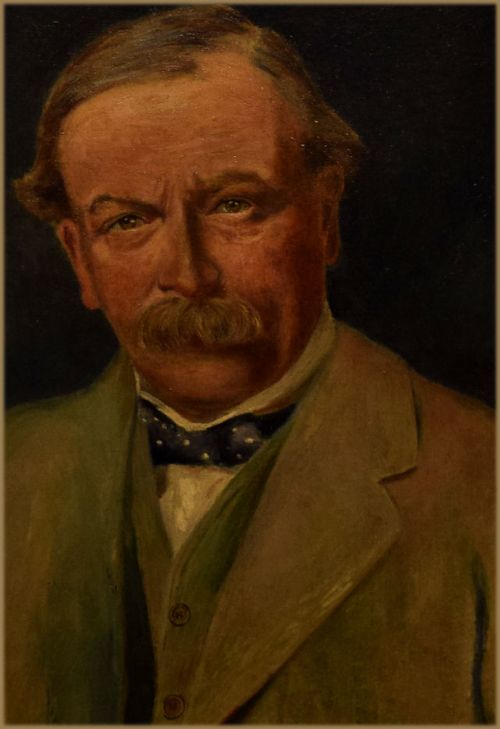
fig 1. An antique oil painting depicting a gentleman with a moustache wearing a green jacket and polka-dot bowtie against a dark background.
fig 1. Attributed to Sir James Guthrie, 1859 – 1930 Portrait of David Lloyd George, 1st Earl Lloyd-george of Dwyfor, Om, Pc, 1863 – 1945

The boy David's political ascent was almost pre-ordained. At the age of five he was carried on his uncle's shoulders at meetings during the dramatic Liberal victories in Caernarvonshire and elsewhere in Wales at the ‘great general election’ of 1868. Lloyd George went to the local village school at Llanystumdwy, where he stayed until July 1878 when he was fifteen. He was admirably taught mathematics and geography by the headmaster, David Evans. But even here politics intruded. The school was an Anglican foundation and when the children were invited to recite the catechism before a local landowner, Ellis Nanney, Lloyd George led a strike by the pupils. When his brother, William, broke the silence by intoning 'I believe', according to legend (later denied) he received a thrashing from his elder brother. Ellis Nanney was destined to be Lloyd George's opponent at his first parliamentary election in Caernarfon Boroughs. In 1878 Lloyd George was attached to a solicitor's firm in nearby Portmadoc, Breese, Jones, and Casson. In 1884 he passed the Law Society final examinations with honours. He could now set up practice on his own in Cricieth (brother William was shortly to join him there), a platform for a future political career.

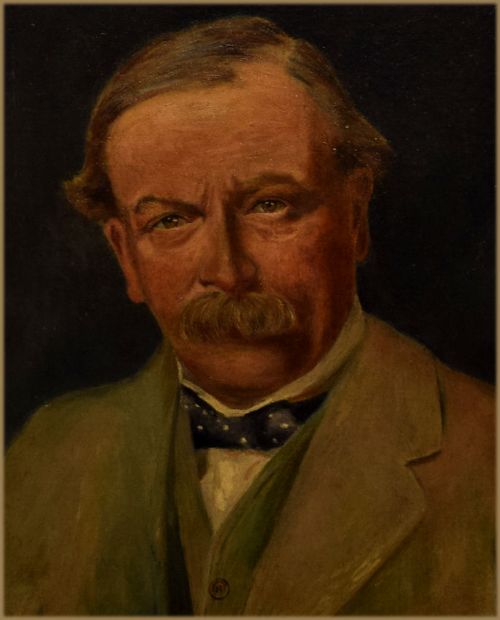
fig 2. An antique oil painting depicting a gentleman with a moustache wearing a green jacket and polka-dot bowtie against a dark background.
fig 2. Attributed to Sir James Guthrie, 1859 – 1930 Portrait of David Lloyd George, 1st Earl Lloyd-george of Dwyfor, Om, Pc, 1863 – 1945

It was a time of great political excitement in Wales. The impact of democracy after theReform Acts of 1867 and 1884 fired campaigns by radical Liberals against landlordism and the established status of the Church of England in Wales. They fought for civic equality for nonconformists, social equality for tenant farmers and labourers—and increasingly national equality for Wales. Lloyd George plunged into political life while still in his teens. He took part in the debates of the Portmadoc debating society and spoke in local temperance and foreign mission gatherings. He proved to be a naturally graphic and compelling speaker with a rare gift of imagery. His political ambitions were kindled by a visit to London in 1881 at which he saw the House of Commons for the first time. He noted in his diary for 12 November 1881 (W. R. P. George, Making of Lloyd George, 101), 'I will not say but that I eyed the assembly in a spirit similar to that in which William the Conqueror eyed England on his visit to Edward the Confessor, as the region of his future domain. Oh, vanity!' By 1885 he had established a reputation as a fiery young orator on Liberal platforms. He took some part in the Merioneth contest in the general

Height
46cm (18.11")
Width
36cm (14.17")
Depth
2cm (0.79")
Date of Manufacture

Artware Fineart has dated this Antique Oil Portrait Painting to the 1920s.

Reference Numbers
Sellingantiques Ref
SA677005
Dealers Internal Ref
4031
Artware Fineart
Sellingantiques verified Since Sep 2008
Dealer Profile

You can view the stock and full dealer information on the Artware Fineart Profile Page

PDF SHARE
SAVE
An antique oil painting depicting a gentleman with a moustache wearing a green jacket and polka-dot bowtie against a dark background.
1 / 3
Archive I An antique oil painting depicting a gentleman with a moustache wearing a green jacket and polka-dot bowtie against a dark background.

Attributed to Sir James Guthrie, 1859 – 1930 Portrait of David Lloyd George, 1st Earl Lloyd-george of Dwyfor, Om, Pc, 1863 – 1945

Archive II An antique oil painting depicting a gentleman with a moustache wearing a green jacket and polka-dot bowtie against a dark background. View II
Archive III An antique oil painting depicting a gentleman with a moustache wearing a green jacket and polka-dot bowtie against a dark background. View III
FURTHER BROWSING

Visitors also looked at these ⇣

Enlarged Archival View
Telephone 07958 699 645
Location
18 La Gare
51 Surrey Row
London
SE1 0BZ
United Kingdom
Verified Since Sep 2008
Items For Sale 243
Items Sold 223
Artware Fineart
Verified Since Sep 2008
View Dealer Info
Location: 18 La Gare , 51 Surrey Row , London , SE1 0BZ , United Kingdom
Verified
Sep 2008
For Sale
243
Sold
223
An antique oil painting depicting a gentleman with a moustache wearing a green jacket and polka-dot bowtie against a dark background.
Attributed to Sir James Guthrie, 1859 – 1930 Portrait of David Lloyd George, 1st Earl Lloyd-George of Dwyfor, OM, PC, 1863 – 1945
Ref: SA677005
An antique oil painting depicting a gentleman with a moustache wearing a green jacket and polka-dot bowtie against a dark background.
Detail View 1
Detail View 2
Archival Detail
Every single antique dealer on our platform is individually approved by our internal team. We verify their professional trade history, ethical standards, and photographic quality to ensure a secure, high-standard buying environment. Upon joining, every dealer agrees to a strict 9-point code of conduct. While issues can occasionally arise, our dealers typically resolve them swiftly and directly with the buyer. In fact, since our founding in 2002, Sellingantiques has only had to step in to help resolve an issue on roughly five occasions—a true testament to the quality of our dealers and their dedication to your happiness.
Our dealers are highly experienced in packing and shipping fragile, high-value antiques. Because you are in direct contact with the dealer, you will be able to easily go through all available shipping and insurance options together to ensure your item arrives safely.
Antiques are the ultimate green purchase. By choosing historical pieces over newly manufactured goods, you completely eliminate the carbon footprint of modern mass production while preserving exceptional, timeless craftsmanship.

Early 20th-century British portraiture often reflects traditional realism influenced by impressionistic brushwork, capturing civic, military, and political figures with restrained tonal palettes and atmospheric lighting.

Artists typically used oil pigments suspended in linseed or walnut oil, applied onto stretched flax canvas or wooden panels prepared with a gesso ground.

Authentic pieces display age-appropriate craquelure across the paint surface, natural oxidisation of historical varnish, and consistent age darkening on the reverse of the canvas weave.

Position the portrait against a contemporary dark or neutral feature wall to create a focal point, pairing it alongside modern furniture for an eclectic interior aesthetic.

Keep the artwork away from direct sunlight, fluctuating humidity, and direct heat sources, dusting the surface gently with a dry soft-bristle brush rather than liquid cleaners.
items
Add keywords to the filter
Price
£100
£250000
Era
Movements
Material
Origin
Stock Location
Freshness
Online Payments
Categories