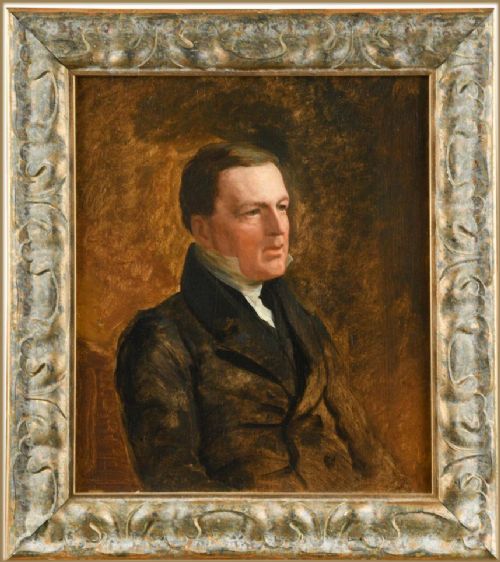
George Hayter, 1792 - 1871
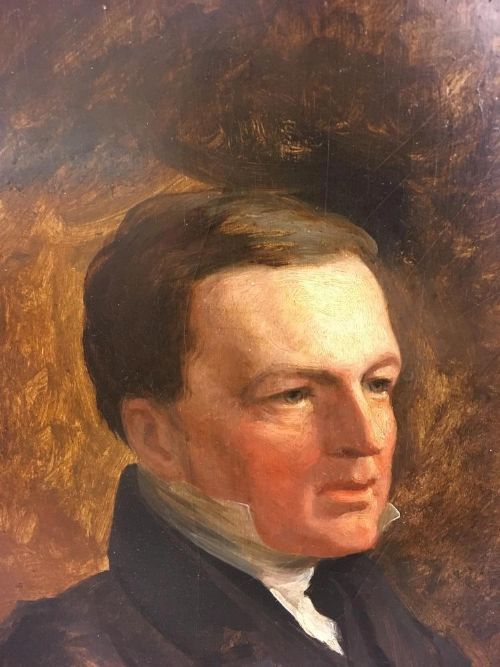
Portrait of Charles Christopher Pepys, 1st Earl of Cottenham (1781-1851)
Signed/Inscribed:
inscribed on the reverse
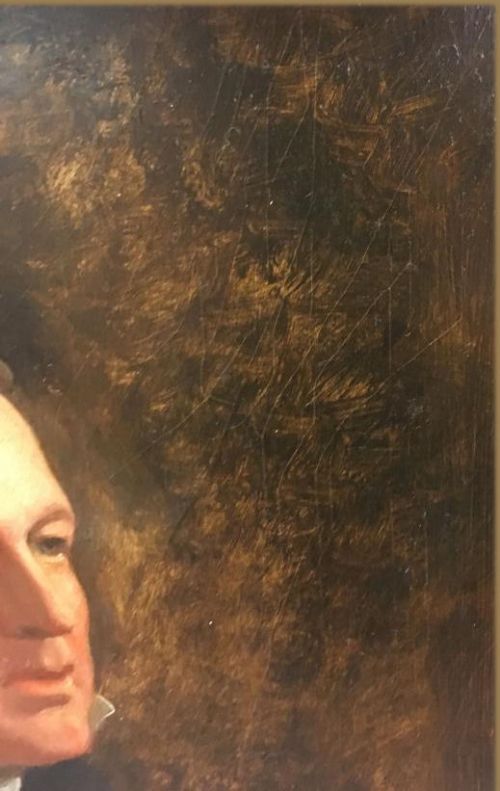
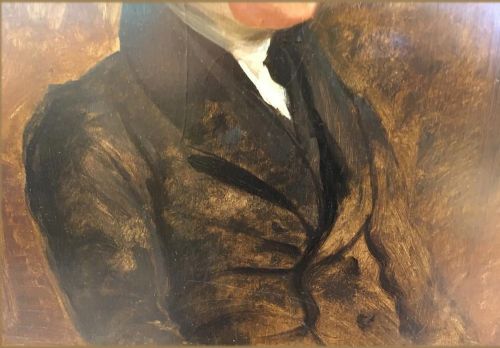
oil on panel
33 x 28 cm.
The present portrait is a study for Hayter''s great painting ''The House of Commons'', painted 1833-43, now in the National Portrait Gallery.
Notes
Charles Christopher Pepys, 1st Earl of Cottenham, PC, QC (/''p?p?s/; 29 April 1781 – 29 April 1851) was an English lawyer, judge and politician. He was twice Lord Chancellor of Great Britain.
Background and education
Cottenham was born on 29 April 1781 in Wimpole Street, Cavendish Square, London the second son of three sons of Sir William Pepys, 1st Baronet, a master in chancery, who was descended from John Pepys, of Cottenham, Cambridgeshire, a great-uncle of Samuel Pepys the diarist. Pepys was educated at Harrow School and at Trinity College, Cambridge, where he did not sit for the tripos but was content to graduate LLB in 1803. Contemp
...oraries remembered him as a short,
stout, sturdy, thickset boy, of blunt speech and cold disposition, aiming at no distinction, making few friends … None could say that he was clever; some of his schoolfellows pronounced him dull. His dark, searching eyes, massive forehead and expressive lips, refuted the charge.
He never lost his ''air of independence and determination which indicated an inward consciousness of superiority'' (Le Marchant, 59–60).
Pepys was called to the bar of Lincoln''s Inn in 1804.
Legal and political career
Pepys was admitted a student of Lincoln''s Inn on 26 January 1801 and was called to the bar on 23 November 1804, the same day as the future Viscount Melbourne. In 1837 he became treasurer of his inn. Like many of his distinguished contemporaries, he was a pupil of the famous special pleader, William Tidd. His fellow pupil, John Campbell, later Lord Campbell, described him as ''the greatest ornament of our [Tidd''s] Bar'' (Life of John, Lord Campbell, 1.138). He decided to practise at the emerging chancery bar (he was among the first generation of chancery lawyers who did not go circuit), so, having taken chambers in 16 Old Square, Lincoln''s Inn, he began his study of equity with Sir Samuel Romilly. The fact that his father was a master in chancery must have helped his practice. Within five years of his call, his father wrote to Hannah More: ''The success of my second son at the Chancery Bar has been most rapid, and highly gratifying to me'' (Gaussen, 2.295). His professional success came from his total dedication to his equity practice and his disdain for society; in later life his only recreation was foreign travel. A chancery advocate did not have to be an Erskine or a Scarlett. Pepys had a clear mind, reasoned cogently, was rarely repetitious, and ''never forgot that he was addressing a single judge and that judge a professional man'' (Law Review, 14, 1853, 354).
Pepys''s practice at the bar prospered, enabling him on 30 June 1821 to marry Caroline Elizabeth (1802–1868), the second daughter of William Wingfield KC, then chief justice of the Brecon circuit, and to become another master in chancery. On 24 August 1826 he received his silk gown from Lord Lyndhurst and became a bencher of his inn in November that year. Four years later he was appointed solicitor-general to Queen Adelaide, retaining that post until May 1832.
Whiggism was in Pepys''s blood; his maternal grandfather had been the chancellor of the exchequer in the Rockingham administration in 1765. Though he had shown little political ambition, in July 1831 he entered the House of Commons as the member for Higham Ferrers, a seat which he exchanged the following September for Lord Fitzwilliam''s borough of Malton. In the house he rarely spoke, and then on purely legal questions; his first speech, on 31 October 1831, was on the Bankruptcy Bi
Internal Reference: 4157
Antique ID Number (AIDN): SA637978
Dateline of this antique is 19th Century
Height is 33cm (13.0inches)Width is 28cm (11.0inches)Depth is 1cm (0.4inches)




Thank you.
Your comment has been sent to Sellingantiques.