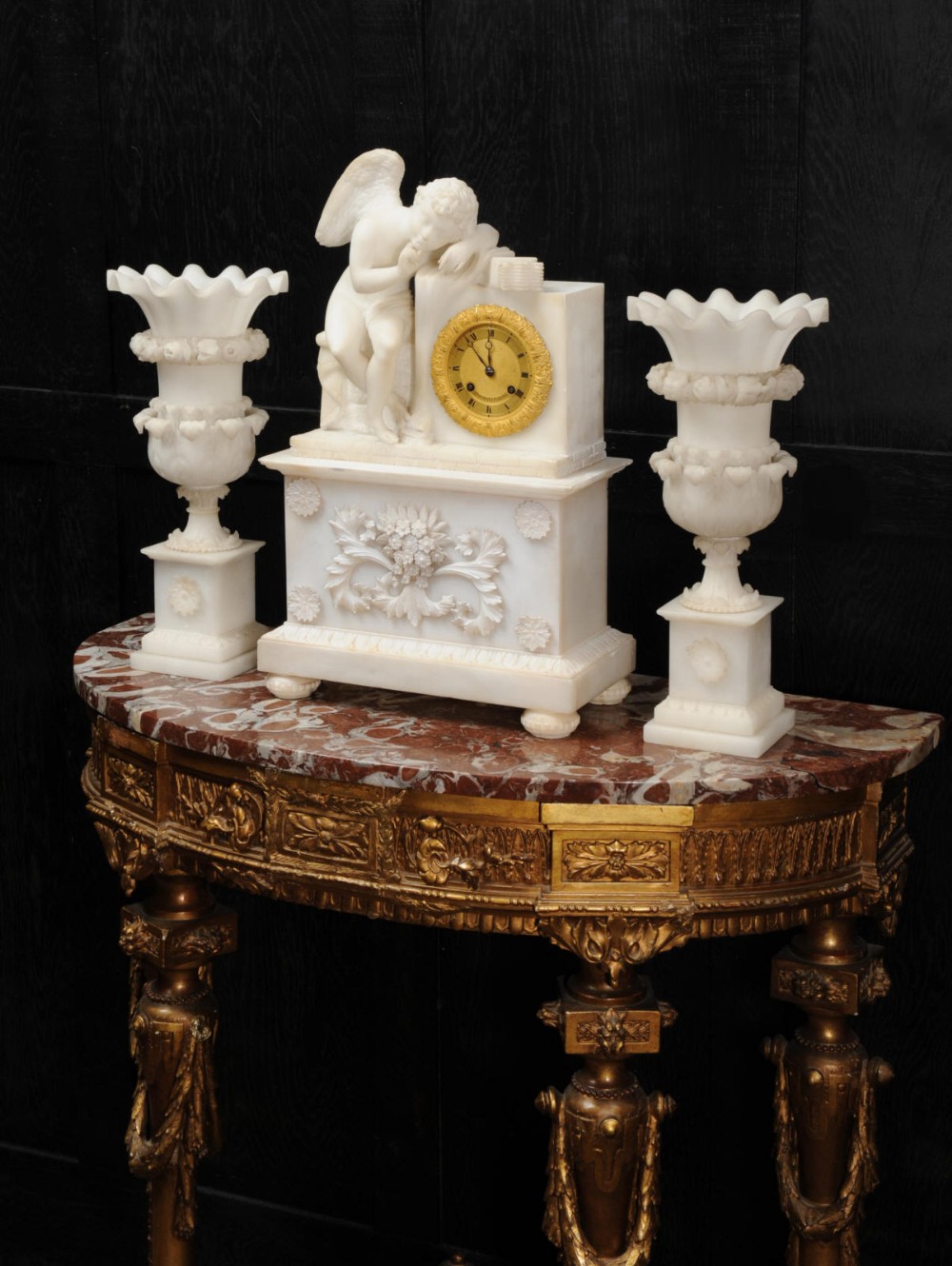
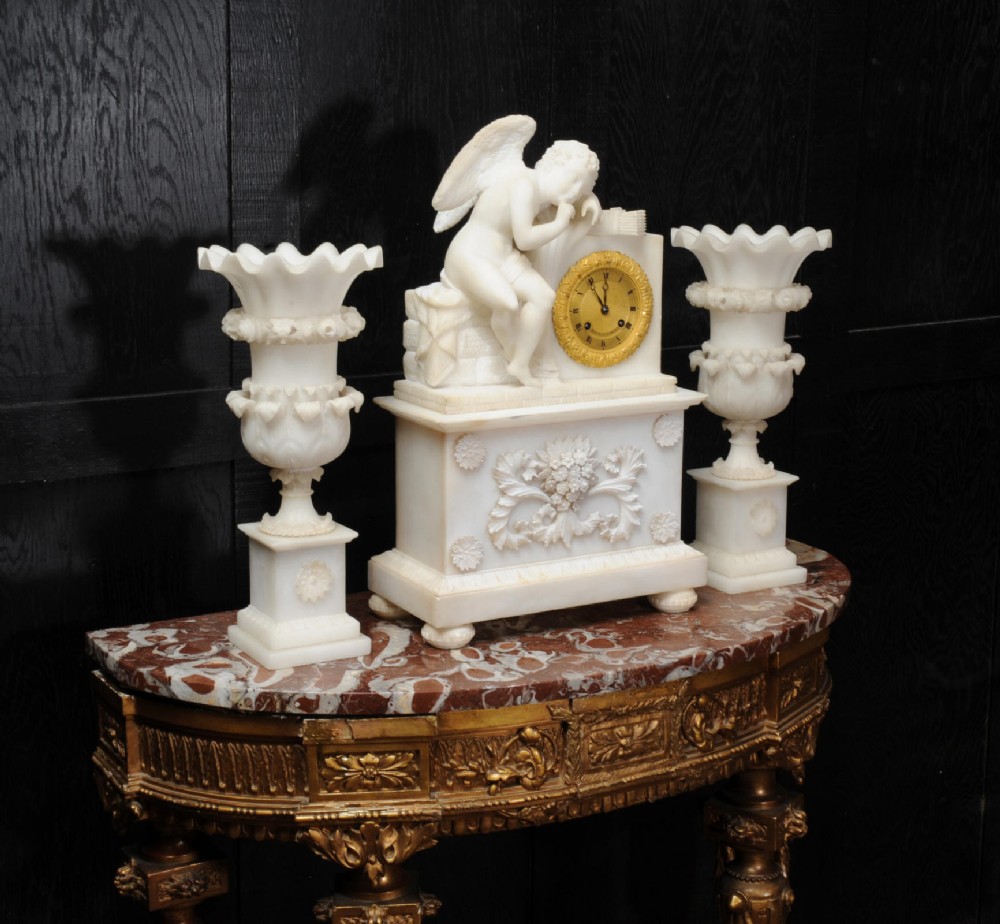
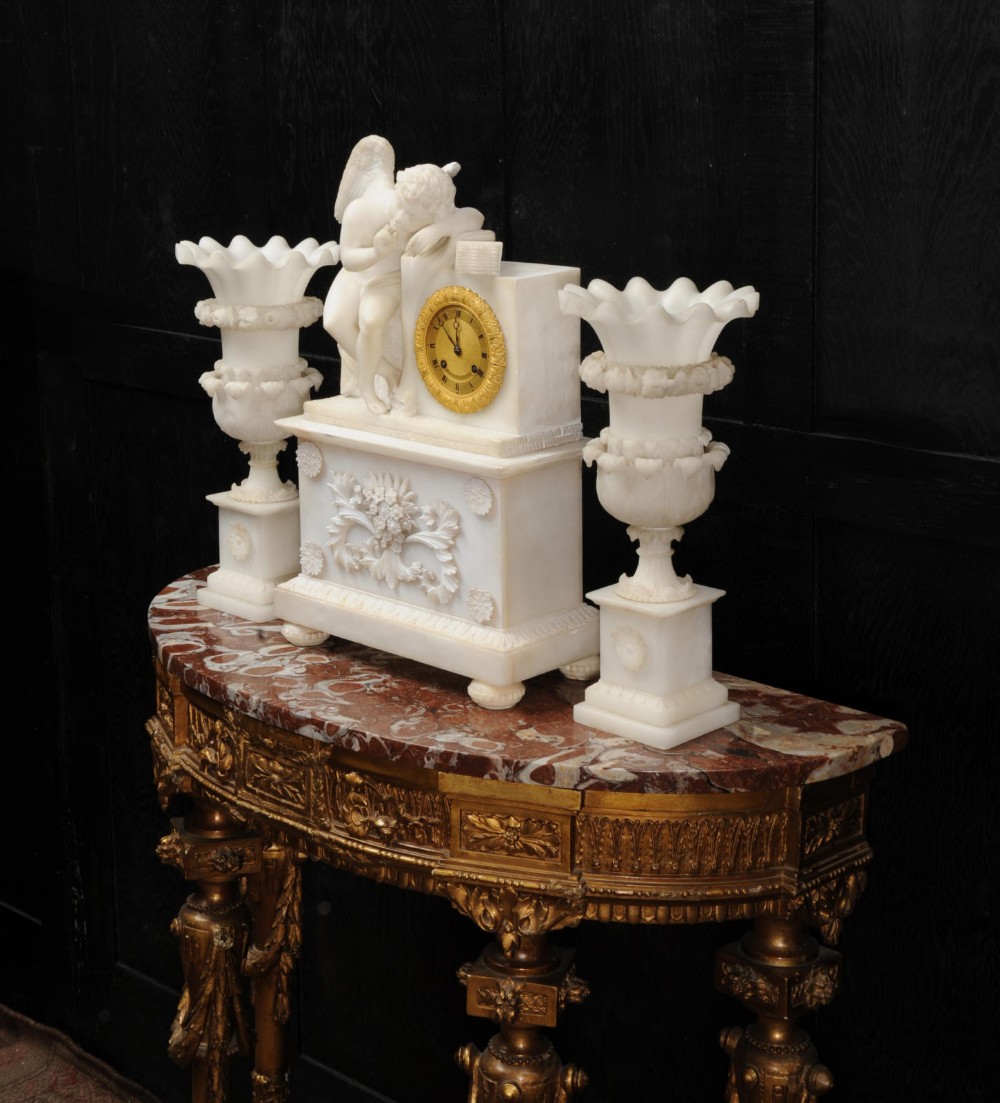
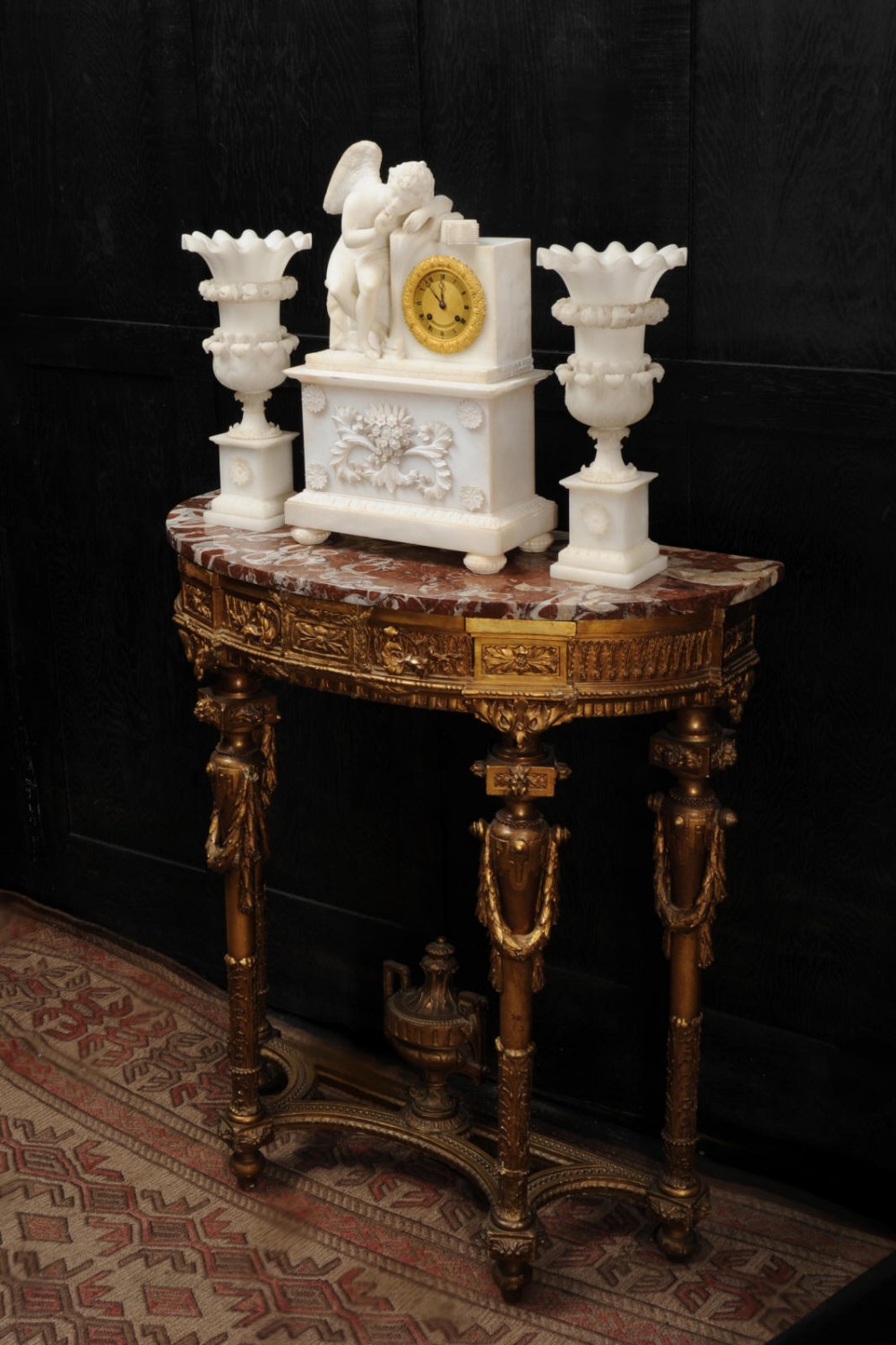
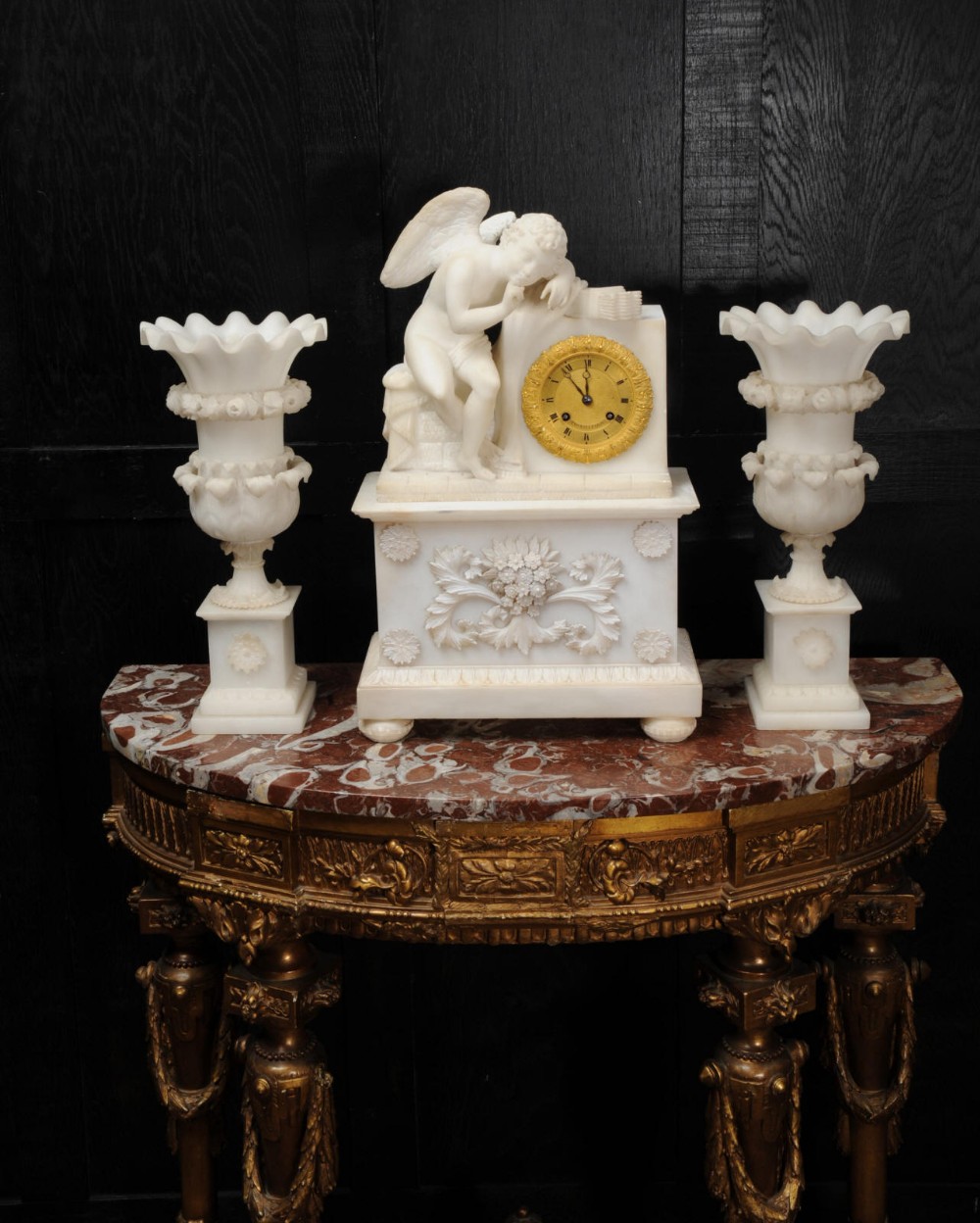
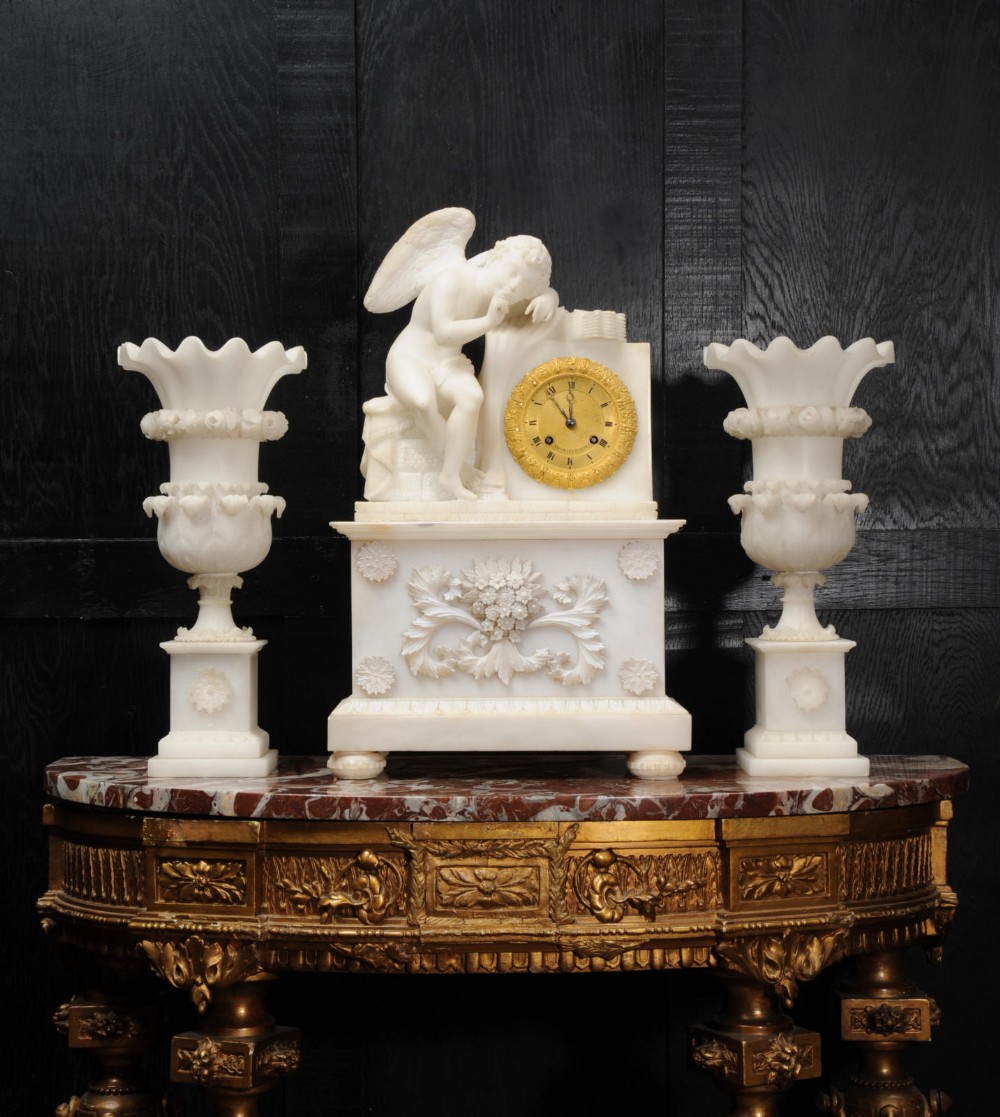
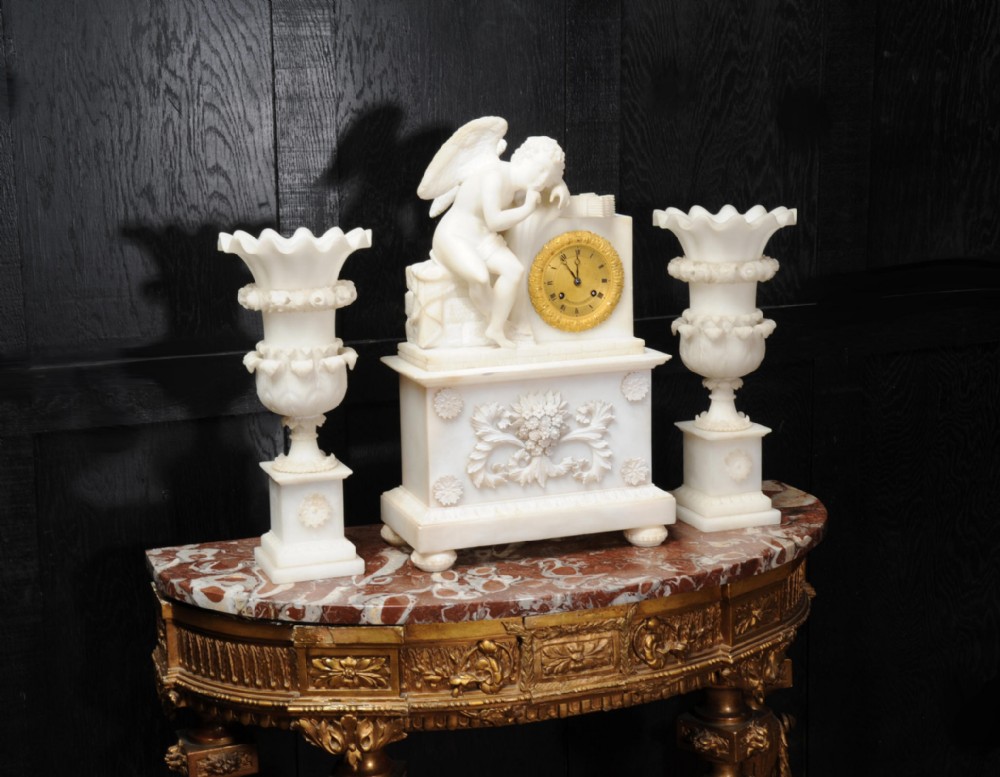
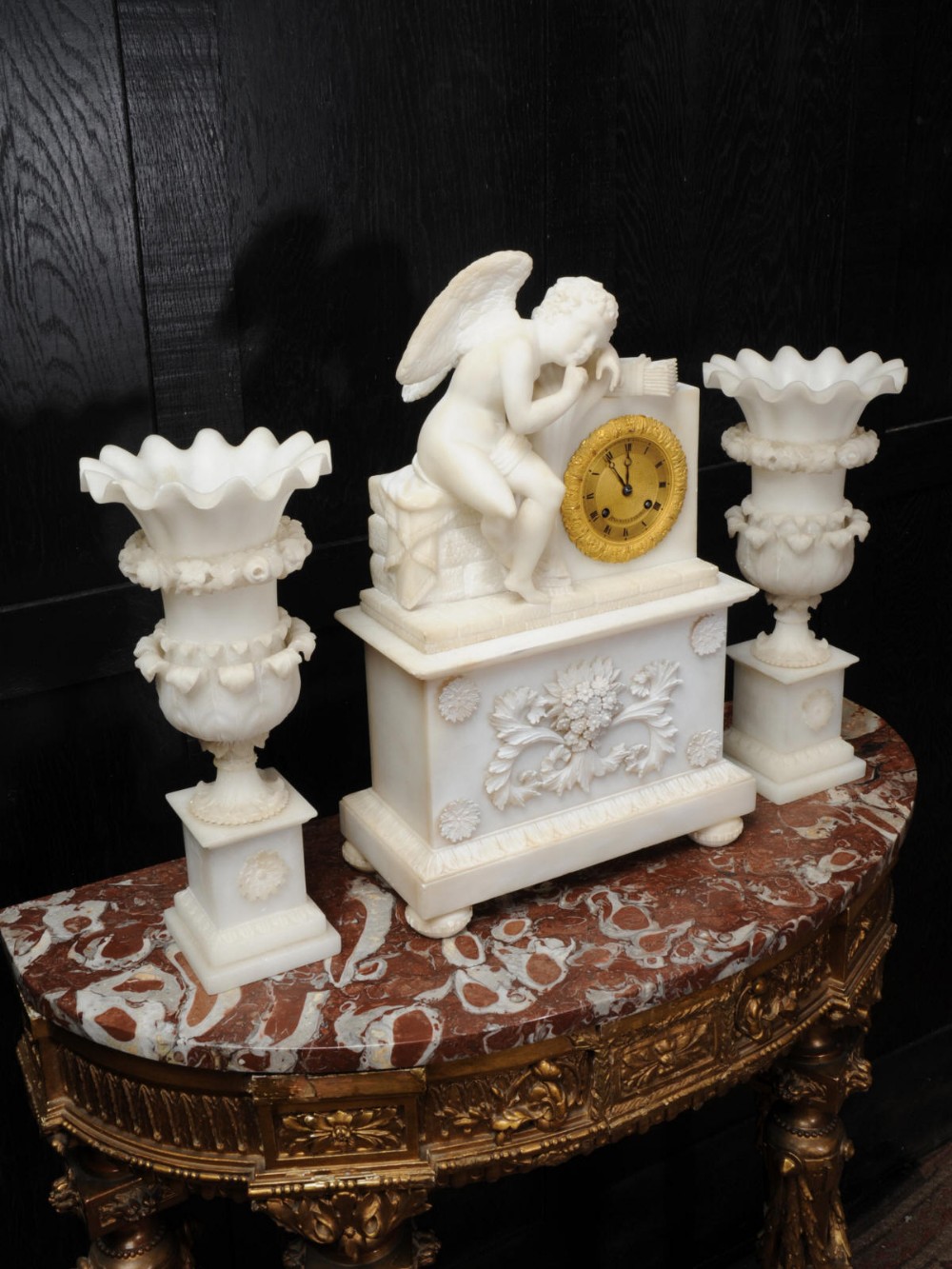
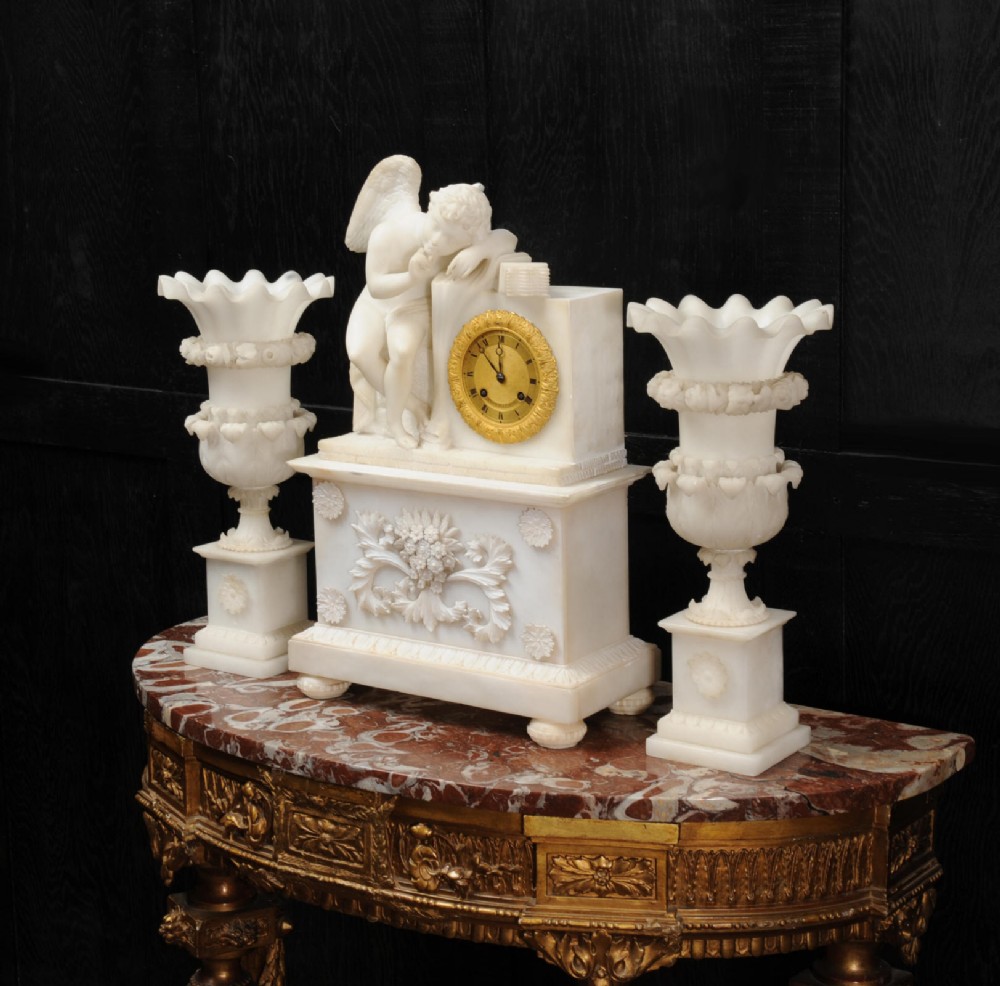
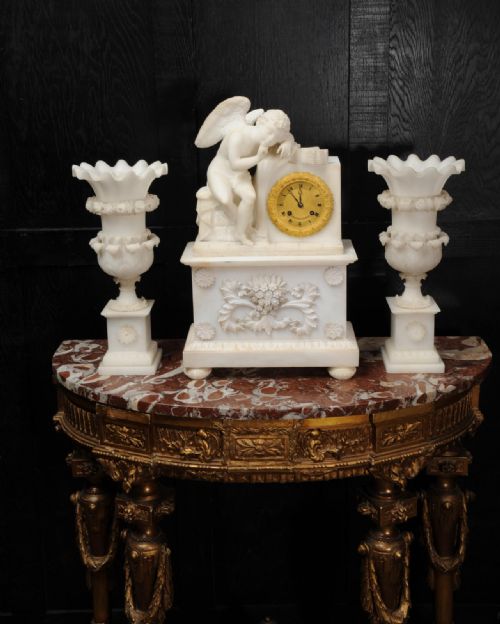
Dragon-Antiques.com has dated this French Alabaster Clock Set to the 1850s.
~~ Excellent condition, fully working ~~
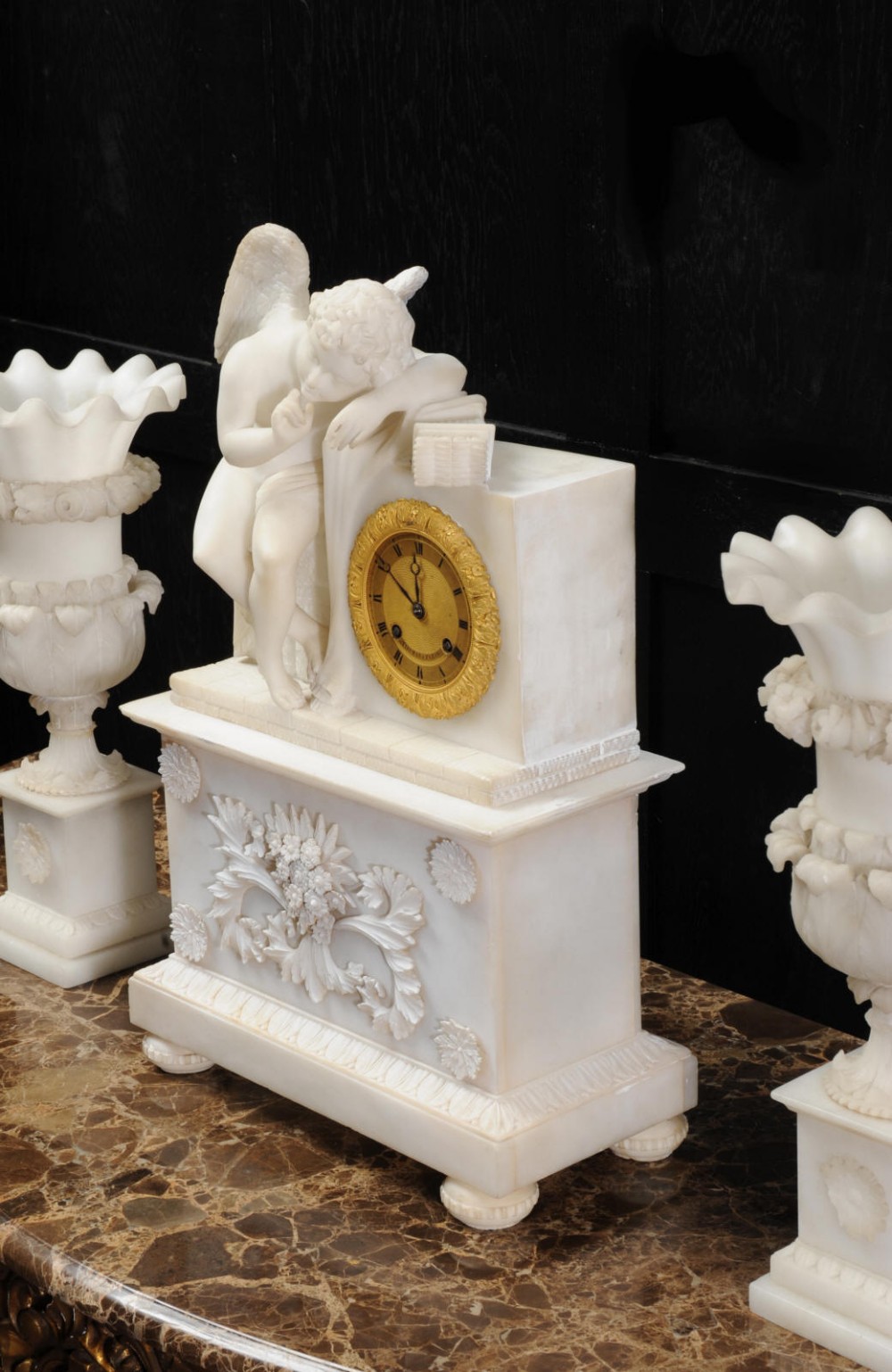
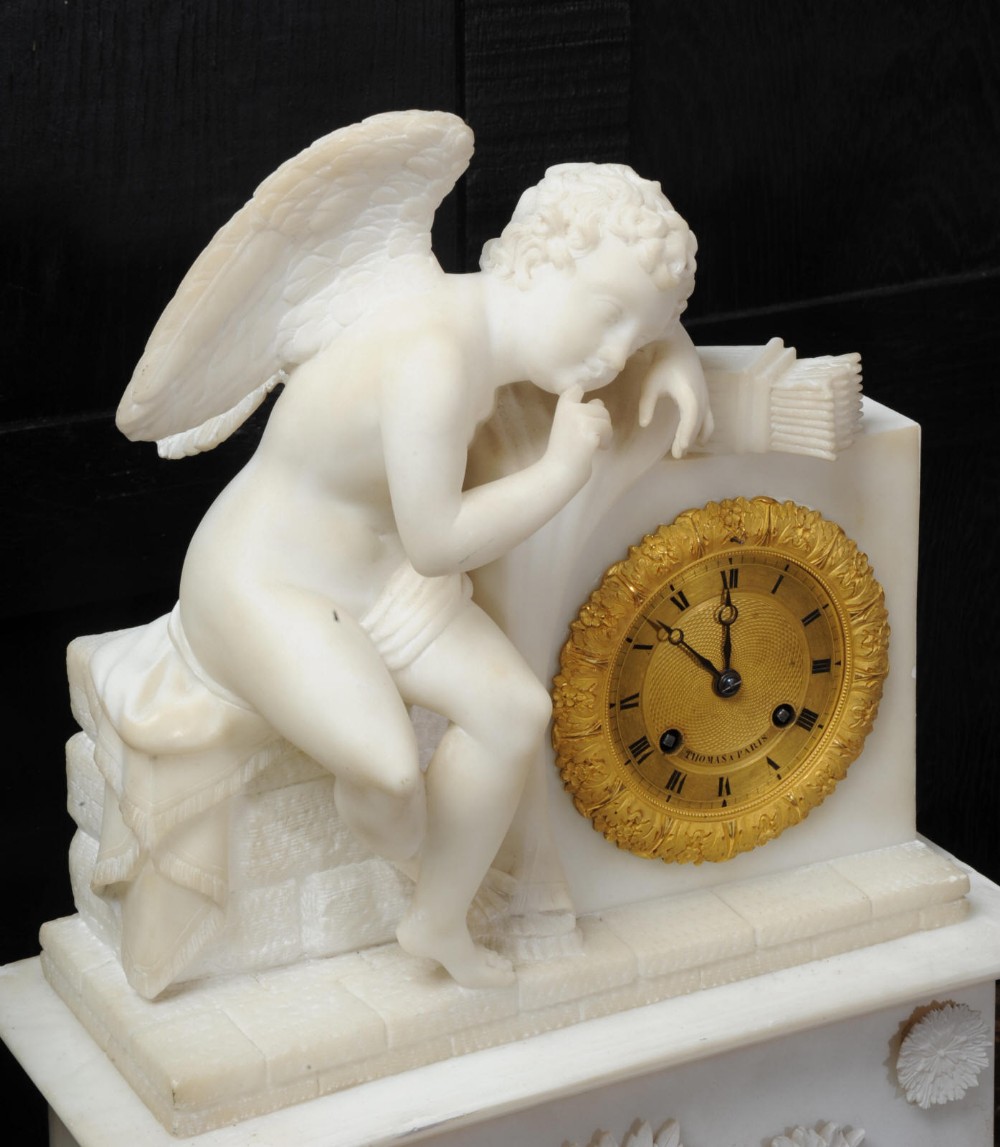
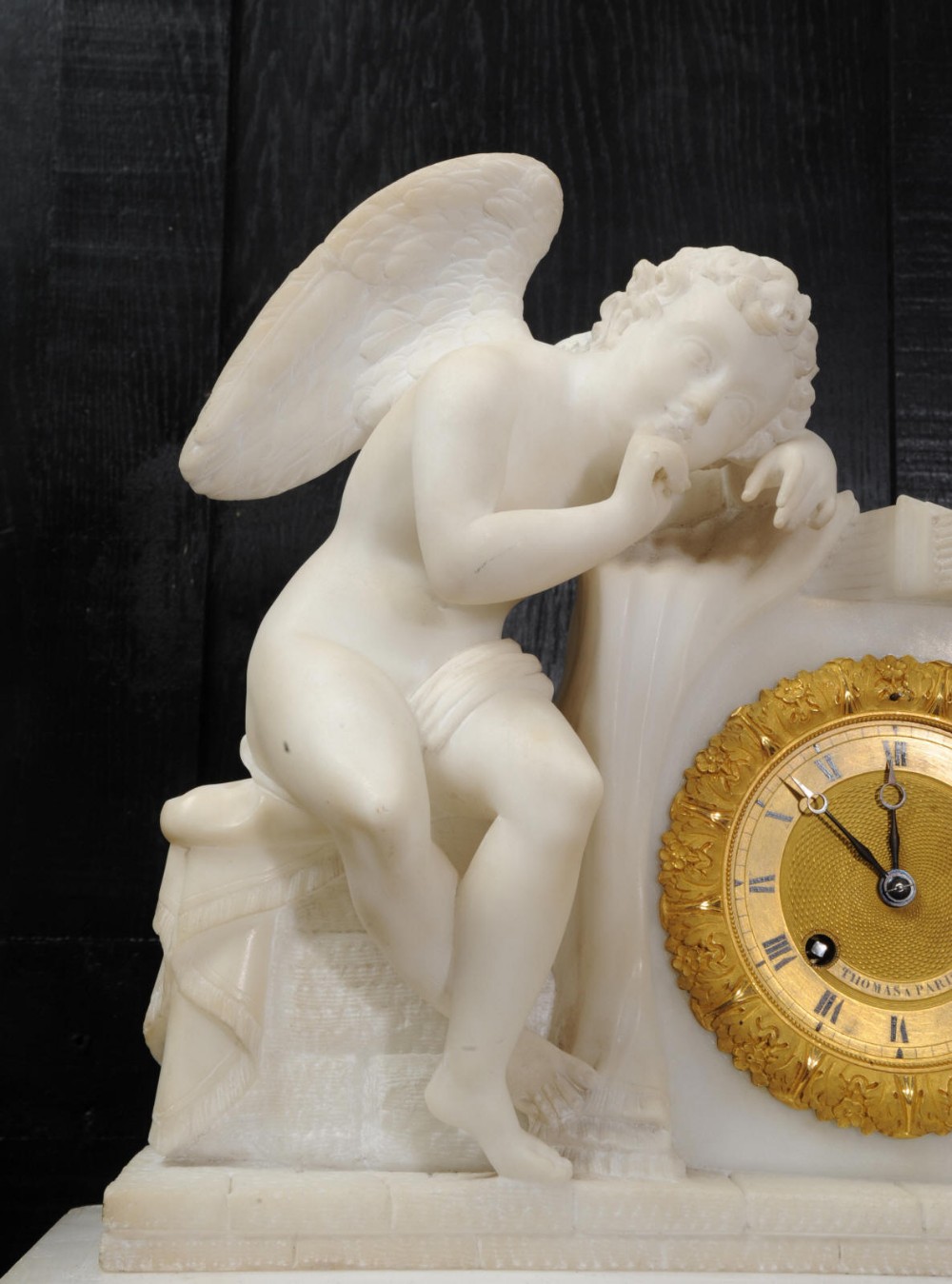
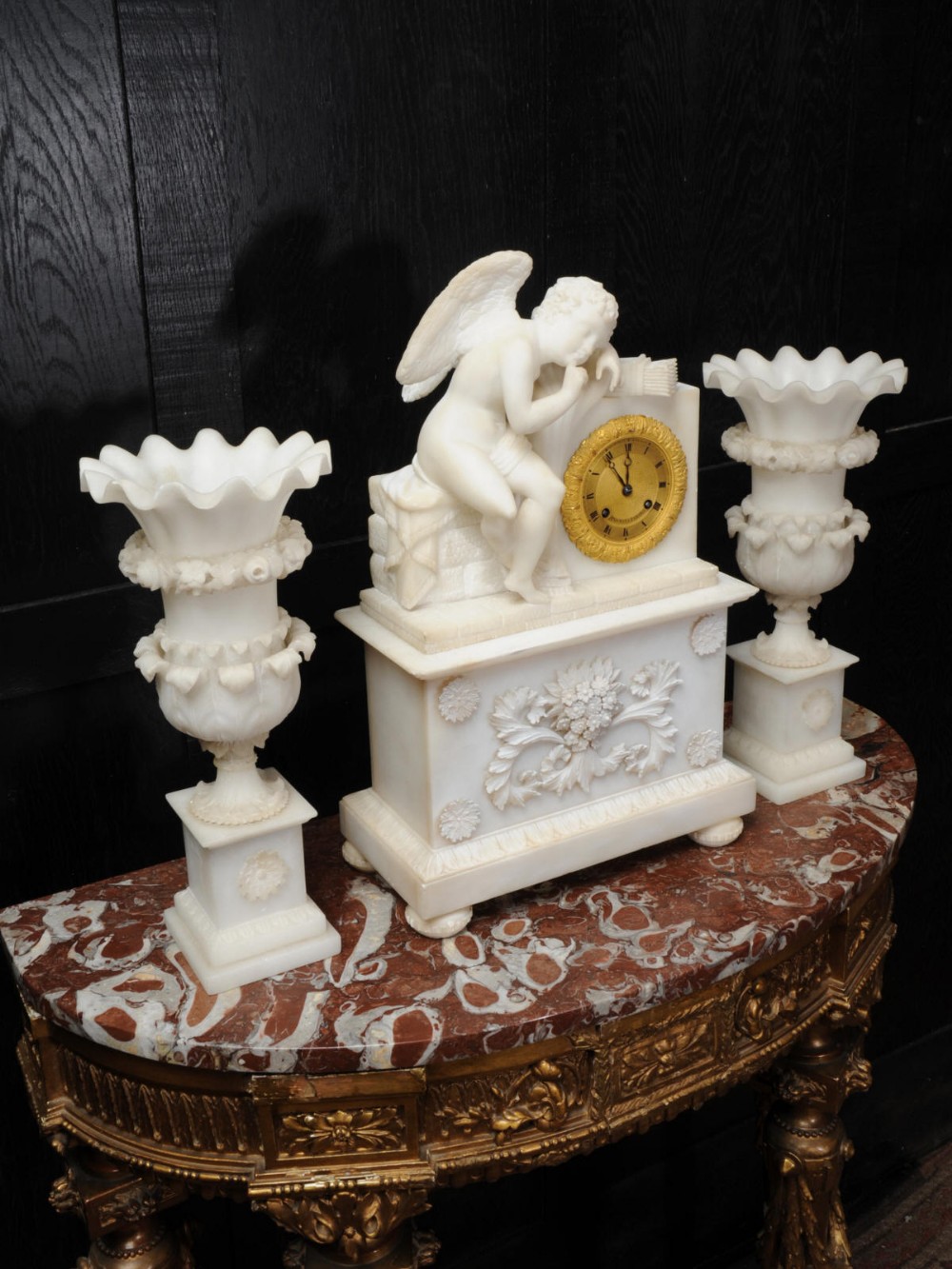
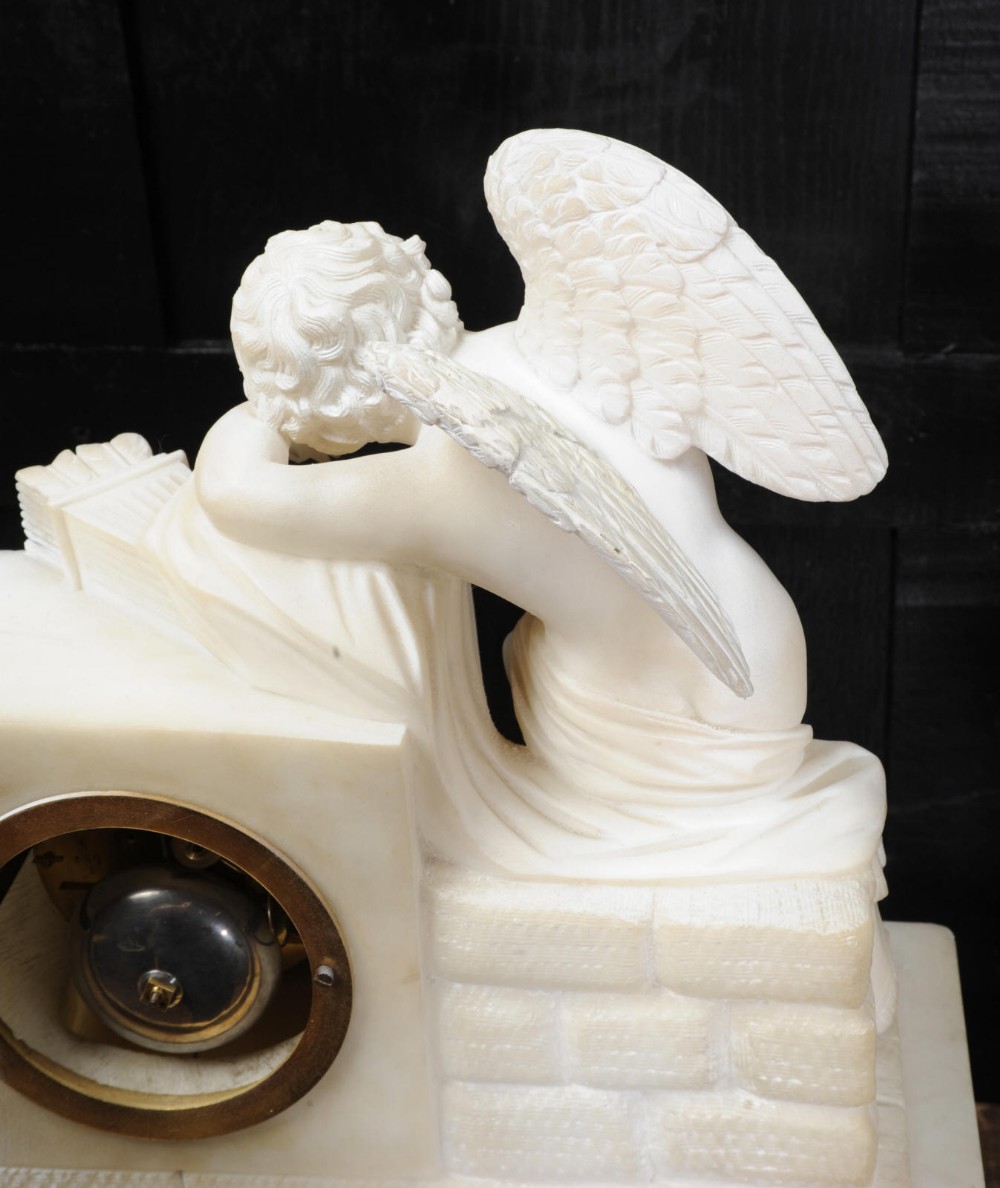
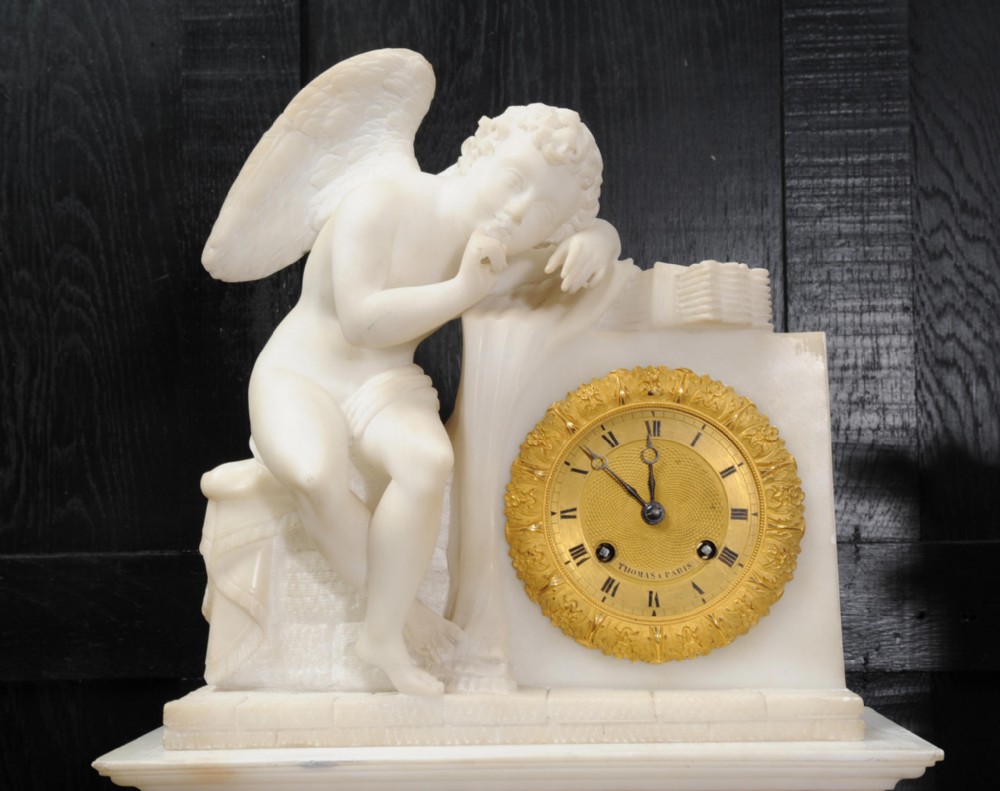
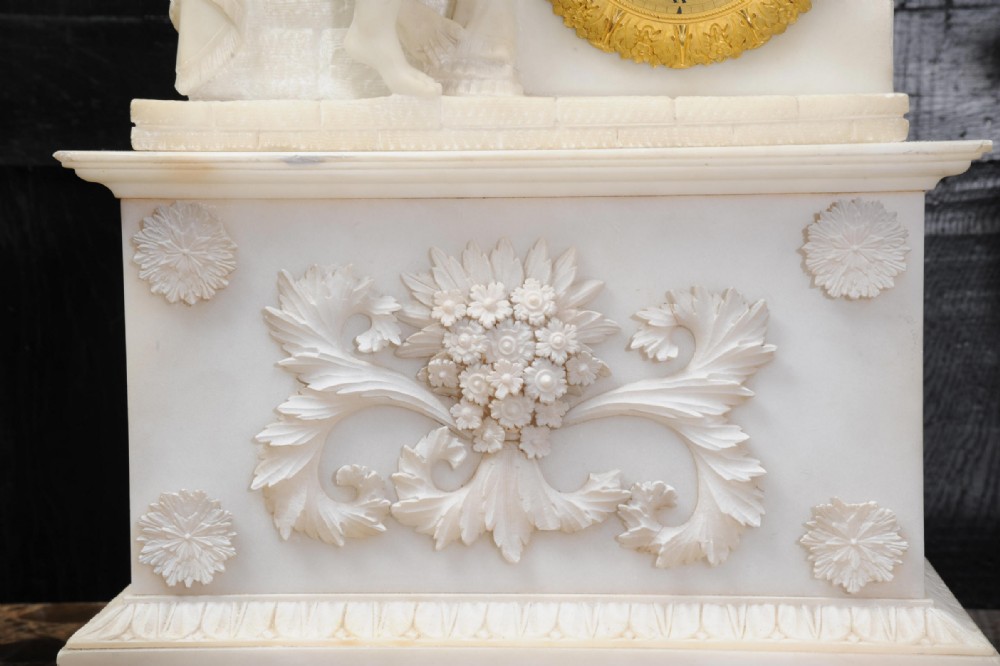
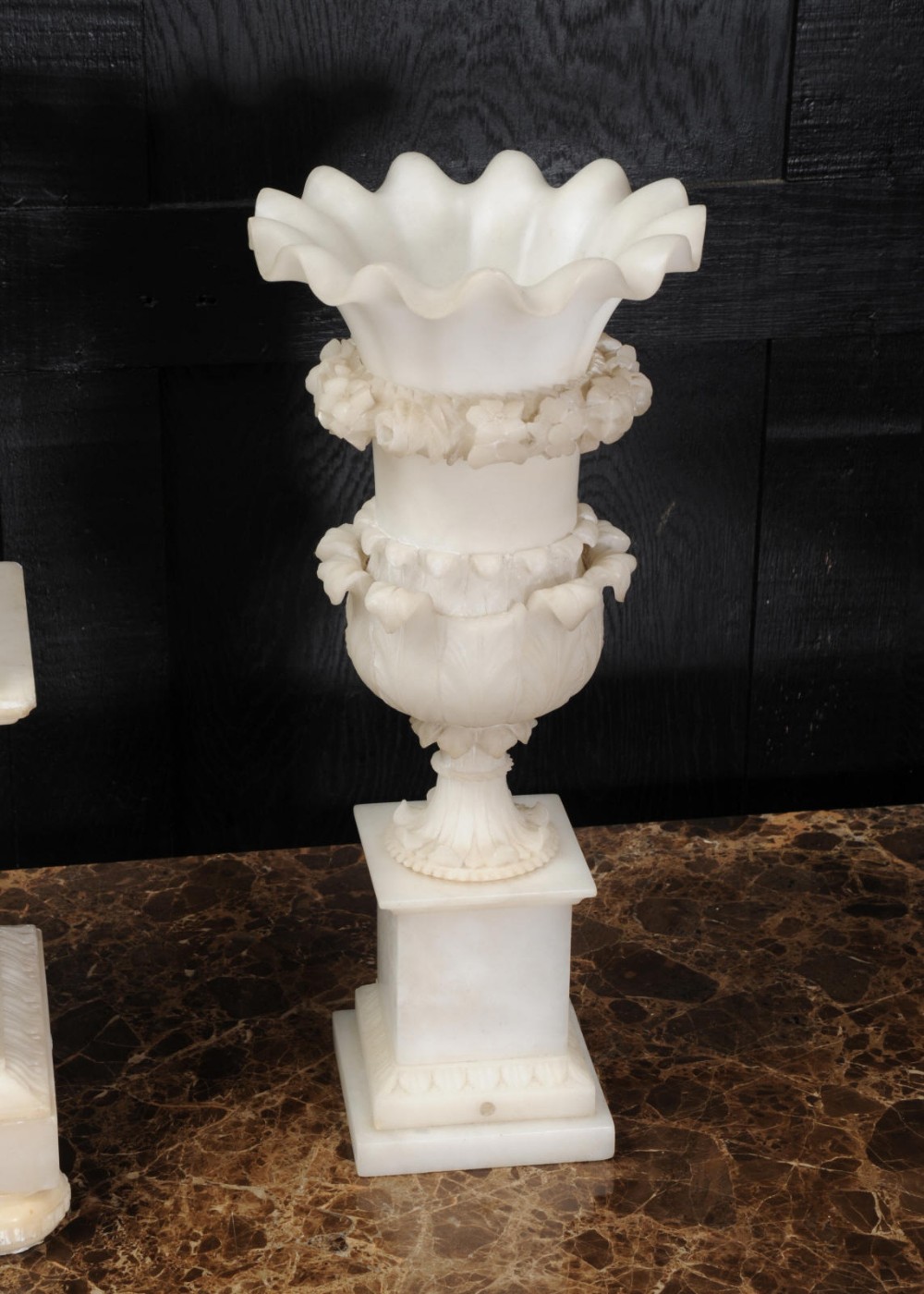
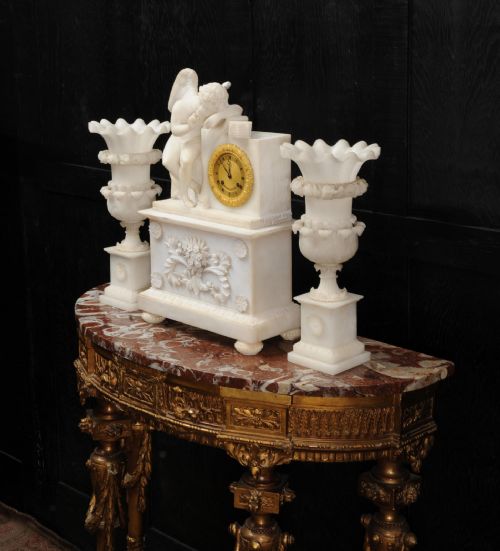
It is beautifully carved from crisp white alabaster, Cupid leans on the clock, asking for silence as he pulls out an arrow. The pair of classical urns are finely carved to be semi transparent, decorated with beautiful acanthus leaves.
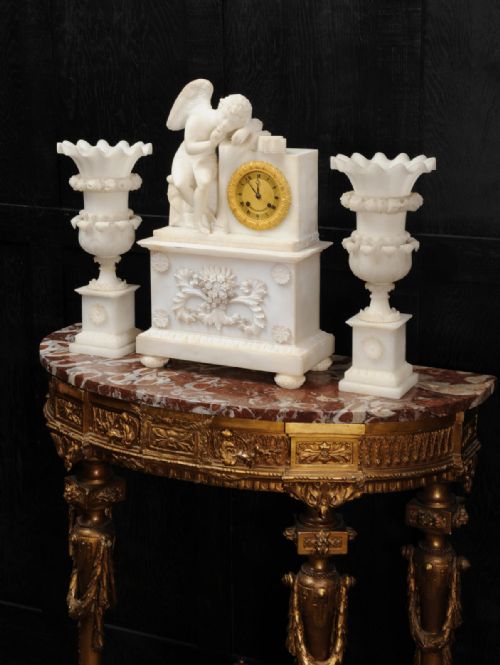
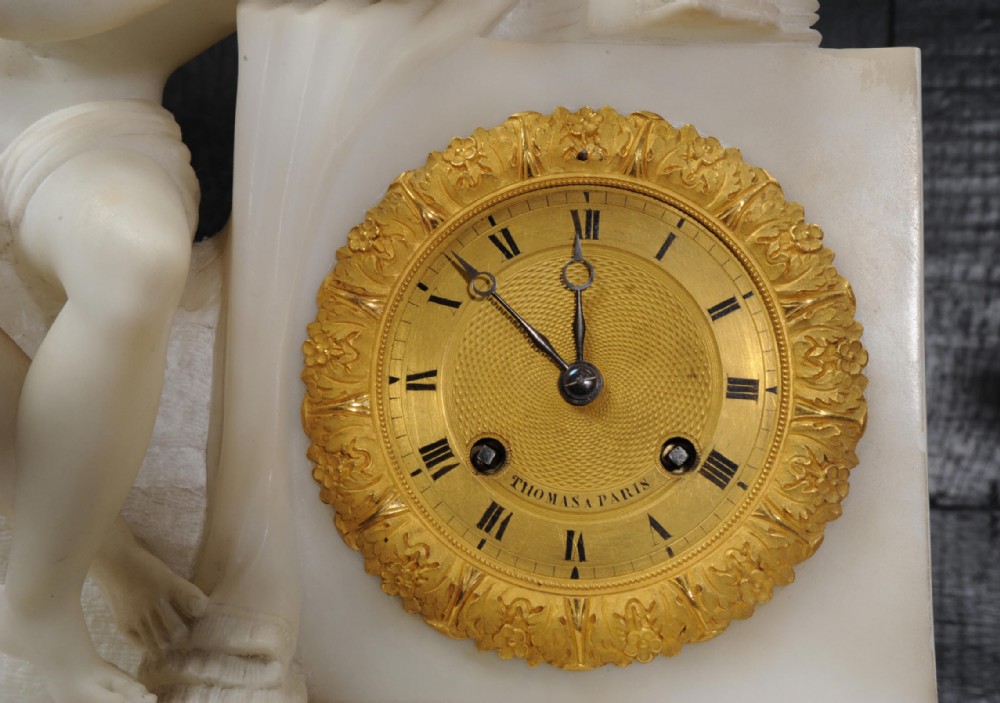
The dial is mercury gilded bronze (Bronze Doré) with engine turned centre and Breguet hands in blued steel. The dial is signed for the clockmaker Philippe Thomas of Paris.
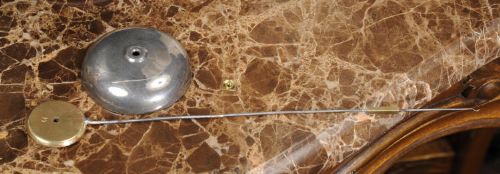
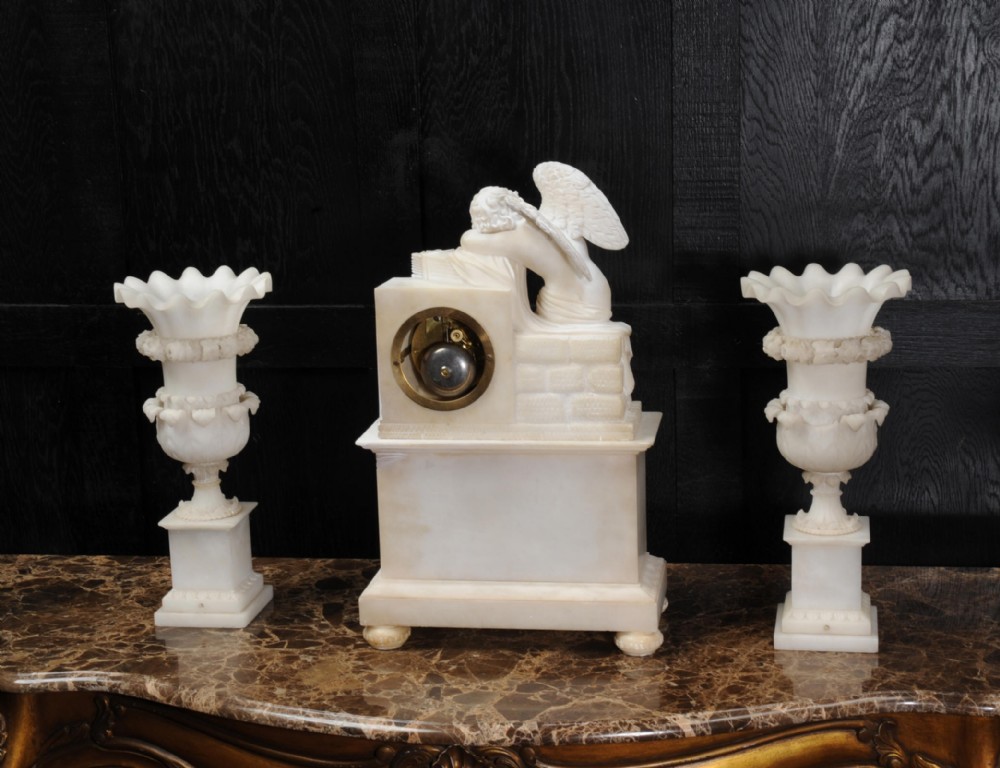
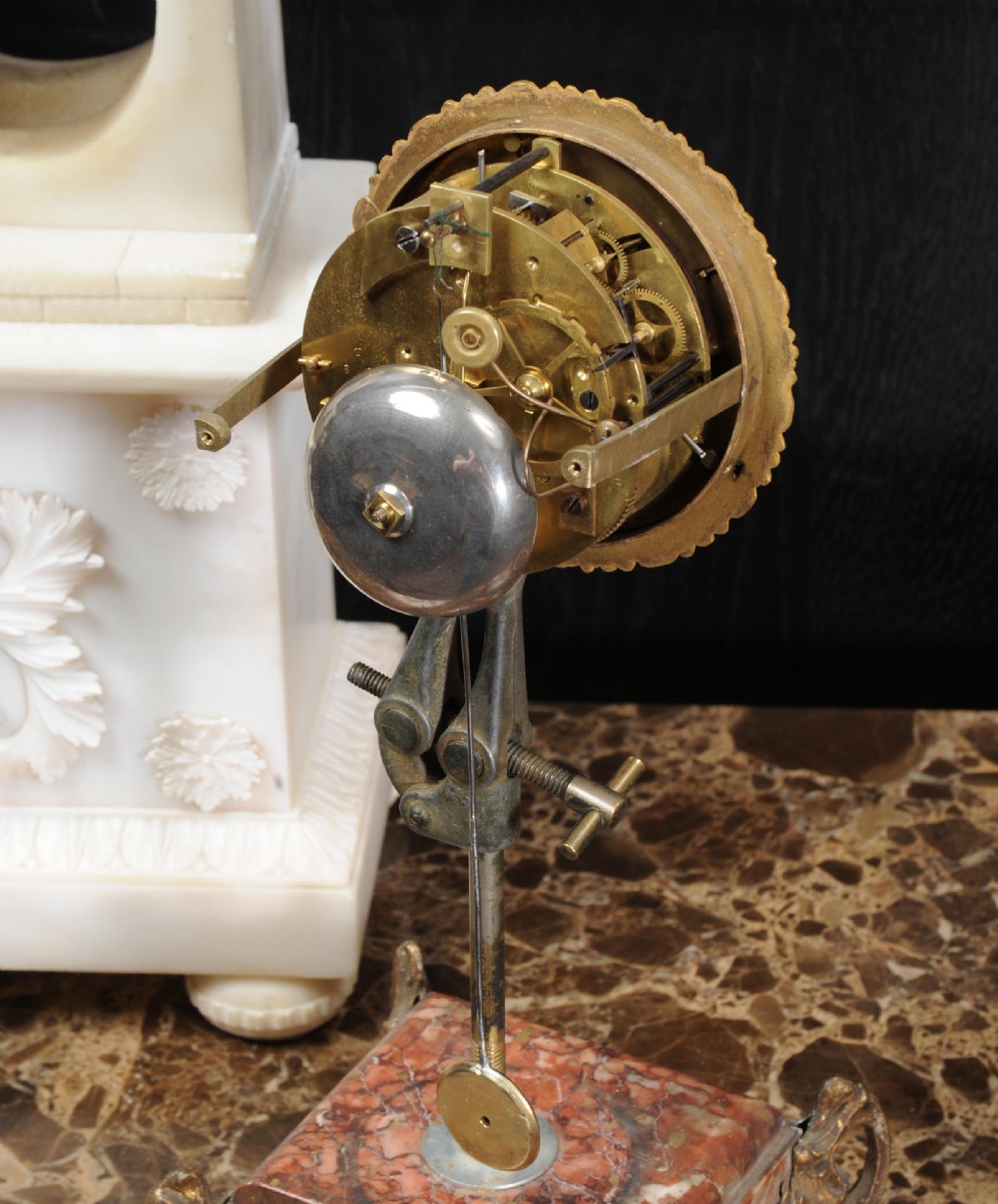
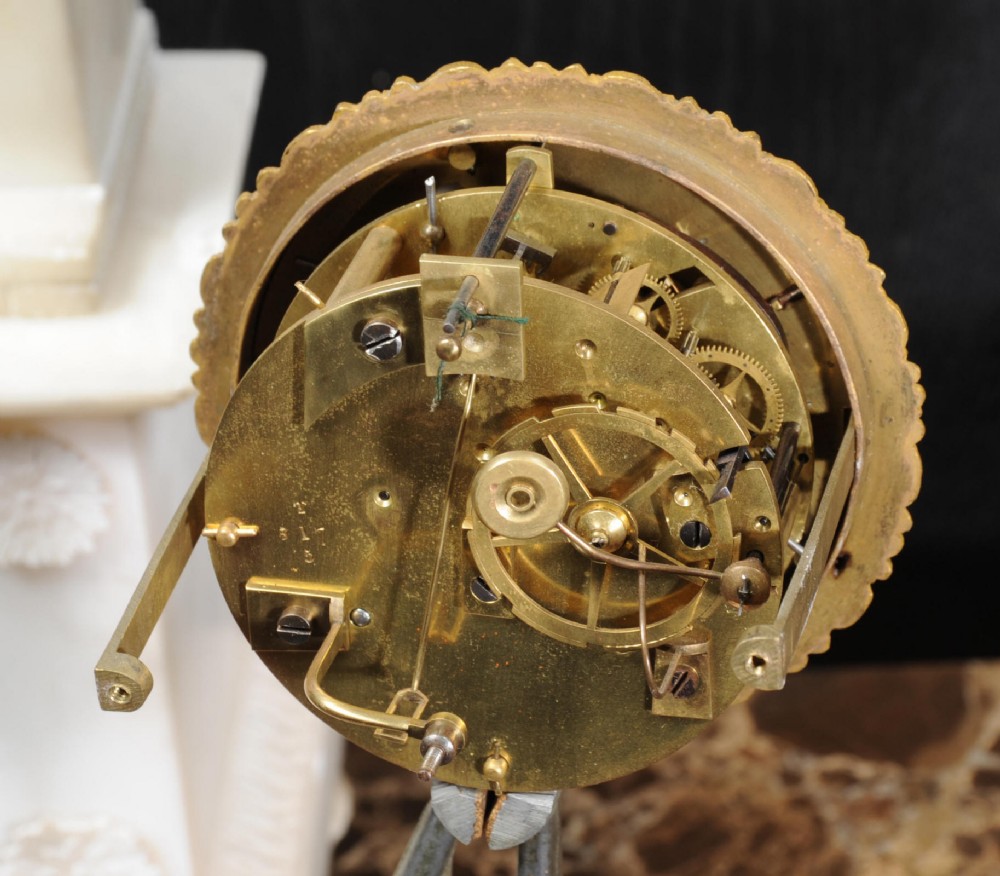
The French movement is of high quality and is in excellent clean and running condition. It is an early movement with silk suspension and outside hammer spring. Pendulum is a replacement. It runs for 8 days and strikes the hours and halves on a bell. Click the video clip below to hear the bell and watch the clock running!
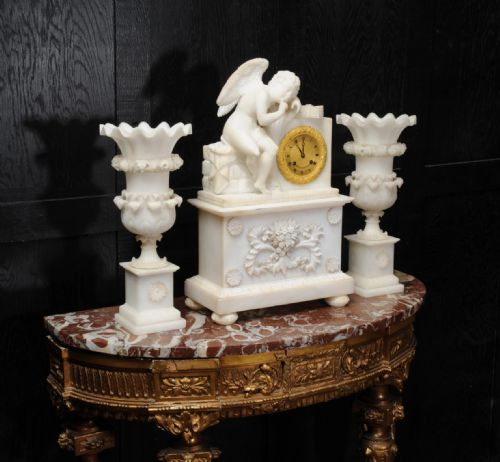
This famous Sèvres model is known as l'Amour Falconet after designer Etienne Maurice Falconet, director of sculpture at Sèvres from 1757 to 1766. He exhibited the original plaster versions of the figure at the Salon in 1755. The marble version of Cupid, made for Madame de Pompadour, was exhibited at the Salon in 1757, and then went to the Hôtel d’Evreux, her Paris house, which is now the Elysée Palace. The following year, 1758, the model was produced in biscuit at Sèvres. His pair, Psyche, was first produced in biscuit in 1761. Cupid was always known as L’Amour Falconet at Sèvres. The plaster and marble versions have been variously called L’Amour Menaçant, L’Amour Silencieux and Garde à Vous. The first biscuit example was sold on December 28, 1758 and Madame de Pompadour purchased one on December 30. Other royal purchasers of biscuit Cupids include the duc d’Orléans, Madame Victoire, Marie-Antoinette, Louis XVI and the duchesse de Chartres. Cupid is called “threatening” (menaçant) because he is about to withdraw a treacherous arrow – which compels its victim to fall in love – from his quiver, while placing a finger to his lips to signify silence or a secret.
There are several clockmakers named Thomas listed in Tardy; Dictionnaire Des Horlogers Francais, but Philippe Thomas fits the date of this clock. He is listed as working in Rue J.J. Rousseau in 1820.
Ref: Department of Sculptures, Room 222 The Louvre. Rijksmuseum, Amsterdam, room 1.9. British Museum; A Catalogue of French Porcelain in The British Museum, London, BMP, 1994, Dawson 1994. Savage, George, Seventeenth and Eighteenth Century French Porcelain, London, Barrie & Rockliff, 1960.
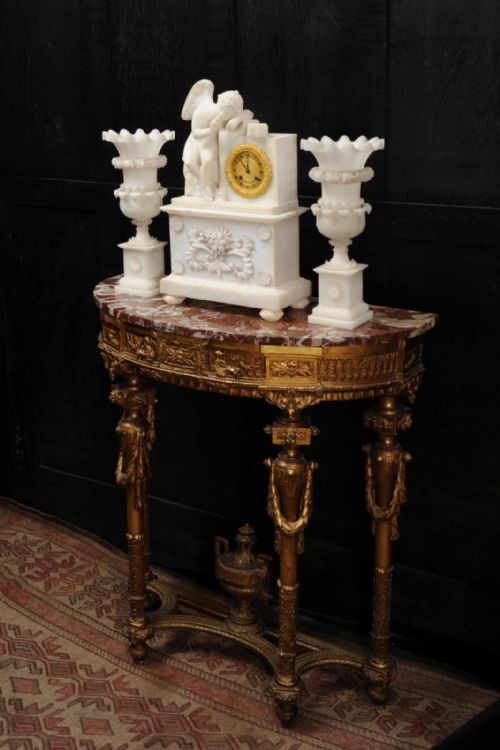
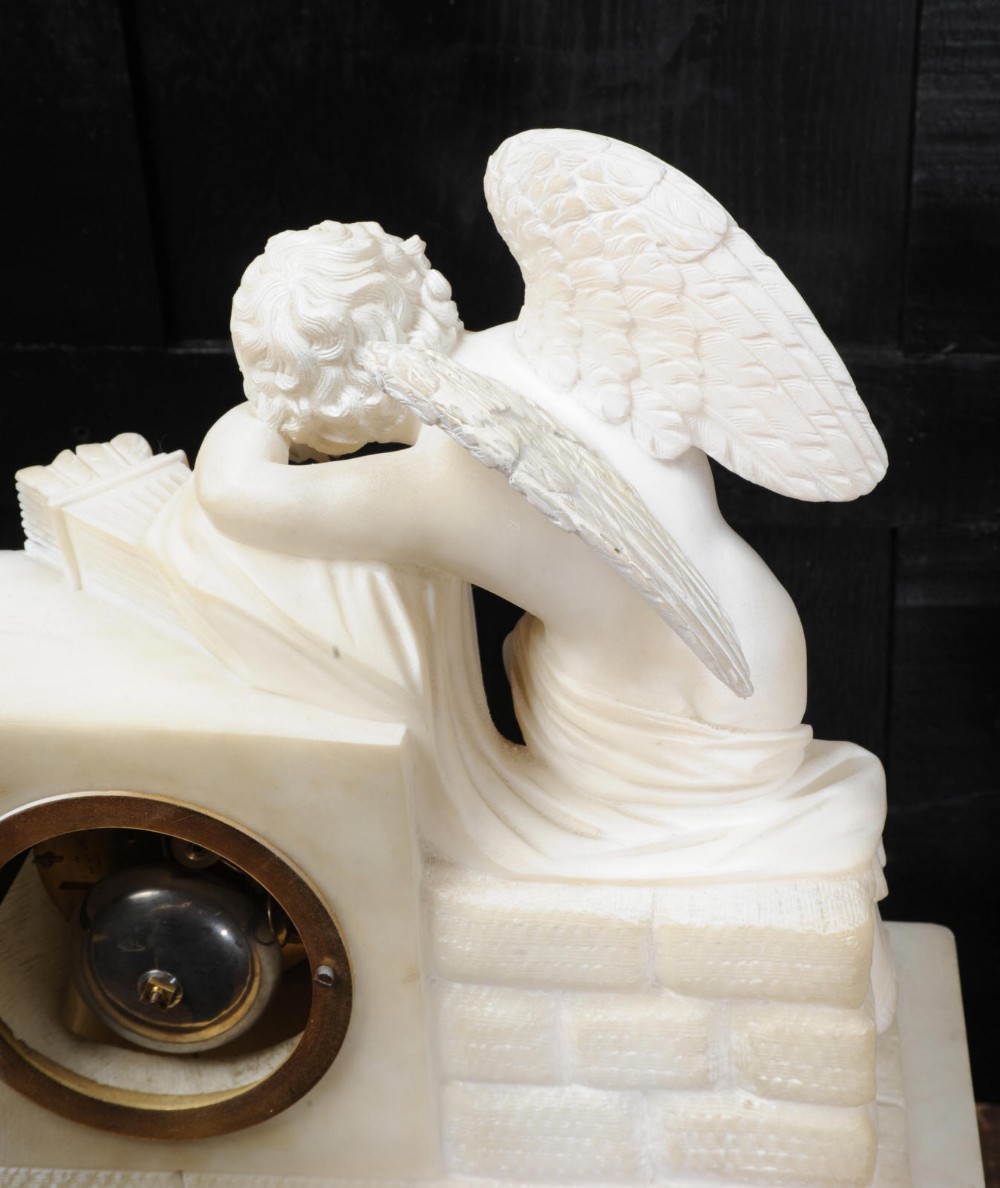
Condition of the case is good, alabaster is a fragile material and there are several small losses and repairs. Cupids wing has a repair, there is a repaired chip to the right hand side of the base and there is a glued repair to the stem of one vase. Losses include 2 fingers to cupids hand, an acanthus leaf on the rear of one urn and small losses to the applied rosettes on the clock and vase bases. There is some discolouration and staining of the alabaster. The vases have previously been wired as lamps. Dial is in lovely bright condition.
Dial Signed for Philippe Thomas of Paris.
Complete with pendulum, bell and a suitable key. Full setting up instructions supplied if required.
Dimensions of clock:
inches: Height 18 1/4", Width 11 1/2", Depth 6"
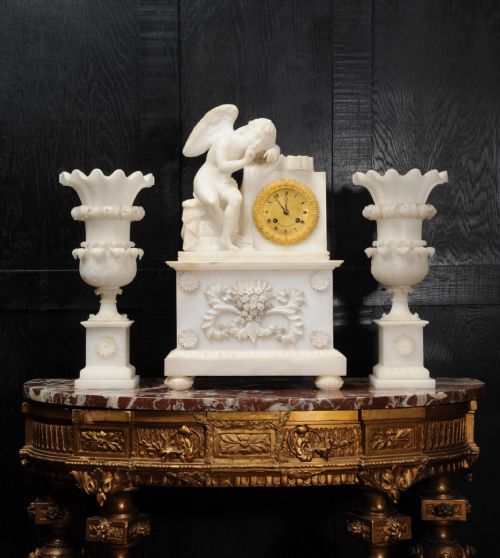
centimetres: Height 46.5 cm, Width 29 cm, Depth 15 cm
Dimensions of vases:
inches: Height 14 1/4", Width 6 1/4", Depth 6 1/4"
centimetres: Height 36 cm, Width 16 cm, Depth 16 cm
Shipping within UK £35
Shipping to USA / Europe £150 by air fully insured
World wide shipping - £225 by air fully insured
Dragon-Antiques.com has dated this French Alabaster Clock Set to the 1850s.
You can view the stock and full dealer information on the Dragon-Antiques.com Profile Page
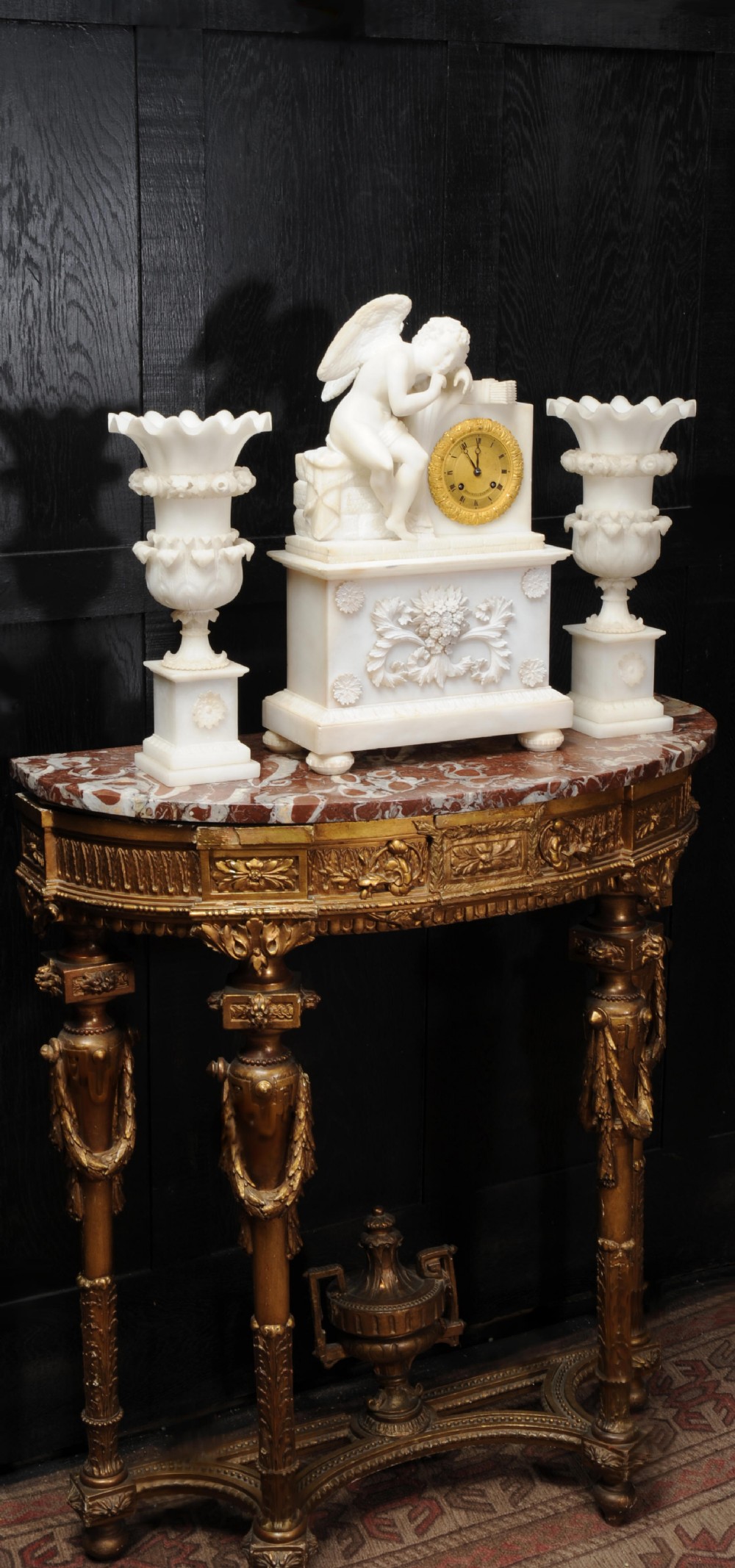
Early Antique French Alabaster Clock Set ~ Cupid After Etienne Maurice Falconet (1716-1791)