28,849  PAGES BROWSED TODAY PAGES TODAY 74  ANTIQUES UPLOADED TODAY NEW ARRIVALS
ID #SA605768
FOR SALE
£8,000
Email
Save
Henry Hoppner Meyer, 1780 - 1847 Portrait of Lt General Sir Rufane Shaw Donkin, Gch Kcb Frs Frgs (1772-1841)
Artware Fineart
for sale €9,360     $10,160
£8,000

Artware Fineart

Sellingantiques Verified Since Sep 2008
View Dealers Stock Page
Id #SA605768
PDF SHARE
SAVE

Henry Hoppner Meyer, 1780 - 1847 Portrait of Lt General Sir Rufane Shaw Donkin, Gch Kcb Frs Frgs (1772-1841)

19th century
For Sale by Artware Fineart
Description

Henry Hoppner Meyer, 1780 - 1847

Portrait of Lt General Sir Rufane Shaw Donkin, GCH KCB FRS FRGS (1772-1841)

oil on canvas

140 x 110 cm. (55.1/4 x 43.1/4 in.)
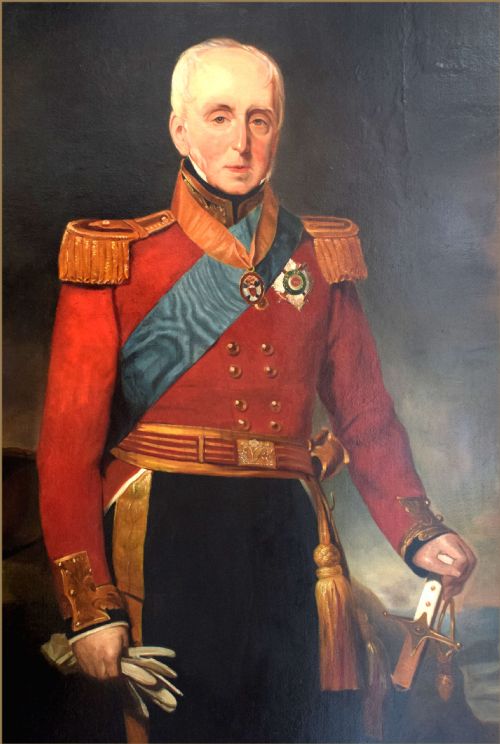
in full regalia with his hand on an ivory-handled Mughal/Indian sword, wearing Knight of the Garter insignia and the Guelphic Order.

Notes

Sir Rufane Shaw Donkin, (1773–1841), army officer, belonged to a respectable Northumbrian family, said to be of Scottish descent, and originally named Duncan. His father, General Robert Donkin (1726/7–1821), served in Flanders, the West Indies, Ireland, and America, was reputedly a personal friend of the historian David Hume, and published two books about his military experiences. In 1772 he married Mary, daughter of the Revd Emanuel Collins. Rufane Shaw was the eldest of their three children, and the only son. General Robert Donkin had served with many famous British commanders including Wolfe and Gage and his Colonel, William Rufane. Young Rufane was baptised at St David's Church, Exeter on 9 October 1772 with the name Rusaw Shaw Donkin.
On 21 March 1778 Rufane was appointed to an ensigncy in the 44th foot, in which his father then held the rank of major, advancing to lieutenant on 9 September 1779 through purely paper transactions. He was educated at Westminster School in London until the age of fourteen and appears afterwards to have been a diligent student. At one time when on leave from his regiment—probably after its return from Canada in 1786—he studied classics and mathematics in France for a year, and when on detachment in the Isle of Man, read Greek for a year and a half with a Cambridge graduate. He obtained his company on 31 May 1793, and became Captain and in September he sailed for the West Indies with the flank companies of the 44th foot to be involved in the capture of Martinique, Guadeloupe, and St Lucia, and the subsequent loss of Guadeloupe in 1794.
After his return to England he was brigade major, and for several months aide-de-camp, to Major-General Thomas Musgrave, commanding at Newcastle upon Tyne, and advanced to major on 1 September 1795. He went back with the regiment to the West Indies in Lieutenant-General Sir Ralph Abercromby's expedition, which in April and May 1796 recaptured St Lucia (which had been again occupied by the French in 1795); here the 44th lost 20 officers and over 800 men, chiefly from fever. He gained the rank of Major in 1796.

Donkin was removed to Martinique unconscious and afterwards invalided home dangerously ill. Having recovered, in May 1798 Donkin was detached from the regiment to command a provisional light battalion, composed of the light companies 11th foot, 23rd Royal Welch Fusiliers, and 49th foot, with Major-General Eyre Coote's expedition to Ostend, which sought to destroy the basin, gates, and sluices of the Bruges Canal, thus hampering the concentration of French troops for an invasion of England. On 20 May Donkin distinguished himself in an action near Ostend, in which he was wounded and taken prisoner but earned Coote's special praise for his conduct. He transferred to the 11th foot as lieutenant-colonel on 24 May and joined it in temporary captivity near Douai.

In 1799 the 11th sailed for the West Indies, but a regimental historian, quoting an official War Office record that he was 'in London on regimental duty' during December 1799, has noted that 'no evidence' exists for his having served in the West Indies in 1799–1800, as claimed in the Dictionary of National Biography (Robinson, 284). There is no doubt, however, that he did command the regiment there in 1801, when the 11th took part in the capture of numerous islands, which were returned to France after the peace of Amiens. On 29 April 1802 Donkin proposed that convicts who had opted to serve in the West Indies should not be kept there for life but be allowed to serve a normal term of en

Physical Dimensions
Height
140cm (55.12")
Width
110cm (43.31")
Depth
1cm (0.39")
Declaration

Artware Fineart has dated this Regency Military Officer Portrait to the 19th Century.

Reference Numbers
Sellingantiques Reference
SA605768
Dealers Internal Reference
3988
Description
Henry Hoppner Meyer, 1780 - 1847

Portrait of Lt General Sir Rufane Shaw Donkin, GCH KCB FRS FRGS (1772-1841)

oil on canvas

140 x 110 cm. (55.1/4 x 43.1/4 in.)

in full regalia with his hand on an ivory-handled Mughal/Indian sword, wearing Knight of the Garter insignia and the Guelphic Order.
Artware Fineart
fig 1. An early nineteenth-century oil portrait of a military officer standing in a scarlet coat with gold epaulettes, a blue sash, and military decorations.
fig 1. Henry Hoppner Meyer, 1780 - 1847 Portrait of Lt General Sir Rufane Shaw Donkin, Gch Kcb Frs Frgs (1772-1841)

Notes

Sir Rufane Shaw Donkin, (1773–1841), army officer, belonged to a respectable Northumbrian family, said to be of Scottish descent, and originally named Duncan. His father, General Robert Donkin (1726/7–1821), served in Flanders, the West Indies, Ireland, and America, was reputedly a personal friend of the historian David Hume, and published two books about his military experiences. In 1772 he married Mary, daughter of the Revd Emanuel Collins. Rufane Shaw was the eldest of their three children, and the only son. General Robert Donkin had served with many famous British commanders including Wolfe and Gage and his Colonel, William Rufane. Young Rufane was baptised at St David's Church, Exeter on 9 October 1772 with the name Rusaw Shaw Donkin.

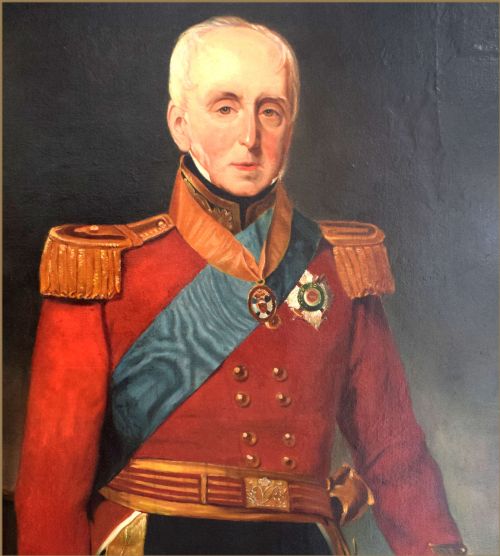
fig 2. An early nineteenth-century oil portrait of a military officer standing in a scarlet coat with gold epaulettes, a blue sash, and military decorations.
fig 2. Henry Hoppner Meyer, 1780 - 1847 Portrait of Lt General Sir Rufane Shaw Donkin, Gch Kcb Frs Frgs (1772-1841)

On 21 March 1778 Rufane was appointed to an ensigncy in the 44th foot, in which his father then held the rank of major, advancing to lieutenant on 9 September 1779 through purely paper transactions. He was educated at Westminster School in London until the age of fourteen and appears afterwards to have been a diligent student. At one time when on leave from his regiment—probably after its return from Canada in 1786—he studied classics and mathematics in France for a year, and when on detachment in the Isle of Man, read Greek for a year and a half with a Cambridge graduate. He obtained his company on 31 May 1793, and became Captain and in September he sailed for the West Indies with the flank companies of the 44th foot to be involved in the capture of Martinique, Guadeloupe, and St Lucia, and the subsequent loss of Guadeloupe in 1794.

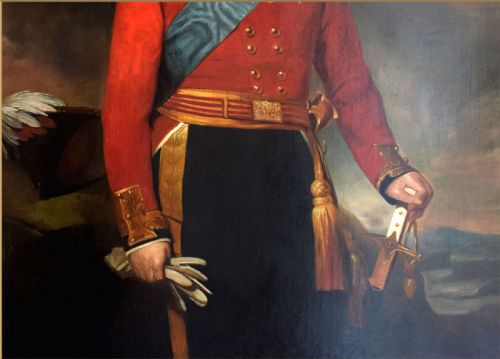
fig 3. An early nineteenth-century oil portrait of a military officer standing in a scarlet coat with gold epaulettes, a blue sash, and military decorations.
fig 3. Henry Hoppner Meyer, 1780 - 1847 Portrait of Lt General Sir Rufane Shaw Donkin, Gch Kcb Frs Frgs (1772-1841)

After his return to England he was brigade major, and for several months aide-de-camp, to Major-General Thomas Musgrave, commanding at Newcastle upon Tyne, and advanced to major on 1 September 1795. He went back with the regiment to the West Indies in Lieutenant-General Sir Ralph Abercromby's expedition, which in April and May 1796 recaptured St Lucia (which had been again occupied by the French in 1795); here the 44th lost 20 officers and over 800 men, chiefly from fever. He gained the rank of Major in 1796.

Donkin was removed to Martinique unconscious and afterwards invalided home dangerously ill. Having recovered, in May 1798 Donkin was detached from the regiment to command a provisional light battalion, composed of the light companies 11th foot, 23rd Royal Welch Fusiliers, and 49th foot, with Major-General Eyre Coote's expedition to Ostend, which sought to destroy the basin, gates, and sluices of the Bruges Canal, thus hampering the concentration of French troops for an invasion of England. On 20 May Donkin distinguished himself in an action near Ostend, in which he was wounded and taken prisoner but earned Coote's special praise for his conduct. He transferred to the 11th foot as lieutenant-colonel on 24 May and joined it in temporary captivity near Douai.

In 1799 the 11th sailed for the West Indies, but a regimental historian, quoting an official War Office record that he was 'in London on regimental duty' during December 1799, has noted that 'no evidence' exists for his having served in the West Indies in 1799–1800, as claimed in the Dictionary of National Biography (Robinson, 284). There is no doubt, however, that he did command the regiment there in 1801, when the 11th took part in the capture of numerous islands, which were returned to France after the peace of Amiens. On 29 April 1802 Donkin proposed that convicts who had opted to serve in the West Indies should not be kept there for life but be allowed to serve a normal term of en

Height
140cm (55.12")
Width
110cm (43.31")
Depth
1cm (0.39")
Date of Manufacture

Artware Fineart has dated this Regency Military Officer Portrait to the 19th Century.

Reference Numbers
Sellingantiques Ref
SA605768
Dealers Internal Ref
3988
Artware Fineart
Sellingantiques verified Since Sep 2008
Dealer Profile

You can view the stock and full dealer information on the Artware Fineart Profile Page
PDF SHARE
SAVE
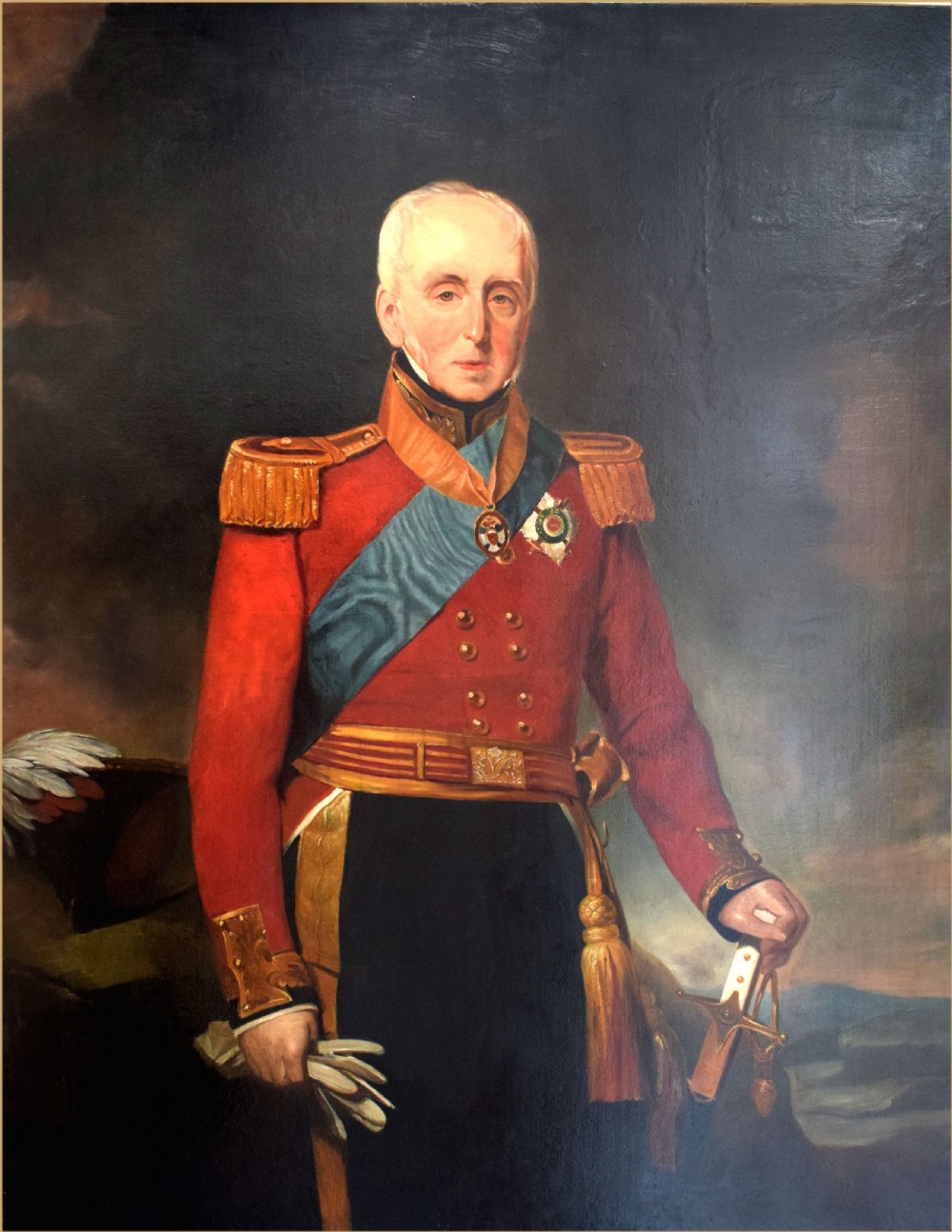
An early nineteenth-century oil portrait of a military officer standing in a scarlet coat with gold epaulettes, a blue sash, and military decorations.
1 / 4
Archive I An early nineteenth-century oil portrait of a military officer standing in a scarlet coat with gold epaulettes, a blue sash, and military decorations.

Henry Hoppner Meyer, 1780 - 1847 Portrait of Lt General Sir Rufane Shaw Donkin, Gch Kcb Frs Frgs (1772-1841)

Archive II An early nineteenth-century oil portrait of a military officer standing in a scarlet coat with gold epaulettes, a blue sash, and military decorations. View II
Archive III An early nineteenth-century oil portrait of a military officer standing in a scarlet coat with gold epaulettes, a blue sash, and military decorations. View III
Archive IV An early nineteenth-century oil portrait of a military officer standing in a scarlet coat with gold epaulettes, a blue sash, and military decorations. View IV
Enlarged Archival View
Telephone 07958 699 645
Location
18 La Gare
51 Surrey Row
London
SE1 0BZ
United Kingdom
Verified Since Sep 2008
Items For Sale 243
Items Sold 223
Artware Fineart
Verified Since Sep 2008
View Dealer Info
Location: 18 La Gare , 51 Surrey Row , London , SE1 0BZ , United Kingdom
Verified
Sep 2008
For Sale
243
Sold
223
An early nineteenth-century oil portrait of a military officer standing in a scarlet coat with gold epaulettes, a blue sash, and military decorations.
Henry Hoppner Meyer, 1780 - 1847 Portrait of Lt General Sir Rufane Shaw Donkin, GCH KCB FRS FRGS (1772-1841)
Ref: SA605768
An early nineteenth-century oil portrait of a military officer standing in a scarlet coat with gold epaulettes, a blue sash, and military decorations.
Detail View 1
Detail View 2
Detail View 3
Archival Detail
Every single antique dealer on our platform is individually approved by our internal team. We verify their professional trade history, ethical standards, and photographic quality to ensure a secure, high-standard buying environment. Upon joining, every dealer agrees to a strict 9-point code of conduct. While issues can occasionally arise, our dealers typically resolve them swiftly and directly with the buyer. In fact, since our founding in 2002, Sellingantiques has only had to step in to help resolve an issue on roughly five occasions—a true testament to the quality of our dealers and their dedication to your happiness.
Our dealers are highly experienced in packing and shipping fragile, high-value antiques. Because you are in direct contact with the dealer, you will be able to easily go through all available shipping and insurance options together to ensure your item arrives safely.
Antiques are the ultimate green purchase. By choosing historical pieces over newly manufactured goods, you completely eliminate the carbon footprint of modern mass production while preserving exceptional, timeless craftsmanship.

Regency military portraits typically depict high-ranking military officers in formal scarlet or dark dress uniforms, detailing rank through gold epaulettes, sashes, and honours against dark, dramatic backgrounds.

Artists during the early 19th century primarily used ground pigments mixed with linseed oil, applied onto stretched linen canvas or wooden panels, and sealed with natural resin varnish.

Authenticity is assessed through brushwork technique, historical provenance, natural craquelure patterns in the varnish layer, and physical evidence of period-appropriate canvas weave and wooden stretchers.

A traditional military portrait creates visual focus when mounted above a fireplace mantel or console table, contrasting effectively against contemporary wall paint or textured plaster.

Paintings must be kept away from direct sunlight and fluctuating humidity, dusted lightly with a soft dry brush, and cleaned exclusively by a qualified professional art conservator.
items
Add keywords to the filter
Price
£100
£250000
Era
Movements
Material
Origin
Stock Location
Freshness
Online Payments
Categories