33,764  PAGES BROWSED TODAY PAGES TODAY 90  ANTIQUES UPLOADED TODAY NEW ARRIVALS
ID #SA598236
FOR SALE
£1,200
Email
Save
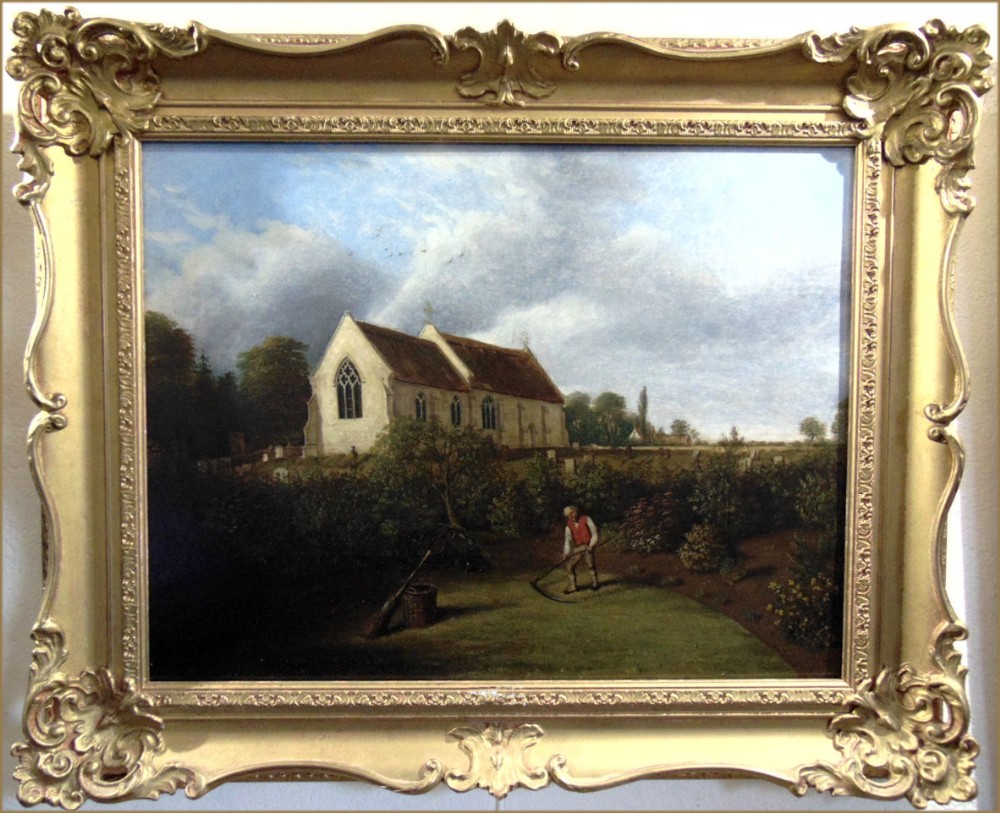
English School 19th, Century a Gardner Scything a Lawn Before a Herbaceous Border with a Church Beyond
Artware Fineart
for sale €1,404     $1,524
£1,200

Artware Fineart

Sellingantiques Verified Since Sep 2008
View Dealers Stock Page
Id #SA598236
PDF SHARE
SAVE

English School 19th, Century a Gardner Scything a Lawn Before a Herbaceous Border with a Church Beyond

19th century
For Sale by Artware Fineart
Description

English School 19th, Century

A Gardner Scything a Lawn before a Herbaceous border with a Church beyond

oil on canvas

37.50 x 48.50 cm. (14.3/4 x 19 in. )

Lawn mowing and ornamental landscaping held no particular interest to 99% of the people who lived during the Georgian era. Cottagers and town dwellers maintained small plots of vegetable gardens and laborers worked in the fields, using scythes to cut wheat and grain for their employers. The garden laborers wielding scythes used a smooth, well-rehearsed motion, they worked in teams to cover large areas of ground. Their labor was cheap and they followed a system that included working in the morning when the ground was still damp. To prepare the lawn for scything, a gardener would: “pole” the lawn first (swishing a long whippy stick across the grass to remove wormcasts) and … roll the ground to firm it and set the blades of grass in a uniform direction.” – Notes and Queries, The Guardian UK. The secret to maintaining a close-cropped lawn was to trim it frequently, about once a week. Lawn edges were best trimmed with sheep shearing clippers. The grass was kept free of daisies with an instrument named a daisy grubber, which is the long-handled instrument with angled pick in the image below. Daisy grubbers are still sold today, as they apparently do the job well. With improvements in gardening equipment, including the invention of the lawn mower in 1830 by Edwin Beard Budding, machines began to take over the hard work of the scythe men.
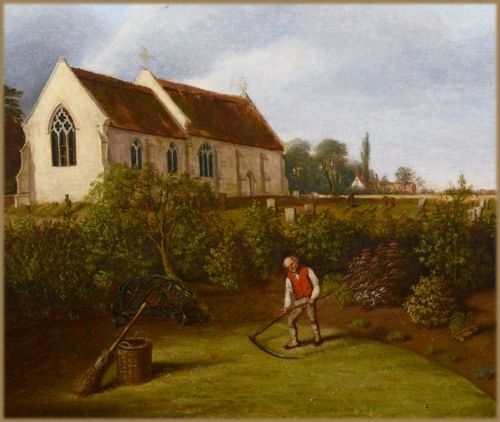
The word "scythe" derives from Old English siðe. In Middle English and after it was usually spelt sithe or sythe. However, in the 15th century some writers began to use the sc- spelling as they thought (wrongly) the word was related to the Latin scindere (meaning "to cut"). Nevertheless, the sithe spelling lingered and notably appears in Noah Webster's dictionaries. A scythe consists of a shaft about 170 centimetres (67 in) long called a snaith, snath, snathe or sned, traditionally made of wood but now sometimes metal. Simple snaiths are straight with offset handles, others have an "S" curve or are steam bent in three dimensions to place the handles in an ergonomic configuration but close to shaft. The snaith has either one or two short handles at right angles to it, usually one near the upper end and always another roughly in the middle. The handles are usually adjustable to suit the user. A curved, steel blade between 60 to 90 centimetres (24 to 35 in) long is mounted at the lower end at 90°, or less, to the snaith. Scythes almost always have the blade projecting from the left side of the snaith when in use, with the edge towards the mower; left-handed scythes are made but cannot be used together with right-handed scythes as the left-handed mower would be mowing in the opposite direction and could not mow in a team.
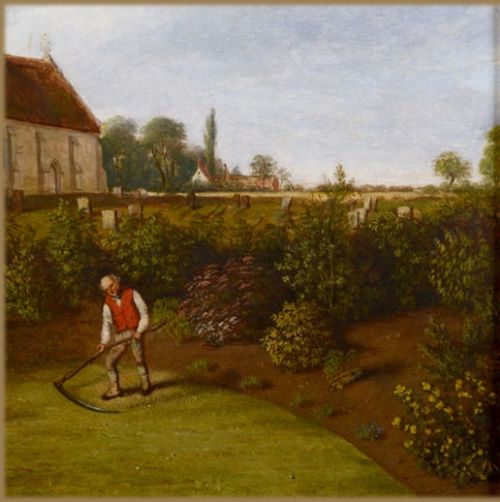
The use of a scythe is traditionally called mowing, now often scything to distinguish it from machine mowing. The mower holds the top handle in the left hand and the central one in the right, with the arms straight, the blade parallel and very close to the ground and the uncut grass to the right. The body is then twisted to the right, the blade hooks the grass and is swung steadily to the left in a long arc ending in front of the mower and depositing the cut grass neatly to the left. The mower takes a small step forward and repeats the motion, proceeding with a steady rhythm, stopping at frequent intervals to hone the blade. The correct technique has a slicing action on the grass, cutting a narrow strip with each stroke, leaving a uniform stubble on the ground and forming a regular windrow on the left.
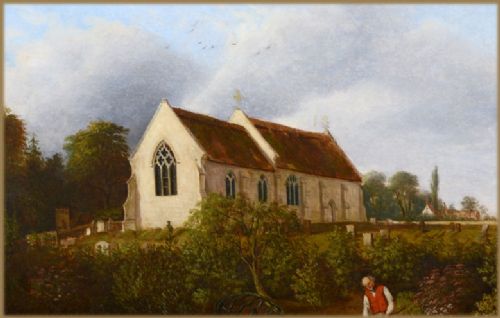
The mower moves along the mowing-edge with the uncut grass to the right and the cut grass laid in a neat row to the left, on the previously mown land. Each strip of ground mown by a scythe is called a swathe (pronounced /sw

Physical Dimensions
Height
38cm (14.96")
Width
48cm (18.90")
Depth
2cm (0.79")
Declaration

Artware Fineart has dated this Victorian Garden Oil Painting to the 19th Century.

Reference Numbers
Sellingantiques Reference
SA598236
Dealers Internal Reference
4027
Description
English School 19th, Century

A Gardner Scything a Lawn before a Herbaceous border with a Church beyond

oil on canvas

37.50 x 48.50 cm. (14.3/4 x 19 in. )

Lawn mowing and ornamental landscaping held no particular interest to 99% of the people who lived during the Georgian era.
Artware Fineart

Cottagers and town dwellers maintained small plots of vegetable gardens and laborers worked in the fields, using scythes to cut wheat and grain for their employers. The garden laborers wielding scythes used a smooth, well-rehearsed motion, they worked in teams to cover large areas of ground. Their labor was cheap and they followed a system that included working in the morning when the ground was still damp. To prepare the lawn for scything, a gardener would: “pole” the lawn first (swishing a long whippy stick across the grass to remove wormcasts) and … roll the ground to firm it and set the blades of grass in a uniform direction.” – Notes and Queries, The Guardian UK. The secret to maintaining a close-cropped lawn was to trim it frequently, about once a week. Lawn edges were best trimmed with sheep shearing clippers. The grass was kept free of daisies with an instrument named a daisy grubber, which is the long-handled instrument with angled pick in the image below. Daisy grubbers are still sold today, as they apparently do the job well. With improvements in gardening equipment, including the invention of the lawn mower in 1830 by Edwin Beard Budding, machines began to take over the hard work of the scythe men.

fig 1. A 19th-century oil painting depicting a gardener scything a green lawn in front of a herbaceous border with a parish church in the background.
fig 1. English School 19th, Century a Gardner Scything a Lawn Before a Herbaceous Border with a Church Beyond

The word "scythe" derives from Old English siðe. In Middle English and after it was usually spelt sithe or sythe. However, in the 15th century some writers began to use the sc- spelling as they thought (wrongly) the word was related to the Latin scindere (meaning "to cut"). Nevertheless, the sithe spelling lingered and notably appears in Noah Webster's dictionaries. A scythe consists of a shaft about 170 centimetres (67 in) long called a snaith, snath, snathe or sned, traditionally made of wood but now sometimes metal. Simple snaiths are straight with offset handles, others have an "S" curve or are steam bent in three dimensions to place the handles in an ergonomic configuration but close to shaft. The snaith has either one or two short handles at right angles to it, usually one near the upper end and always another roughly in the middle. The handles are usually adjustable to suit the user. A curved, steel blade between 60 to 90 centimetres (24 to 35 in) long is mounted at the lower end at 90°, or less, to the snaith. Scythes almost always have the blade projecting from the left side of the snaith when in use, with the edge towards the mower; left-handed scythes are made but cannot be used together with right-handed scythes as the left-handed mower would be mowing in the opposite direction and could not mow in a team.

fig 2. A 19th-century oil painting depicting a gardener scything a green lawn in front of a herbaceous border with a parish church in the background.
fig 2. English School 19th, Century a Gardner Scything a Lawn Before a Herbaceous Border with a Church Beyond

The use of a scythe is traditionally called mowing, now often scything to distinguish it from machine mowing. The mower holds the top handle in the left hand and the central one in the right, with the arms straight, the blade parallel and very close to the ground and the uncut grass to the right. The body is then twisted to the right, the blade hooks the grass and is swung steadily to the left in a long arc ending in front of the mower and depositing the cut grass neatly to the left. The mower takes a small step forward and repeats the motion, proceeding with a steady rhythm, stopping at frequent intervals to hone the blade. The correct technique has a slicing action on the grass, cutting a narrow strip with each stroke, leaving a uniform stubble on the ground and forming a regular windrow on the left.

fig 3. A 19th-century oil painting depicting a gardener scything a green lawn in front of a herbaceous border with a parish church in the background.
fig 3. English School 19th, Century a Gardner Scything a Lawn Before a Herbaceous Border with a Church Beyond

The mower moves along the mowing-edge with the uncut grass to the right and the cut grass laid in a neat row to the left, on the previously mown land. Each strip of ground mown by a scythe is called a swathe (pronounced /sw

Height
38cm (14.96")
Width
48cm (18.90")
Depth
2cm (0.79")
Date of Manufacture

Artware Fineart has dated this Victorian Garden Oil Painting to the 19th Century.

Reference Numbers
Sellingantiques Ref
SA598236
Dealers Internal Ref
4027
Artware Fineart
Sellingantiques verified Since Sep 2008
Dealer Profile

You can view the stock and full dealer information on the Artware Fineart Profile Page

PDF SHARE
SAVE
A 19th-century oil painting depicting a gardener scything a green lawn in front of a herbaceous border with a parish church in the background.
1 / 6
Archive I A 19th-century oil painting depicting a gardener scything a green lawn in front of a herbaceous border with a parish church in the background.

English School 19th, Century a Gardner Scything a Lawn Before a Herbaceous Border with a Church Beyond
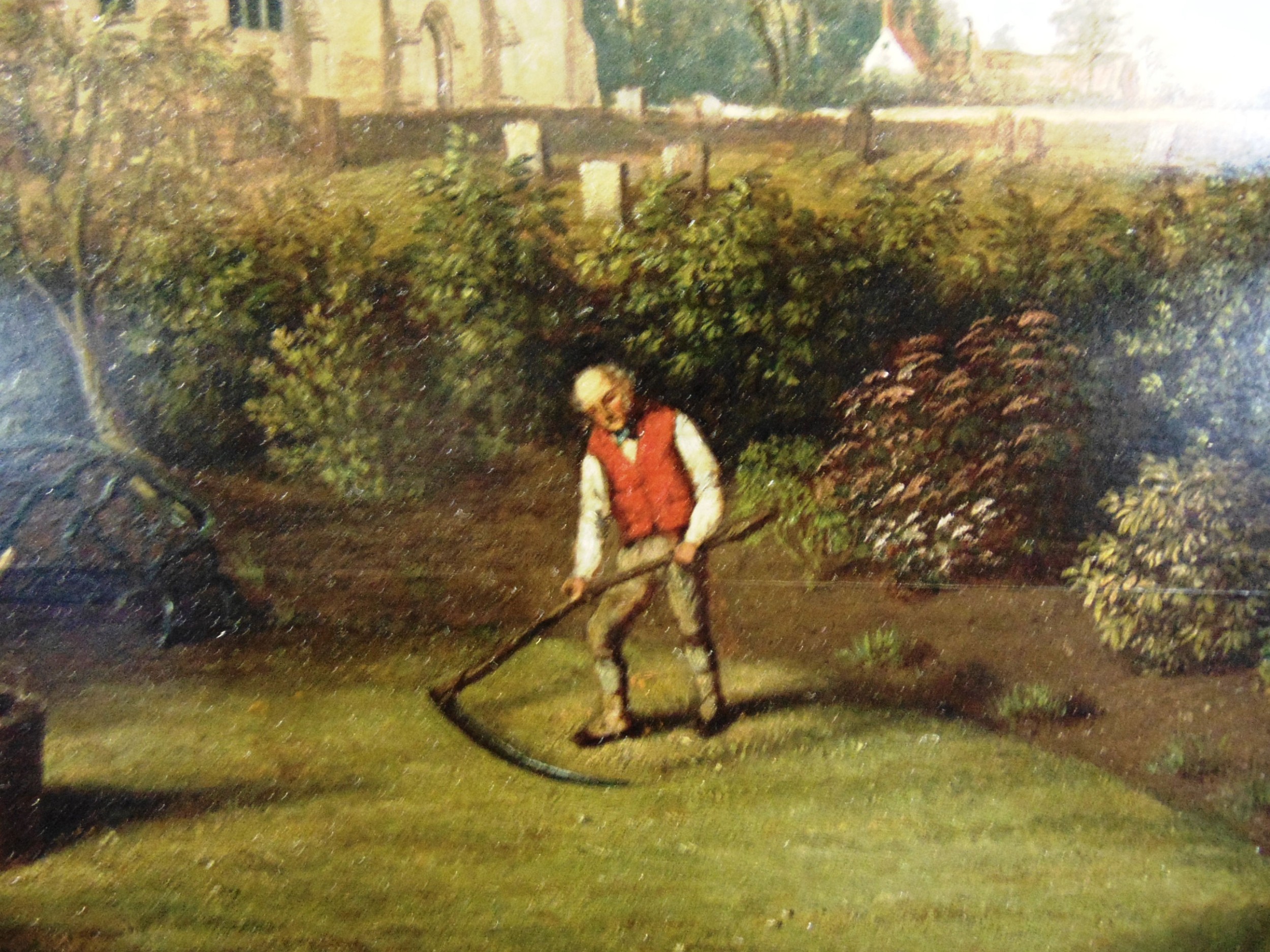
Archive II A 19th-century oil painting depicting a gardener scything a green lawn in front of a herbaceous border with a parish church in the background. View II
Archive III A 19th-century oil painting depicting a gardener scything a green lawn in front of a herbaceous border with a parish church in the background. View III
Archive IV A 19th-century oil painting depicting a gardener scything a green lawn in front of a herbaceous border with a parish church in the background. View IV
Archive V A 19th-century oil painting depicting a gardener scything a green lawn in front of a herbaceous border with a parish church in the background. View V
Archive VI A 19th-century oil painting depicting a gardener scything a green lawn in front of a herbaceous border with a parish church in the background. View VI
Enlarged Archival View
Telephone 07958 699 645
Location
18 La Gare
51 Surrey Row
London
SE1 0BZ
United Kingdom
Verified Since Sep 2008
Items For Sale 243
Items Sold 223
Artware Fineart
Verified Since Sep 2008
View Dealer Info
Location: 18 La Gare , 51 Surrey Row , London , SE1 0BZ , United Kingdom
Verified
Sep 2008
For Sale
243
Sold
223
A 19th-century oil painting depicting a gardener scything a green lawn in front of a herbaceous border with a parish church in the background.
English School 19th, Century A Gardner Scything a Lawn before a Herbaceous border with a Church beyond
Ref: SA598236
A 19th-century oil painting depicting a gardener scything a green lawn in front of a herbaceous border with a parish church in the background.
Detail View 1
Detail View 2
Detail View 3
Detail View 4
Detail View 5
Archival Detail
Every single antique dealer on our platform is individually approved by our internal team. We verify their professional trade history, ethical standards, and photographic quality to ensure a secure, high-standard buying environment. Upon joining, every dealer agrees to a strict 9-point code of conduct. While issues can occasionally arise, our dealers typically resolve them swiftly and directly with the buyer. In fact, since our founding in 2002, Sellingantiques has only had to step in to help resolve an issue on roughly five occasions—a true testament to the quality of our dealers and their dedication to your happiness.
Our dealers are highly experienced in packing and shipping fragile, high-value antiques. Because you are in direct contact with the dealer, you will be able to easily go through all available shipping and insurance options together to ensure your item arrives safely.
Antiques are the ultimate green purchase. By choosing historical pieces over newly manufactured goods, you completely eliminate the carbon footprint of modern mass production while preserving exceptional, timeless craftsmanship.

English School landscape paintings of the 19th century typically depict rural scenes, parish churches, and agrarian motifs, reflecting the pastoral interests of Victorian Britain.

Artworks from this period were primarily created using oil pigments on stretched linen canvas or timber panels, housed within timber or gesso moulding frames.

Authentic period works often display uniform craquelure across the paint layer, natural oxidisation on the reverse of the support, and period-appropriate stretcher construction.

This style of painting functions as a focal point when positioned above a sideboard, mantelpiece, or desk in traditional, transitional, or country-inspired room schemes.

Position the artwork away from direct sunlight, moisture, and heating elements, and clean the surface lightly using a dry, soft-bristled brush rather than liquids.
items
Add keywords to the filter
Price
£100
£250000
Era
Movements
Material
Origin
Stock Location
Freshness
Online Payments
Categories