6,588  PAGES BROWSED TODAY PAGES TODAY 0  ANTIQUES UPLOADED TODAY NEW ARRIVALS
ID #SA584282
FOR SALE
£3,000
Email
Save
John Russell, Ra, 1745-1806 Portrait of a Young Boy
Artware Fineart
for sale €3,510     $3,810
£3,000

Artware Fineart

Sellingantiques Verified Since Sep 2008
View Dealers Stock Page
Id #SA584282
PDF SHARE
SAVE

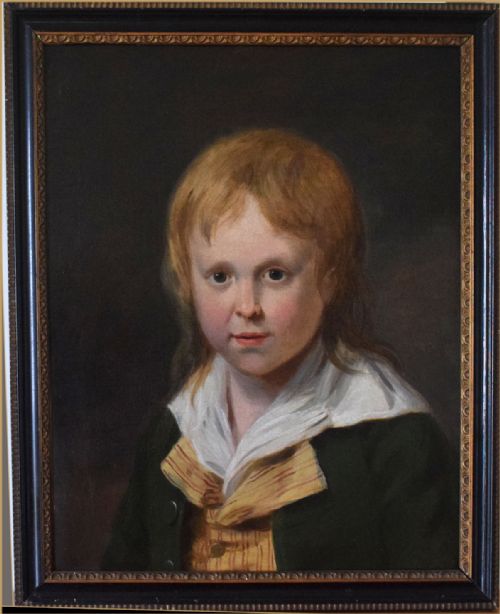
John Russell, Ra, 1745-1806 Portrait of a Young Boy

18th century
For Sale by Artware Fineart
Description

John Russell, RA, 1745-1806

Portrait of a Young Boy

Signed/Inscribed:

on a label attached to the reverse

oil on canvas

20 x 15in. (51 x 38 cm.)

John Russell, (1745–1806), portrait painter and astronomer, was born on 29 March 1745 at 32 High Street, Guildford, the second child of John Russell (1711–1804), book- and printseller, five times mayor of Guildford, and an artist himself (his Prospects of Guildford were engraved and published in 1759 and 1782), and his wife, Ann Parvish (1719–1775).

John Russell was baptized in the ruins of Holy Trinity Church, Guildford, and educated at the local grammar school before winning premiums at the Society of Arts in 1759 and 1760. He was then apprenticed to the painter Francis Cotes, who became a friend and mentor, and painted a miniature of his promising pupil. This happy relationship was frequently endangered by Russell's religious ‘conversion’, which began with an entry on the title-page of his diary, decorated with a stony desert and a view of Golgotha in the background: ‘John Russell converted September 30, 1764, aetat. 19, at about half an hour after seven in the evening’ (Russell). This prompted an evangelical ardour. For example, while painting Lord Montagu's portrait at Cowdray House in 1767, Russell not only annoyed the household by his intrusive fanaticism but excited such ill feeling among the many Anglicans and Roman Catholics of the neighbourhood that on his return journey he was refused accommodation at all the inns in Midhurst. Even his fellow citizens of Guildford rioted in protest.
In 1768 Russell settled in London, first in Portland Street, where he painted, in 1769, an oil portrait of the notorious forger Dr William Dodd (NPG). Here he met another celebrated Methodist, Selina Hastings, countess of Huntingdon, who tried unsuccessfully to make him give up painting and to lure him to her religious community. On 5 February 1770 he married one of his ‘converts’—Hannah Faden (1745–1816), daughter of a map- and printseller at Charing Cross—and moved to 7 Mortimer Street, Cavendish Square. They lived contentedly there, moving later to Newman Street, and produced twelve children, their religious enthusiasm gradually subsiding.

At about this time Russell turned from oils to pastel, a medium in which he excelled, forming his style on that of Rosalba Carriera. A stream of portraits followed, exhibited first at the Incorporated Society of Artists, then in 1769 at the first exhibition of the Royal Academy, where he continued to show annually until his death in 1806. His pastel portraits are technically and aesthetically brilliant, easily surpassing those of his master, Francis Cotes. They are usually laid on blue paper, the pastel colours vivid, a striking sfumato effect achieved by blurring with the finger and crayon, and the details accented with black chalk. In 1770 he showed his Portrait of George Whitefield and his large figure Aquarius won the Royal Academy's gold medal. He also painted the eleven-year-old William Wilberforce (the work is in the National Portrait Gallery, London), the first of many oil and pastel portraits of the philanthropist who later described Russell as ‘A religious man, very high-church indeed.’ (R. I. Wilberforce and S. Wilberforce, The Life of William Wilberforce, vol. 1, 1838, 5–6). Marriage may have softened Russell's militant evangelicalism but his diary bears daily witness to anxiety for his spiritual welfare. He would not work on a Sunday nor would he allow anyone to enter his studio. He was afraid to go out to dinner on account of the loose and blasphemous conversation he might hear. He was on good terms with Sir Joshua Reynolds, with whom he dined at the Royal Academy, the Dilettanti Society, and the Literary Club, but on these and other festive occasions he always left early.

Dozens of fancy pictures followed, specially o

Physical Dimensions
Height
51cm (20.08")
Width
38cm (14.96")
Depth
2cm (0.79")
Declaration

Artware Fineart has dated this Georgian Boy Portrait Painting to the 18th Century.

Reference Numbers
Sellingantiques Reference
SA584282
Dealers Internal Reference
3848
Description
John Russell, RA, 1745-1806

Portrait of a Young Boy

Signed/Inscribed:

on a label attached to the reverse

oil on canvas

20 x 15in. (51 x 38 cm.)

John Russell, (1745–1806), portrait painter and astronomer, was born on 29 March 1745 at 32 High Street, Guildford, the second child of John Russell (1711–1804), book- and printseller, five times mayor of Guildford, and an artist himself (his Prospects of Guildford were engraved and published in 1759 and 1782), and his wife, Ann Parvish (1719–1775).

John Russell was baptized in the ruins of Holy Trinity Church, Guildford, and educated at the local grammar school before winning premiums at the Society of Arts in 1759 and 1760.
Artware Fineart

He was then apprenticed to the painter Francis Cotes, who became a friend and mentor, and painted a miniature of his promising pupil. This happy relationship was frequently endangered by Russell's religious ‘conversion’, which began with an entry on the title-page of his diary, decorated with a stony desert and a view of Golgotha in the background: ‘John Russell converted September 30, 1764, aetat. 19, at about half an hour after seven in the evening’ (Russell). This prompted an evangelical ardour. For example, while painting Lord Montagu's portrait at Cowdray House in 1767, Russell not only annoyed the household by his intrusive fanaticism but excited such ill feeling among the many Anglicans and Roman Catholics of the neighbourhood that on his return journey he was refused accommodation at all the inns in Midhurst. Even his fellow citizens of Guildford rioted in protest.

fig 1. An 18th-century portrait painting depicting a young boy with light hair wearing a dark green coat, yellow striped waistcoat, and white cravat.
fig 1. John Russell, Ra, 1745-1806 Portrait of a Young Boy

In 1768 Russell settled in London, first in Portland Street, where he painted, in 1769, an oil portrait of the notorious forger Dr William Dodd (NPG). Here he met another celebrated Methodist, Selina Hastings, countess of Huntingdon, who tried unsuccessfully to make him give up painting and to lure him to her religious community. On 5 February 1770 he married one of his ‘converts’—Hannah Faden (1745–1816), daughter of a map- and printseller at Charing Cross—and moved to 7 Mortimer Street, Cavendish Square. They lived contentedly there, moving later to Newman Street, and produced twelve children, their religious enthusiasm gradually subsiding.

fig 2. An 18th-century portrait painting depicting a young boy with light hair wearing a dark green coat, yellow striped waistcoat, and white cravat.
fig 2. John Russell, Ra, 1745-1806 Portrait of a Young Boy

At about this time Russell turned from oils to pastel, a medium in which he excelled, forming his style on that of Rosalba Carriera. A stream of portraits followed, exhibited first at the Incorporated Society of Artists, then in 1769 at the first exhibition of the Royal Academy, where he continued to show annually until his death in 1806. His pastel portraits are technically and aesthetically brilliant, easily surpassing those of his master, Francis Cotes. They are usually laid on blue paper, the pastel colours vivid, a striking sfumato effect achieved by blurring with the finger and crayon, and the details accented with black chalk. In 1770 he showed his Portrait of George Whitefield and his large figure Aquarius won the Royal Academy's gold medal. He also painted the eleven-year-old William Wilberforce (the work is in the National Portrait Gallery, London), the first of many oil and pastel portraits of the philanthropist who later described Russell as ‘A religious man, very high-church indeed.’ (R. I. Wilberforce and S. Wilberforce, The Life of William Wilberforce, vol. 1, 1838, 5–6). Marriage may have softened Russell's militant evangelicalism but his diary bears daily witness to anxiety for his spiritual welfare. He would not work on a Sunday nor would he allow anyone to enter his studio. He was afraid to go out to dinner on account of the loose and blasphemous conversation he might hear. He was on good terms with Sir Joshua Reynolds, with whom he dined at the Royal Academy, the Dilettanti Society, and the Literary Club, but on these and other festive occasions he always left early.

Dozens of fancy pictures followed, specially o

Height
51cm (20.08")
Width
38cm (14.96")
Depth
2cm (0.79")
Date of Manufacture

Artware Fineart has dated this Georgian Boy Portrait Painting to the 18th Century.

Reference Numbers
Sellingantiques Ref
SA584282
Dealers Internal Ref
3848
Artware Fineart
Sellingantiques verified Since Sep 2008
Dealer Profile

You can view the stock and full dealer information on the Artware Fineart Profile Page

PDF SHARE
SAVE
An 18th-century portrait painting depicting a young boy with light hair wearing a dark green coat, yellow striped waistcoat, and white cravat.
1 / 3
Archive I An 18th-century portrait painting depicting a young boy with light hair wearing a dark green coat, yellow striped waistcoat, and white cravat.

John Russell, Ra, 1745-1806 Portrait of a Young Boy
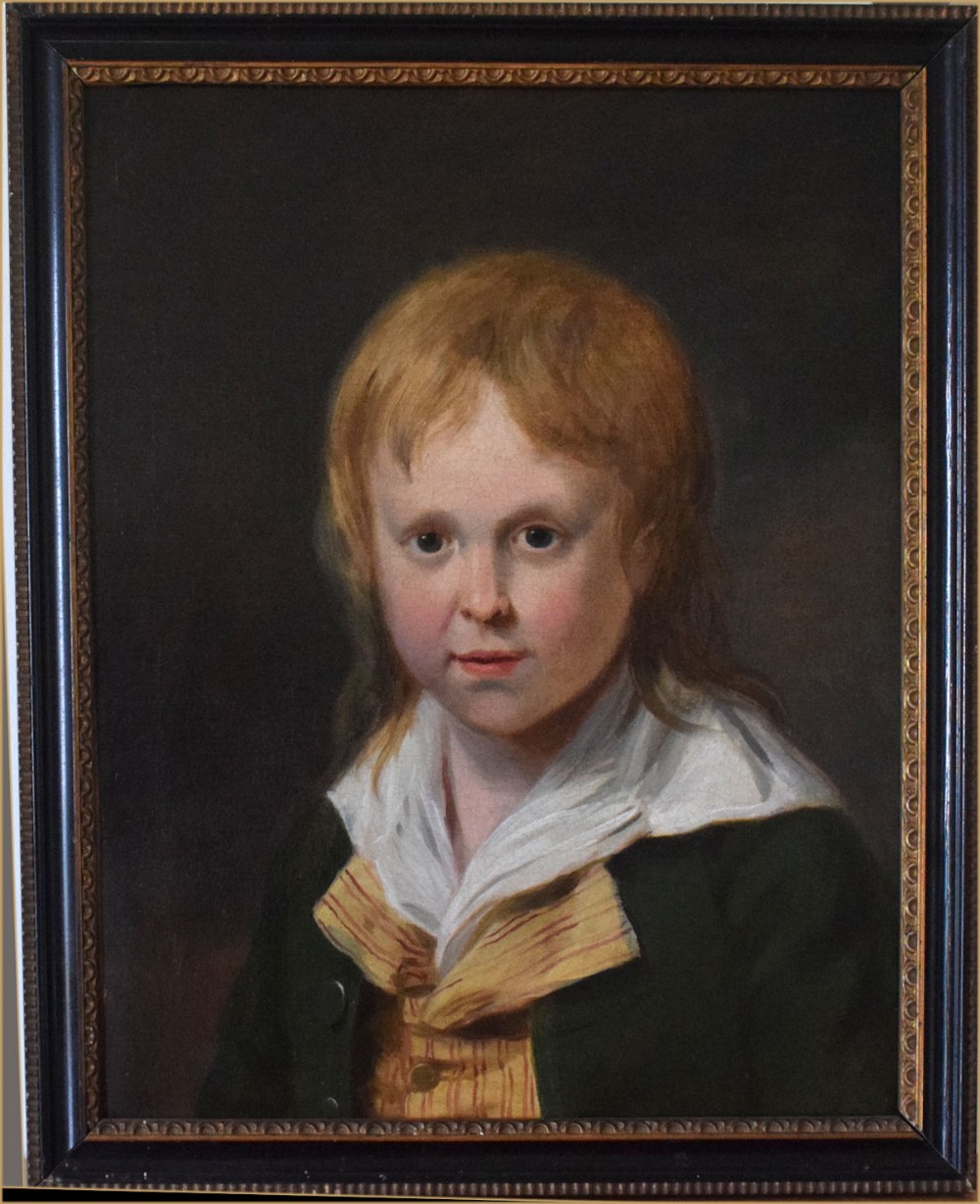
Archive II An 18th-century portrait painting depicting a young boy with light hair wearing a dark green coat, yellow striped waistcoat, and white cravat. View II
Archive III An 18th-century portrait painting depicting a young boy with light hair wearing a dark green coat, yellow striped waistcoat, and white cravat. View III
Enlarged Archival View
Telephone 07958 699 645
Location
18 La Gare
51 Surrey Row
London
SE1 0BZ
United Kingdom
Verified Since Sep 2008
Items For Sale 243
Items Sold 223
Artware Fineart
Verified Since Sep 2008
View Dealer Info
Location: 18 La Gare , 51 Surrey Row , London , SE1 0BZ , United Kingdom
Verified
Sep 2008
For Sale
243
Sold
223
An 18th-century portrait painting depicting a young boy with light hair wearing a dark green coat, yellow striped waistcoat, and white cravat.
John Russell, RA, 1745-1806 Portrait of a Young Boy
Ref: SA584282
An 18th-century portrait painting depicting a young boy with light hair wearing a dark green coat, yellow striped waistcoat, and white cravat.
Detail View 1
Detail View 2
Archival Detail
Every single antique dealer on our platform is individually approved by our internal team. We verify their professional trade history, ethical standards, and photographic quality to ensure a secure, high-standard buying environment. Upon joining, every dealer agrees to a strict 9-point code of conduct. While issues can occasionally arise, our dealers typically resolve them swiftly and directly with the buyer. In fact, since our founding in 2002, Sellingantiques has only had to step in to help resolve an issue on roughly five occasions—a true testament to the quality of our dealers and their dedication to your happiness.
Our dealers are highly experienced in packing and shipping fragile, high-value antiques. Because you are in direct contact with the dealer, you will be able to easily go through all available shipping and insurance options together to ensure your item arrives safely.
Antiques are the ultimate green purchase. By choosing historical pieces over newly manufactured goods, you completely eliminate the carbon footprint of modern mass production while preserving exceptional, timeless craftsmanship.

Georgian portraiture from the late 18th century is distinguished by naturalistic depictions, subtle lighting, and soft skin rendering. Artists of this era, including Royal Academicians, captured contemporary dress, character, and social status through pastels and oil paints.

Georgian pastel portraits were created using finely ground mineral pigments bound into soft sticks, applied directly to textured paper or vellum. These artworks were mounted onto canvas or wooden stretchers and protected behind glass to shield the delicate dry pigment from moisture.

Authenticity is indicated by period-specific clothing details, such as high-collared waistcoats and hand-stitched cravats, as well as period framing and natural surface age. Examining the backing materials, paper stretchers, and draughtsmanship assists in verifying age.

Position the portrait as a focal feature above a sideboard or integrate it into a gallery wall alongside contemporary artwork. Pairing historical figurative art with minimalist modern furniture creates a balanced contrast in contemporary settings.

Display the portrait away from direct sunlight, high humidity, and heat sources to prevent pigment fading and paper decay. Ensure pastel artworks remain framed behind glass with protective spacers to avoid pigment contact with the glass surface.
items
Add keywords to the filter
Price
£100
£250000
Era
Movements
Material
Origin
Stock Location
Freshness
Online Payments
Categories