40,229  PAGES BROWSED TODAY PAGES TODAY 98  ANTIQUES UPLOADED TODAY NEW ARRIVALS
ID #SA553734
FOR SALE
£12,000
Email
Save
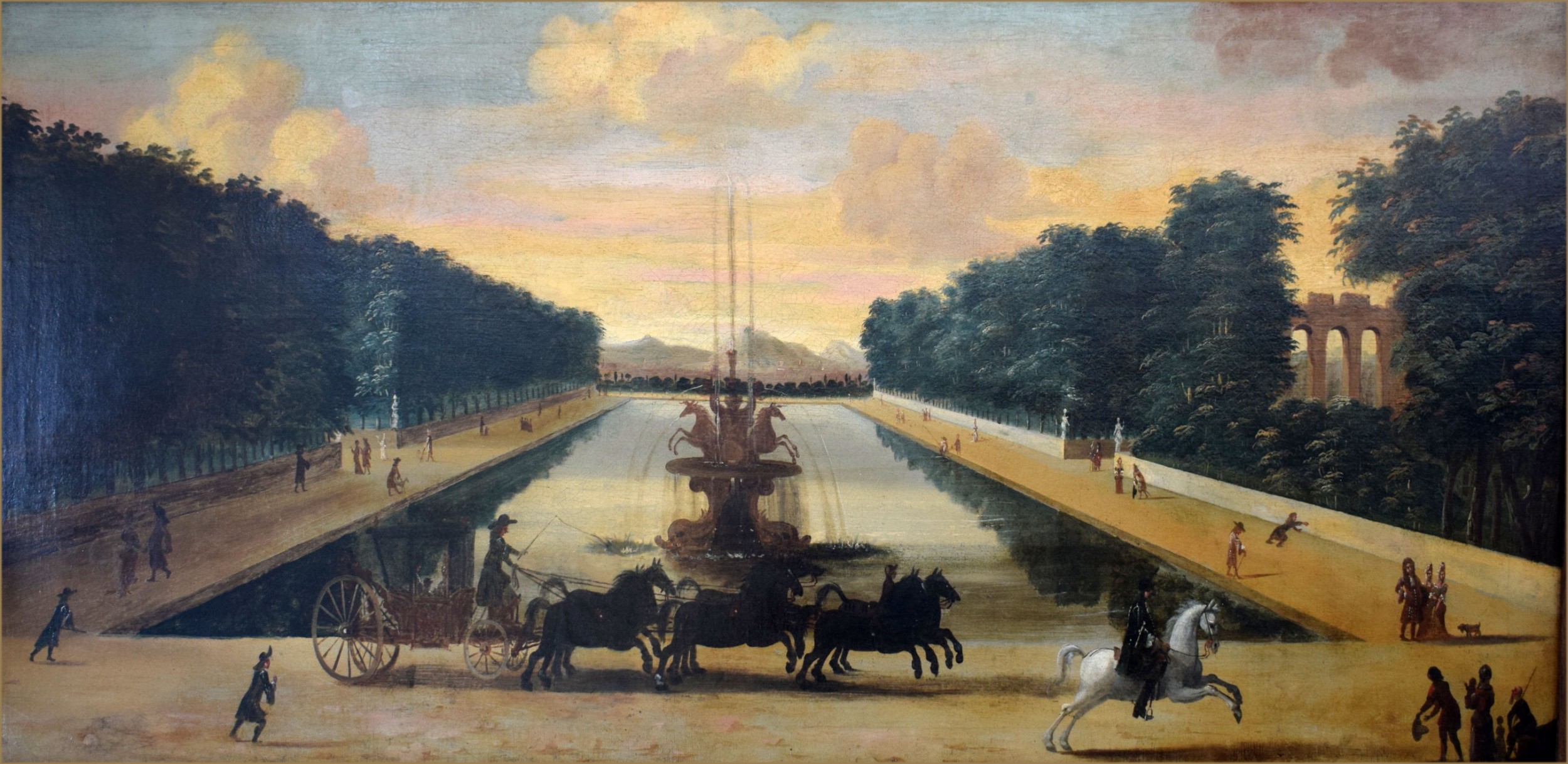
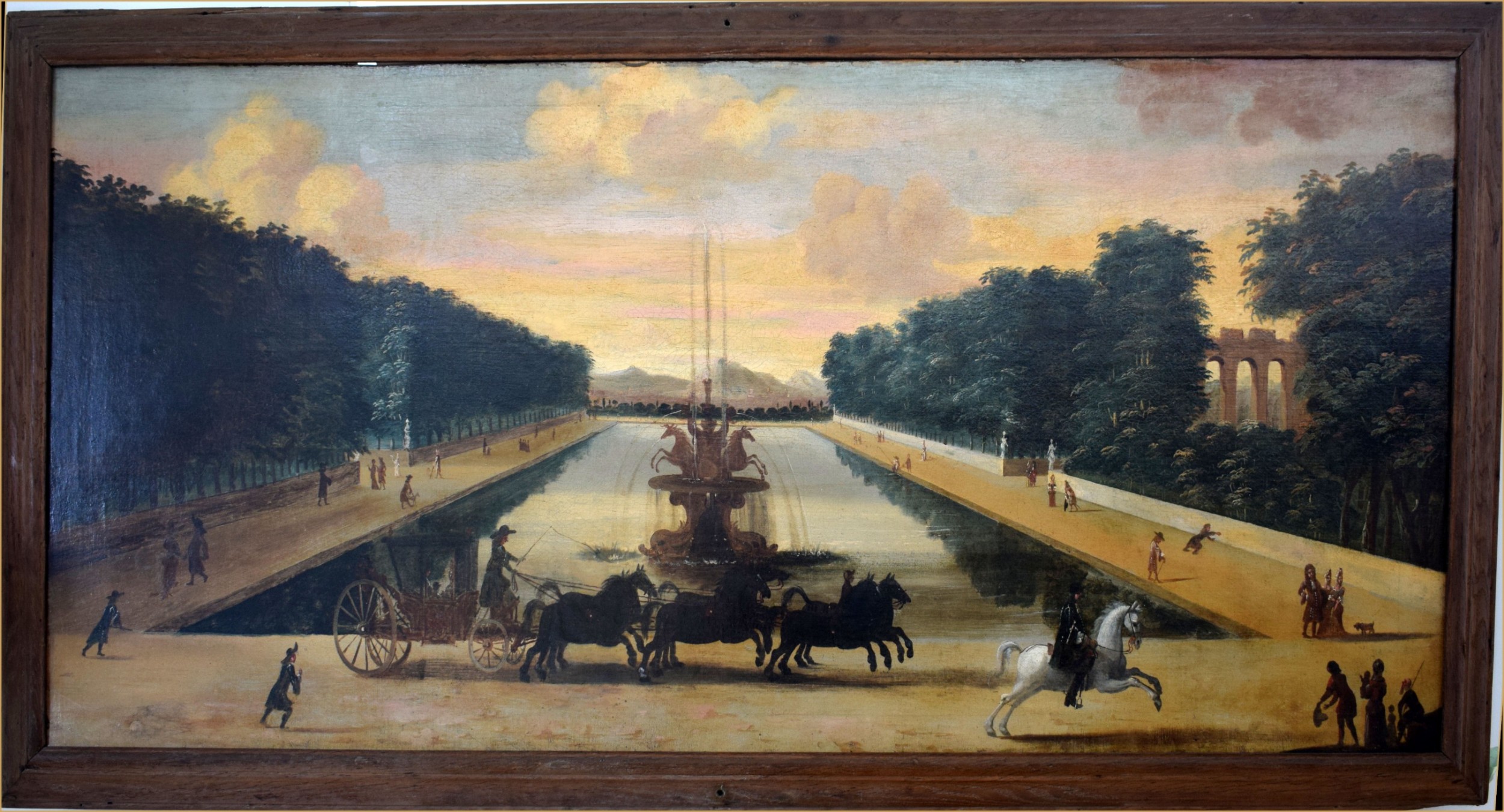
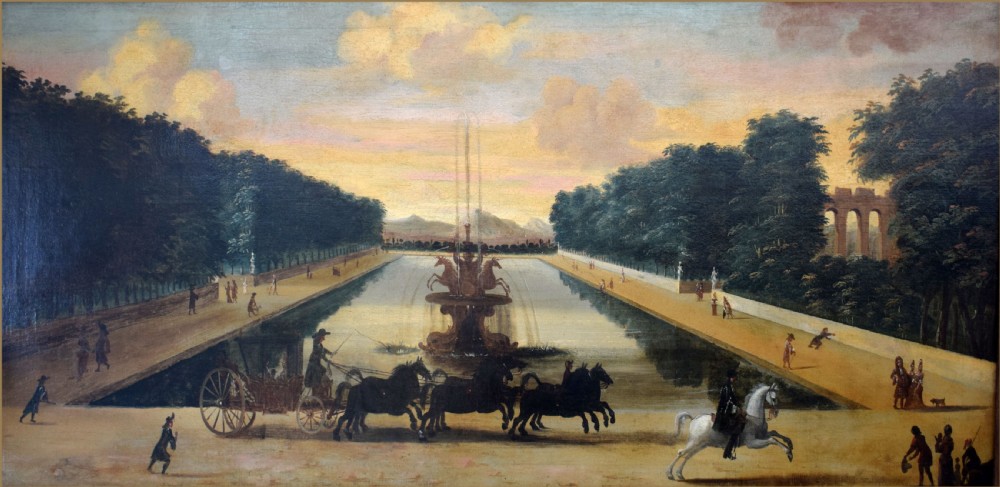
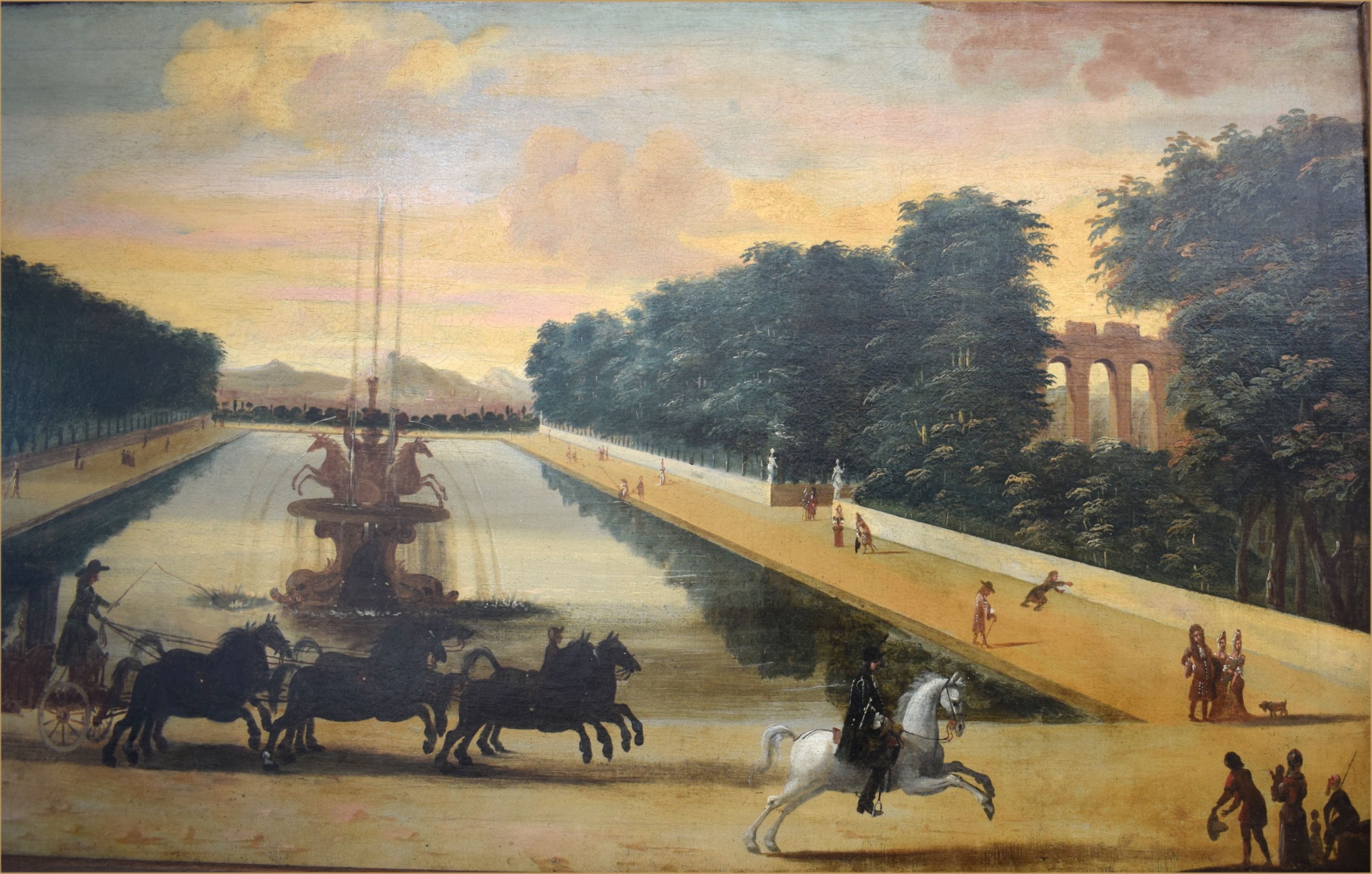
Martin Pierre - Denis, 1663 - 1742 Royal Coach Party, Passing an Ornamental Lake and Fountain at the Château De Marly with the Marly Aquaduct to the Right.
Artware Fineart
for sale €14,040     $15,240
£12,000

Artware Fineart

Sellingantiques Verified Since Sep 2008
View Dealers Stock Page
Id #SA553734
PDF SHARE
SAVE

Martin Pierre - Denis, 1663 - 1742 Royal Coach Party, Passing an Ornamental Lake and Fountain at the Château De Marly with the Marly Aquaduct to the Right.

18th century
For Sale by Artware Fineart
Description

Martin Pierre - Denis, 1663 - 1742

Royal Coach Party, passing an Ornamental lake and Fountain at The Château de Marly with the Marly Aquaduct to the right.

oil on canvas

72 x 157 cm. (28.1/2 x 62 in.)

The Château de Marly was a relatively small French royal residence located in what has become Marly-le-Roi, the commune that existed at the edge of the royal park. The town that originally grew up to service the château is now a dormitory community for Paris.
At the Château of Marly, Louis XIV of France escaped from the formal rigors he was constructing at Versailles. Small rooms meant less company, and simplified protocol; courtiers, who fought among themselves for invitations to Marly, were housed in a revolutionary design of twelve pavilions built in matching pairs flanking the central sheets of water, which were fed one from the other by prim formalized cascades (illustration, right).
The château is no more, nor the hydraulic "machine" that pumped water for Versailles. Only the foundation of Jules Hardouin-Mansart's small château, the pavillon du Roi remains at the top of the slope in Marly park.
The works at Marly were begun in the spring of 1679, on 22 May, before Louis had moved his court permanently to Versailles. The king was looking for a retreat on well-wooded royal lands between Versailles and Saint-Germain-en-Laye that were well-watered and provided a grand view. Marly was chosen.
Robert Berger has demonstrated that the design of Marly was a full collaboration between Jules Hardouin-Mansart and the premier peintre Charles Le Brun, who were concurrently working on the Galerie des Glaces at Versailles. Mansart's elevations for the pavilions were to be frescoed to designs adapted from a suite that Le Brun had recently drawn and the frescoed exteriors of the otherwise somewhat severe buildings created a richly Baroque ensemble of feigned sculptures against draperies and hangings, with vases on feigned sculptural therms against the piers— all in the somewhat eclectic Olympian symbolism that Le Brun and the King favoured everywhere at Versailles.

The decor of the pavillon du Roi featured Apollo, the Sun King's iconographic persona, and Thetis. Other pavilions were dedicated to other Olympians, but also to Hercules, and to Victory, Fame and Abundance. Construction was completed by 1684, though the overcharged painted programmes were simplified and restrained in the execution.

The Sun King attended the opening of the completed hydraulic works in June 1684 [1] and by 1686 development was sufficiently advanced for the King to stay there for the first time, with a picked entourage. The theme of Marly was that it was a simple hunting lodge, just enough to accommodate the Royal Hunt. In 1688 the Grand Abreuvoir à chevaux was installed on the terrace, a mere "horse trough."Throughout the rest of his life, Louis continued to embellish the wooded park, with wide straight rides, in which ladies or the infirm might follow the hunt, at some distance, in a carriage, and with more profligate waterworks than waterless Versailles—watered from Marly in fact—could provide: the Rivière or Grande Cascade dates to 1697–1698.

The famous description of Marly in the memoirs of Louis de Rouvroy, duc de Saint-Simon were written in retrospect and, for the initiation of Marly, at second hand; when Saint-Simon wrote, in 1715, Marly's heyday was ending, with the death of Louis XIV that year. Louis' heirs found the north-facing slope at Marly damp and dreary, and rarely visited.

The "river" was filled in and grassed in 1728. During the Revolution the marble horses by Guillaume Coustou the Elder, the Chevaux de Marly, were transported to Paris (1794), to flank the opening of the Champs-Élysées in the soon-to-be-renamed Place de la Concorde. (They are now in the Musée du Louvre, along with many other Marly sculptures.)

In 1799/1800, Marly was sold to an industrialist, M. Sagniel, who i

Physical Dimensions
Height
28cm (11.02")
Width
62cm (24.41")
Depth
2cm (0.79")
Declaration

Artware Fineart has dated this French Landscape Oil Painting to the 18th Century.

Reference Numbers
Sellingantiques Reference
SA553734
Dealers Internal Reference
3874
Description
Martin Pierre - Denis, 1663 - 1742
Royal Coach Party, passing an Ornamental lake and Fountain at The Château de Marly with the Marly Aquaduct to the right.
Artware Fineart

oil on canvas

72 x 157 cm. (28.1/2 x 62 in.)

The Château de Marly was a relatively small French royal residence located in what has become Marly-le-Roi, the commune that existed at the edge of the royal park. The town that originally grew up to service the château is now a dormitory community for Paris.

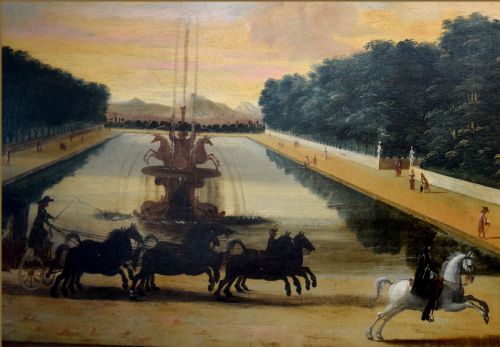
fig 1. An 18th-century oil painting depicting a royal carriage with horses passing an ornamental lake and fountain at the Chateau de Marly.
fig 1. Martin Pierre - Denis, 1663 - 1742 Royal Coach Party, Passing an Ornamental Lake and Fountain at the Château De Marly with the Marly Aquaduct to the Right.

At the Château of Marly, Louis XIV of France escaped from the formal rigors he was constructing at Versailles. Small rooms meant less company, and simplified protocol; courtiers, who fought among themselves for invitations to Marly, were housed in a revolutionary design of twelve pavilions built in matching pairs flanking the central sheets of water, which were fed one from the other by prim formalized cascades (illustration, right).

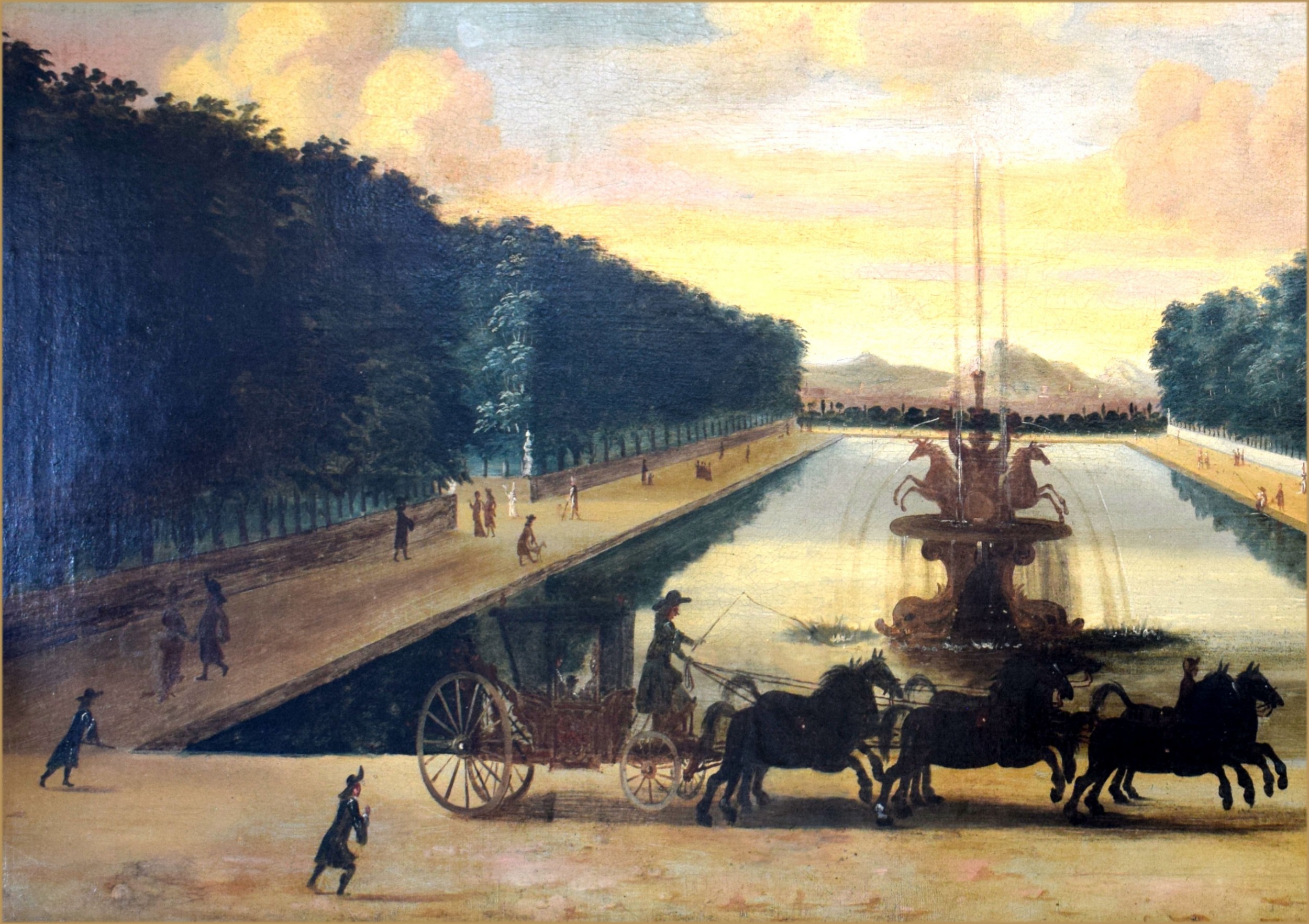
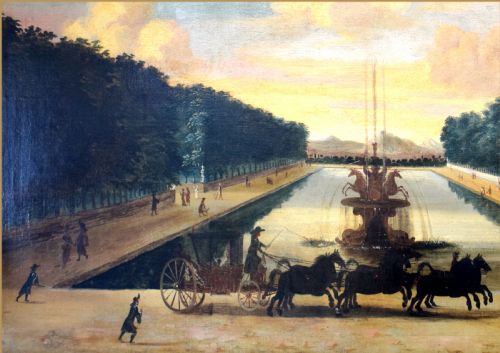
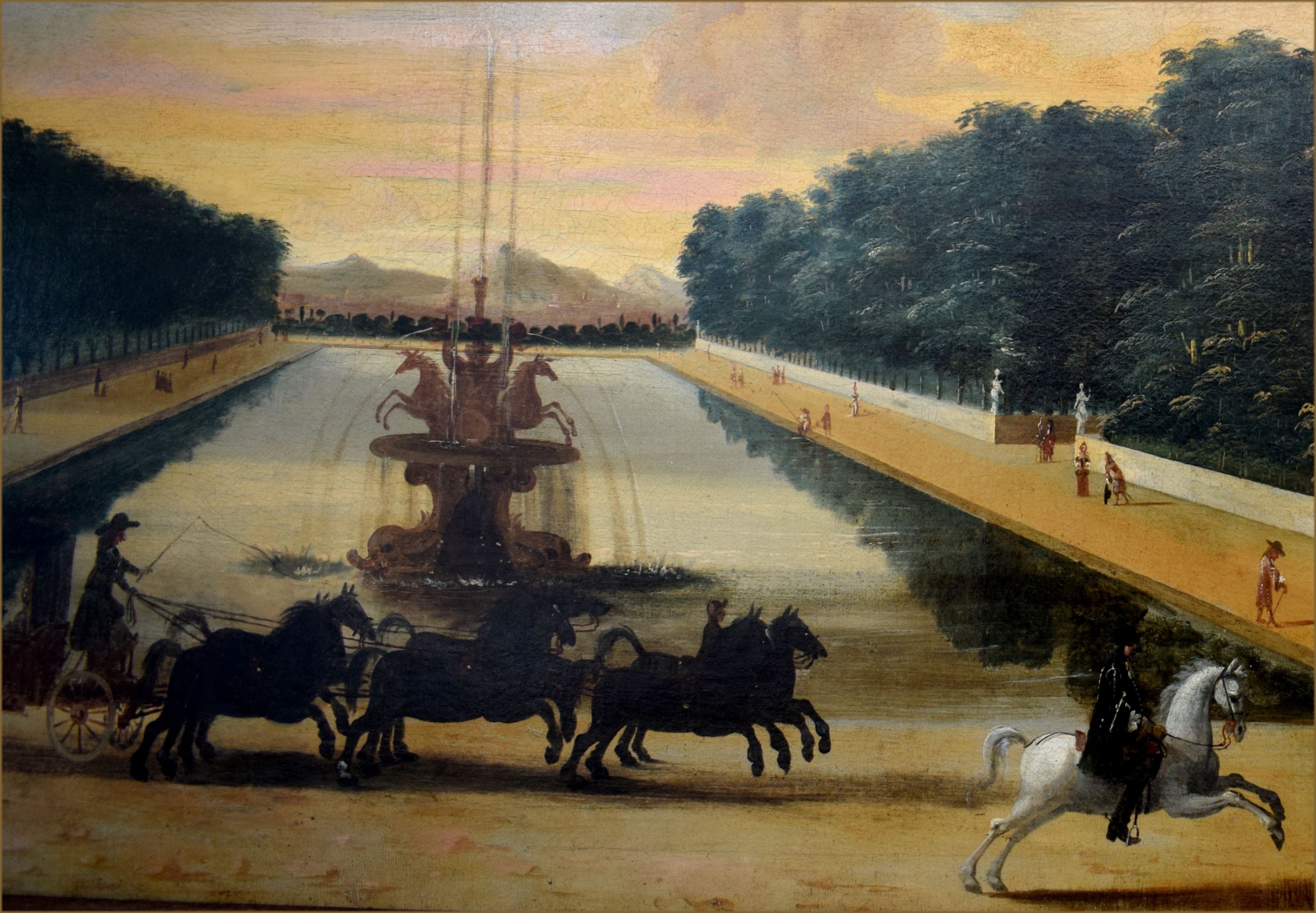
fig 2. An 18th-century oil painting depicting a royal carriage with horses passing an ornamental lake and fountain at the Chateau de Marly.
fig 2. Martin Pierre - Denis, 1663 - 1742 Royal Coach Party, Passing an Ornamental Lake and Fountain at the Château De Marly with the Marly Aquaduct to the Right.

The château is no more, nor the hydraulic "machine" that pumped water for Versailles. Only the foundation of Jules Hardouin-Mansart's small château, the pavillon du Roi remains at the top of the slope in Marly park.

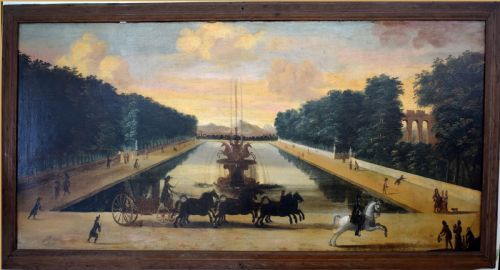
fig 3. An 18th-century oil painting depicting a royal carriage with horses passing an ornamental lake and fountain at the Chateau de Marly.
fig 3. Martin Pierre - Denis, 1663 - 1742 Royal Coach Party, Passing an Ornamental Lake and Fountain at the Château De Marly with the Marly Aquaduct to the Right.

The works at Marly were begun in the spring of 1679, on 22 May, before Louis had moved his court permanently to Versailles. The king was looking for a retreat on well-wooded royal lands between Versailles and Saint-Germain-en-Laye that were well-watered and provided a grand view. Marly was chosen.

fig 4. An 18th-century oil painting depicting a royal carriage with horses passing an ornamental lake and fountain at the Chateau de Marly.
fig 4. Martin Pierre - Denis, 1663 - 1742 Royal Coach Party, Passing an Ornamental Lake and Fountain at the Château De Marly with the Marly Aquaduct to the Right.

Robert Berger has demonstrated that the design of Marly was a full collaboration between Jules Hardouin-Mansart and the premier peintre Charles Le Brun, who were concurrently working on the Galerie des Glaces at Versailles. Mansart's elevations for the pavilions were to be frescoed to designs adapted from a suite that Le Brun had recently drawn and the frescoed exteriors of the otherwise somewhat severe buildings created a richly Baroque ensemble of feigned sculptures against draperies and hangings, with vases on feigned sculptural therms against the piers— all in the somewhat eclectic Olympian symbolism that Le Brun and the King favoured everywhere at Versailles.

The decor of the pavillon du Roi featured Apollo, the Sun King's iconographic persona, and Thetis. Other pavilions were dedicated to other Olympians, but also to Hercules, and to Victory, Fame and Abundance. Construction was completed by 1684, though the overcharged painted programmes were simplified and restrained in the execution.

The Sun King attended the opening of the completed hydraulic works in June 1684 [1] and by 1686 development was sufficiently advanced for the King to stay there for the first time, with a picked entourage. The theme of Marly was that it was a simple hunting lodge, just enough to accommodate the Royal Hunt. In 1688 the Grand Abreuvoir à chevaux was installed on the terrace, a mere "horse trough."Throughout the rest of his life, Louis continued to embellish the wooded park, with wide straight rides, in which ladies or the infirm might follow the hunt, at some distance, in a carriage, and with more profligate waterworks than waterless Versailles—watered from Marly in fact—could provide: the Rivière or Grande Cascade dates to 1697–1698.

The famous description of Marly in the memoirs of Louis de Rouvroy, duc de Saint-Simon were written in retrospect and, for the initiation of Marly, at second hand; when Saint-Simon wrote, in 1715, Marly's heyday was ending, with the death of Louis XIV that year. Louis' heirs found the north-facing slope at Marly damp and dreary, and rarely visited.

The "river" was filled in and grassed in 1728. During the Revolution the marble horses by Guillaume Coustou the Elder, the Chevaux de Marly, were transported to Paris (1794), to flank the opening of the Champs-Élysées in the soon-to-be-renamed Place de la Concorde. (They are now in the Musée du Louvre, along with many other Marly sculptures.)

In 1799/1800, Marly was sold to an industrialist, M. Sagniel, who i

Height
28cm (11.02")
Width
62cm (24.41")
Depth
2cm (0.79")
Date of Manufacture

Artware Fineart has dated this French Landscape Oil Painting to the 18th Century.

Reference Numbers
Sellingantiques Ref
SA553734
Dealers Internal Ref
3874
Artware Fineart
Sellingantiques verified Since Sep 2008
Dealer Profile

You can view the stock and full dealer information on the Artware Fineart Profile Page
PDF SHARE
SAVE
An 18th-century oil painting depicting a royal carriage with horses passing an ornamental lake and fountain at the Chateau de Marly.
1 / 5
Archive I An 18th-century oil painting depicting a royal carriage with horses passing an ornamental lake and fountain at the Chateau de Marly.

Martin Pierre - Denis, 1663 - 1742 Royal Coach Party, Passing an Ornamental Lake and Fountain at the Château De Marly with the Marly Aquaduct to the Right.
Archive II An 18th-century oil painting depicting a royal carriage with horses passing an ornamental lake and fountain at the Chateau de Marly. View II
Archive III An 18th-century oil painting depicting a royal carriage with horses passing an ornamental lake and fountain at the Chateau de Marly. View III
Archive IV An 18th-century oil painting depicting a royal carriage with horses passing an ornamental lake and fountain at the Chateau de Marly. View IV
Archive V An 18th-century oil painting depicting a royal carriage with horses passing an ornamental lake and fountain at the Chateau de Marly. View V
Enlarged Archival View
Telephone 07958 699 645
Location
18 La Gare
51 Surrey Row
London
SE1 0BZ
United Kingdom
Verified Since Sep 2008
Items For Sale 243
Items Sold 223
Artware Fineart
Verified Since Sep 2008
View Dealer Info
Location: 18 La Gare , 51 Surrey Row , London , SE1 0BZ , United Kingdom
Verified
Sep 2008
For Sale
243
Sold
223
An 18th-century oil painting depicting a royal carriage with horses passing an ornamental lake and fountain at the Chateau de Marly.
Martin Pierre - Denis, 1663 - 1742 Royal Coach Party, passing an Ornamental lake and Fountain at The Château de Marly with the Marly Aquaduct to the right.
Ref: SA553734
An 18th-century oil painting depicting a royal carriage with horses passing an ornamental lake and fountain at the Chateau de Marly.
Detail View 1
Detail View 2
Detail View 3
Detail View 4
Archival Detail
Every single antique dealer on our platform is individually approved by our internal team. We verify their professional trade history, ethical standards, and photographic quality to ensure a secure, high-standard buying environment. Upon joining, every dealer agrees to a strict 9-point code of conduct. While issues can occasionally arise, our dealers typically resolve them swiftly and directly with the buyer. In fact, since our founding in 2002, Sellingantiques has only had to step in to help resolve an issue on roughly five occasions—a true testament to the quality of our dealers and their dedication to your happiness.
Our dealers are highly experienced in packing and shipping fragile, high-value antiques. Because you are in direct contact with the dealer, you will be able to easily go through all available shipping and insurance options together to ensure your item arrives safely.
Antiques are the ultimate green purchase. By choosing historical pieces over newly manufactured goods, you completely eliminate the carbon footprint of modern mass production while preserving exceptional, timeless craftsmanship.

French classical and Baroque landscape painting typically incorporates structured compositions, symmetrical vistas, architectural monuments, and formal gardens. Artists emphasised order, perspective, atmospheric light, and classical themes reflecting aristocratic life.

Paintings from this era were constructed using natural earth pigments suspended in linseed or walnut oil, applied onto hand-stretched linen canvases. Stretchers were crafted from native softwoods, and frames were frequently made from hand-carved, gilded timber.

Authentic works feature age-appropriate craquelure patterns across the paint surface, hand-hammered iron nails on the stretcher bars, dark oxidisation on unprimed canvas edges, and multi-layered glazing techniques typical of historical masters.

An antique oil landscape can serve as a focal point when positioned above a mantelpiece, sideboard, or console table. Pairing historical artwork with clean-lined contemporary furniture creates a balanced, curated contrast in classical or modern spaces.

Keep canvas artwork away from direct sunlight, radiators, and high humidity areas. Dust the surface lightly with a soft, dry camel-hair brush, and consult a professional conservator for surface cleaning or structural repairs.
items
Add keywords to the filter
Price
£100
£250000
Era
Movements
Material
Origin
Stock Location
Freshness
Online Payments
Categories