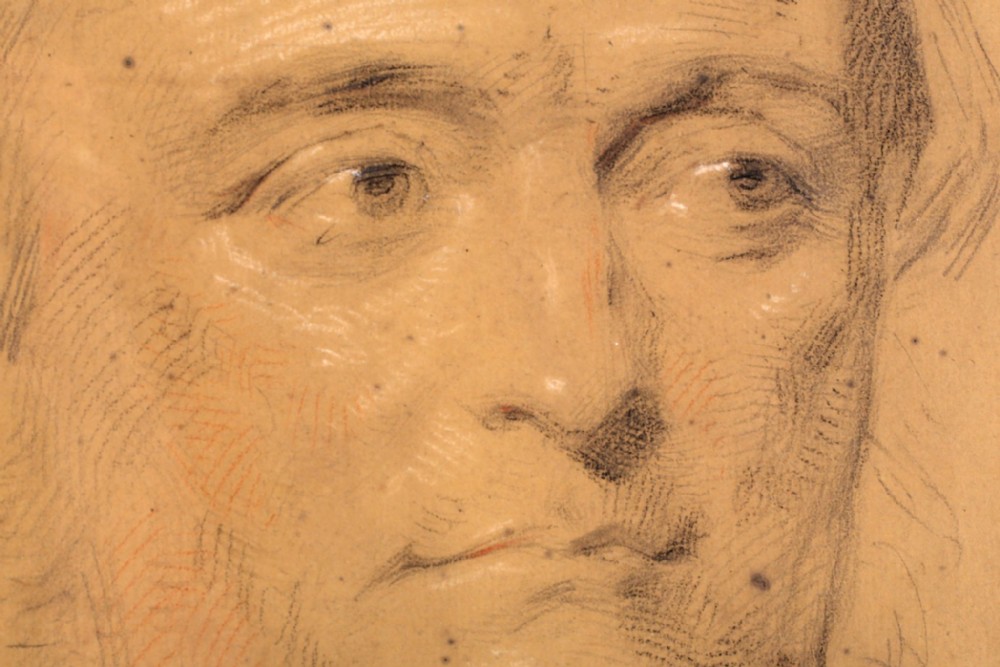
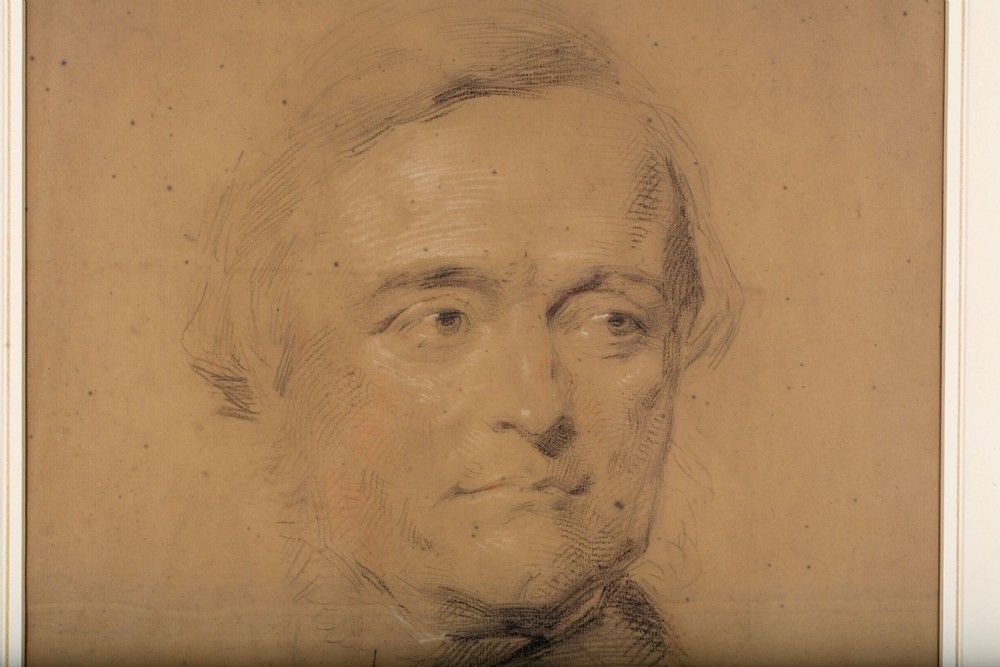
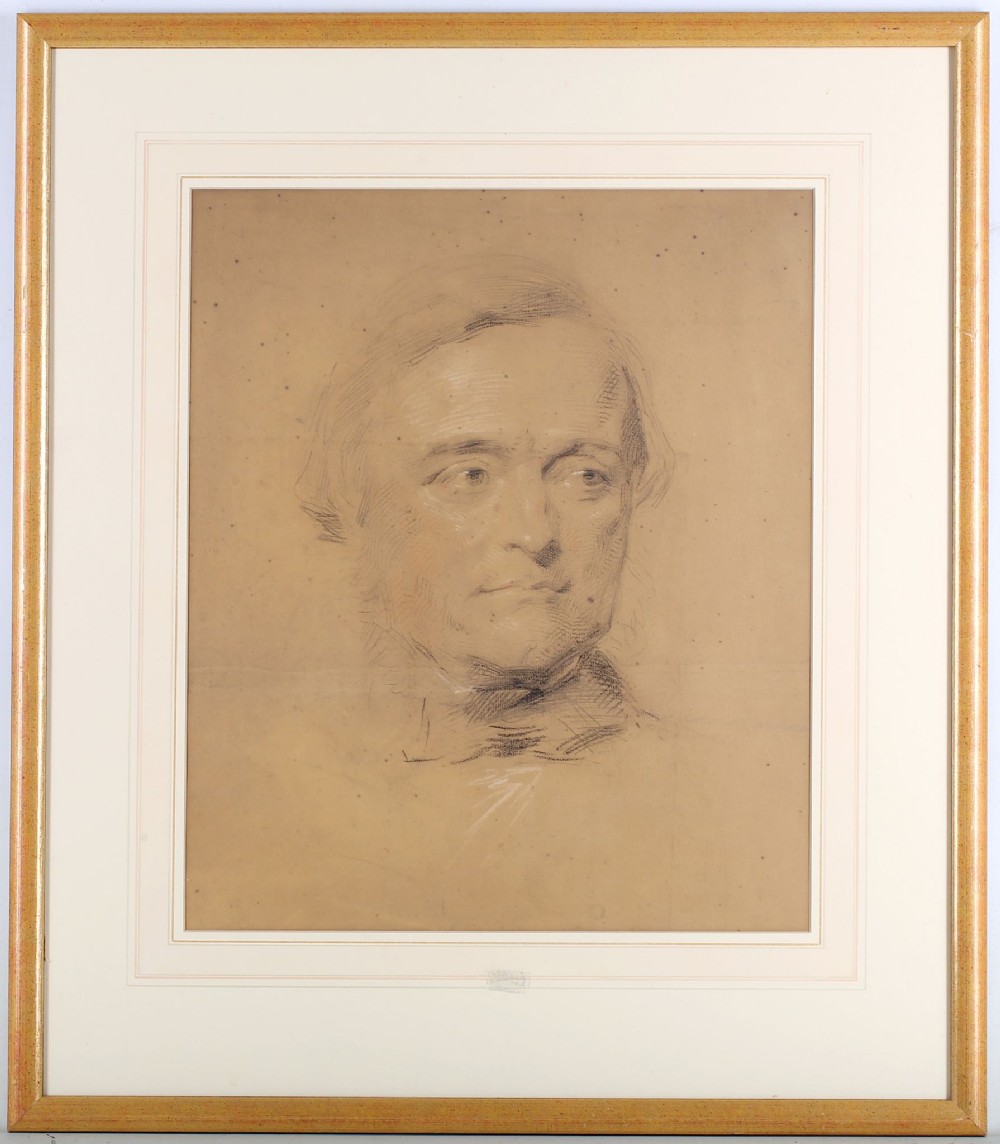
Artware Fineart has dated this Victorian Portrait Sketch Drawing to the 19th Century.
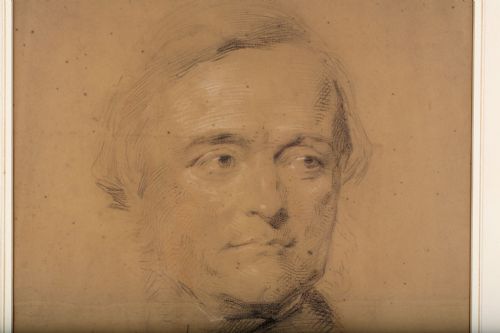
Portrait of Charles Kingsley 1819 - 1875
coloured chalks on buff paper
42.5 x 35.3 cm. (16.3/4 x 13.3/4in.)
He was the eldest of the six surviving children of Revd Charles Kingsley (1781–1860), then (briefly) curate of Holne, a Hampshire country gentleman from an old family, including soldiers who had fought at Naseby and at Minden, who had taken orders only at the age of thirty-five, three years previously, after his mismanaged inheritance was exhausted. His mother, Mary Lucas (1787–1873), was born in Barbados, the daughter of a judge who had inherited slave-run sugar plantations. But any prospect of substantial wealth from this source eventually passing to the Kingsley family vanished with the decline of the West Indian sugar trade and the abolition of slavery in 1833. His father's subsequent career in the church took the family to Nottinghamshire, to Barnack, near Stamford (1824–30), close to the fen country which later supplied background for his historical novel Hereward the Wake, to Clovelly on the north Devon coast (1830–36), which inspired an enduring fascination with sea and shore later reflected in Westward Ho! and The Water-Babies, and, finally, in 1836, to St Luke's rectory, Chelsea (1836–60).
A delicate, nervous, imaginative child afflicted with a stutter which persisted into adult life, Kingsley nevertheless shared his father's passion for country sports and natural history. His education started at home, where he showed a precocious interest in writing sermons and poems. In 1831 he and his brother Herbert were sent to a preparatory school at Clifton, where he was a horrified and fascinated witness to the Bristol riots associated with the Reform Bill agitation, an experience which influenced his ambivalent attitude towards popular politics in later years. The following year the boys went to Helston grammar school in Cornwall, a small school run by Revd Derwent Coleridge, second son of the poet. Kingsley had an attack of cholera at the school (English cholera rather than the more virulent Asiatic cholera then ravaging Cornwall), which left him with a lifelong intestinal weakness but also stimulated his passion for sanitary reform as a way of containing and preventing disease. He seems to have learnt a great deal from informal botanizing expeditions with one of the masters, C. A. Johns, later a distinguished naturalist, and from browsing in the headmaster's library, where he encountered arcane treasures such as Iamblichus and Porphyry, but his formal instruction in classics and mathematics was rather neglected until he and his family moved to London in 1836. He studied at King's College, London (1836–8), where he worked hard and engaged in extensive private reading. Living at home, he became increasingly bored and irritated with the puritanical restrictions of rectory life and the endless fuss of church business and district visiting in his father's large and active evangelical parish.
In October 1838 Kingsley went up to Magdalene College, Cambridge. Lonely, intensely shy, and physically restless, he gradually found companionship through rowing and riding to hounds, and acquired a close friend in the brilliantly eccentric athlete and amateur scientist Charles Mansfield, another clergyman's son. He discovered the calming effects of tobacco and was soon addicted, though he had already suffered from lung disease. More significantly, he developed religious doubts. He managed to win a scholarship in the May examinations at the end of his first year, and during the long vacation of 1839 met his future wife, Frances Eliza Grenfell, known as Fanny [see Kingsley, Frances Eliza (1814-1891)], devout da
Artware Fineart has dated this Victorian Portrait Sketch Drawing to the 19th Century.
You can view the stock and full dealer information on the Artware Fineart Profile Page

George Richmond, Ra, 1809 - 1896 Portrait of Charles Kingsley 1819 - 1875