37,216  PAGES BROWSED TODAY PAGES TODAY 90  ANTIQUES UPLOADED TODAY NEW ARRIVALS
ID #SA525010
FOR SALE
£6,000
Email
Save
Arthur Royce Bradbury, Ara, 1892-1977 Portrait of Sir Winston Leonard Spencer Churchill, (1874–1965) in Garter Robes
Artware Fineart
for sale €7,020     $7,620
£6,000

Artware Fineart

Sellingantiques Verified Since Sep 2008
View Dealers Stock Page
Id #SA525010
PDF SHARE
SAVE

Arthur Royce Bradbury, Ara, 1892-1977 Portrait of Sir Winston Leonard Spencer Churchill, (1874–1965) in Garter Robes

1940 - 1960
For Sale by Artware Fineart
Description

Arthur Royce Bradbury, ARA, 1892-1977

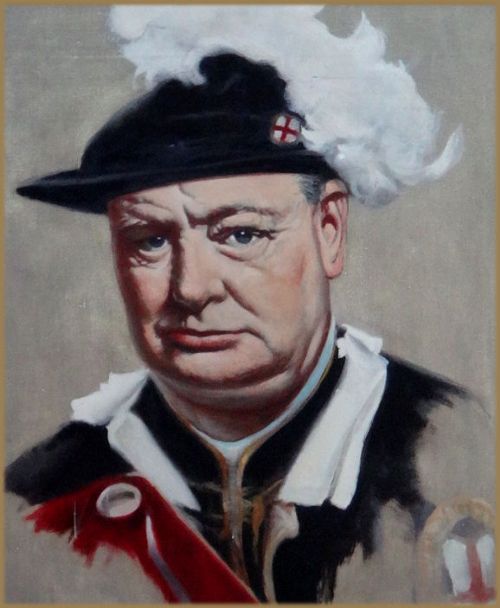
Portrait of Sir Winston Leonard Spencer Churchill, (1874–1965) in Garter Robes

Signed/Inscribed: "Arthur Bradbury"

oil on canvas

59 x 49 cm. (23.1/4 x 19.1/4 in.)

After his defeat at the 1945 General Election Churchill was offered the Order of the Garter by H.M. King George VI, but he refused. Churchill had on refusing the Order of the Garter in 1945, given one of his many quotes : ‘How can I accept the Order of the Garter, when the people of England have just given me the Order of the Boot?’ -Winston S Churchill, September 1945

But in 1953 he relented and accepted the honour and was invested by HM Queen Elizabeth II as a Knight of the Garter. The installation, in St. George's Chapel Windsor, took place on 14th June 1954.
There is a theorey that The order of the garter was "Restored to gift of the Sovereign by Attlee in 1946". So maybe he wouldn't accept it from the Labour prime minister but would accept it from the monarch. What makes the most sense is that in 1945 he (actually his party) had just been voted out of office. At this point he still had hopes of getting back the majority (and perhaps the PM office), and in fact he did regain it in 1951.
So I think in 1945 he was mostly telling you what his problem was. He was still an active politician, and as such it would be next to impossible to accept such an honor without it being tainted by Great Britian's extant political climate. People could not help but speculate that there were crass political dimensions to the "honor".
In 1953 he was PM again. However, he was also 78, and suffered a fairly bad stroke, after which he never walked or spoke quite right again. He was clearly in his declining years, and in fact retired the PM position 2 years later. So at this point the logic that compelled him to decline the honor a decade prior no longer applied. Its also quite possible that, given his failing health, the soverign was a bit more insistent on giving it to him this time, for fear of any further wait causing it to have to be bestowed posthumously.
As customary on the death of a Knight of the Garter, Churchill’s Garter achievements (banner crest, helm and sword) were removed from his Garter stall in St George’s Chapel on the announcement of his death and a wreath was placed in his stall. The wreath remained in the stall until the presentation of Churchill’s banner to his family at Evensong on 5 April 1965. Churchill’s Garter stall plate remains on the stall as a permanent memorial of his membership of the Order of the Garter. However, it was not the only stall plate made for Churchill’s stall – the other one is now believed to be in private hands. How did this come about?

Sir Winston Churchill was nominated as a Knight of the Garter on 24 April 1953 and invested and installed over a year later, on 14 June 1954. However, the production and fixing of his stall plate were delayed by a long running dispute between the stall plate maker, Harold Soper, and the College of Arms. Soper produced a partially completed stall plate for Churchill’s installation ceremony in 1954, but removed it immediately after the ceremony ‘in its unfinished state’, replacing it with a cardboard dummy plate of Churchill’s quarterly arms and two crests. By 5 October 1954, Soper informed the Garter King of Arms, Sir George Bellew, that the stall plate was finished but refused to produce it or to submit an invoice. On 29 November, Bellew wrote to Soper: ‘Can you let me have the Churchill Plate? If you do not wish me to have it and refuse to send it you can scarcely blame me for having another one made elsewhere, but that seems to me a foolish waste’.

In 1957, at the end of his tether, Bellew attempted to find an alternative manufacturer of stall plates, not just for Churchill but also for the other Companions of the Garter who lacked plat

Physical Dimensions
Height
59cm (23.23")
Width
49cm (19.29")
Depth
2cm (0.79")
Declaration

Artware Fineart has dated this Winston Churchill Oil Painting to the 1950s.

Reference Numbers
Sellingantiques Reference
SA525010
Dealers Internal Reference
3971
Description
Arthur Royce Bradbury, ARA, 1892-1977

Portrait of Sir Winston Leonard Spencer Churchill, (1874–1965) in Garter Robes

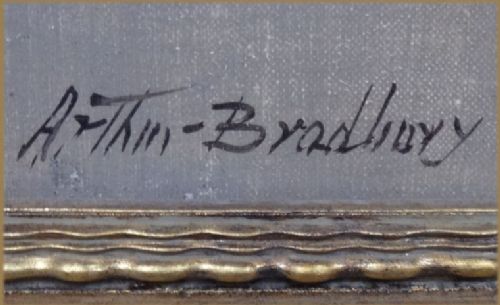
Signed/Inscribed: "Arthur Bradbury"

oil on canvas

59 x 49 cm. (23.1/4 x 19.1/4 in.)

After his defeat at the 1945 General Election Churchill was offered the Order of the Garter by H.M. King George VI, but he refused. Churchill had on refusing the Order of the Garter in 1945, given one of his many quotes : ‘How can I accept the Order of the Garter, when the people of England have just given me the Order of the Boot?’ -Winston S Churchill, September 1945

But in 1953 he relented and accepted the honour and was invested by HM Queen Elizabeth II as a Knight of the Garter.
Artware Fineart

The installation, in St. George's Chapel Windsor, took place on 14th June 1954.

fig 1. A mid-20th century oil portrait depicting Sir Winston Churchill wearing a black Order of the Garter velvet hat with white plumes and ceremonial robes.
fig 1. Arthur Royce Bradbury, Ara, 1892-1977 Portrait of Sir Winston Leonard Spencer Churchill, (1874–1965) in Garter Robes

There is a theorey that The order of the garter was "Restored to gift of the Sovereign by Attlee in 1946". So maybe he wouldn't accept it from the Labour prime minister but would accept it from the monarch. What makes the most sense is that in 1945 he (actually his party) had just been voted out of office. At this point he still had hopes of getting back the majority (and perhaps the PM office), and in fact he did regain it in 1951.

fig 2. A mid-20th century oil portrait depicting Sir Winston Churchill wearing a black Order of the Garter velvet hat with white plumes and ceremonial robes.
fig 2. Arthur Royce Bradbury, Ara, 1892-1977 Portrait of Sir Winston Leonard Spencer Churchill, (1874–1965) in Garter Robes

So I think in 1945 he was mostly telling you what his problem was. He was still an active politician, and as such it would be next to impossible to accept such an honor without it being tainted by Great Britian's extant political climate. People could not help but speculate that there were crass political dimensions to the "honor".

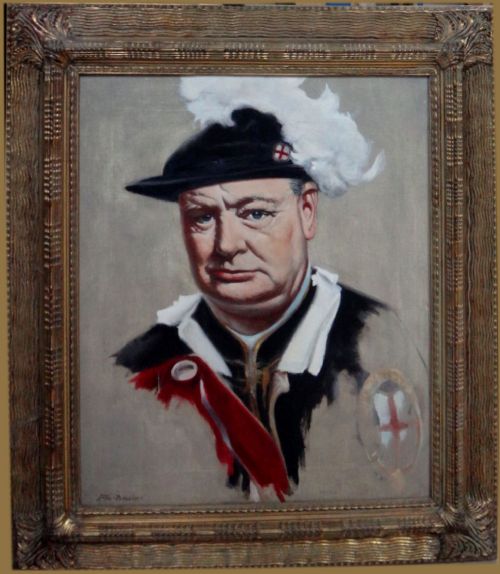
fig 3. A mid-20th century oil portrait depicting Sir Winston Churchill wearing a black Order of the Garter velvet hat with white plumes and ceremonial robes.
fig 3. Arthur Royce Bradbury, Ara, 1892-1977 Portrait of Sir Winston Leonard Spencer Churchill, (1874–1965) in Garter Robes

In 1953 he was PM again. However, he was also 78, and suffered a fairly bad stroke, after which he never walked or spoke quite right again. He was clearly in his declining years, and in fact retired the PM position 2 years later. So at this point the logic that compelled him to decline the honor a decade prior no longer applied. Its also quite possible that, given his failing health, the soverign was a bit more insistent on giving it to him this time, for fear of any further wait causing it to have to be bestowed posthumously.

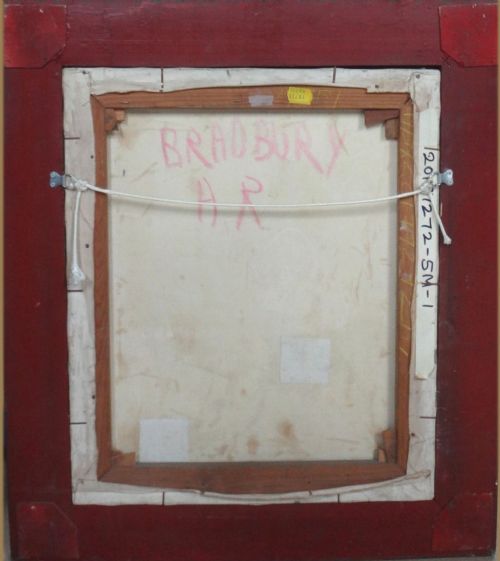
fig 4. A mid-20th century oil portrait depicting Sir Winston Churchill wearing a black Order of the Garter velvet hat with white plumes and ceremonial robes.
fig 4. Arthur Royce Bradbury, Ara, 1892-1977 Portrait of Sir Winston Leonard Spencer Churchill, (1874–1965) in Garter Robes

As customary on the death of a Knight of the Garter, Churchill’s Garter achievements (banner crest, helm and sword) were removed from his Garter stall in St George’s Chapel on the announcement of his death and a wreath was placed in his stall. The wreath remained in the stall until the presentation of Churchill’s banner to his family at Evensong on 5 April 1965. Churchill’s Garter stall plate remains on the stall as a permanent memorial of his membership of the Order of the Garter. However, it was not the only stall plate made for Churchill’s stall – the other one is now believed to be in private hands. How did this come about?

Sir Winston Churchill was nominated as a Knight of the Garter on 24 April 1953 and invested and installed over a year later, on 14 June 1954. However, the production and fixing of his stall plate were delayed by a long running dispute between the stall plate maker, Harold Soper, and the College of Arms. Soper produced a partially completed stall plate for Churchill’s installation ceremony in 1954, but removed it immediately after the ceremony ‘in its unfinished state’, replacing it with a cardboard dummy plate of Churchill’s quarterly arms and two crests. By 5 October 1954, Soper informed the Garter King of Arms, Sir George Bellew, that the stall plate was finished but refused to produce it or to submit an invoice. On 29 November, Bellew wrote to Soper: ‘Can you let me have the Churchill Plate? If you do not wish me to have it and refuse to send it you can scarcely blame me for having another one made elsewhere, but that seems to me a foolish waste’.

In 1957, at the end of his tether, Bellew attempted to find an alternative manufacturer of stall plates, not just for Churchill but also for the other Companions of the Garter who lacked plat

Height
59cm (23.23")
Width
49cm (19.29")
Depth
2cm (0.79")
Date of Manufacture

Artware Fineart has dated this Winston Churchill Oil Painting to the 1950s.

Reference Numbers
Sellingantiques Ref
SA525010
Dealers Internal Ref
3971
Artware Fineart
Sellingantiques verified Since Sep 2008
Dealer Profile

You can view the stock and full dealer information on the Artware Fineart Profile Page

PDF SHARE
SAVE
A mid-20th century oil portrait depicting Sir Winston Churchill wearing a black Order of the Garter velvet hat with white plumes and ceremonial robes.
1 / 5
Archive I A mid-20th century oil portrait depicting Sir Winston Churchill wearing a black Order of the Garter velvet hat with white plumes and ceremonial robes.

Arthur Royce Bradbury, Ara, 1892-1977 Portrait of Sir Winston Leonard Spencer Churchill, (1874–1965) in Garter Robes

Archive II A mid-20th century oil portrait depicting Sir Winston Churchill wearing a black Order of the Garter velvet hat with white plumes and ceremonial robes. View II
Archive III A mid-20th century oil portrait depicting Sir Winston Churchill wearing a black Order of the Garter velvet hat with white plumes and ceremonial robes. View III
Archive IV A mid-20th century oil portrait depicting Sir Winston Churchill wearing a black Order of the Garter velvet hat with white plumes and ceremonial robes. View IV
Archive V A mid-20th century oil portrait depicting Sir Winston Churchill wearing a black Order of the Garter velvet hat with white plumes and ceremonial robes. View V
Enlarged Archival View
Telephone 07958 699 645
Location
18 La Gare
51 Surrey Row
London
SE1 0BZ
United Kingdom
Verified Since Sep 2008
Items For Sale 243
Items Sold 223
Artware Fineart
Verified Since Sep 2008
View Dealer Info
Location: 18 La Gare , 51 Surrey Row , London , SE1 0BZ , United Kingdom
Verified
Sep 2008
For Sale
243
Sold
223
A mid-20th century oil portrait depicting Sir Winston Churchill wearing a black Order of the Garter velvet hat with white plumes and ceremonial robes.
Arthur Royce Bradbury, ARA, 1892-1977 Portrait of Sir Winston Leonard Spencer Churchill, (1874–1965) in Garter Robes
Ref: SA525010
A mid-20th century oil portrait depicting Sir Winston Churchill wearing a black Order of the Garter velvet hat with white plumes and ceremonial robes.
Detail View 1
Detail View 2
Detail View 3
Detail View 4
Archival Detail
Every single antique dealer on our platform is individually approved by our internal team. We verify their professional trade history, ethical standards, and photographic quality to ensure a secure, high-standard buying environment. Upon joining, every dealer agrees to a strict 9-point code of conduct. While issues can occasionally arise, our dealers typically resolve them swiftly and directly with the buyer. In fact, since our founding in 2002, Sellingantiques has only had to step in to help resolve an issue on roughly five occasions—a true testament to the quality of our dealers and their dedication to your happiness.
Our dealers are highly experienced in packing and shipping fragile, high-value antiques. Because you are in direct contact with the dealer, you will be able to easily go through all available shipping and insurance options together to ensure your item arrives safely.
Antiques are the ultimate green purchase. By choosing historical pieces over newly manufactured goods, you completely eliminate the carbon footprint of modern mass production while preserving exceptional, timeless craftsmanship.

Mid-20th century British ceremonial portraiture focuses on capture of realistic likeness combined with formal regalia, such as heraldic robes, orders, and ceremonial headwear. Artists employed traditional oil techniques to document notable public figures and statesmen in official attire.

Paintings from this period were primarily executed using oil pigments ground in linseed oil, applied onto stretched linen or cotton canvas. Artists worked over gesso grounds, often applying varnish coatings to protect the paint layer and enhance depth.

Authentic oil paintings display natural craquelure matching the age of the canvas, artist signatures rendered within the paint layer, and stretcher frame construction typical of the mid-20th century. Provenance records and gallery labels on the reverse also assist in verification.

A formal portrait provides visual weight and historical character when framed simply and positioned above a fireplace mantelpiece, sideboard, or within a dark panelled study. Pairing historic portraiture with minimalist or dark academia schemes creates an impactful focal point.

Keep oil paintings out of direct sunlight and away from heat sources to prevent cracking and fading. Clean the surface gently using a soft, dry camel-hair brush, avoiding water or chemical solvents, and maintain a stable room temperature and humidity level.
items
Add keywords to the filter
Price
£100
£250000
Era
Movements
Material
Origin
Stock Location
Freshness
Online Payments
Categories